All posts by Estwing

Education is No Waste

I have been fortunate in my life to have been involved with many excellent sustainability initiatives from designing and building an Eco Dormitory with my students to Community Supported Agriculture. Most of my experience, however, has been with waste. You might call me a “waste case.” As a matter of fact, I can’t stand waste, and I have made it a mission to design systems that minimize or eliminate waste. Some of you may recall a volunteer effort I was involved with earlier this year where we diverted over 95% of the waste stream during a community event hosting over 1,500 people. That success prompted a friend to suggest we take that successful model to other events in our community. And so we are…

Zero Waste Events

educational waste management system

Organizing an event? Want to go Zero Waste? Here’s how:

Background: The 2011 YMCA Connecting Families Day in Whanganui was declared a ‘zero waste’ event. From past experience managing large events, the management team knew that proper sorting (to avoid cross-contamination of recovered resources) is of the utmost importance and that it is essential to station someone where the collection bins are clustered. This person acts as an on-site educator and as a quality control officer. The event was successful in diverting over 95% of materials from landfill (world-class results).

Operation: We partner with event organisers to bring waste management and community education together in a combined ‘learning zone’. People enter a discrete ‘Resource Recovery’ area and are guided by ultra-clear signage and a helpful waste educator.

Benefits: For you ~ you get to declare your event ‘Zero Waste’ – think of the kudos! Know you’re doing the right thing. Saves money in waste disposal.

For the community ~ a large number of people in a short time can experience first hand world-class waste management in action. We anticipate that through repetition of this type of management scheme at all large events in Whanganui, the commitment of our community to resource recovery will be made clear to all residents, and that the practices of recycling and composting will catch on even more.


What does it cost? We have acquired funding from the Positive Futures Trust to educate about Zero Waste at events. Commercial events contribute roughly the same amount again as the educational component. This amount is usually recouped in disposal costs saved.
Who we are: Experienced educators and community business activists keen to advance resource recovery. We are eager to share our decades of experience.

If you would like to talk about making yours a Zero Waste Event, please contact us.

Turning a Disability into an Asset

Traditional schooling never worked for the way my brain functions. I suspect I’m not alone.

I write this as my fourth and final tuition payment for my PhD is being processed by the University. Although my thesis is based on research I did two years ago, it has informed some awesome education initiatives we’ve been running in our local schools. The following is an article I’ve written for the Wanganui Chronicle sharing little of the success of those programmes.

Enhancing Student Learning Through Sustainability

My Year 3 teacher told my parents I would never read. It was the early seventies and many learning disabilities were yet to be recognized. I was not so interested on the ink on the page, but the space between the ink and the space between the school and my home, which, thankfully, was mostly lush and green and wild. While I struggled through school, I thrived outdoors. I learned more from turtles than from teachers.
Traditional schooling did nothing for me because it was all about objects and goals and marks when I was more interested the interconnectedness of things. Even courses in ecology were taught in a reductionist manner. In University I did my best to gravitate toward what was then called environmental studies, although even in those papers I spent most of my time sitting in lecture halls taking notes. It was not until I reluctantly entered a Masters programme that I first experienced a different way of teaching and learning. I never looked back, and now I am three quarters my way through a PhD, which examines student responses to learning ecology in ecological ways.

But holistic approaches to teaching and learning are not limited to the study of ecology. In fact, journals are full of research that indicates the value of education that is cross-curricular, experiential, relevant, student-centred, action-oriented and based on the needs of the community. I have been lucky enough to bring this type of education to schools in Wanganui thanks to funding from the District Council and administrative support from the Sustainable Whanganui Trust.

From a Year 1 classroom at Aranui School to every student at Wanganui Intermediate, and on to a Year 13 class at WHS, holistic, solution-oriented educational approaches have engaged students in high quality learning experiences. Each programme was designed to meet the needs expressed by individual teachers and to align with the New Zealand Curriculum. Feedback from teachers, students and principals has been excellent, and more programmes are underway.

An exciting programme that is being run for four rural schools during Term 4 is called “The Little House That Could.” This cross-curricular programme integrates science, maths, English and the arts while students learn about passive solar home design and energy efficiency. Student learning is supported by a curriculum guide provided to teachers and interactive web pages on The Eco-Thrfity Renovation blog. A culminating experience is being planned for the students to visit the actual “Little House That Could” in Castlecliff.

First and foremost, the programme aims to provide the highest quality learning experiences for students in numeracy, literacy, science and the arts based on current education research and the New Zealand Curriculum. After all, schools are for student learning. It is up to the education community to strive to provide the best learning experiences for children. With budget cuts coming from Wellington, the financial support from Council and other local charitable sources will be increasingly valuable for innovative approaches to student learning.

Sidebar: There will be a presentation on The Little House That Could as a model for sustainable living and for high quality teaching and learning at the Castlecliff School library on Tuesday the 29th of November at 6:30 pm. A koha is suggested to support high quality sustainability education in our community.

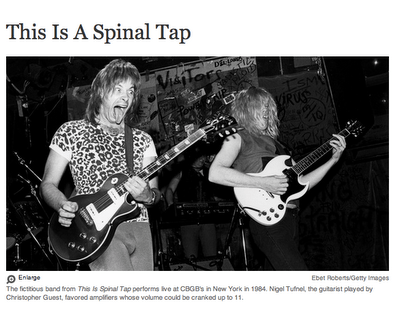
Nigel Tufnel Day

I tried every video shop in town and could not find a copy of This is Spinal Tap.
If you have seen the film, you know what this means. If you have not, you need to see the film.
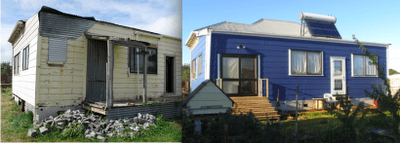
One year into our project, we are striving for 11 as well. We started with what may have been the worst house in Wanganui and turned it into a warm, dry, beautiful, energy-efficient home. Additionally, we have developed outstanding educational programmes alongside the physical work. In my opinion, the current unsustainable state of the world requires us all to strive for 11. For a laugh, see where we started last November. Hard case!
Peace, Estwing

Anarchy in the UK

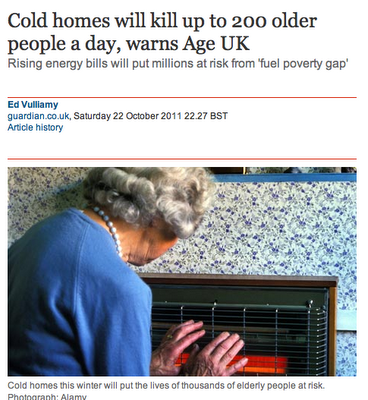
I almost always write about NZ and the USA, but a few news items out of the UK recently certainly hold great relevance for this blog.
Although the headline above is more dramatic, the one below is more far reaching.

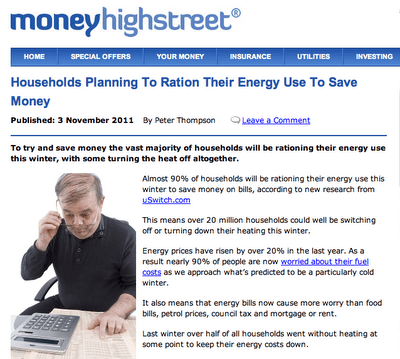
Almost 90% of households will be rationing their energy use this winter to save money on bills, according to new research fromuSwitch.com

This means over 20 million households could well be switching off or turning down their heating this winter.

Energy prices have risen by over 20% in the last year. As a result nearly 90% of people are now worried about their fuel costs as we approach what’s predicted to be a particularly cold winter.

It also means that energy bills now cause more worry than food bills, petrol prices, council tax and mortgage or rent.

Last winter over half of all households went without heating at some point to keep their energy costs down.

Some reduced the number of hot baths or showers they took, others bought less food or cut back on lighting or even went without hot dinners or sacrificed buying medicines just so that they could pay their heating bills.

Household disposable income has been hit hard with 90% of households believing that their disposable income has reduced because of rising energy prices.

The worry is that growing numbers are finding themselves with debt problems with over one in three households struggling to pay their essential bills and have turned to debt to cover them

In another story from this week, total consumer debt is expected to reach 1.5 trillion pounds by the end of the calendar year. It appears that the positive feedback loop of rising debt and energy prices that has gripped the motherland of the Commonwealth is in full swing with no signs of improvement. The irony, for me, is that when times are good no one worries about high energy prices but when times get tough they claim they don’t have enough to invest in energy efficiency measures. I read another good article recently called “The Energy Trap” but I can’t find it at the moment.
Looking around the world at OECD nations, it appears that the debt and energy trap will engulf almost all of them, especially NZ and the USA. But it’s not too late for communities to be proactive. We have developed a model for whole community sustainability education that could easily be replicated worldwide. Below is a description I recently sent out on the web.

The Little House That Could (TLHTC) is a model for whole community sustainability education based on eco-renovation and permaculture food production. It engages school children from the earliest grades all the way through senior citizens with local, tangible, affordable and realistic approaches to ecological, economic and social sustainability. The programme emphasizes ecological literacy, thermodynamic literacy and financial literacy.

At the primary school level, teachers are trained in high quality cross-curricular approaches to topics such as solar energy, growing food, recycling and composting. At the intermediate and high school levels, teachers are encouraged to get students to “think globally and act locally” through systems thinking exercises and carefully planned field trips to TLHTC site. Adult education includes hands-on workshops on passive solar design, energy efficiency, solar cooking, permaculture design and low-input/high-productivity gardening. And TLHTC reaches older residents with less mobility through PowerPoint presentations at seniors clubs and rest homes. On a global scale, TLHTC maintains an educational blog, a Facebook page and Twitter account.

Every community on Earth has a run down house with a yard full of weeds. Therefore, every community could be a TLHTC community. Through online networking and sharing, we just might achieve a Little Planet That Could. This programme holds great promise due to it’s low costs and high quality and effectiveness.

We continue to seek out partners in all of our initiatives. Please contact us with your interest.


On a final note, warm thoughts go out to my home town.

Peace, Estwing

Warm and Fuzzy


This post is part of The Little House That Could series, designed for upper primary school and lower intermediate school children. The academic curriculum that accompanies these posts was developed by the ECO School with partial funding from Wanganui District Council and administrative support from the Sustainable Whanganui Trust.

So far we have learned about how the sun can warm a home and how “thermal mass” can store heat during the day and let it out at night. The third thing to include in a passive solar home is insulation.
Remember, things that sink in water are better as thermal mass and things that float are better as insulation. The higher they float in water means they are probably better insulators.
When it’s cold, most heat escapes from a house through the roof, then the walls and then the floor.
So we put heaps of insulation above the ceiling, some in the walls, and a bit under the floor. We also removed the window in the yellow part of the house on the left because it faced southwest. That means it let lots of heat out in the winter and let lots of heat in during the summer. That’s no good!
This is the way it looks now. Warm as!
Thermal curtains also act as insulation to keep heat from going through windows. You probably already use them at home. We use thermal curtains, but also put an extra layer of wool on some windows for extra insulation.
And another way to insulate windows in double glazing. The two layers of glass hold an air space between them that acts as an insulator. We don’t have double glazed glass windows, but we are using plastic to double glaze our windows. Can you see it?
It’s practically invisible! For about $100 you can do every window in your house. That much money won’t even buy one double glazed glass window. If your family does not have very much money to spend but wants a warmer home and lower power bills, this might be a good idea for them. All of these things together – plus solar hot water and energy efficient fridge, washing machine, etc. – help us have a warm house and low power bills.
During August we used 68 units of electricity. The average home in NZ probably used about 800. If each unit of power costs 25 cents, how much money did we save in just one month compared to the average NZ home?
(800 x 0.25) – (68 x 0.25) = ?
Post your questions and comments. I look forward to seeing you on a field trip to our Little House That Did!
Peace, Estwing

Not So Grim

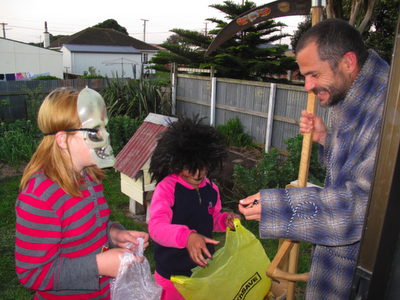
Halloween is far and away my favorite holiday.
It is even better in the southern hemisphere where it is light until 8 o’clock.
I’ve been doing far more sowing recently than reaping.
We are getting ready for the River City Garden Awards.
But there is also plenty of reaping too.
And even some lawn “mowing.”
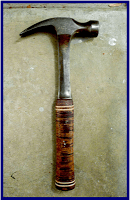
If you are in the market for a scythe, always buy a hammered Austrian scythe. It is worth the price. Speaking of Europe, it appears that they have been reaping a large harvest of discontent, which they sowed very effectively over the last decade. It’s almost pitch fork season in Transylvania.
Peace, Estwing

The $2,000 Bathroom

When many people think of renovation they think of kitchens and bathrooms. It is not uncommon for Kiwis or Americans to spend over $20,000 on such projects. The perception is that such investments will increase the resale value of the home. Under an outdated paradigm this may have been true. But now, as many are aware, conditions have changed.
Instead of splashing out for a flash kitchen and a flash bathroom at $20,000 each, we have invested about 10% of that in each and spent the bulk of our money on insulation, solar hot water, a multi-fuel stove and a new roof. But what, you may ask, does a $2,000 bathroom look like? You’ll find a run-down below. But first, the “before” picture.
This “room” had been the kitchen with a painted timber floor and a hardboard ceiling, most of which had been removed, with some sheets still in the removal process aided by gravity. The corner of the room to my left now looks like this.

Linoleum: $50 on TradeMe (3 metres by 3 metres)

Sink: $20 at Hayward’s Auctions

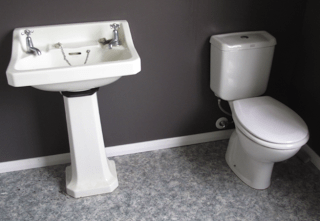
Toilet: $99 at the Renovator’s Centre

Lights: $20 on TradeMe

Medicine Cabinet: Mirror ($15 at Hayward’s Auctions) and Drawer ($1 on TradeMe)

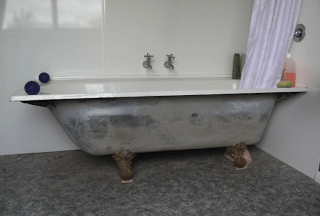
Bath: $55 on TradeMe

Bath Taps: $150 at Mitre 10 (New)

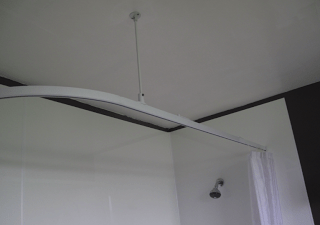
Curved Curtain Rod: $12 at Hospice Shop

Seratone Panels: $400 at Mitre 10 (New)

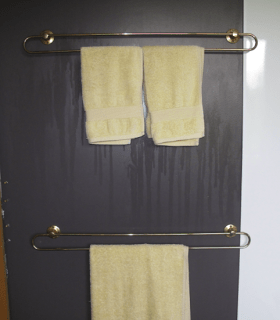
Towel Racks: $2 at Hayward’s Auctions


Laundry Tub: Traded other materials for store credit at Renovator’s Centre

Washing Machine: $700 at Mitre 10 (New) *Not included in total


Cabinet: $15 at Hayward’s Auctions


Other expenses:

Paint: $90 at Mitre 10 (New)

Plumbing Parts and Services: $1,000

Electrical Parts and Services: $100

Total: $2,029

I’m not including the price of the washing machine because that is not a usual bathroom expense. I’m also not including the cost of replacing the ceiling because most people who spend $20,000 would not to have to replace their ceiling either. This is not meant to be the definitive eco-thrifty bathroom, as the available second hand resources will always vary. This is about as good as we could do in our particular place at this particular time while following the NZ Building Code and keeping down costs and ecological footprints.


Tread lightly, Estwing

Keep it Comfortable


This post is part of The Little House That Could series, designed for upper primary school and lower intermediate school children. The academic curriculum that accompanies these posts was developed by the ECO School with partial funding from Wanganui District Council and administrative support from the Sustainable Whanganui Trust.

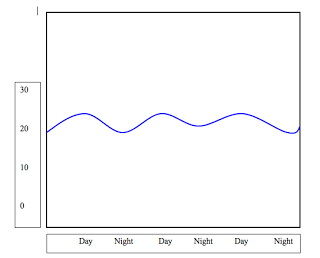
One problem that happens sometimes with passive solar houses is that they can get too hot even in the middle of winter. For instance, once when we were house sitting in Raglan, the temperature inside the house could reach almost 30 degrees in the late afternoon just from sunlight. This happened because it had lots of windows facing north that let the sun inside, but most of the energy from the sun heated the air. But overnight the heat would escape and by the next morning it would be 12 degrees inside. A graph of the temperature would look like this.


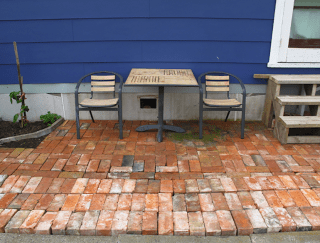
This graph shows that it’s hot during the day and cold at night. You might as well live outdoors! The reason for this is because the house had lots of windows in the right places, but not enough “thermal mass” inside to absorb the heat during the day and let it out slowly at night. An example of thermal mass is our brick patio. Even an hour after sunset the bricks still feel warm. In a way, the bricks are like rechargeable batteries because they can store the sun’s energy like a battery stores electricity. But when the energy runs out they need to be recharged.

But of course the patio is outside. We want more thermal mass inside. To get an idea of what might be a good example of thermal mass, think of water and anything that sinks in water. We might call these things “heavy.” Anything that floats in water is not so good as thermal mass, but is better as insulation. That’s what the next post will be about.

So how do we get thermal mass inside our house that is up on piles? Here are a few ways.

Our iron bath.

Our Multi-fuel Stove

Extra layer of GIB on some walls.

We put the bath, the stove and the extra GIB all along the northwest-facing interior wall as shown in the picture below.


The winter afternoon sun shines directly on them, and instead of our house overheating, it gets up to 22 or 23 degrees. Then as the house cools down at night, the heat stored in the bath, stove and GIB goes into the air space of the house. A graph of the temperature in a house that gets lots of sunlight but also has enough thermal mass and insulation would look like this.


This graph shows that it gets warm during the day but not too hot, and it cools down at night but doesn’t get cold. Goldilocks might say that this is “Just right!”

Any questions or comments?


Peace, Estwing

Brains Not Brawn in the Garden

At the ECO School, we believe in making the highest quality sustainability education affordable. Money should never be a barrier to getting top notch information to people of moderate means, and delivering that information expertly by making it logical, practical, relevant, easy to understand, and teaching to multiple intelligences.
We reach the world through the Web, and we reach out in our community (and those communities where we are invited) by working with teachers in schools, presenting to community groups, running workshops and offering consulting services. Most of our local initiatives are payable 100% in REBS, our local currency, meaning anyone can join that network and attend a workshop “on credit” and “pay” for it later by offering their own talents to the REBS network. And on top of that, all of our workshops and consulting services are designed to help people save money. In most cases, the cost of the education pays for itself in a matter of months, and after that it is all savings. Compare that to the average US or NZ university degree!
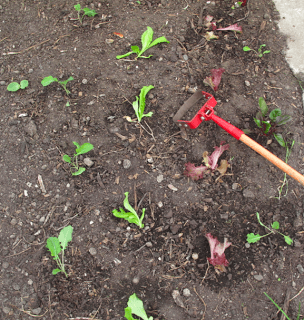
By far our most popular and most successful workshop has been “Organic Weed Control: Human Scale Design and Management” aka, “Low-Maintenance / High-Productivity Gardening.” We’ve trained over 300 people over the last four years in Australia, USA and New Zealand with excellent feedback. We will be offering this workshop on Sunday, November 13th from 1 to 5 pm here on Arawa Place. Some aspects of the programme include:
• Designing garden beds with the mantra, “Tools, Timing, Technique.”
• Improving germination rates in chunky soils.

• Tips for transplanting, spacing, staking, propagating and pruning tomatoes.
• The judicial use of mulch, and growing great garlic and onions.

• Super lazy, super productive pumpkin patches.
• Eco-thrifty compost making. For more details, click here.
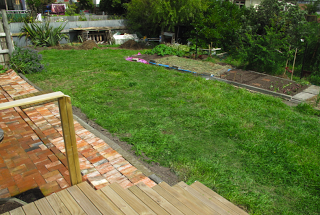
And while you’re here, check out the rest of or eco-thrifty landscaping…
… including our almost finished brick patio. (John and Amy, Come back and help us complete it!)
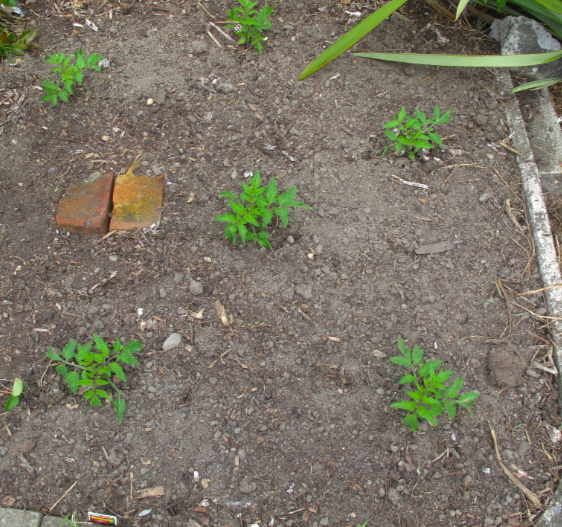
And, most importantly, someone tell me the name of this plant. It has a thick, perennial woody root but the foliage dies back in winter. It grows everywhere in our sandy section.

Pre-registration required. Contact us through the ECO School. As always, discounted rate for our neighbors in Castlecliff.
Peace, Estwing

Sunrise, Sunset

This post is part of The Little House That Could series, designed for upper primary school and lower intermediate school children. The academic curriculum that accompanies these posts was developed by the ECO School with partial funding from Wanganui District Council and administrative support from the Sustainable Whanganui Trust.

It was August, 2011, and the little blue house on Arawa Place in Wanganui had almost been renovated.

Before and After
And then it happened…

… the coldest week in recorded New Zealand history. Times were tense.
And the plumber had not come to install the wood burner. What to do? We could just turn on the electric heaters, but that would cost a lot of money. Luckily, we had a plan. We renovated our home to be heated by the sun in winter. This is how it works.
The sun rises and sets in different places at different times of year. In the winter, it rises in the northeast and sets in the northwest. During our renovation, we added windows on the northeast and northwest and removed windows on the southeast and southwest.
The winter morning sun comes into our lounge and our kitchen at a low angle.
The midday sun comes in our French doors on a low angle.
And the afternoon sun, well look at all that we do with it!
In the winter, the sun appears low in the sky, so the sunlight reaches deep into a home.

We put the lounge, kitchen, bathroom and dining room on the north side of the house because those are the places we like to be when we are awake. The bedrooms are on the south side. We use hot water bottles in bed.
Even though that was a cold week, with snow in Auckland and Wellington and even Wanganui, it was also a very sunny week. Cold and sunny are perfect conditions for Passive Solar Design. That is the name for what we’ve done. And how did it work?
Celsius – Top is indoors & bottom is outdoors – Farenheit
These are the indoor and outdoor temperatures when we closed our thermal curtains at 5:30 pm. Good one, eh?

Peace, Estwing