All posts by Estwing

Organizing a Working Bee

A working bee, “permablitz,” or PET day (People Energy Transfer) can be useful for working on a big project, for building community and for providing informal education. However, poor planning can make them stressful and counterproductive. Failing to plan is planning to fail. Before 2 to 22 people show up on your property, it pays to be organized and prepared. Here are a few words of advice for running a smooth and productive bee.
First, make sure that you have a project that is labor intensive but requires low skills. In this case, I wanted to “renovate” this garden bed.
But I also had other chores ready, like turning the compost pile and building a new compost pile.
A half an hour before anyone arrives, make sure you have all of your tools and materials ready to go. Most people don’t like standing around waiting for you to get organized if you leave it until after they arrive. Also, you’re not taking advantage of all of the “person hours” if you’re not prepared in advance.
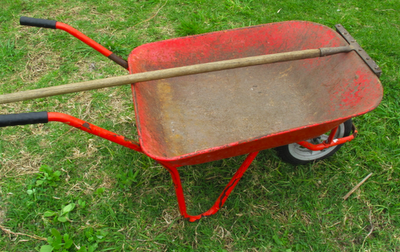
Some tools can be paired and ready to go. For example, this couple is ready for someone to collect grass mulch from the other side of the house.
And finally, I like to have an example of what we’ll be doing already completed for people to see. As part of “renovating”this garden bed, I’ve put newspapers along the outside edges to help slow down invasive grasses such as couch and kikuyu.

It pays to be organized in order to get the most possible work done, but also to make sure it is done to your liking. Nothing is worse than having to undo something that someone has done poorly because lack of clear directions.

And don’t forget to make it fun, and share a cuppa afterward.
Peace, Estwing

Coming Attractions

We are pleased to announce an upcoming innovative cross-curricular programme that we have designed for schools in the Wanganui District. Feel free to follow along in the weeks to come. Here is a preview.


The Little House That Could

Curriculum Overview

Introduction: The Little House That Could programme is designed for learners at Levels two and three, and includes four learning areas of The New Zealand Curriculum: science, maths, the arts and English. The scientific foundations of passive solar design are presented first in a science unit. This is followed by a combined maths, English and arts unit on eco-design and communication. All of the units are presented as clearly and concisely as possible for ease of implementation.

The Story: The Little House That Could is introduced in a narrative style intended to “hook” students with a recent significant event that made headlines across New Zealand: The coldest week in recorded national history. An illustrated blog post tells the story of an incomplete passive solar renovation project and how it performed during this historic week of frigid, but sunny weather. The wood burner had not been fully installed when the cold southerly blew in…

…but the little house that could…

To be continued at: http://www.ecothriftydoup.blogspot.com/…

A series of interactive posts follow that allow students to post questions.

The Science Unit: Based on the age and ability of pupils, a number of science activities are suggested and described to varying degrees in the attached science unit. They address the basic elements of passive solar design: sunlight energy, thermal mass and insulation.

The Combined Maths, English and Arts Unit: This integrated unit is presented as a cross-curricular approach to meeting learning objectives of the New Zealand Curriculum. It is presented in its entirety, and individual teachers can adapt it to their students’ needs.

The Little House That Could programme was developed by The ECO School with financial support from the Wanganui District Council and administrative support from the Sustainable Whanganui Trust.

Peace, Estwing

From Tar Sands to Tauranga…(and Taranaki)

Alliteration is about connecting and emphasizing words and sounds. Permaculture is about recognizing and maximizing beneficial relationships while minimizing or eliminating harmful ones. From my perspective, oil is doing a lot of harm to our planet, many of it’s living inhabitants and especially certain regional human communities. Of particular concern to me are the tar sand developments in Alberta, Canada. Talk about a carbon footprint and water pollution! My heart goes out to the native communities effected by these disastrous projects. In case you missed it, a 1,700 mile pipeline is proposed from Alberta to Texas and the final public hearing is in Washington D.C. today.
Meanwhile, we have our own oil catastrophe off the coast of Tauranga…

… and ongoing concern about deep water (sound familiar) oil drilling off the coast of Taranaki, and fracking around Mount Taranaki itself. I know lots of people who are gutted by all of these developments. Last March/April heaps of people drove to the East Cape to protest the Orient Explorer (under contract with Petrobras) doing a seismic survey of the Raukumara Basin. A friend of mine who is a professional geologist and amateur renovator and gardener pointed out how ironic it was that people drove all the way to the East Cape to protest the potential extraction of oil from the earth.
It is hard to disagree with him, but from my experience there is nothing a Greenie hates more than to have their own hypocrisy pointed out to them. Best to stay away from it. That is one reason that I push the economics of sustainable living over the environmental arguments. It is clear that world leaders are not willing to take serious action regarding climate change so why expect average citizens to do so? Many, many people have no problem arguing with science, but they may find it harder to argue with maths. For example, electric rates in NZ have increased just over 7% for the last 8 years. This translates into a doubling time of just under 10 years (using the “Bankers Rule of 7”). There is no reason to think that this rate will go down in the foreseeable future. Meanwhile, rates are set to increase in the USA as well.
And, in another meanwhile, both countries face inflation that outpaces wage increases. This means every year the gap between income and outgo narrows. Most Kiwis and Yankees have to live on less and less as time passes. These are mathematical truths. Can’t much argue with them, although undoubtedly some will try.
For reasons known only to people who want to influence “consumer” sentiment, food and energy are not included in US inflationary data. None the less, food and energy prices continue to rise with a high degree of correlation.
Back to permaculture and minimizing or eliminating harmful relationships. For most people living in OECD nations, oil, electricity and food come from “away” and are subject to volatile yet increasing prices controlled by people outside of their communities. The relationships between people and energy, food, lifestyle, comfort, security and quality of life are complex and variable. But the current mathematical reality indicates that the more that lifestyle and comfort rely on energy and food “from away,” the greater the risks to lifestyle, comfort and quality of life. From this perspective, the relationship between volatile and increasing energy and food prices and quality of life will be an increasingly harmful one as long as individuals, families and communities rely heavily on energy and food from outside sources.
The Eco-Thrifty Renovation seeks to demonstrate that humanity’s harmful relationship with energy (and particularly oil) can be greatly minimized not just for environmental reasons (ie, climate change, oil spills, etc.), and social reasons (ie, Alberta indigenous communities, low-lying Pacific Island nations, Louisiana fishermen, etc.), but also for economic reasons. Here is a thought experiment:
How would your life change if tomorrow the cost of your electricity, food and petrol doubled?
Think about it for a minute.
For us, the honest answer is not much at all. Check the maths:
Current electric use: 50 kWh/month at 25 cents per kWh, plus 38 cents per day line charge = ($12.50 in power) + ($11.40 in line charges) = $23.90
Doubled electric rate: 50 kWh/month at 50 cents per kWh, plus 38 cents per day line charge = ($25.00 in power) + ($11.40 in line charges) = $36.40
Current petrol use: less than 1 tank per month at about $100 to fill the tank = $90
Doubled petrol price: less than 1 tank per month at about $200 to fill the tank = $180
Current annual energy bill: around $1,366.80
Annual energy bill if rates doubled: around $2596.80
In our home, one person works about 40 hours per week for $15/hour. Working 48 weeks per year means our household income is about $28,800, minus 20% for taxes equals $23,040. As you can see, even with a doubling of energy costs they would make up only around 11% of our household budget. Not too bad.
The food bill is much harder to calculate because we don’t track it. But we have planted over 30 fruit trees and built 50 square meters of annual garden beds, and three poultry paddocks with the goal of ultimately growing half of our food on this 700 square meter section. Plus we have walkable access to fishing. The point is, even with a doubling of food prices we’ll still do fine. If that were to happen I imagine there would be so much social unrest that number crunching would become a low priority.
So how would you do with a doubling of energy and food prices? Good, bad, ugly? Let us know. Post a comment.
Peace, Estwing
How to Cook a Goat: Building Community One Koha at a Time

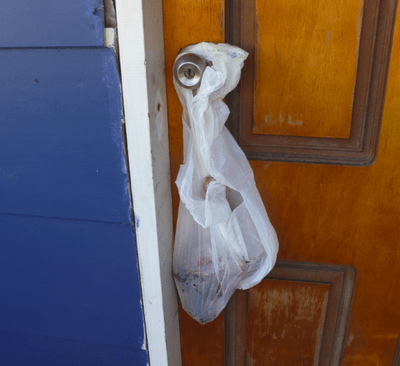
What does it mean when a mysterious stranger leaves a package hanging from your front door?
Containing the leg of a recently live goat?
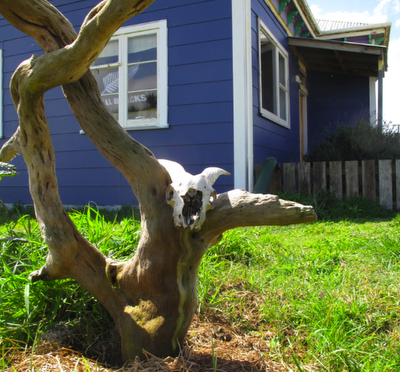
Two questions come to mind: Who left this gift? How do you cook a goat? Our only previous experience with goat is the one we found dead on the beach and composted. That one now serves as fertilizer and a lawn ornament.
We do have some experience with Koha, a Maori custom of giving a contribution, often Kai, food. Our neighbor in Raglan gave us a bag of frozen white bait (Google it) over a year ago and we finally ate it last weekend as white bait fritters.
We have friends that we bartered garden design for smoked fish, preserved fruits and native plants, but they said the goat was not their doing. And so yesterday, when the young girls who climb our back fence to feed our ducks and chooks and get fed by us came by I asked them if they knew anything about the goat. One of them told me her uncle may have had something to do with it. I asked her how to cook it, and she said, “Everybody knows how to cook a goat.”
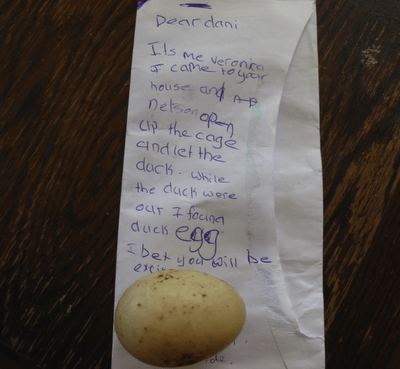
Shortly thereafter, she found our first duck egg. She was so proud of her find that she left a note for Dani.
So then, how do you cook a goat? On a sunny day, the answer is obvious.
With you own garlic from last season.
And some carrots and onions.
She was going great, but I also wanted to cook an apple crumble, so I fired up the pizza oven.
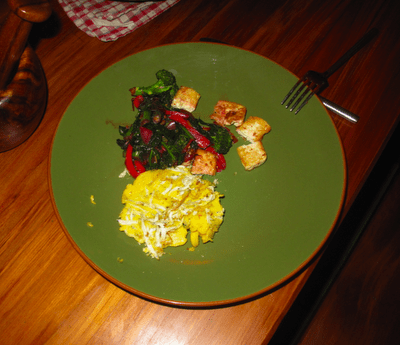
And finished the goat in there while the crumble took in the last rays of sunlight.
If anything, it was slightly overcooked in the end…
… but no one seemed to mind.
What goes around comes around. We have been working hard in our first 11 months here to build community while building a sustainable home and property from scratch. The latter is much easier than the former. If you have ever been new to a community you know how hard it can be to make friends. But we do believe that the good will we put out will come back to us as it did this week. The New York Times just ran an article on how the Greeks have taken up bartering with a passion lately. I believe the Argentineans did the same after they default a decade ago. It is clear that austerity measures are coming our way too, and the best way to prepare for them is cut your expenses and build your relationships. We have done both here on Arawa Place, and they are both paying us back.
Thanks to our 29th follower. Please help spread our message that being green is not expensive. We are proof.
Peace, Estwing
Downgrade


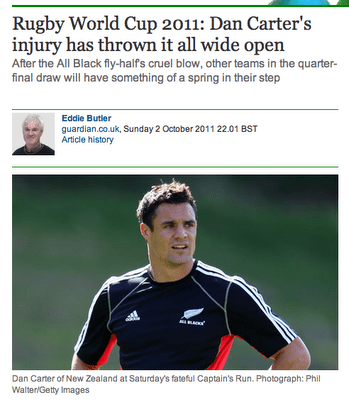
It is difficult to judge which piece of news was more devastating to New Zealanders this week: the unexpected credit rating downgrades from both Fitch and Standard & Poor’s, or the equally unexpected World Cup tournament ending injury to All Black stand out, Dan Carter. In the short term, neither development had much effect over the weekend: opposition Labour party leadership blew some hot air at the National government, and the All Blacks beat Canada 79 – 15. But the long term outlook for both offers significant challenges.

I’m neither a financial nor rugby analyst, but I reckon the Wallabies (if they beat the Springboks) could be as tough on the depleted ABs as the Aussie banks will be on indebted Kiwis. Another headline last week about the NZ Rugby Union claiming they may not be able to afford the send the ABs to World Cup 2015 brings up an equally interesting question: will England be able to host it? Current austerity measures in the UK are accompanied by civil unrest, and the 2012 Olympics are likely to run at a massive economic loss. How jolly will Ol’ England be after that?

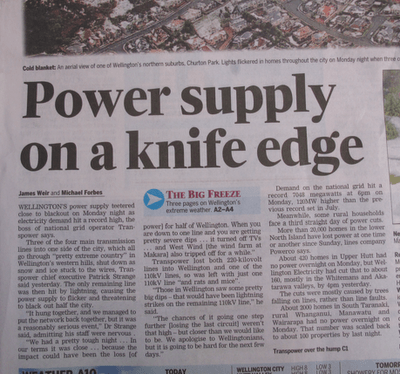
Interestingly, there only seems to be one growth industry creating jobs. This headline from the USA.

Debt is dangerous. Personal debt is dangerous. Household debt is dangerous. Municipal debt is dangerous. National debt is dangerous. I don’t know how else to put it. This next headline is an example of what debt can lead to. I need not go into inflated housing prices, sketchy mortgage agreements, and people with eyes bigger than their wallets. But debt never forgets, and even people who walked away from their mortgages are being tracked down by debt collectors (see above) and the courts.

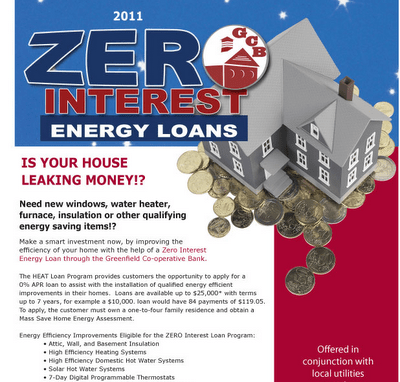
While I have no overt love of suburbs, I sold my 38 acre farm – among the most sustainable properties in North America – and now live in a suburb with plenty of poverty. We made this choice to demonstrate that living green and living on the smell of an oily rag are highly compatible. Our power bill is pennies per day, our transportation tab is similar, and our grocery bill is falling monthly as we convert a weed-infested lawn into vegetable gardens, food forests and poultry pastures. We have been fortunate that decades of fiscal conservatism has allowed us to do this without going into debt. But we also realize that this is extremely rare for individuals living in OECD nations. Considering that, the best, most sustainable, most genuine effort any government could make to help the PEOPLE live more sustainably ecologically and economically is to offer zero interest loans for energy efficiency measures in the home.

Insulation, solar hot water, Energy Star appliances, etc. pay a far better return on investment than any term deposit or certificate of deposit in any bank. Congratulations to the state of Massachusetts, USA for offering zero interest energy loans. It is time governments around the world followed suit and served the PEOPLE and instead of the BANKS.

Until then, live within your means, save your pennies, avoid debt and pay cash.

Peace, Estwing
Mutually Beneficial

We are in the unique position in that we are both permaculturists and educators. Our home is our classroom and a working model for sustainability. Our school – The ECO School – is perhaps the smallest, lowest budget non-profit on Earth. We are trying to grow it so that it can be financially sustainable, but our business model is outside of the mainstream and many people do not understand it.
The approach we take at The ECO School is an ecological one. We seek to enter into mutually beneficial relationships with individuals or organizations to provide the highest quality of education for sustainability for entire communities: from children through seniors. In nature this is called symbiosis, and more specifically mutualism. Synergy is another way to describe it: the whole is greater than the sum of its parts. In permaculture this is sometimes called “regenerative design.”
We don’t walk in to an organization, school or business and say “this is what you should do.” We say, “What are your needs and how can we help you? Here are some ideas for you to ponder, but you decide what direction we take together.” In other words, we can help others do what they do better… as long as “better” means more sustainably. Here are three recent examples:
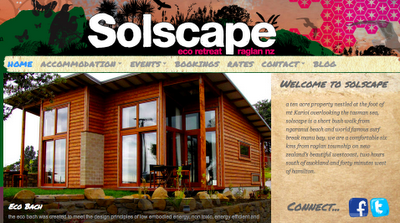
Solscape Eco-Retreat in Raglan is in the process of developing into an education and conference centre. They launched an exciting new educational initiative a week ago today, so we went up to help our dear friends celebrate this important milestone. At the same time, we were able to run workshops at Solscape over the weekend as part of Raglan’s Sustainable September calendar of events. We were able to bring the highest quality of education for sustainability to Solscape to help raise their profile as a leading facility in this area, and we were able to reach out beyond our normal audience in the greater Wanganui area and earn some money. (Well, it covered our travel expenses so we had a free weekend away with friends.)
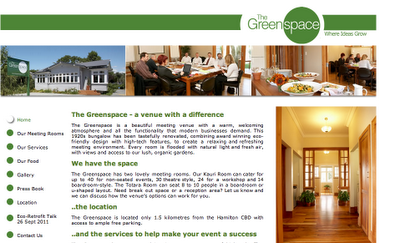
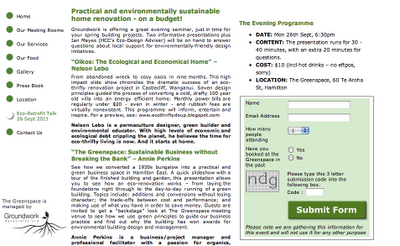
The Green Space in Hamilton is a meeting venue run by other friends. I knew they had done an eco-renovation of which they were proud. Since Hamilton is near Raglan (and where I am an enrolled PhD student) I asked our friends if they would like to tag team a workshop for Hamiltonians. Again, the goal was for a mutually beneficial relationship where the Green Space gets local exposure, attendees get an excellent, low cost educational experience and I get to do what I love to do.
This afternoon I will be heading to Kakatahi School to help a cluster of rural schools plan a term 4 curriculum based on the sustainable use of energy. In this case, the principal contacted me to arrange for this professional development programme made possible by grant writing by the Sustainable Whanganui Trust and funding from the Wanganui District Council. This is a four-way partnership that permaculturists may call a “guild.” All four entities benefit from this initiative and at least three schools will be in attendance.
Just in case you are interested in innovative, cross-curricular sustainability education, here are a few ideas I sent to the cluster to think about before our meeting this afternoon. I treat my curriculum design work like I do my permaculture landscape design work, starting with a client brief. This client brief came directly from the principal.

Brief: The topic that we would like to use for our planning would be: How can we be more sustainable in relation to Energy? (in our homes, schools, on our roads and on our farms). Each school has slightly different needs, but I think for our first meeting it would be useful to plan a unit of work for a term, based around the Energy theme. Each school could then adapt the unit to suit. It would be an Integrated Unit incorporating Science, Maths, English, Social Science and the Arts. It would be in the context of Education for Sustainability.

Preliminary ideas: Energy is everywhere around us all the time. Integrating energy across the curriculum should not be difficult, but the challenges will be meeting the needs of different schools, different age levels and different learners. I can provide ideas and support for teachers to adapt specific lessons for their students. Below is a short list of possible approaches. These can be clarified and expanded upon at the cluster meeting on the 30th.

• I have a professional development workshop called Eco-Maths that uses a PowerPoint slide show to provide ideas on how the teaching and learning of maths can be based on eco-design and home energy use. This workshop is designed to spark ideas that can be further developed by teachers with support from me or a local engineer, or green architect, etc.

• Our eco-thrifty renovation project has an active blog: www.ecothriftydoup.blogspot.com. I could set up a “kid-friendly” version of the blog, that classes to go to and post questions to which I could respond.

• I am an advocate of concept mapping as a teaching tool. I believe it is especially well suited for complex issues like energy. I would be happy to share some ideas on concept mapping.

• Some lessons on solar energy for Level 1 students can be found on the attached example of cross-curricular lesson planning at a Wangnaui primary school.

• I can share some ideas on science activities on various aspects of energy.

• I have an excellent, colorful graphic that compares the efficiency of different forms of transportation. If you have a colour copier it would be worth reproducing.

Peace, Estwing

Equinox

Balance is something many of us struggle to maintain in our lives. With the profound unsustainability surrounding us, the task often appears that much more difficult. This project seeks to find the balance between eco and thrifty but finds – much of the time – that they are one and the same.
Lakota star quilt was a wedding gift.
The equinox is a great global reminder about balance, and a time for us to celebrate the sun.
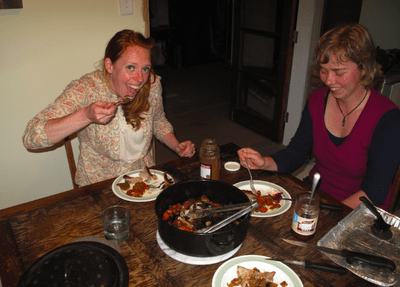
Since our monthly Wanganui Permaculture Gathering (the third Wednesday) fell on the 21st, we decided to have an “alternative cooking” party with our solar cooker, rocket stove and pizza oven. Our friends brought a thermette (if you don’t know it, Google it) and a wood-buring BBQ.

Peace, Estwing
Eco, Thrifty, Lazy

One thing I learned from growing lots of vegetables with no use of powered machinery was how to make efficient use of my time and energy. When facing back-to-back-to-back 12 and 14 hour days of manual labor, one figures out how to be effort-thrifty. Here is an example that I’m sure most of you know already, but with a few subtle notes.
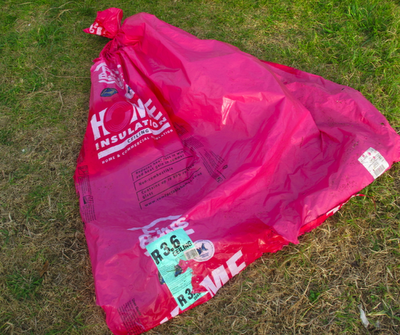
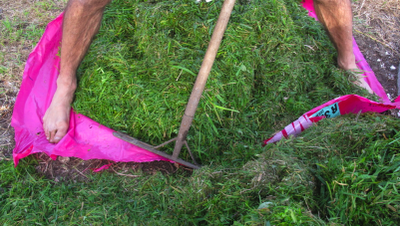
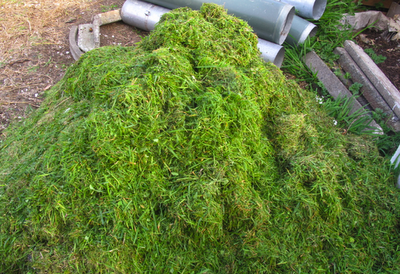
The other day a landscaper dropped off a large pile of grass clippings in front of our home. I wanted to take them around the back, so instead of six to eight wheel barrow loads I grabbed a “tarp” (large plastic bag saved from our insulation purchase).
I’ve found the easiest way to load the tarp is to hold down the front edge with my feet and rake through my legs. I used this technique when raking leaves in New England.
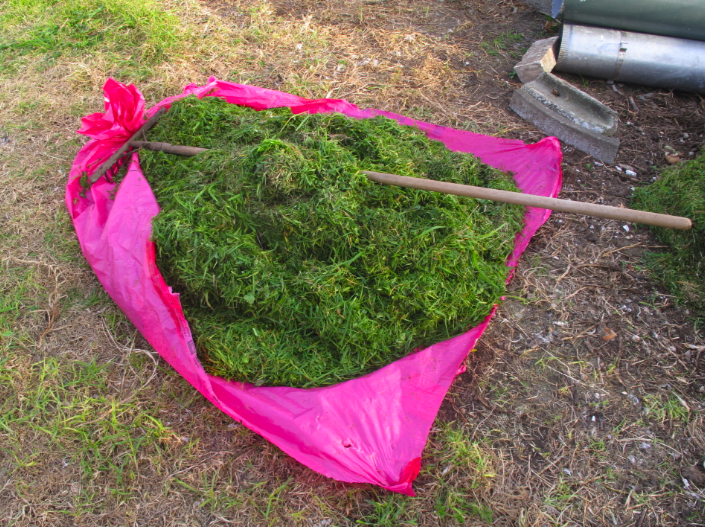
The loaded tarp is ready to go. Note that in this case the bottom has been cut open but the top zip tie has been left in place. By pulling from the bottom end the top bundles the grass so it does not fall off the back while transporting the load. The rake stays on for the ride if it is needed at the other end of the journey.
I decided I would add the grass to an existing compost pile to heat it up and finish it. The first tarp load I pulled to the edge of the compost pile and lifted the back of the tarp over.
Because the pile is in a corner, I could not repeat this on the other side, so I pulled the edge of the tarp to the top of the pile and then lifted the back over the top.

Nothing revolutionary here, but an example of a quick and easy way to move a load of lightweight material. By using lots of effort-thrifty techniques like this it is possible to do 12 hours of work in 10 hours and with the effort of 8 hours. When your personal metabolism is the energy source, every bit counts.
And on a final note, I always store plastic items out of direct sunlight. Many plastics are UV sensitive and break down in the sun over time. Even a plastic bag from insulation – what many people would toss in the rubbish on day one – can be saved and re-used for years.

And there are many uses for sheets of plastic like this. Do you have any good ideas? Please post them.
Peace, Estwing
Citizenship Day (?!?)

I discovered this week on my Yankee Magazine calendar (thanks mum) that the 17th of September is Citizenship Day. There was no further clarification as to whether this citizenship extends beyond New England, or the USA, but I will assume that this is a global event. And so I’ll write about being a global citizen.
When thinking about what it means to be a global citizen, I submit that the permaculture ethics are a good place to start: earth care, people care, fair share. As a matter of fact, that may even be a good place to end. Through this lens, let’s look at an example of poor citizenship.
This data comes from a recent article in Forbes: Wasting Away: Our Garbage by the Numbers. One of the saddest bits about this is that I recall numbers like this when I started my career as an environmental educator 20 years ago. But back then the amount of garbage the average American produced was “only” 4 pounds. It is interesting that the current number is 4.4 pounds, because that is 2 kilograms. I have not seen the number for New Zealand, but I suspect it would be similar.
The three Rs (reduce, reuse, recycle) are so fundamental that I won’t write extensively on them except to say that global citizens would take them into account with every purchasing decision they make. During our renovation and in our domestic life we produce next to no rubbish: about one bag every two months.
I’d like to challenge global citizens to raise the bar for global citizenship beyond the 3 Rs by taking serious steps at energy conservation. We have had great success with our passive solar redesign and are using less than 10% of the electricity of even what is considered a “low user” (8000 kWh/year) in New Zealand.
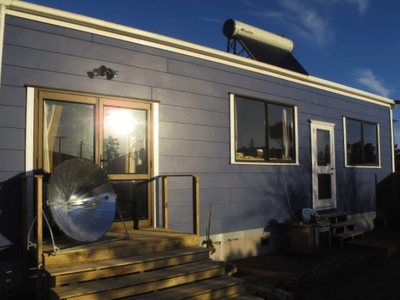
This is the power bill that came this morning, after a month that included the coldest week in New Zealand recorded history. During this record cold spell, with no supplemental heating except electric, we averaged just over 2 kWh per day.
Even a “low user” can average over 21 kWh per day year round. Presumably, that may vary from 15 kWh per day in summer and 25 kWh per day in winter. By comparison, our 2 kWh appears to fall into the truth-is-stranger-than-fiction category. But its true. You can see the bill above. That is the power of sunlight, thermal mass and insulation.
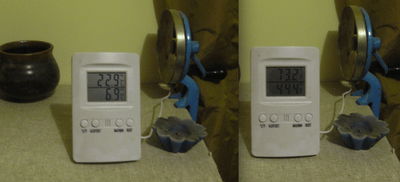
Indoor/Outdoor Temperatures in C and F at 6 pm, Sept. 4th.
Indoor/Outdoor Temperatures in C and F at 6:30 pm, Sept. 6th.
And we’re not even done insulating and draft-proofing yet.
Global citizens who are concerned about drought in East Africa, flooding in Pakistan and Bangladesh (formerly “East Pakistan”), and rising sea level in Tuvalu should feel an obligation to cut their energy use even if much of it comes from renewables like here in NZ. Even renewables have “side effects.”
Our friends in Raglan are fighting the wind mills proposed for the coastline to the north. I’ll be there a week from today helping them start that fight from home one kWh at a time.
Peace, Estwing
Low Maintenance/High Productivity Gardening

With garden season in the Southern Hemisphere getting underway, we’re offering a popular workshop on eco-effective, beyond-organic gardening. Below is a draft for a book proposal that I wrote two years ago before my thesis writing got underway. It should provide an idea of the 4 dimensional design and management strategies we employ in our carbon positive agriculture.

Garlic planted just wider than a stirrup hoe.


Maximizing Human-Scale Food Production

or

Organic Weed Control: Human-Scale Design and Management

Weed management is the greatest challenge to both large scale organic farming and the home gardener. Many home gardeners abandon their vegetable patches because they fall behind on weeding and then get overwhelmed. I’ve seen it happen over and over again. It’s a pity because this is completely unnecessary if the garden is designed well in the first place. Planning a garden around weed control may not sound exciting, but the result can save hours of drudgery and frustration, and potentially abandonment. It can make the difference between success and failure, and may mean the difference between a novice giving up after one attempt or making gardening a lifelong passion. For the experienced gardener it means doubling or tripling the size of a vegetable patch with no additional time commitment or expensive mulches.

Low/no maintenance edge even with invasive grasses.

Over the course of ten years I have developed a highly effective organic weed management system that also breaks insect pest and disease cycles, builds soil fertility, and cuts down on watering needs. It is also inexpensive to establish and maintain. The original system, designed for cold climates, relies on a four year rotation in beds from one square meter up to a quarter acre. For milder climates, I’ve modified the system to accommodate six half-yearly rotations over the course of three years. In both systems, an extra year of cover crop/green manure can easily be added if desired.

Rocket (arugula) as cover crop and seed bank.

In an era of rising energy prices, economic volatility, and changing climate it is significant to note that one person can manage up to an acre of vegetables using only hand tools. Forget carbon-neutral. This is a carbon positive system, as it uses no fossil fuels and actually sequesters carbon in the soil. By converting lawn into garden beds, concerned citizens of planet earth can save time, money and carbon by not mowing, and simultaneously increase their personal food security. Anyone can turn high maintenance/low productivity landscapes into low maintenance/high productivity foodscapes. The keys are design, timing and tools.

On site, scythe-harvested mulch.

It is human nature to blossom at the possibility of building something new, but to wilt at the thought of ongoing upkeep. People tend to love projects but hate maintenance. This system is designed with that in mind. The system harnesses natural energy flows, including human energy. After the initial design and construction, ongoing maintenance is kept to a minimum. Time spent on weeding, watering, and pest control are all reduced. The result is more food calories grown on fewer food calories (and no fossil fuels) burned. I have traveled the world looking for examples of sustainable agriculture and have found few better. Where conventional agriculture requires up to 20 fossil fuel calories burned for every food calorie produced, this system reverses those figures. It produces a net energy profit, instead of loss, and uses no fossil fuels at all.

Chicken tractor 1.2 meters wide – same as the garden beds.

The system relies on thoughtful design, the right tools, and proper timing. It is a low budget system as it relies on a few high quality tools that will pay for themselves many times over in time savings and food production. I developed the system on my farm in Andover, New Hampshire. During my time there, Pedal Power Farm was over 95% energy independent. Keeping costs low and productivity high is crucial to any small-scale farmer. This system is ideal for anyone growing produce in four square meters up to an acre.
Roofing iron placed temporarily to weaken couch and kikuyu grasses.

Chapters/Sections

1) Why rotate?

2) Original four-year rotation for cooler temperate climates

3) Regular, easy weed control

4) Understanding no-till systems
5)Plant spacing and successive planting

6) Modified three-year rotation for milder temperate climates

7) How to make your own compost

8) How to grow your own mulch

9) The right tools, their use and care

10) How to convert lawn to garden as part of the rotation – 3 Ways

11) Useful tips

Peace, Estwing