All posts by Estwing

9/11 Yesterday/Today

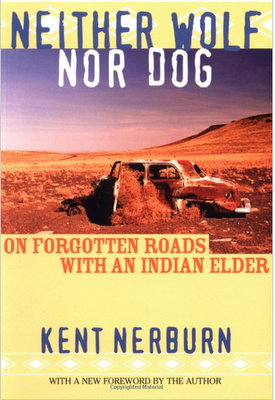
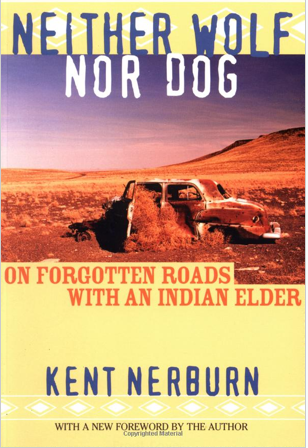
As with birthdays, wedding anniversaries and holidays, we met the 10-year anniversary of the plane crashes of the 11th of September divided. Days arrive a day earlier in New Zealand than they do in the USA. As we awoke on Sunday, 11-09-11 in Wanganui, NZ, our families were enjoying an autumn Saturday afternoon in New Jersey, Washington DC, Pennsylvania and Massachusetts. As I write these words on Monday, 12-09-11 in Wanganui, memorial services are taking place on Sunday, 11-09-11 in New York City and elsewhere around the country. Living between two worlds reminds me of an amazing book about the Native American experience called Neither Wolf Nor Dog.

Being dedicated to the sustainability movement but living in a patently unsustainable world gives me the sense of inbetweenness that many Native Americans and Maori feel regarding cultural identity. I don’t mean to imply for a moment that I can identify with being a colonized people, but I share a feeling of not belonging to the dominant culture and not living a 100% alternative lifestyle. Like many people, I walk in two worlds and often stumble.
Even though many of our friends and neighbors think our lifestyle is extreme in the extreme (“their %$#^@ mad” as one of our good friends recently put it) I consider our lifestyle fairly normal. We have mains power, mains water, internet service, a mobile phone, a slow-cooker (crock pot), a refrigerator, two circular saws, two electric drills, two computers, a printer, a digital camera, hot and cold running water, and a car. Of that list, for most of my time on my farm in New Hampshire I had only seasonal cold running water, a computer, sometimes a mobile phone and sometimes a car. By comparison, I feel absolutely cosmopolitan now.
And so it was with a sense of privilege that I accompanied my lovely wife on our bicycles to the Castlecliff Club on Friday evening to watch the opening ceremonies and first game of the Rugby World Cup being held here in Aotearoa New Zealand. It is said that rugby is a hoodlum’s game played by gentlemen while soccer is a gentleman’s game played by hoodlums. When I think of that juxtaposition it reminds me of what it means to embrace voluntary simplicity. Although the two of us hold 4 and 2/3 tertiary qualifications, we live well below the poverty level. In a sense, we are “gentlemen playing a hoodlums game.” But of course it is not a game (and we ain’t no gentleman neetha’). This is our life, and it is a very good life at that. It is just surprising how few people are genuinely interested in saving money and preserving the health of the planet.
Among the events we chose for our Sunday the 11th of September were: planting native shrubs and grasses in the local dunes; kareoke practice; softball team AGM and muster; priming trim boards for interior doorways and windows; and going to the Castlecliff Hotel to watch the USA play Ireland in their first round rugby match. It was billed as an emotional match for the USA as the team was playing on 11-09-11 in NZ. And the boys put up a good first half against a strong Irish club. The score was closer than most would have predicted, although the US kept it that way with a stingy defense and a lucky last second score.
Watching rugby from the perspective of an American footballer can be counter intuitive. Football is usually considered a game of possession, and rugby – I’m told – is a game of position. Pinned down at their own goal line, a football team would never punt on first down. But it is common in rugby to punt the ball voluntarily to improve the field position while giving up ball possession. Again, I am reminded of voluntary simplicity. Our material possessions are not as important as the position of our relationships with friends and neighbors (although they may think us a bit odd).
This perspective of position over possession became acutely clear to us as the game was winding down in conjunction with my second Lion Brown. A woman who Dani had just met at Kareoke practice (conveniently held at the same venue) came up and offered to buy us a round of drinks. “No thank you,” we said, “we’re just heading home.”
“OK,” she said, “then just take the money.” She held a twenty dollar bill toward us.
“No. No. That’s alright,” we said.
“I just won the jackpot and I have to share it or else it will never come back to me.”
“No, really, that’s OK.”
“You have to take it. Its an offering. You have to take it.”
We reluctantly accepted and walked outside.
I don’t want to read too much into this interchange, especially because it was an intercultural exchange and I cannot offer insights into the motivations of someone brought up within a more indigenous worldview than mine. But I suspect that the sustainability movement has more in common with traditional Maori and Native American perspectives than what most people recognize. I’m curious what you might think about the relationship between the permaculture ethics of earth care, people care and fair share, and the concept of the potlatch ceremony, or giveaway. From Wikipedia:
A potlatch[1][2] is a gift-giving festival and primary economic system[3] practiced byindigenous peoples of the Pacific Northwest Coast. This includes Haida, Nuxalk,Tlingit, Makah, Tsimshian,[4] Nuu-chah-nulth,[5] Kwakwaka’wakw,[3] and Coast Salish[6]cultures. The word comes from the Chinook Jargon, meaning “to give away” or “a gift.”


What do you think?


Peace, Estwing

Hauling Brass

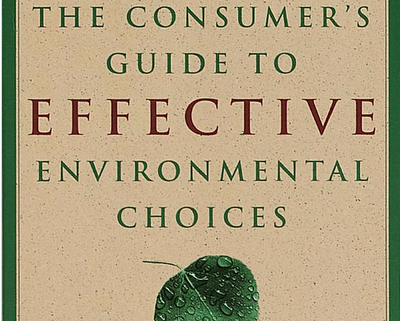
In 1999, a pair of researchers published a book called The Consumer’s Guide to Effective Environmental Choices.
In this book, the authors use stacks of data to say, basically, don’t worry about paper or plastic. If you really want to have a small ecological footprint do two things: Drive your car less and eat less meat. These two actions far outweigh other “consumer” choices. And how many people took them up on their advice?
Apparently not enough. From my two decades of experience as an environmental educator, these are the two things that most citizens of wealthy nations (and particularly the English speaking ones, USA, Australia, Canada and New Zealand) least want to hear. Even many self-styled Greenies in these countries embrace dubious claims about bio-fuels rather than take the bus or ride a bike.
The energy returned on energy invested (EROEI) of ethanol is very low. In other words, it takes about a gallon of diesel to make 1.1 gallons of bio-diesel. The numbers vary depending on whose study you look at. And in the meantime, global food prices skyrocket because globalization has dismantled most of the corn growing around the planet in favor of American exports. In the Asia-Pacific region, I’ve read that rainforests have been cut down in Malaysia for palm plantations to make palm kernel oil for bio-fuels in Europe.
And there are other problems with driving, as a member of my family – to be unnamed – recently discovered.
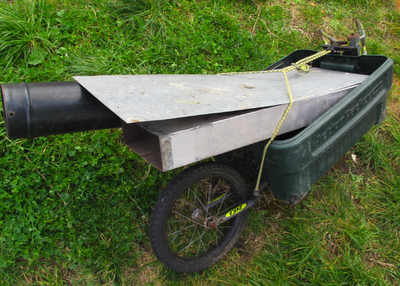
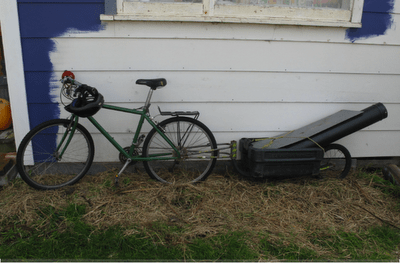
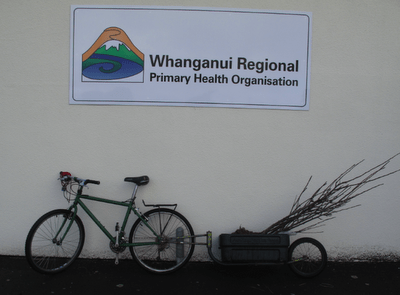
And so it was with great pleasure that I set off recently on a rainy, winter afternoon to run some errands. I loaded up the BOB trailer with some bits of your flue pipe that needed to be joined by a welder.
And, naturally, as soon as I got the bike loaded the rain intensified.
So I did not take any photos until I reached my destination…
… where a welcoming committee was waiting for me.
I managed to make it there with the load intact.
I dropped off my flue sections with Jonah, man of many talents, and headed to my next destination.
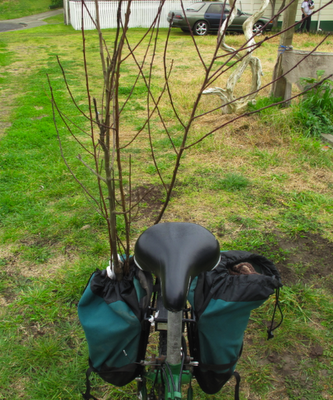
The PHO was giving away fruit trees. I was contacted about distributing them in our neighborhood, Castlecliff, which is lower decile. I picked up the apple trees, but they had run out of peach trees. But the next week they had been restocked with peaches, so I went back for a few.
The total round trip was about 10 kilometers (6.2 miles) on flat roads. Even in the rain it was not a bad ride. After all, I had a warm, dry house to return to with heaps of solar hot water, and soon to be a functional wood-burning stove thanks to Jonah’s handiwork.
For as long as the book mentioned above had been around, and for the level of concern that many permaculturists claim to have about climate change and peak oil, I’ve always been amazed at how few choose to ride bicycles or buses instead of driving. As a matter of fact, I can count on one hand the number of permaculturists that I know who regularly choose alternative (to the car) modes of transportation. Does anyone have any ideas why this is? I’ve never been able to figure it out.
For a boy who grew up on the outskirts of Detroit, my heart goes out to the unemployed auto workers who suffered the mismanagement of General Motors, Ford and Chrysler. I’m in the Michael Moore camp on this one. (He, as you’ll recall, is from Flint, Michigan). I wonder how I’d feel now if I still lived in the Detroit area. Perhaps its easier to shun driving when your local economy does not depend on the automobile industry. Could be. But now, I live around the corner…
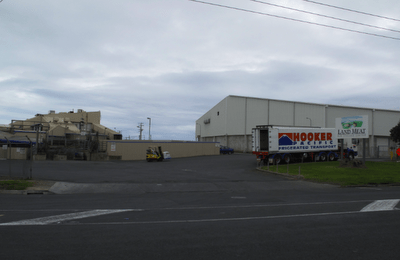
… from the meat works. This facility is less than a kilometer from our home. Many of our neighbors work at Land Meat and at the Mars Pet Food factory next door that does, I’m told, 1 million dollars of business per day. What does it mean to support your local economy while shrinking your ecological footprint? Where are the trade-offs?
On a whim, I stopped by the local butcher shop where I had heard they developed a “healthy sausage” that contains somewhere between a quarter and a third vegetables to make it lower in fat and calories, but still tasty. I asked the manager if he would donate some of this product to support a Solar Sausage Sizzle in local schools. He appeared interested while we were chatting, but I have not heard from him with a firm commitment yet. Stay tuned…
Where do you see the intersection of permaculture, diet, and transportation?
Peace, Estwing

Giving Back

We were surprised and saddened to learn last week that the Wanganui Regional Council officials declined to fund the Sustainable Schools Programme for a second year through the Sustainable Whanganui Trust. We were especially surprised given the universal excellent feedback we have received from teachers. Some examples:

We expressed our need to have sustainability issues linked to science curriculum requirements in the run-up to the Science Fair which has been a bugbear for some. Nelson made the link in a clever way linking ideas with a narrative style. Many staff spoke to me about how useful the session was and ALL asked for follow-up.

-Keith Beautrais, Head of Science and Environment, Wanganui Intermediate School.

Was invaluable to have so many ideas that are quick to set up, cost efficient and aimed at the students level.

– Teacher, Wanganui Intermediate School.

Nelson was really involved and passionate in his discussion with the kids – in turn this has helped them to get into their research.

– Teacher, Wanganui Intermediate School.

As a first year teacher I found the presentation provided me with a lot of ideas to hap me to guide my class in their projects. Enviro was not an area that I felt confident to suggest to my students as a topic for science fair until I heard Nelson’s talk.

– Teacher, Wanganui Intermediate School.

This excellent feedback is joined by similar compliments on other educational projects we’ve done outside of schools. This one comes after a powerpoint presentation on “The Principles of Eco-Thrifty Renovation” presented to the Pukenamu PROBUS Club. (PROBUS stands for professionals and business people. Mostly retired.)

Many club members have said to our committee how much they enjoyed the talk and generally they were amazed at what you have been doing and what you have achieved. Your power bill shows just how much we could all save for ourselves and for this earth if our building practices and living styles were focused on the principles you espouse.

– Colin Clancy, President, Pukenamu PROBUS Club

A colleague in the field of environmental education just told me that she presented the idea of the Eco-Thrifty Renovation to a group of 300 at a professional development programme in Winnepeg, Canada. And I just received confirmation that I will be presenting the ETR at the New Zealand Association for Environmental Education conference in January. Here is the abstract as submitted.


A Whole Community Approach to EfS


Introduction: The ECO School is a tiny organisation presently operating in Wanganui. It’s current focus is a project called The Eco-Thrifty Renovation, which takes a multi-modal, multi-generational approach to EfS, and has achieved outstanding success in just its first 9 months.

Content: The Eco-Thrifty Renovation is a 12-month project to turn an abandoned house on a weed-infested section into a sustainable urban homestead while sticking to a tight budget and abiding by the New Zealand Building Code. Meanwhile the project is being used as the context through which to bring EfS to learners in our community from Year 1 all the way through senior citizens. The educational effort emphasises: saving energy through passive solar design and energy efficiency; growing food organically at home; and saving money through the first two emphases. Thus far, the ECO School has partnered with Sustainable Whanganui to bring the lessons of this project to Year 1 and Year 2 classrooms, all intermediate years, and senior secondary students, all within the framework of The New Zealand Curriculum. Additionally, the ECO School runs weekend workshops for adult learners and has presented to the Senior Lions and PROBUS clubs.

Perspectives: This educational effort takes a permaculture perspective that highlights multi-functionality. In other words, this one project provides both formal and informal education, reaches multiple generations of learners, and addresses both ecological literacy and economic literacy.

Summary: The Eco-Thrifty Renovation offers a unique permaculture approach to providing EfS to an entire community of learners. Feedback in just the first 9 months has been excellent.

We have even been getting positive feedback from the red shavers lately.


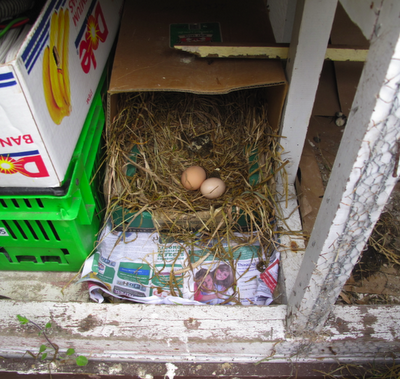
And even the pekins are contributing…


… to the extent they can.


But we’re still waiting on some donors.


So this is the first appeal that we’ll send out to potential donors (this means you) for a raft of potential projects to come. If you have enjoyed this blog, if you have learned something from this blog, if you have laughed at this blog, then maybe you can give something back to our education work. We are currently looking for funding for the following programmes:


Solar Sausage Sizzle. For classrooms in Wanganui schools.


Keen Green Teens. Leadership training retreat for high school students in our region.


Kai and Comfort for Kids. An educational programme for parents and guardians on low incomes that shows inexpensive ways to grow food and make houses warmer.


If you are interested in learning more details about any of these programmes, please contact us through the ECO School email.


Peace, Estwing


Nau Mai Haere Mai!

At the moment Aotearoa New Zealand is welcoming the world to this small stage in the corner of globe (do spheres have corners?) for the 2011 Rugby World Cup.
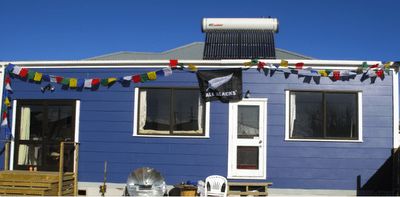
At the same time we welcome our 27th follower to the blog (whoever you are, thanks for joining us), and want to share the new look of the front of our unfinished villa. As we are surrounded by corrugated iron on most sides, we did not want to have it out the front. We want the house to appear warm and welcoming from the street.
Welcomes come in many forms, such as a Maori haka
Probably the worst haka ever. No offense meant to anyone.
… or a welcoming committee.
A ducka?
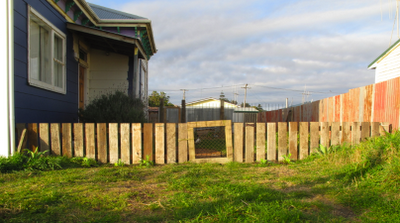
But we have had trouble with a dog getting in and eating three of our chooks. And someone walked through last week and left two back gates unlatched. So instead of open space or iron fortress, I took more of the old native timber deck and made a low fence to help define the spaces around the villa and to create an additional paddock for pasturing our poultry.
No hinges for gate yet. Waiting for some to come up at the weekly auction.
Although this wood has been exposed to the weather for over 30 years, most of it is still solid as. If anyone knows what type of timber this might be, please let me know.
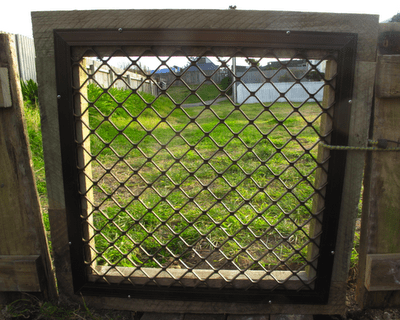
I found a solid aluminium security screen at an opp shop for $8, and used it to frame a gate. I thought this would be more attractive than galvanized wire netting like we have used elsewhere out back.
Plus, this anodized aluminum will last longer in our sea spray zone. Because the screen is rigid, I did not have to reinforce the corners of the wood frame. This saves nails, or nail plates, or diagonals, or whatever approach one might choose. I did, however, shell out for stainless steel screws to prevent oxidation.
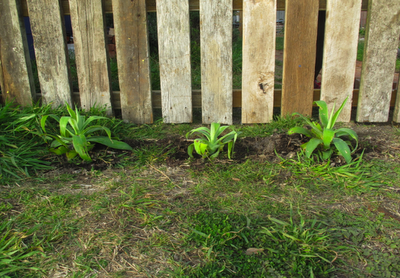
To enhance the look of the fence and discourage dogs (very short dogs like the one that ate our chooks) from digging under, I planted some succulents that our friend Mattie gave me in exchange for doing a garden design for her. (She also gave us smoked fish and chocolate cake. Yum! I love bartering!)
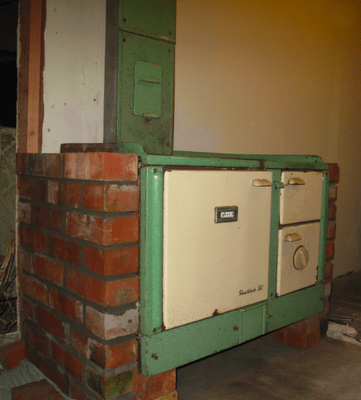
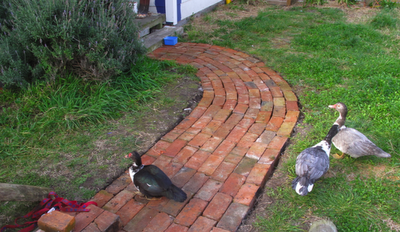
And beyond the gate is a walkway I built with some of the bricks that we bought on Trade Me. We used the rest of the bricks as a surround for our multi-fuel stove (thanks Jonah) and a patio and pizza oven out the back (thanks rockin’ interns John and Amy).
Bricks will be relaid and leveled by our next intern.
And finally, in the back of the picture below is our new chook yard for our new chooks. This fence consists of galvanized security fencing almost 2 meters high and galvanized netting along the bottom. We bought all of the materials from Haywards Auctions and Trade Me. The treated posts were left on the section as rubbish by someone previous to our purchase a year ago.

So welcome, kia ora, and peace, Estwing
Perma-Poppy

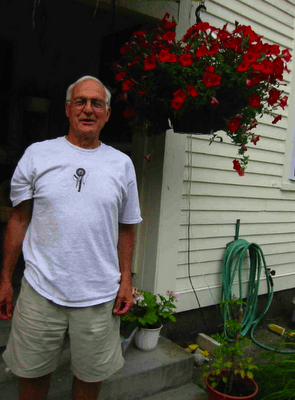
Thanks for all of the positive messages and kind comments that have been sent our way recently. A lot of volunteer hours go into this blog and it is nice to hear from people who appreciate the work we’re doing. We also like to give back – share the love – as much as possible. Today is Father’s Day in New Zealand, and this is my tribute to the man I affectionately call Poppy.
Nelson II
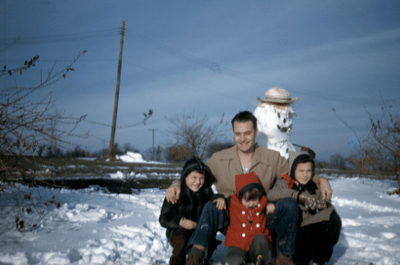
And as long as I’m honoring fathers, here is a pic of my father’s father, Nelson, with my father, Nelson (aka “Winky”).
Grandpa Nelson (“Big Poppy”?) with Winky and his sisters.
Poppy grew up on a farm in New Jersey, although Big Poppy was more of a businessman than a farmer. This is one of the last pictures of Wink at the farm before it was sold.

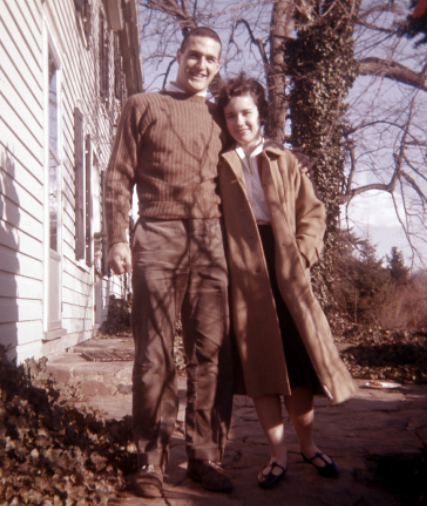
Poppy and Mum!
Although Wink was blessed with winged feet…
… he never forgot his roots down on the farm.
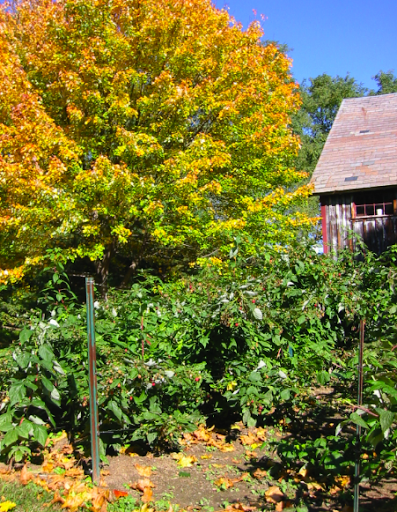
Poppy’s veggies in autumn. Notice maple tree foliage and slate roof on the barn.
He has almost always had vegetable gardens, and I spent many hours weeding one particularly large one as a child. Although I was critical of my conservative schooling in a recent post, I must acknowledge Poppy for planting the seed of gardening in me. (I just did not germinate for over a decade.) Although I have tried to return the favor by giving him a stirrup hoe (my favorite hand tool) and encouraging him to use it, he prefers to stick to his old ways and his new Mantis tiller. But he has made some eco-thrifty renovations of his own lately, like having insulation blown into the walls of their house, which has cut their heating bill by 20%.

Eco-Thrifty Prius in driveway.
A solar-powered clothes dryer has cut the electric bill too.


And it was reported recently that he made pickled beets on his new solar cooker last week. Good on ya, Poppy. I guess the tree doesn’t fall far from the apple.
Peace, Estwing aka N3 aka Nelson III

Multiple Functions

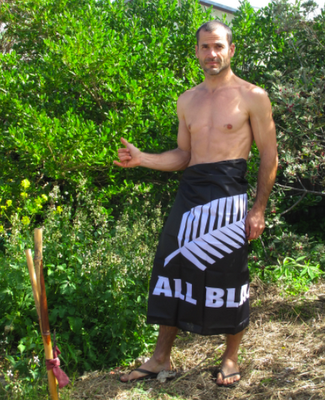
One of the more popular permaculture principles is known as “multiple functions.” Put simply, every element of a system should serve multiple functions. I have posted previously on this principle and will probably do so again. We embrace the idea of multiple functions often on our section. But we have recently acquired an element that surely excels at it. Our Aussie cuzzies will be especially interested in this.
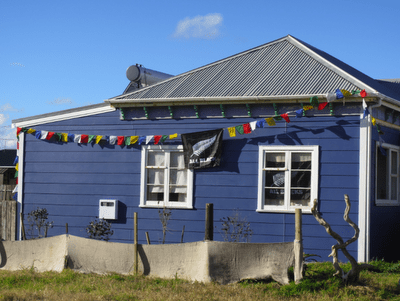
It can be a thermal curtain…
…a sarong…
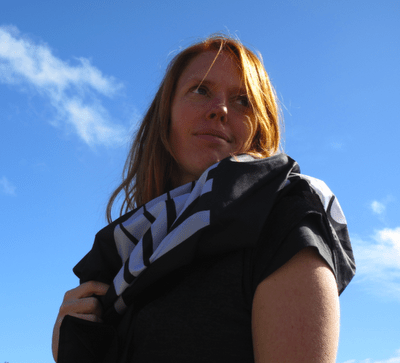
… a scarf…
… a doo-rag…
… a shower curtain…
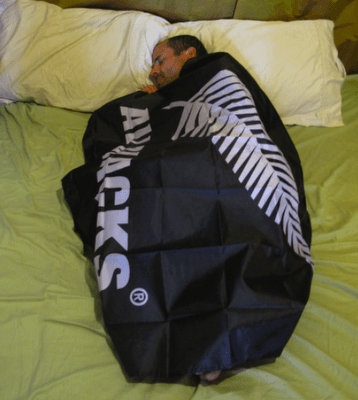
… a blanket…
… a surfboard cover…
… a cape…


… a grudge…


… or a prayer.


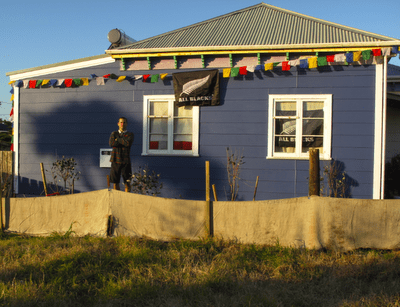
Go the All Blacks!
Peace, Estwing

The Failure of Environmental Education

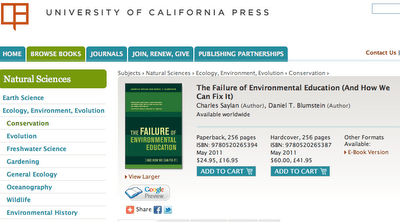
I ran across this book today. The title is what has haunted me for the last five years.
This is the publishers description available at: http://www.ucpress.edu/book.php?isbn=9780520265394
At a time when wild places everywhere are vanishing before our eyes, Charles Saylan and Daniel T. Blumstein offer this passionate indictment of environmental education—along with a new vision for the future. Writing for general readers and educators alike, Saylan and Blumstein boldly argue that education today has failed to reach its potential in fighting climate change, biodiversity loss, and environmental degradation. In this forward-looking book, they assess the current political climate, including the No Child Left Behind Act, a disaster for environmental education, and discuss how education can stimulate action—including decreasing consumption and demand, developing sustainable food and energy sources, and addressing poverty. Their multidisciplinary perspective encompasses such approaches as school gardens, using school buildings as teaching tools, and the greening of schoolyards. Arguing for a paradigm shift in the way we view education as a whole, The Failure of Environmental Education demonstrates how our education system can create new levels of awareness and work toward a sustainable future.
Interestingly, one of the main reasons the failure of EE has haunted me is that my teaching practice in a school included organic gardens, using school buildings as teaching tools, and efforts at greening the campus grounds. And it still failed. Now this may be down to my rubbish teaching skills. But I did get plenty of positive feedback from a diversity of sources and a number of teaching awards. And I do not mean to say that this is not where schools should be headed. I was lucky enough to work at one with excellent token environmental programmes that benefited a small minority of students tremendously. But there was no systemic change. So instead of settling for tokenism any longer I left teaching to become a student. My research is still along the lines of Saylan and Blumstein, but more looking at the barriers and opportunities to actually do what they are proposing. It is neither straightforward nor easy.
One of the recent barriers I’ve come up against – not in my PhD research per se, but in other EE efforts I’m involved with – is what I am calling the Ego-movement. I’ve been saddened and discouraged by the amount of damage that those within the eco-movement inflict on others in the movement. Don’t we get enough thrashing from the outside? Why do those within the eco-movement hold the movement back because of ego? It’s a cryin’ shame. No really, it does make me want to cry, and it is a shame on our movement.
I am an eco-designer. I design systems with the intention that they be adaptive, exploratory and symbiotic. The business model of the ECO School is synergy. In other words, we seek to enter into symbiotic relationships where both parties benefit and the resultant whole is greater than the sum of the individual parts.
• What I have learned while trying to implement this ecological vision for environmental education is that most people and organizations have little or no interest in working cooperatively.
• What I have learned by taking an exploratory (evolutionary) approach to building symbiotic relationships is that most people and organizations do not answer emails which express an interest in working cooperatively. From a large number of emails sent to Transition Town groups, permaculture groups, conservation groups, environment centres, etc., my response rate is well below 20%. I understand that people are busy, but if you put your email address on your website, I would suspect that you may expect to be contacted. I find it very sad that so many of those who place themselves in leadership positions in the eco-movement cannot bring themselves – at a minimum – to say, “Thanks for the inquiry. Sounds cool, but it does not suit our present needs.” In some cases where websites explicitly call for input, those in control fail to thank contributors or even acknowledge their input.
• What I have learned about email lists, Meet-up groups, and newsletters, is that many of them are not democratic. Many of the leaders of the eco-movement who control these networks for the dissemination of sustainability information do not share the power democratically. In my opinion, sustainability networks belong to the people, and they should decide what they want to learn about or not.
• What I have learned about answering all email enquiries I receive is that many people do not make an effort to thank me for my time and effort. From what I understand, everyone has their opinion on whether saying thank you on email is appropriate or not. Call me old fashioned, but when I know that someone has gone out of their way to provide information for me or to compliment me on something I’ve done, I write a thank you note. At very least, it builds good will in the eco-movement.
One final note which may come as a surprise to those outside of academia. Since I have become a PhD student I have sent about half a dozen emails to researchers in the fields of science, psychology, and education. And I have gotten a response from every single one. Some say that academics have big egos, but they do not appear to get in the way. And so the sadness is greater that in the eco-movement, ego does appear to get in the way.
While this does not relate specifically to my research, I am still very interested in learning why this unfortunate situation (the ego-movement) appears to be retarding advances in the eco-movement. If you have any ideas or insights, please post them in the comments section or email me at the ecoschool. I promise I’ll thank you.
Peace maker, Estwing
Science Rulz

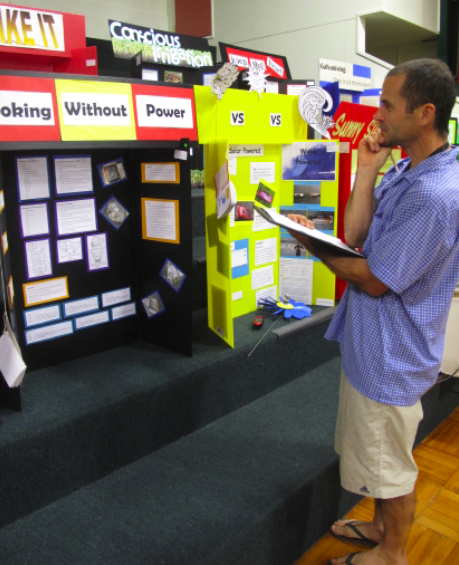
I was honoured to be asked recently to serve as a judge for the regional intermediate schools science fair.

Judge Jandal?
Back in May I posted about some innovative school programming we were doing, including a project at Wanganui Intermediate School called “The Science of Sustainability.” That project highlighted much of the ways we use science here on the Eco-Thrifty Renovation to heat our home and water, and to grow food organically. The idea was to make science relevant to students and also solution oriented. Thanks to the amazing teachers at WIS, there was an entire category at the science fair for environmental science projects.
These are just the finalists in the environmental category from
all the regional intermediate schools.
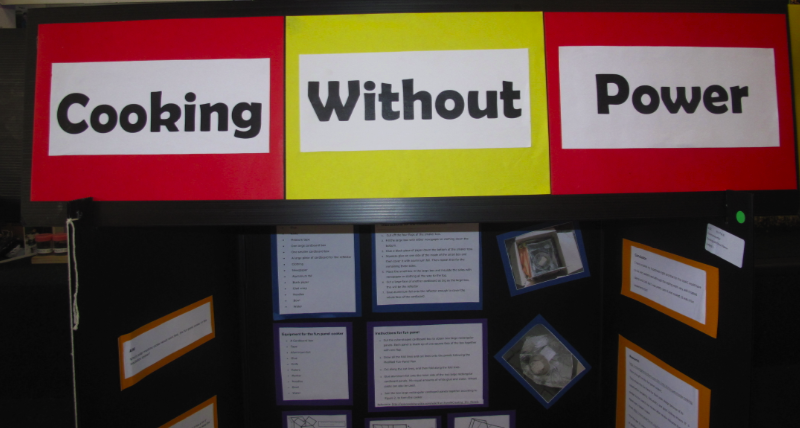
I judged 12 projects and they were all excellent. It was hard picking out three for awards. Here are some of the cool ideas the students came up with.


Good on ya, students! Prize giving tomorrow.
Peace, Estwing
The Third (!?!) Law of Thermodynamics

I’ve taken over editing the monthly River Exchange and Barter System (REBS) Newsletter from my wife because she gets busier by the week with work at the YMCA. It has given me the opportunity to think and write about ways of retaining wealth in our community. Below is the article I wrote for the September Newsletter.

Peace, Estwing
Energy is often defined as the ability to do work. In many ways, money – or wealth of any kind – is also the ability to do work. In other words, I can pay someone like Jonah to help me install my stove, or I can buy petrol to put in my car. A big difference between these two is that when I pay Jonah the wealth stays in the community, but when I buy petrol most of the wealth leaves the community. However, I can’t really pay Jonah to bring my wife home from work on a day she works later than the last bus. (Come to think of it, I probably could but she may not enjoy the ride in his bamboo bike trailer).

The point is, the work that energy or wealth can do is not 100% transferable back and forth. But sometimes it is. Going back to the example of the multi-fuel stove, the work that Jonah did will translate sometime in the future into energy savings in the form of reduced home heating costs.

Additionally, the wood that we will burn will likely come from the land cared for by Melinda and Murray. Therefore, any wealth transfer for home heating goes to these three “locals” and not to Meridian Energy in Christchurch (I believe).

And the same can be said for another form of energy delivered to Wanganui nearly every day for free: sunlight. Sunlight can heat homes quite effectively, and simple insulating and draft-proofing efforts can help hold the heat in overnight. These efforts may be labor intensive, but if the labor is local then the wealth stays in the community. Over time the homeowner makes up the upfront cost in energy savings. And then those savings can be reinvested in the community. For example, our electric bills are so low that we treated ourselves to an afternoon of local rugby. Go the Butcher’s Boys!

Paper

Was it coincidence that our application for New Zealand residency was due the week of our paper anniversary? I think not.


Aside from my masters thesis this was the largest document I’ve ever compiled in my life. Thank goodness this one didn’t need proper APA citation. It did however require documentation for nearly every job I’ve held over the past 10 years, as well as full medical checks, police checks, and proof of our relationship.

My gift for Nelson for our first anniversary wasn’t quite as heavy, but took even longer to prepare. Here it is waiting to be opened.

And fully unfurled in all its glory. A blessing for the home Nelson is building us. Made with paper from Trade Aid, adorned with paper cut outs very carefully done with an exacto-blade.

I can understand why paper represents the first anniversary. It is delicate, can be easily ruined, but also holds promise. Let’s just say there were many a tense moment working on the tiny cutouts. Our blessing, heavily inspired by one I saw in a friend’s home, begins with the following phrase:


All I can hope for is that in five, ten, and twenty years time, I feel as content in my life as I do this week. When I look around me, I find myself surrounded by beautiful things and beautiful people, largely as a result of the work that my husband has done to pave the road for opportunities to come our way (ok, and maybe I helped a bit too!)

And finally, I’ll leave you with one more shot from the night of our anniversary. We are untying the cord that was used for the handfasting during our wedding ceremony. Traditionally this was done one year and one day after the initial tying. We were either a day early, or right on target depending on how you look at it. Getting married in a different timezone can really confuse the whole year and a day component. Let’s hope accuracy isn’t too important.Couples are meant to untie the knot and then decide together whether they want to retie it, or break the bond. We untied the knot and spent a few minutes talking about what we had learned during our first year of marriage.
Then we retied that sucker. Oh yeah!


-June Cleverer