All posts by Estwing

Still the One

We have had an amazing run of mild weather this autumn and early winter. Even up through Matariki – the winter solstice (fewest hours of sunlight for the year) – we have not needed any supplemental (electric or otherwise) heating for hot water or our living space. This has allowed us to keep our electricity use around one kilowatt hour per day for the last eight months. Our last bill was remarkably low. We used only 23 kilowatt hours in 30 days.


$15.72 includes a 38 cents/day line charge.

But those “cheap as chips” power bills are likely to hibernate until September, as we face two cold months ahead, and most immediately cool, cloudy weather and rain for the next 10 days. But I thought I’d share some of the best approaches we’ve chosen to save energy and money. From big picture to detail, they include:

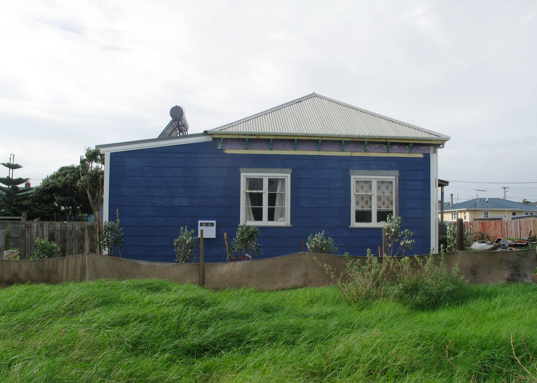
Passive solar design: Increased glazing on the north side (toward the equator) for free heating.

(Morning photo: Drapes are still closed.)

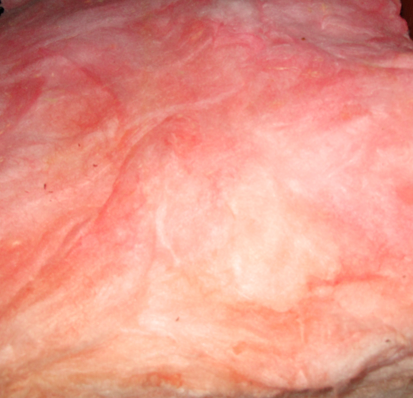
Insulation: Holds that heat in at night.

Fiberglass insulation has up to 80% recycled content and is affordable.

Thermal drapes and pelmets: This is another form of insulation that happens to open and close daily. Mindfulness makes these much cheaper than double-glazing if you are conscientious about opening and closing them at appropriate times.

Pelmet is an old weather board from the exterior. (Ripped to 150mm and inverted.) Will be painted white to look like a crown molding.

Solar hot water: Electric water heating is one of the biggest additions to a power bill.

One of the best investments I’ve ever made. Thanks Allen!

Under-the-bench-fridge: Our refrigerator sips power while many others gulp it.

Small is beautiful! Big enough if you keep yourself organized.

Compact flourescent light bulbs: This hardly needs to be said, but CFLs use 1/4 the power of incandescent bulbs for the same amount of lighting.

Old reliable. I’m looking at LEDs, but the quality has to go up and price down.

We use heaps of other strategies for saving power, but those will be highlighted another day. Which of these can you implement in your home? What other great energy saving strategies do you employ?

Oh, the sun just came out. Gotta go open the drapes… – Estwing

Update 1: The Exterior

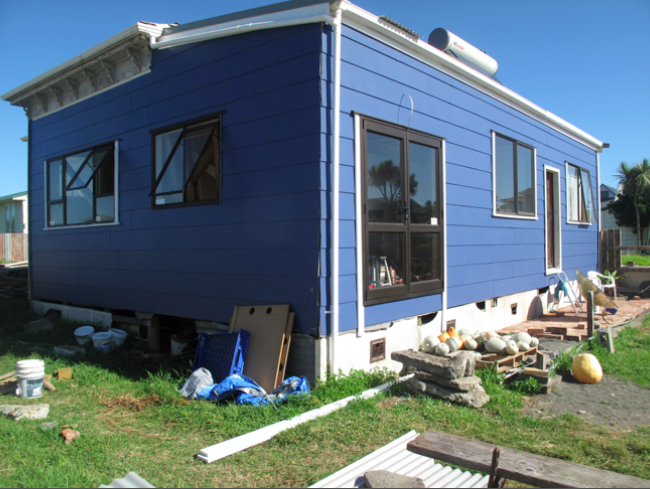
We are getting to a point in this project where a lot of the major work is done. Since October, we have knocked out walls and built new ones. We have re-wired, re-plumbed, and re-inhabited this 100 yr old abandoned house. Before we get onto the finishing details, I thought you might appreciate a look back at progress so far.

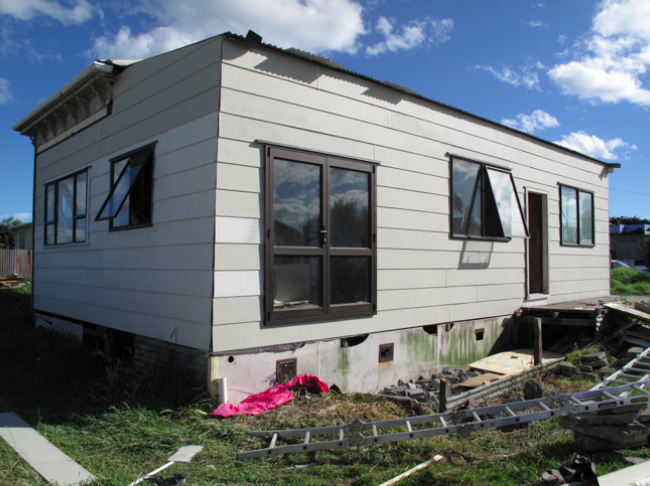
The first of these update posts will take a look at the exterior. From the beginning until now.

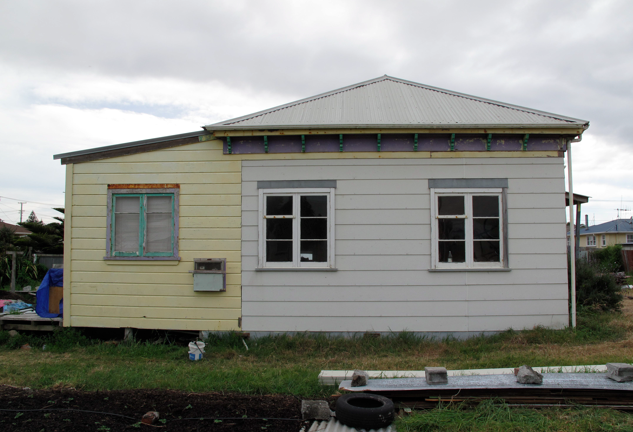
The back of the house:


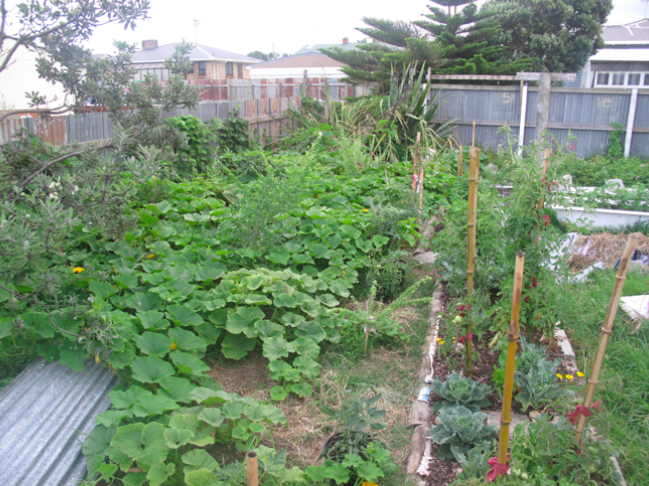
And the weed infested lawn turned garden:


If you think those are dramatic, wait until you see the inside!


-June Cleverer

Success Breeds Success

“Never doubt that a small group of thoughtful, committed citizens can change the world. Indeed, it is the only thing that ever has.”
-Margaret Mead

Google Analytics tells us that our readership has been increasing about 30% every month for the last 4 months. Beyond that, we’ve had great feedback from the school programmes we’ve developed and the YMCA Connecting Families Day resource recovery project. It appears that our network is now building through the blogroll on permaculture.geek.nz, and BioPak Australia’s newsletter and Facebook page. And finally, we are in the process of applying for funding to replicate the huge success at the YMCA event at other community events in Wanganui.

Latest view of our developing permaculture paradise.

It is not easy being green, but sometimes it feels awfully good.

Peace, Estwing
Compost Post

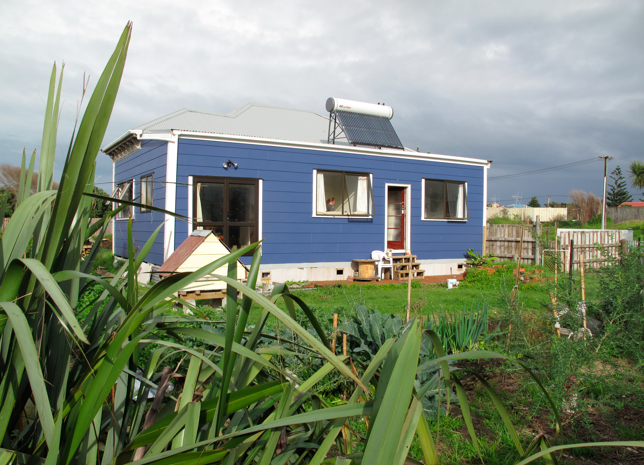
Following up on the post of 12th June (Perfection), here are more details on our methods of composting organic matter. You may recall that we diverted over 95% of materials from landfill at the Connecting Families Day run by YMCA Wanganui. Alongside paper recycling and drink bottles recycling, the bulk of material came in the form of compostable organic matter: napkins, sausages, bread, apple cores and paper cups.


In anticipation of this organic matter coming onto our land, I “feather a nest” by forming a large rectangular bowl with grass cut on a neighbor’s property and “donated” to us by the landscaper. Into this bowl I easily dumped the organic matter collected at the YMCA event.


Then I added half a coal bag of sheep manure we bartered for with a surfing friend. The nitrogen in the manure will balance the high carbon content of the paper cups and napkins.


Then I covered the lot by raking grass over it to prevent wind from blowing the cups around and to allow the compost to “cook.” By turning the pile once every 48 to 72 hours, it will hold temperatures between 50 to 60 degrees Celsius (122 – 140 F) and be completely decomposed in about a month.


Then we’ll have roughly a cubic meter of beautiful, healthy compost ready for our spring planting.

Peace, Estwing

So Happy Together

Imagine me and you, I do…

Warning. Mooshy romantic post ahead. Read at your own peril.

Due to a volcanic ash cloud covering a large band of the southern hemisphere, my return back from the USA to New Zealand was delayed for 4 1/2 days. While I did enjoy my time in Sydney, something was missing from my days.


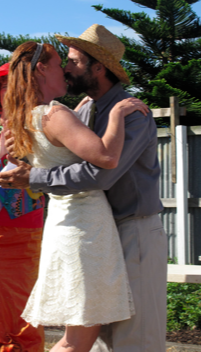
That’s my man. And while I was away having a month of vacation time with our family and friends, he was here. Working hard. Making our home prettier, comfier, and keeping the Eco School going. He is amazing. And I missed him.

Imagine how the world could be
So very fine
So happy together
Glad to be back in the en zed. Even more glad to be here with my honey. I look forward to getting back on the blog more regularly and updating you with our winter projects.


-June Cleverer

Add it up.

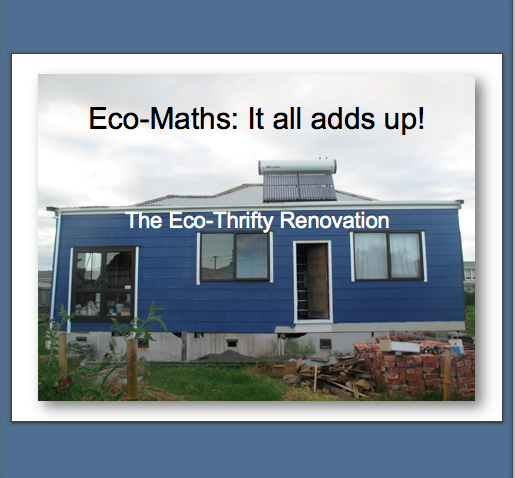
After excellent feedback on our first schools programme, The Science of Sustainability, we have developed a new programme we’re calling Eco-Maths. This will be delivered to primary and intermediate teachers in the form of a professional development session in about a month. Here is a preview:

Hey teachers…

Want to include sustainability in your lessons but don’t know how?

Want to engage students in real life application of maths?


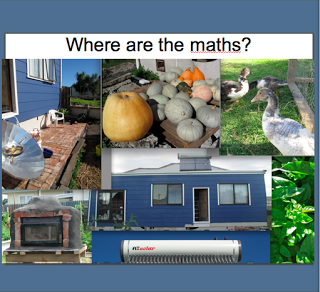
This is your chance. This training session uses eco-design and home renovation to teach mathematical concepts through saving energy and money.

Topics covered:

Area, Volume, Ratios, Percents, Units, Graphing, Rates, and More.


Date and Time: TBA

Location: TBA

Peace and Pythagorus, Estwing

The sad fact…

I’m sad because my beautiful wife has become stranded in Sydney on her way from New York to Wellington because of a Chilean volcano. She has been there for three days and it looks like at least one more. They stamped her passport “Indefinite.” (Yesterday she went to a wildlife park and hugged a Koala.) But I know this sadness will pass.
This sadness, however, is another story.
Before my wife became stranded in Oz, I used to spend my idle hours (between dissertation writing and eco-renovation) talking with her. But these days I fill those hours reading blogs. One of my favorite is James Howard Kunstler’s weekly contribution. Not only is the post a good read, but the comments section is equally insightful and entertaining. The image above is from the comments section quoting JHK, “The sad fact is we don’t want to go where history wants to take us: to a smaller human imprint on the planet, with all that implies.”
As an environmental educator for over 20 years, this sad fact is…a very sad fact. I for one, do want to go there, but I appear to be in the minority. The next comment in the thread reads: “Best, I think, to choose poverty before poverty chooses you.” Indeed, I have been living below the poverty level in the USA and NZ for over a decade – often below half the poverty level as measured by income and expenditure. And during that time I have lived a rich, full life in beautiful places with healthy food and friendly people. My lovely wife, god bless her, has agreed to live this way too.
And we have fun doing it!
But there is a big difference between voluntary poverty and involuntary poverty. For us it is a mindful endeavor where we are simultaneously saving money, saving resources, and reducing waste. It is win-win-win for us, our bank balance and the Earth. That is why it is so sad that most people refuse to voluntarily shrink their ecological footprint. And now, from what I can observe, it is being forced on many of them by: high energy prices, high food prices, high personal debt, high municipal debt, high national debt, austerity measures, unemployment, population growth, etc.
I read a great blog yesterday talking about how the “Baby Boomers” lived far beyond their means during the real estate bubble (house = ATM) and are now having to postpone retirement because of the fall in house prices and the stock market crash (not to mention, gulp, the coming under-funded pension disaster). Forgive me, but I have no sympathy.
Living beyond your means = Destroying the planet on credit
To me, this is another sad fact. 😦
Peace and poverty! Estwing

Perfection

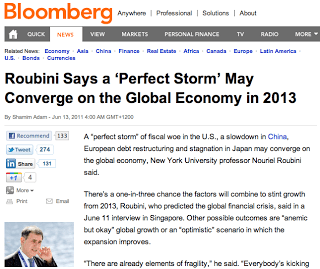
I appears that many global forces of unsustainability have been swirling of late. The synergy with which these forces interact, and the non-linear effects make predictions near impossible. Most economists and politicians appear to be in utter denial of anything other than a return to “growth” and “business as usual.” (I’d say that is the one place we are not headed.) But one economist in particular seems to be able to recognize potential problems better than others.
You may recall that Roubini was the one who accurately predicted the financial crisis of 2008. Are you going to believe him, or someone like Greenspan or Bernanke or Geitner who had no clue?
While the right mixture of forces can, indeed, make storms perfect, the right combination of design, communication and education can make solutions perfect. For example, this weekend the ECO School helped the YMCA manage the waste stream for the Connecting Families Day.
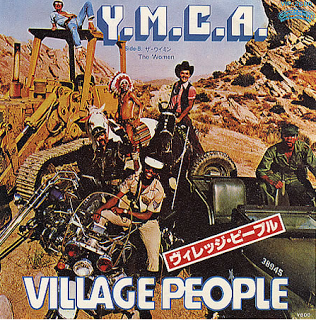
No, not that YMCA, this YMCA.
With over 20 years of experience in award-winning resource recovery programs, we felt confident about working with the Y with the goal of a zero waste event. I’ll write more about the mechanical details in another post, but the guiding principles for success when managing events such as this are:
1) Plan ahead. Sometimes called “pre-cycling,” this means thinking about the entire waste stream of the event and planning accordingly. For example, we ordered compostable cups for both hot and cold drinks. Zero waste.
2) Design. (“Failure to design is to design to fail.”) The physical lay out of collection containers is important. They must be clustered together. For example, we had bins for compost, paper recycling, drinks bottles recycling, and miscelaneous rubbish all together at one station.
3) Communication. This comes in a couple of forms. A) Signage must be brief, clear, colorful and at eye-level for both children and adults. B) Announcements can be used to remind attendees that this is a zero waste event and their efforts are crucial for success.
4) Education. Including the why and how of resource recovery is important to give people reason to act. Our education effort took two forms this weekend. A) I manned the resource recovery station to interact with people and monitor quality control. B) Our friend, Hadi, provided home composting advice at the Sustainable Whanganui table.

5) Quality control. Essential, essential, essential. No one wants to pick through dirty bins afterwards. Make sure everything goes in its proper place during the event. As mentioned above, quality control can and should go hand-in-hand with education.
By employing the above strategy, we were able to divert over 95% of the waste stream from landfill while role modeling positive behaviours to families. Those are world-class results. Not bad for weekend work.
More details on our composting process in a later post.
Peace, Estwing

E.T.R. @ 100

Through much hard work and dedication, we have reached our 100th post. We have tried to keep our posts informative, educational, motivating, humorous and well-illustrated. You may or may not agree. This represents hundreds of hours of unpaid work thinking about appropriate topics, taking photos, writing and making videos. As permaculturists we feel an obligation to share our experiences/knowledge with others at low/no cost. The web is just one way to do that.
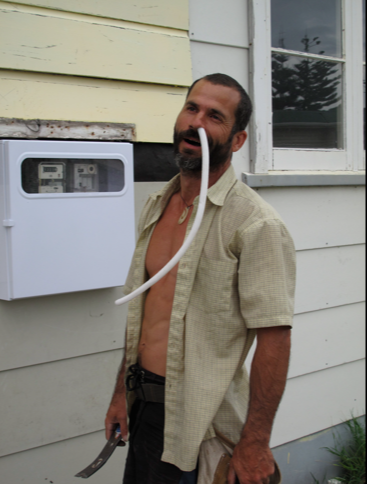
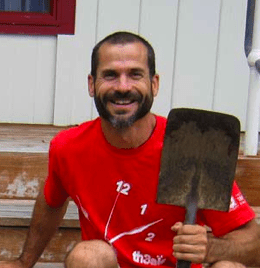
But who the heck are we anyway? Some of you know us well, but others may not. I thought that an update on we, The ECO School, might be appropriate from time to time. (Plus, I had to write a bio for a research symposium I’m going to in Australia next month, and I thought I would let it perform multiple functions for me.) So this is me at the moment. I’ll let ‘the boss’ post herself next.
You may think of me as a designer/builder/dumpster-diver/organic grower, but in fact, I am a Environmental Education/Education for Sustainability researcher. This is my bio for the Oz symposium:
Nelson Lebo, PhD Candidate, University of Waikato, Hamilton, New Zealand.

Although I have been in the field of EE/EfS for 25 years, I am new to the field of EE/EfS research. I can still recall sitting in a lecture theatre in 1986 while a professor covered the problems of the world from deforestation to ozone depletion and everything in between. That course gave a new direction to my life (other than sport) that I have been following ever since. Over the last two decades I have been a secondary school environmental and science teacher, a wilderness trip leader, an organic farmer, and green builder. In 2008 I decided to combine these experiences into PhD research that draws on them all. The challenges my research seeks to address are the high rate of attrition in science classes beyond the compulsory years, and the low uptake of EfS in high schools. As a result, both the scientific literacy and ecological literacy of many post-secondary learners is sub-optimal. While a whole school approach is recommended and appears appropriate for many primary schools, at present it does not appear to be viable for most secondary schools. The approach I’ve developed to engage students in science while incorporating high quality EfS into a Year 10 science classroom in New Zealand is to set the science learning within the context of environmental problem-solving and ecological design through the use of local permaculture projects. Transformative learning theory, systems thinking, social constructivism, and experiential learning play key roles in this research.

Peace, Estwing

Alternatives to wheat and potatoes?

Not to harp on this climate change thing too much, but it just does not seem to go away. Of course along with the extreme weather events predicted by climate scientists are equally dire warnings of drought. That seem to be widespread at the moment.
Well, 2011 seems to be shaping up as a poster child for climate change. Combine the extreme weather with the ongoing global financial crisis and elevated yet still volatile oil prices and you have what some call the “Toxic Trilogy”; Environment, Economy, Energy. Each of these systems is highly unsustainable at the moment with little indication of change in the near term. As permaculturists, we design to protect ourselves from these powerful outside factors beyond our control.
We have written extensively on energy savings on this blog and warned about the dangers of debt and how to hedge against energy inflation. But we have not written much about hedging against food inflation, which goes hand in hand with energy inflation and is made worse by weather extremes such a drought and floods. Of course we have a large and growing vegetable garden and burgeoning food forest, but what about starch? Like most people of European descent, we eat too much bread and pasta. As indicated in the story above, the price of wheat is near record levels with no indication of coming down. My long time strategy has been to grow potatoes as a staple crop, but here in NZ we are having trouble with an aphid that is compromising all nightshades. Both our potato and tomato crops this year were poor. So last week I planted Jerusalem artichoke.


And in the spring we’ll plant kumara.
Any other suggestions?
Peace, Estwing