Category Archives: Eco Thrifty Renovation

Adult Learning for Sustainability and Resilience

Dani, Verti and I have been in North America visiting family. We flew over primarily to celebrate my parents’ 50th wedding anniversary, but in the week before the big day we were able to briefly stop in to my old farm, named Trollbakken by a previous owner. Although the farm has been in the hands of a Springboks supporter for the last five years (a South African immigrant to the U.S.) it has remained in relatively good nick.
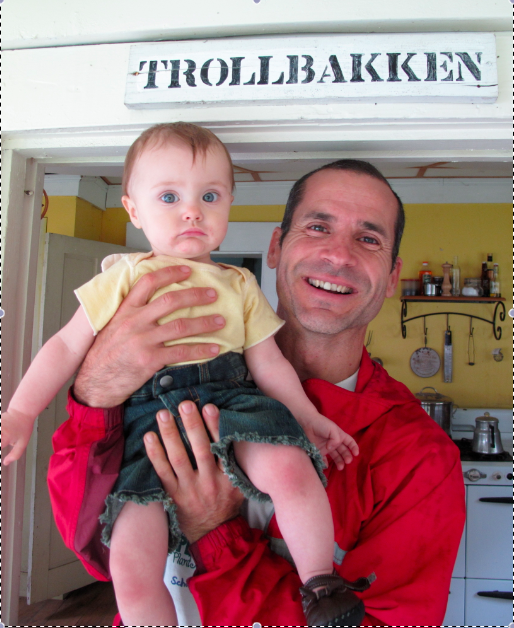
Verti has curbed her enthusiasm. 

The sights, sounds and smells of the place reminded me of the days, weeks, months and years I spent building soil fertility, growing organic veges, and renovating the farmhouse. When I bought the farm in 2000, I had no formal training in agriculture or building. I had been an environmental studies teacher for the previous ten years, and so I knew about crop rotation and solar energy on a textbook level, but had never done them.
The next eight years could be described as learning-by-doing. Although I acquired a large collection of books on organics and eco-building, the real learning took place through trial and error. There is no substitute for experience.
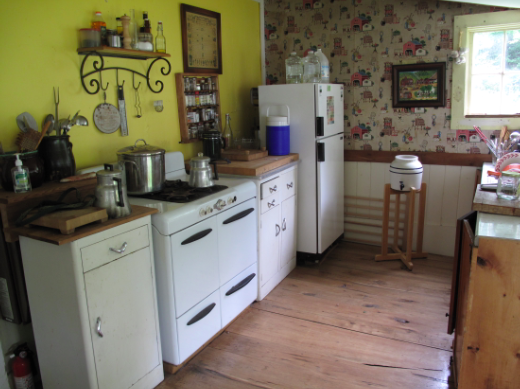
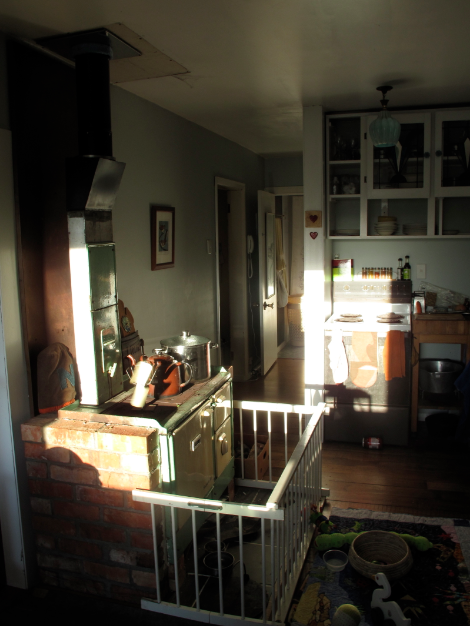
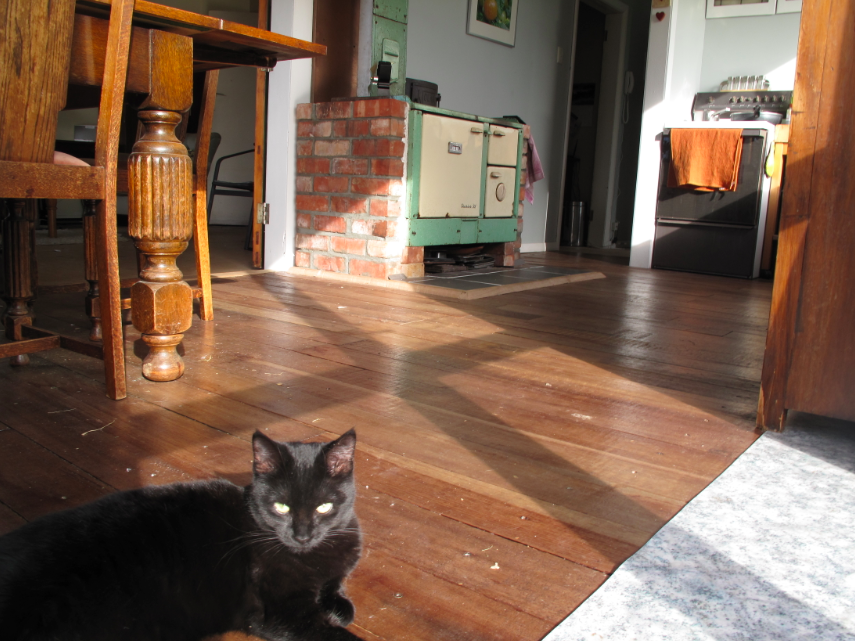
The kitchen at Trollbakken mixes the new with the old (see below). 
A number of unique features of the farm made for an unusual learning experience. First, it was the last property on a dead end road, a kilometre beyond the nearest neighbour. It was quiet, and days could pass without my seeing anyone.
Second, the house was wired for low voltage DC electricity powered by two small solar panels. Aside from a chainsaw, I rarely used power tools for building and renovation.
Third, I chose to manage my market gardens entirely by hand. Aside from transporting hay and compost in the back of a ute, I grew all of my veges without fossil fuels.
New white walnut (butternut) floor milled from a tree on the farm.  
To some readers this may seem like a Siberian work camp, but to me it was a postgraduate education in eco-thrifty design/build. Similar to the PhD I just completed through the University of Waikato, my ‘studies’ at Trollbakken required independence, determination and self-discipline. As I have come to understand, these are some of the key characteristics of adult learners.
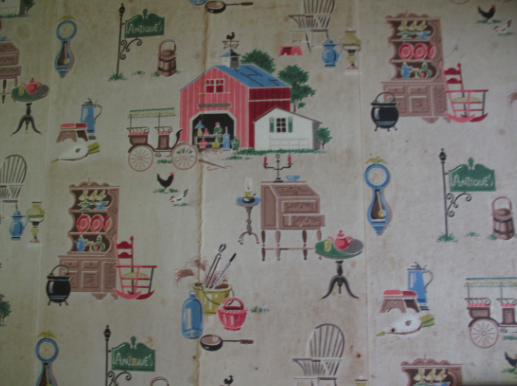
Some vintage wallpaper was preserved during the kitchen renovation. 
When we are no longer in compulsory schooling, it is up to us to get off our bums and take ownership for our learning. I would argue that this is the best type of learning because adult learners usually undertake education – be it informal or formal – that is relevant and meaningful to their lives. This could include job training and career advancement programmes, or, as I’ve been involved with, sustainability workshops based on saving power and money while protecting the environment.
Any adult that lives in a home, pays a power bill, or eats vegetables may see some relevance in one or more of these upcoming free and low-cost presentations scheduled to mark Adult Learners’ Week/He Tangata Mātauranga, 2nd – 8thSeptember. The programme is a partnership between the ECO School, Adult and Community Education Aotearoato, and Community Education Service Wanganui.
Monday, 2nd September – Warm, Dry, Healthy Homes
5:30-6:30 pm. Gonville Café Library, Abbot St. – Free
Tuesday, 3rd September – Understanding Your Power Bill
5:30-6:30 pm. Gonville Café Library, Abbot St. – Free
Wednesday, 4th September – Organic Vege Gardening
5:30-6:30 pm. 10 Arawa Place, Castlecliff – Koha
Thursday, 5th September – Ask a Solar Question
7-9 pm. $20. Registration essential. Ring CES – 345 4717
Friday, 6th September – Composting
5:30-6:30 pm. 10 Arawa Place, Castlecliff – Koha
Saturday, 7th September – Fruit Tree Care: TBD (Ring 344 5013) – Free
Sunday, 8th September – Eco-Literacy Day.
3-5 pm. 10 Arawa Place, Castlecliff – Koha

Insulation and Thermal Bridging

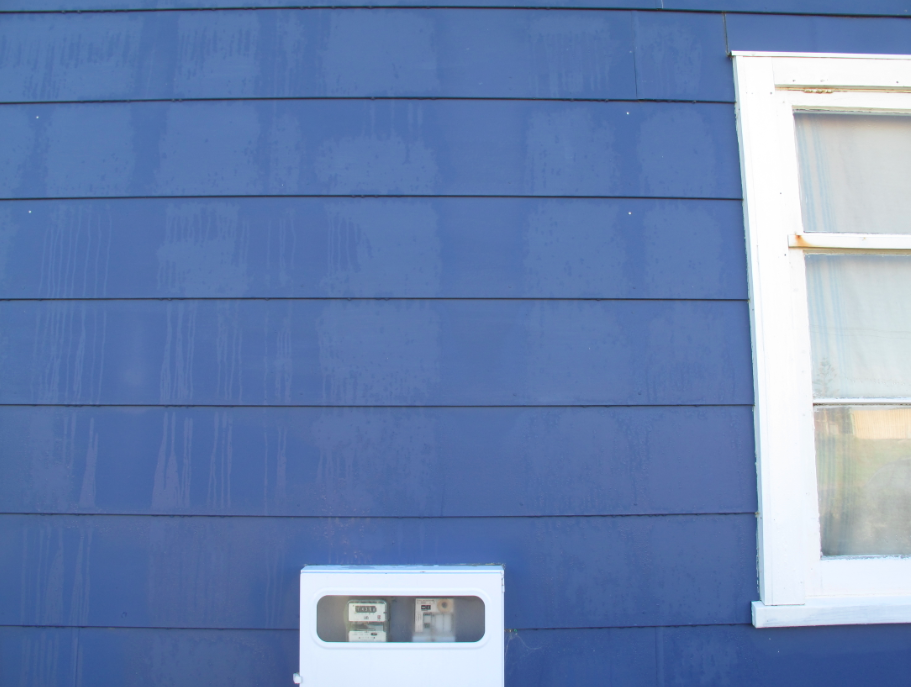
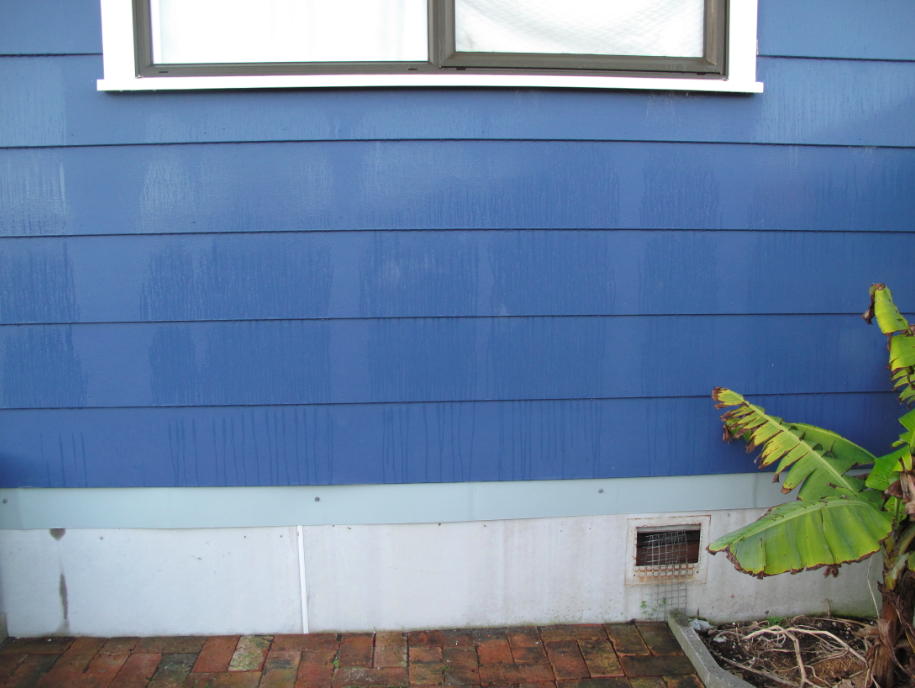
Look closely at this picture. Do you know what caused the ‘stripes’? 
The building trade is full of exciting experiences such as watching paint dry, reading the Building Code, and talking about insulation. Flash new bathrooms and kitchens are much more exciting to consider when planning a renovation, but the choice to add insulation could serve you after the latest trends in cooking and bathing areas have passed. Fashions come and go, but human comfort is constant.
For most of the last half century, New Zealanders have looked at renovation as a way to improve the look of their homes rather than to enhance energy performance. While that perspective is slowly changing, there has been a renewed push for warmer, dryer homes from various health agencies. When compared against the costs of health care and lost productivity, the price of insulation is often considered low. This is why Sharon Duff at the WRPHO is doing great work acquiring funds for insulating ceilings and floors across our region.
Yet in many Kiwi’s minds, it’s still hard to justify spending part of a renovation budget on something stuffed in walls and ceilings that is rarely, if ever, seen. That notion of invisibility, however, is only skin deep. Let me explain.
Take our insulated walls. Well, please don’t actually take them, we’re using them at the moment. I’ll rephrase that: Take a look at the picture of one of our insulated walls. Notice anything that slightly resembles a wonky gridiron field?
Dry areas are where the studs are. 
If I have done my job as an amateur photographer, you’ll see a series of alternating vertical wet and dry ‘stripes’. No, the photo is not altered, nor did I take a rag to the wall. The pattern is the result of a phenomenon called “thermal bridging.” Where the wall is dry, heat from our home is conducting through the timber studs, and where the wall is wet, insulation between the studs has slowed the flow of heat. The studs act as “bridges” because they convey heat across the wall faster than the insulation. What seemed invisible becomes visible on a cool, winter morning.
Thermal bridging also occurs when insulation is placed between ceiling joists, as is normally done. As an alternative, we installed our ceiling batts across (perpendicular to) the joists. We also chose a thicker batt (higher R-value) than required by code. The combination of a thicker batt installed across the joists has resulted in a high performance ceiling at little additional cost.
Rafter to rafter insulation prevents thermal bridging. 
This strategy runs to the core of eco-thrifty design thinking: spend a little and save a lot. Regular readers of this column will know I emphasize the concept of payback period: the amount of time it takes energy savings to pay for the additional installation costs. We embrace payback periods of one to ten years, which represent 7% to 100% annual return. What bank is offering those terms at the moment?
Our money is, quite literally, earning us more stuffed in the walls and ceiling than in any bank in the country.
Want to learn more?
• Warm, Dry, Healthy Homes. Monday, 2nd September, 5:30-6:30 pm. Gonville Café Library, Abbot St. Wanganui. Free
• Understanding Your Power Bill. Tuesday, 3rd September, 5:30-6:30 pm. Gonville Café Library, Abbot St. Wanganui. Free
• Ask a Solar Question. Thursday, 5th September, 7-9 pm. Quaker Meeting House. 256 Wicksteed St. Wanganui. $20. Registration essential. Ring CES – 345 4717

ETR @ 300

We are celebrating 300 blog posts with photos of some of our helpers over the last three years.

Our first intern, John. 

Our second intern, Amy.  

Graham the sparky. 

La Bandita 

Manuel Labour 

Tommy the third intern

Ji Qiao, the fourth intern  

Renovation interrupted by a home birth.  

Midwives, Syd and Jemma 

Verti does our online banking 

Cousins Molly and Jessea help out 

Xander, our fifth intern. 

Thanks for all the help.

Peace, Estwing

Thermal Mass and Multiple Functions

The concept of multi-tasking is familiar to most of us, but the concept of multiple functions less so, although we encounter many examples of it every day. For instance, with a modern mobile phone you can: ring your mate, text your partner, take a photo, tell the time, store your friends’ contact details, light up a dark night, and in some cases check your email or tweet. There are probably another 326 functions that I cannot figure out because I’m over 40.
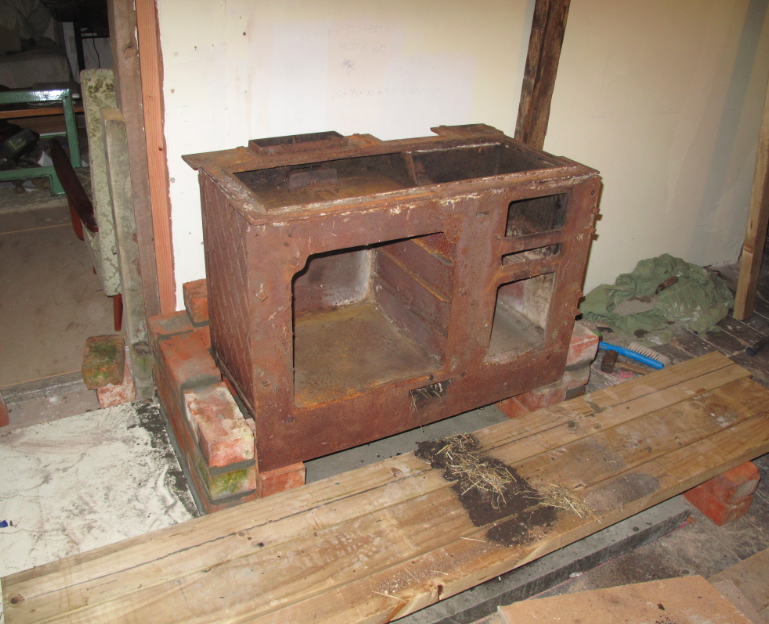
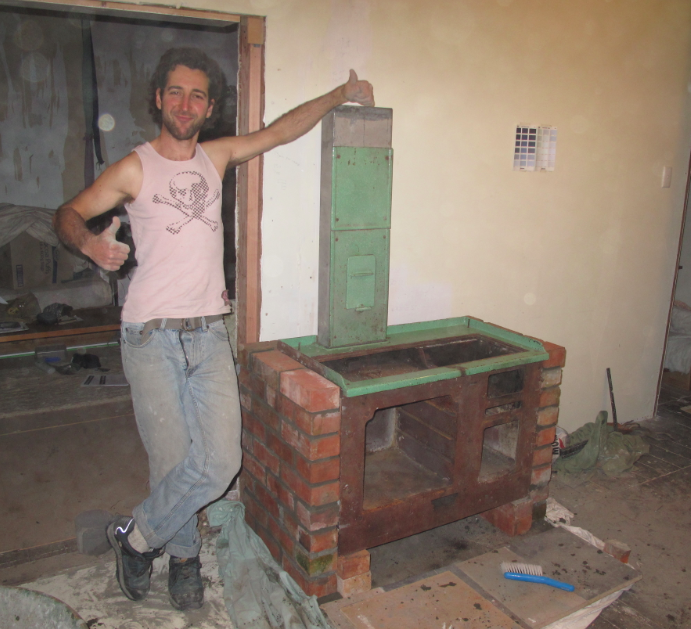
Eco-thrifty design embraces the concept of multiple functions. A prime example involves the vintage Shacklock 501 multi-fuel cooker we installed during our renovation. The most obvious functions it serves are cooking and heating, but these only scratch the surface. (We did not hook up the wetback because we have so much solar hot water already.)

A naked Shacklock. 

 Jonah the Magnificent. 
More significantly, the Shacklock plays a key role in our passive solar home, which could be easily overlooked by those not familiar with eco-design. That role is ‘thermal mass’, or something very heavy (mass) that absorbs and releases heat (thermal).
Traditionally, thermal mass has been the neglected member of the passive solar trio: solar gain, thermal mass, and insulation. The term ‘passive’ indicates that the design harnesses solar energy effortlessly. (Active solar is another story.) Like a car parked on a sunny day, a passive solar home absorbs the sun’s energy by being in the right place at the right time. But a car on a sunny day gets too hot during the day and then cold at night. This was the case with many solar structures built in the late 1960s and early 1970s – too much glazing and not enough mass and insulation.
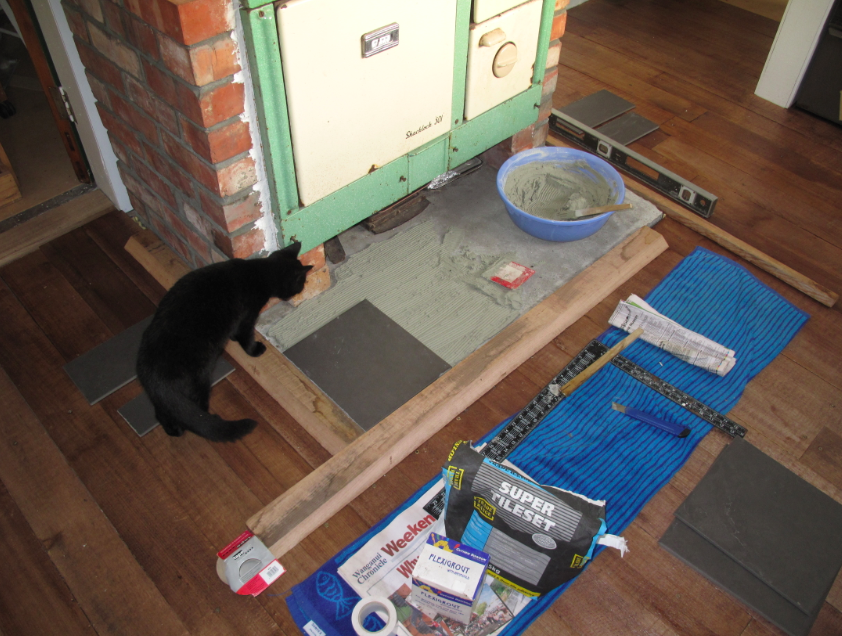
 Tiling the 70 mm thick concrete hearth.
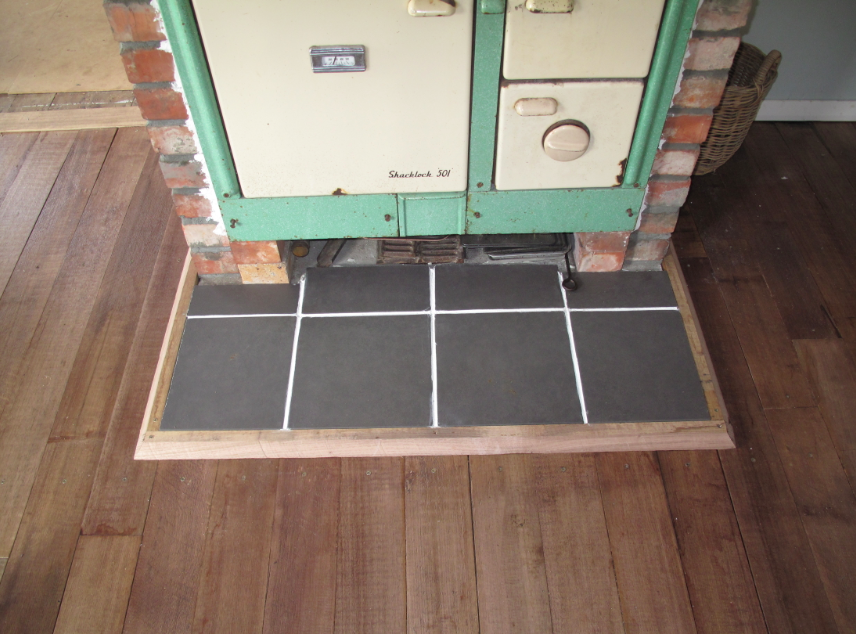
Tiled hearth with beveled oak frame to match the oak floor.
Similarly, in late July I was invited by a homeowner to look at a TV room that had been added to an older home. The addition was recent, but before the present family bought the property. At 2 pm on that sunny winter afternoon the temperature was 27 degrees C. But she also complained of the room being uncomfortably cold at night.
This is a classic case of poor design I see over and over in Wanganui. It represents a lost opportunity, and detracts from the comfort and health of the human beings occupying the space. Not eco and not thrifty.
My suggestion for the volatile TV room was this: cut out the middle 2/3 of the timber floor and replace it with an insulated concrete slab. This would decrease the high daytime temperature and increase the low nighttime temperature. Problems solved.
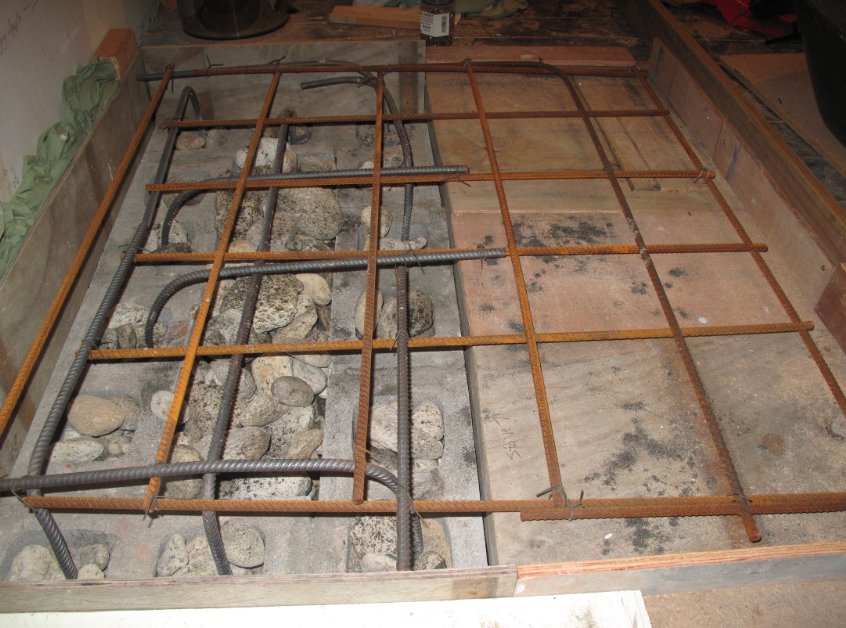
We insulated our stove foundation with pumice.  
Due to expense, it is unlikely the family will take this advice. Sadly, it is equally unlikely that the architect or builder considered passive solar design ten or so years ago when the addition was built.
Morning winter sun enters through a northeast window. 
For the passive solar renovation of our old villa, we didn’t need an insulated slab because of the strategic placement of our Shacklock 501. The 700 kilogram beast is centrally located between our kitchen, dining room and lounge, and receives direct winter sunlight three times a day: morning, midday, and afternoon. 
Midday winter sun enters through French doors.
The range, brick and hearth absorb the sun’s heat during the day and release it at night. The process is passive because it simply does it. There are no moving parts. As mentioned earlier, it would be overlooked as a ‘massive element’ in our design by the casual observer because it simply looks like an old coal range. It is that, but so much more. Other functions served by the Shacklock are: focal point of the kitchen, conversation piece, and, most notably, wedding present from me to my wife. BTW, Happy Anniversary, Dani.
Learn more: “Ask a Solar Question”
Thursday, 5th September, 7-9 pm.
Quaker Meeting House, 256 Wicksteed St.
Registration essential. Ring CES – 345 4717

Dealing to Damp

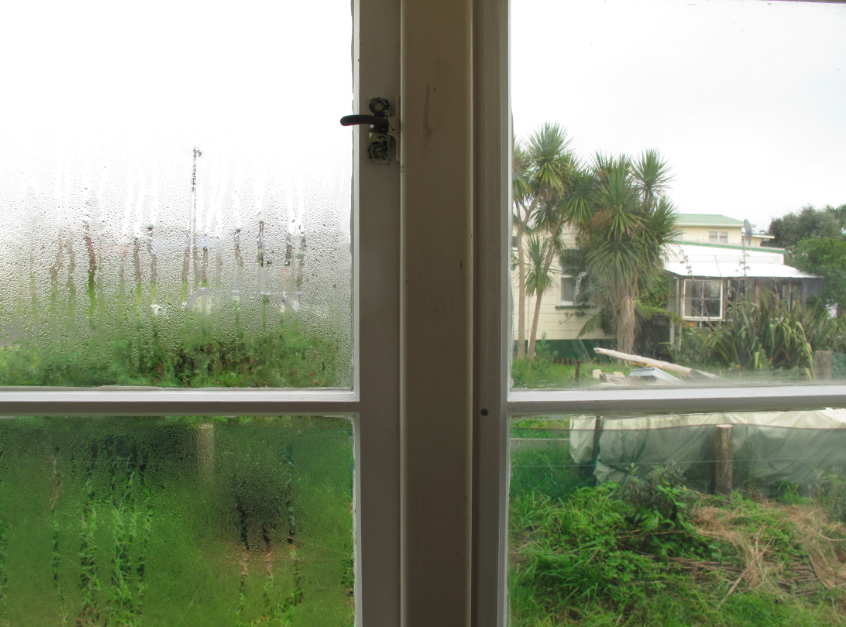
Moisture has never been a problem in our home…until last week. We had three loads of washing on the line as the sun set and the rain began. We brought it all inside and discovered the next morning why it is recommended never to dry laundry indoors. On that morning we had more than twice as much water on our windows than I’ve ever seen before.
Any amount of moisture in a home will seek the coldest surface on which to condense. Let the science lesson commence!
Dew point is the temperature at which di-hydrogen oxide (water) turns from vapor to liquid. The good news is that this process releases energy. The bad news is that it makes your windows wet.
In most homes, a single-paned window on a long winter’s night is the coldest surface. It is colder than, for example, a wall, a ceiling, a floor, a cat, or your forehead, but not colder than a bottle of beer fresh from the fridge. Yeah, right.

No actually, I’m serious. A cold bottle of beer “sweats” because the warm, moist air around it condenses (dew point reached) on the cold exterior glass surface. Ever notice that once you’ve consumed the top half of beer that only the bottom half of the bottle continues to sweat? If not, tell your spouse you urgently need to conduct a scientific experiment. Find a friend and peer review your results. (Hurray for science!)
Dew point depends on two components: humidity and temperature. In our home, the humidity is usually so low that no matter the temperature of our single-glazed windows, we won’t get much condensation. You can’t get blood from a stone and you can’t get weeping windows from low relative humidity.
High humidity in a cold home is bad for human health. Additionally, our bodies feel more comfortable at low humidity than high humidity at any given temperature. So naturally, the aim is to reduce the total amount of indoor water vapor. There are a handful of ways that moist air can enter a home: showering, cooking, breathing, airing laundry, houseplants, and rising damp.
Most of us will agree that we won’t cut back on breathing, but we can avoid drying washing indoors. There are also ways to cut down on moisture while cooking and showering, which I’ll describe another day. I rarely ponder houseplants because we have none, but if you do, just be aware that they, too, “breath” out water. Preventing rising damp, however, can be inexpensive and highly effective for certain homes in certain suburbs.
Because Whanganui has a variety of soil types, some areas suffer more from rising damp than others. For example, we are on sand in Castlecliff and experience no rising damp. On the other hand, we have a number of friends on Durie Hill clay that used to complain about cold, damp homes. I used the past tense in that last sentence because all three of those families have installed polythene on the ground below their homes.
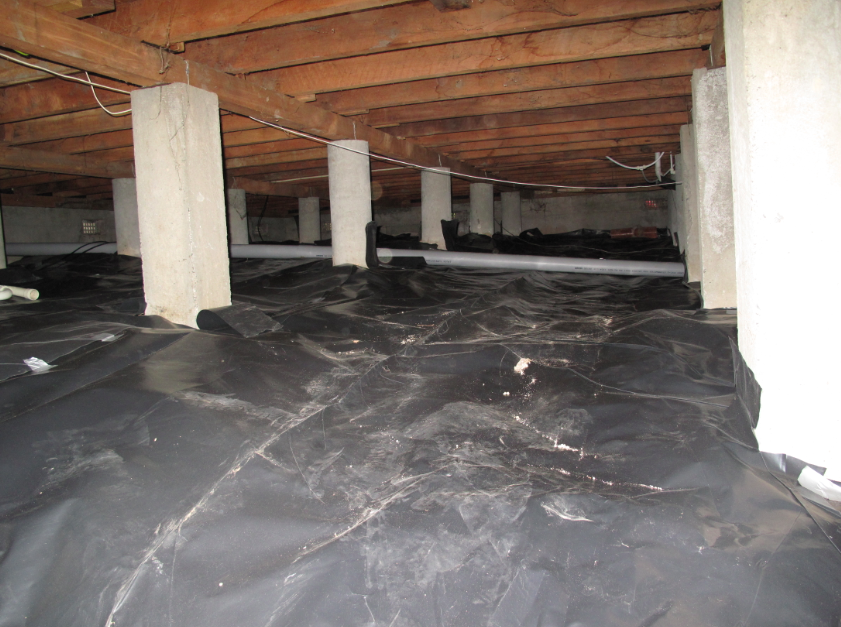
If properly installed, polythene can make a major difference in the “feel” of a home because of reduced relative humidity. It acts as a physical barrier to water vapor that wants to arise from the earth like an army of zombies waking from their graves to wander about your home causing mild discomfort, if not chaos and disarray. As seen in the photograph, proper installation includes: 1) cutting the polythene around the piles; and, 2) taping the seams.
At about $1 per square metre, polythene is one of the cheapest and most effective investments householders can make if they know their home suffers from rising damp. Ours doesn’t but yours might.

Processing Our Chooks

Our four hens have grown old and their egg production has dropped off. We have not seen an egg for 6 weeks and it is likely to be another four to six weeks before they start up meager laying with the spring. Instead of feeding them through the winter, we decided to eat them and then buy layers in the spring. Here is a brief description of our process.

* Please note there are some photos that show the humane killing and processing of chickens.

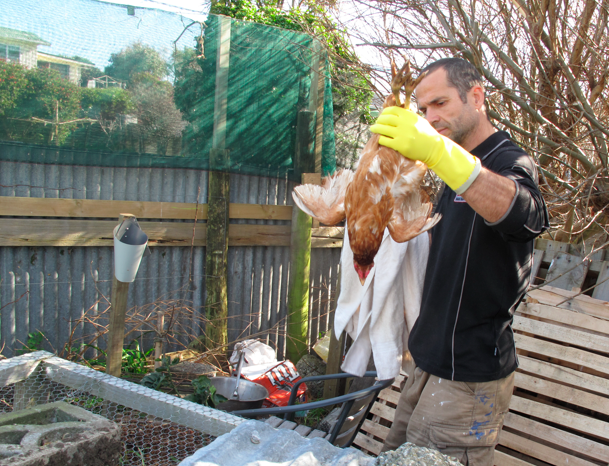
First, I like to carry chickens by their feet. I’m told when the blood rushes to their heads that they calm down. I have found this mostly to be the case.

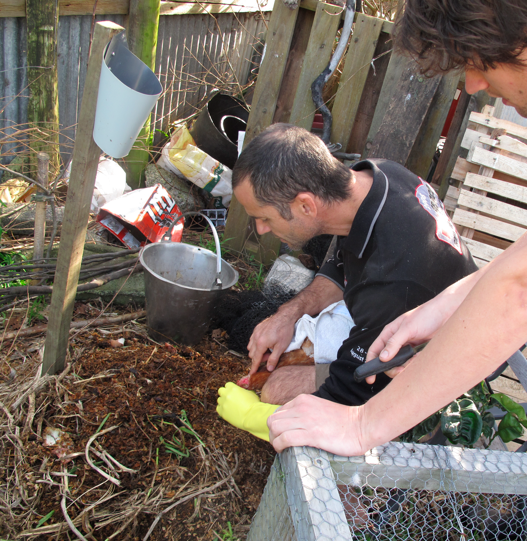
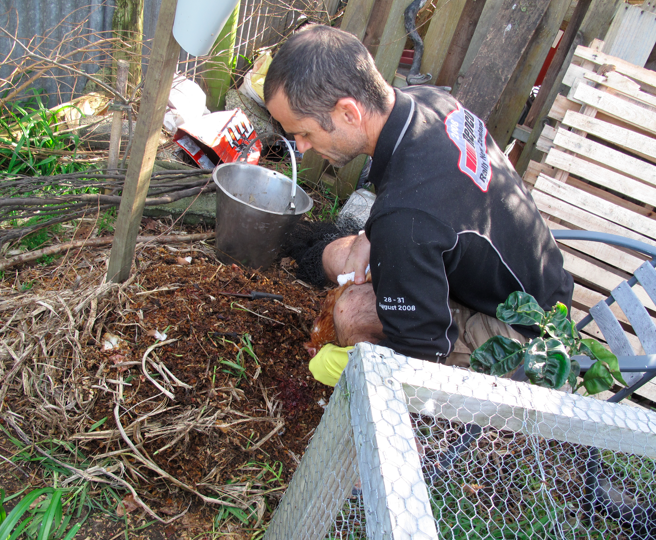
I made a killing cone and mounted it over our compost pile, but then we discovered a youtube video of a woman slitting a chicken’s throat without a cone, but just squeezing it gently between her knees. We decided to go with this option. In the video, she gently massaged the neck where she would make the cut. She also held the beak and head in an overhand grip, as you can see below. My index finger was on her beak a little like the trigger of a gun, and my thumb firm but gently head the back of her head so she would not squirm at all.

I pulled just enough tension on her neck to keep it straight, and so that she would not wriggle.

I’m not sure how the muscovies felt about witnessing this event, but they happened to be next to the compost pile at the time.

It took only about a minute for the blood to drain from the neck.

We don’t have pictures of the plucking, but here is where we did it. We dunked the birds in hot water and then hung them up to be plucked.

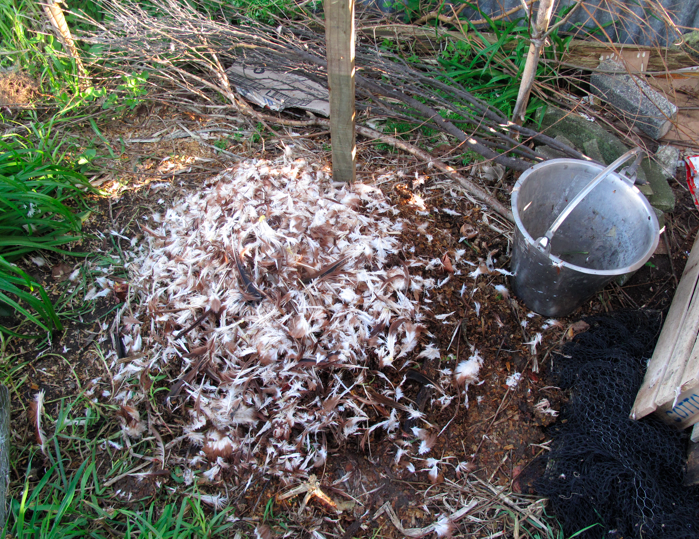
We collected the feathers to put into the compost.

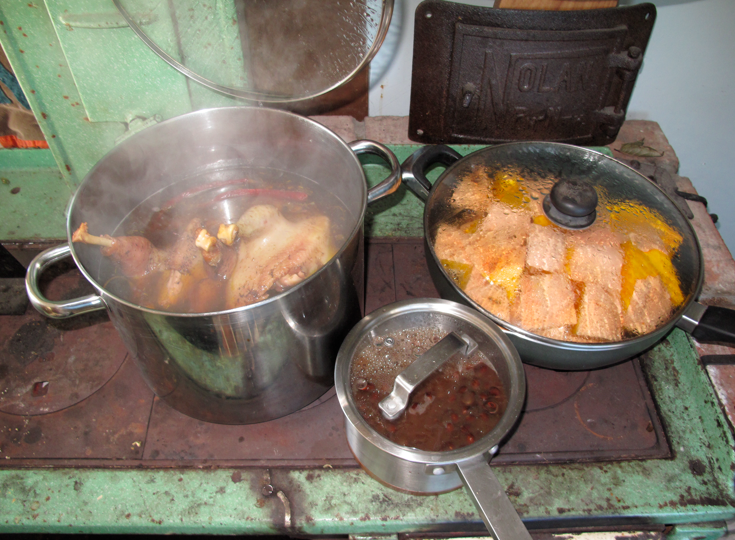
Jessea gutted the birds and then we put them in a pot with homemade veggie stock for a long boil. You can also see our homegrown pumpkins and homegrown blackbeans cooking.

The whole process took about two hours – faster than I would have expected. Mind you, we had three people working together on 4 chooks.

The entire process was very calm. There were no freaked out, clucking chooks or people. I think the mindful processing of these birds is about as good as it gets.

Peace, Estwing

Passive Solar Renovation

The other day we were driving home at about 5:30 – just after sunset – and could barely make out plumes of wood smoke exiting cowls on Heads Road and Cornfoot Street. The day had been sunny, but cool, as would be expected in July. Our curtains were still open, so we hurried along while remaining under 50 km/hr.
We parked, grabbed the bubs and groceries, and walked inside. Upon entering our old villa on Arawa Place, we were pleased to feel the warmth gifted us by the sun. The thermometer in the kitchen read 23 degrees Celsius.
By now, my wife is tired of hearing me say, “Wow, it’s so warm in here. I can’t believe all those houses had wood burners going.”
I chalk the difference up to legacy and sunlight.
 Before

 After
Unfortunately, Whanganui has been left with a legacy of thousands of homes built with seemingly no regard to the sun or even thermal comfort for that matter. Many of the dwellings I’ve audited during the last three months through Project HEAT share these characteristics: cold in winter and hot in summer.
Our home would have been the same before its passive solar renovation. As a matter of fact, we met a woman shortly after we bought the villa who told us, “I’ve been in that house before. I babysat there once. That’s the coldest house in New Zealand.”
While no longer the coldest home in the country, it is still far from the warmest. But on a sunny winter day, we find ourselves toasty warm inside long after dark, and with plenty of solar heated water – all free energy with no daily line charge!
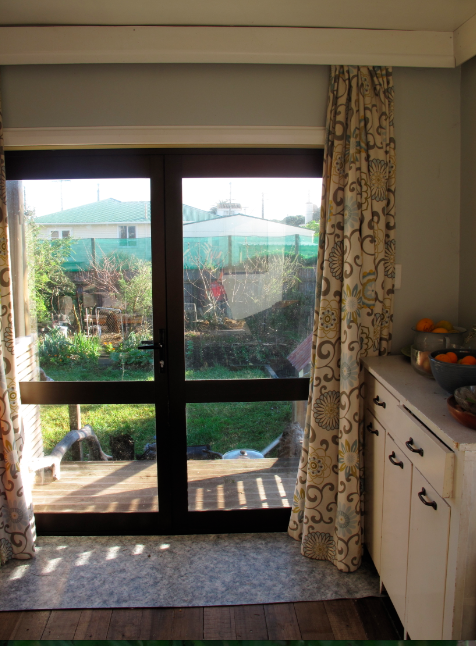
The primary way we tapped into this free, abundant energy source required no specialist equipment and no specialist skills. As a matter of fact, the ‘solar collectors’ we used already exist in every home in the country: windows. The problem with most homes is that the windows are evenly distributed between the north, south, east and west.
On sunny winter days, only the northerly-facing windows have a positive energy balance. In other words, they gain more heat through sunlight energy during the day than they lose through radiation at night (if properly curtained, as you would). All of the other windows have negative energy balances even on the sunniest of winter days.
For us, the obvious solution was to ‘shift’ windows from southern exposure to northern exposure. While retaining roughly the same amount of total glazing, we were able to dramatically improve the solar gain of this old villa where – once upon a time – someone decided to put the toilet in the north corner.
 Before

After
Shifting the toilet to a more appropriate location was accompanied by opening up the north corner to create a bright, warm, cosy kitchen with French door access to abundant backyard vege gardens and an outdoor pizza oven. All of the work was done in accordance with the New Zealand Building Code, with special attention paid to weather-tightness and bracing.
At the same time, we insulated the ceilings as well as those walls that were opened up during the renovation. And finally, we added thermal mass inside of the building envelope to moderate and store solar thermal energy, but that, my friends, is a story for another day.

Bad Advice – Good Advice

Bad advice can come at a good price, or even for free. What appears cheap initially, can prove expensive in the long run. Of course we don’t know if advice is good or bad when we first get it – that’s why it’s called advice.
Be aware, however, that often times the person offering advice may also be offering a product or service to sell based on that advice. This is particularly true of the automotive repair and home improvement professions.
For example, most of us know little more about our car than where to put the key, where to put the petrol, where to put the wiper fluid, and maybe where to put the oil. When there is a problem, we take it to a mechanic for advice and, most likely, servicing and parts. I suspect this is why everyone says, “You need to find an honest mechanic.”
An honest mechanic will give you good advice at a fair price. She or he is, after all, a trained expert in the field and deserves to make a living.
The same should be said of builders and architects. They are trained professionals who deserve a fair wage. But from my observations in North America and New Zealand, very few builders, architects, or any trade for that matter, understand how energy flows through a home and how to optimize thermal comfort and the health of the indoor environment. Please note I said few, not none.

This is what is possible when good design is involved.  
There are those in Whanganui in the design and building professions who know much more than me. We might call them ‘experts’ and their advice will be excellent, but not inexpensive. Remember, you get what you pay for, and in cases involving the energy performance of your home, expert advice may pay for itself in energy savings over the course of ten, twenty or thirty years. That, I consider, is a good investment, and anyone considering a new build or a major renovation should budget the advice of an eco-design expert into the cost of their project.
I remember a project in New Hampshire – where I used to live – where a company was able to double the size of its offices without having to increase the size of the heating and cooling system. They did this by hiring an ecological design advisor who did some research, crunched some numbers, and made recommendations that saved them tens of thousands of dollars by not having to install a second heating and cooling system. On top of that, they enjoyed lower operating costs. That said, businesses tend to be more budget conscious than householders.
That said, I have seen more than a few examples of bad advice and bad design over the course of the last three months and 80 free home energy audits provided by Project HEAT (Home Energy Awareness Training). That bad advice, in some cases, has cost homeowners thousands of dollars – money that could have been much better spent elsewhere. Unfortunately, that’s water under the bridge, or, rather, heat through the building envelope.

Hurry, free advice ends this month.  

But for you, however, I may have something to offer in these the waning days of Project HEAT. Please note, I have nothing to sell but practical advice made possible through the generosity of an anonymous donor along with community-minded Whanganui citizens Melinda Hatherly, Murray Jones and Jason Quinn.
And that said, Act Now! Limited time offer! Don’t miss out! Free advice for a warm, dry, healthy home.
Seriously, if you have a question, please ring me. 

Creative Reuse and Eco-Art for Kids

Creative reuse, or what some people call “repurposing,” is common practice among the ‘oily rag’ crowd. Seeing a practical and/or beautiful use for something in a second life exhibits a form of thinking that is simultaneously creative, ecological, and fiscally responsible.

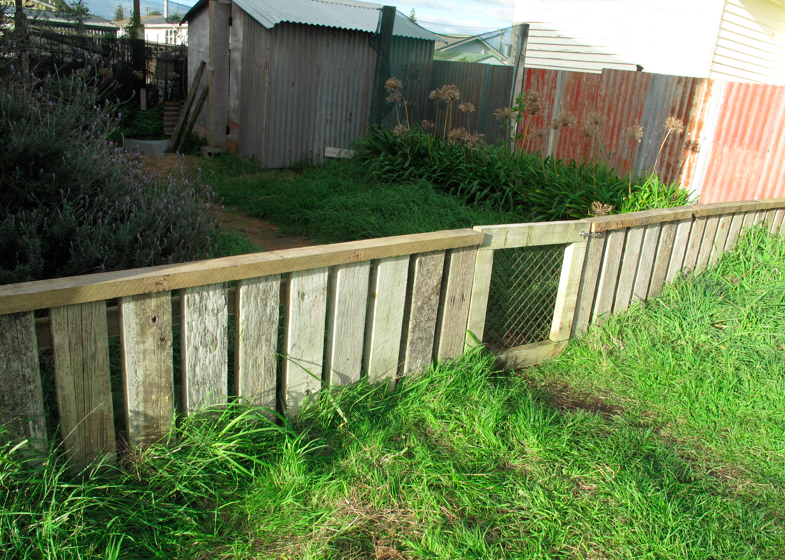
Once a dangerous deck… 

… now a beautiful, functional fence. 
My talented wife spends many hours on a website called Pinterest, where other talented wives post digital images of their ingenuity and then feed off of the ingenuity of others. This feeding frenzy of creativity is called ‘pinning’ and probably also ‘re-pinning.’ I don’t know much about the site, except: 1) it eats free time; 2) there are some amazing photos from re-purposers far more creative and talented than us.
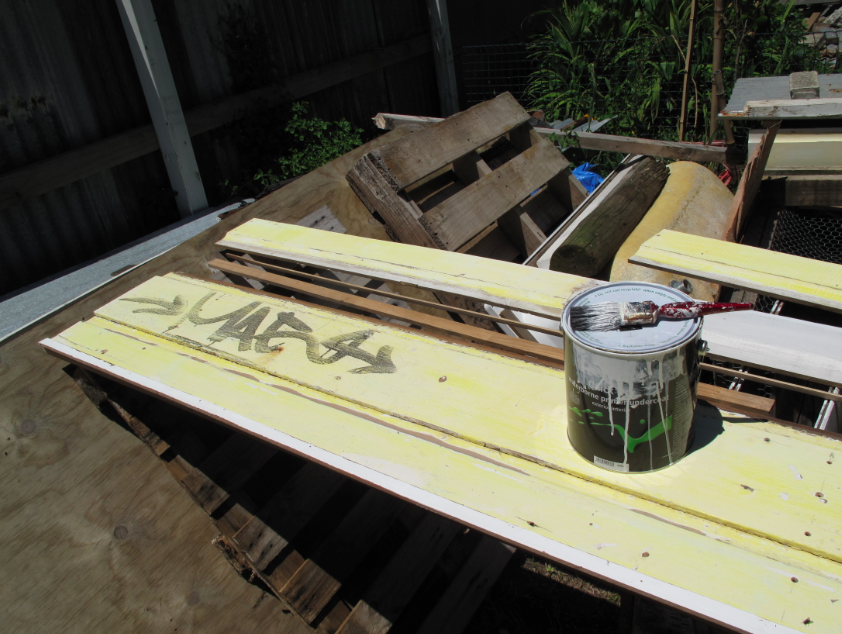
Nonetheless, we do our best to make things for our home that are functional, beautiful, and easy on the planet. One example is the pelmets I made from rusticated weatherboards that we removed while re-cladding. Turning the old, weathered cladding into an attractive interior feature required a lot of scraping and sanding, priming and painting, and then some more painting. This is what they do not show on Pinterest!
I’ve written about our pelmets before so I’ll put this briefly. I inverted the weatherboards so that the scallop was facing down (opposite of its orientation as exterior cladding), and ripped them lengthwise with a circular saw to suit the width for different rooms. The photos show 1 and 1/3 weatherboards screwed together to make a tall pelmet reaching from the top of the door in our ‘mud room’ to the ceiling.
 Once a tagged weatherboard…
… now a pelmet.
Regardless of whether you like pelmets or not, you’ve got to admit this was a fine reuse of a demolition material on site. Perhaps our best example of such.
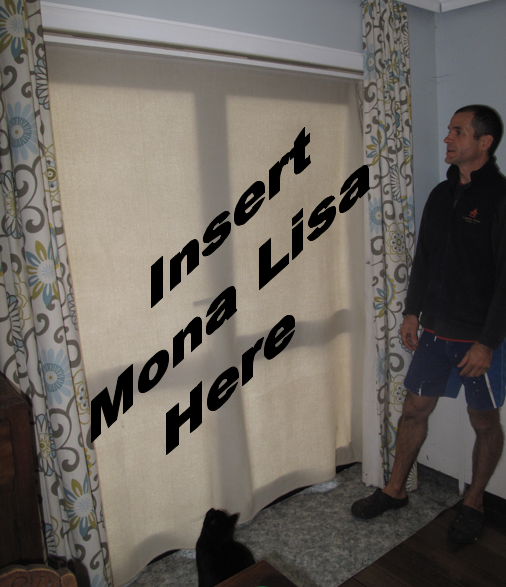
But judging from the two overenrolled window blanket workshops we ran last month, the humble but effective window blanket appears to be the most well-known of our eco-thrifty creations.
Yet, as with anything humble but effective, it has it detractors. About a year ago – when I first wrote about window blankets in this column – someone at the Saturday market passed on a comment from someone else that went something like, “How many middle-class, middle aged, women are going to put blankets in their windows at home.” Judging from the number of middle-class, middle-aged women who came to our workshops, a fair number.
From my perspective, just because something is eco-thrifty does not mean that it cannot be attractive. From a friend of mine’s perspective (an eco-engineer working in the Indian Himalaya at 3,000 – 4,000 metres), “Warm is always beautiful.”
Well kids, here’s your chance to combine these two perspectives into one great holiday programme at the Sarjeant Gallery! I have the pleasure to be working with art educator Andrea Gardner and artist Sue Cooke to run a free holiday programme for children ages 10 to 14 to make window blankets that are also works of art.
The programme runs 24th-25th July, with other cool “Art Adventures with Recycled Materials” happening the 16th-18thas well as the 23rd (ages 7-12). The programme is inspired by Sue’s Paradise Project showing at the gallery, and funded by Horizons Regional Council. Let’s call it, “The Fun Plan.” Please ring Sietske at the Sarjeant to enroll.