Category Archives: Eco Thrifty Renovation

Mid-Winter Gardens Update

Even in the heart of winter, we see new growth in the gardens and around the section. The prime examples include garlic…

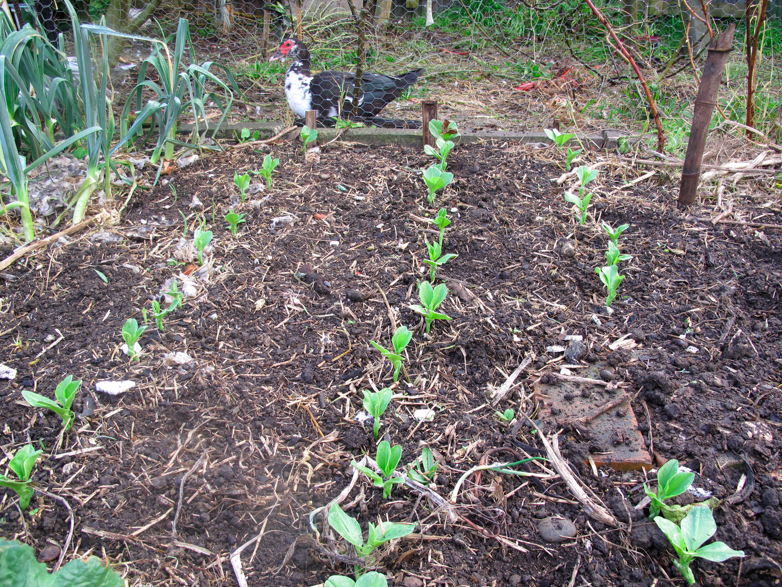
broad beans…

and olive trees setting new leaves.

We also see broccoli, cauliflower and cabbages growing well without pesky white butterflies around.

Finally, we see one ripe lemon on our world’s smallest lemon tree.

Figs cling to branches after the leaves have fallen.

But hungry birds are on to that.

Finally, check out what one of our plum trees has been up to!

There are dozens of these looped branches on the tree. Does anyone know why?

Peace, Estwing

Serious Composting for Serious Results

When I was in intermediate school in the states, I took lots of nonsense state and national tests, but I didn’t need the government to tell me how dumb I was – my older brother was quite enough, thank you.
I was rubbish at these tests, and especially the “verbal” (English language) sections. I could never complete the “reading comprehension” sections in time, and was baffled by the this-is-to-that-as-the-other-is-to-what? I-was-like-wtf-mate!
Now that I’m no longer in school and have learned to think for myself, I understand the thought process of these types of questions. For example, the All Blacks are to winning as _______ is to losing. While there are lots of options here, I think most of us would agree that Wallabies is the most appropriate.
Try this one for yourself: Insulation is to an eco-home as ________ is to a garden.
While there may be a few possibilities, the best response is compost.

Compost and insulation share the following characteristics:
Neither makes good cocktail party conversation.
Each remains slightly mysterious to many people.
Both are the unsung heroes of their respective domains.
Each must be done properly to function well.
An energy-efficient dwelling is only as good as its insulation, and an organic garden is only as good as its compost. There are many other factors that go into a home or garden, but these are the biggies.
Oh, and one more thing they have in common: Winter is a good time for both.
Obviously the colder months are when we rely on insulation in our homes to keep us warm, but winter is also an excellent time to make compost in preparation for spring planting. Nothing beats having an excess of high quality compost at the ready.
Making your own compost is the cheapest and best way to obtain a quality product. It’s not rocket science or brain surgery, but some knowledge and skills are required.
I usually make 1 cubic metre at a time, although at the moment I have six cubic metres going. Hot composting relies on a certain ratio of volume to surface area to stay warm – up to 50 or 60 degrees – which is reached at about 1 cubic metre. As the pile ‘cooks’ the volume shrinks as carbon dioxide and water vapor are ‘exhaled’ by the micro-organisms munching happily away.
Hot composting requires a balance of carbon-rich material such as shavings or brown grasses and nitrogen-rich materials such as manure, food scraps or green grass clippings. The materials should be layered so as to maximize the contact between carbon and nitrogen. Build a pile but don’t constrain it.
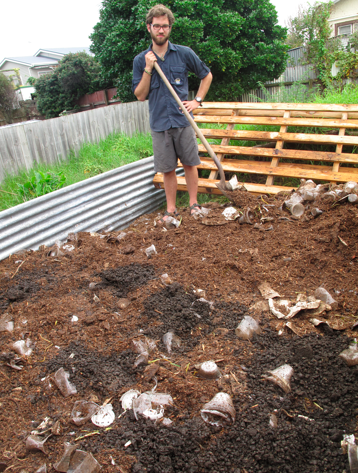
I am an advocate for free-range compost: no bins, no boxes. This makes turning the pile easier, as oxygen is the limiting factor. Turning a well-balanced pile once every 48 to 72 hours for one month will result in the best compost you’ve ever made. This has been the secret to my vege production for over a decade.
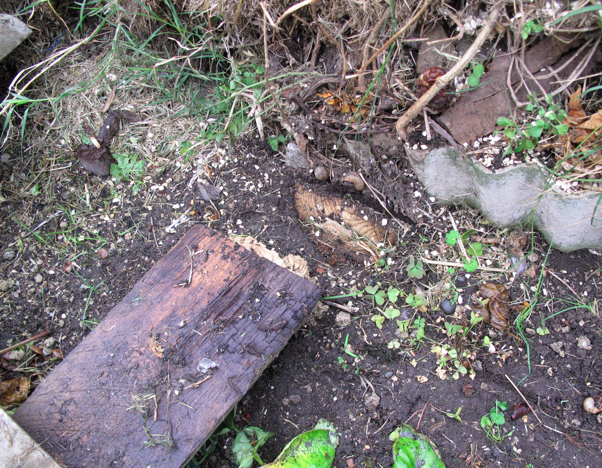
However, I have run into a challenge lately with some so-called ‘biodegradable’ products that are being promoted around Wanganui. After four months of hot composting they show no sign of decomposition. Upon contacting the supplier, I’ve learned they require 6 to 18 months to break down, which doesn’t fit my timetable. I guess the bottom line is that not all biodegradables are created equal. Caveat emptor.
Want to learn more? Check out these upcoming workshops:
The Carbon-Neutral Lawn: 13th July, 3-4 pm, or 14thJuly, 3-4 pm.
How to REALLY Compost: 13th July, 4-5 pm, or 14thJuly, 4-5 pm

Registration essential: 344 5013    022 635 0868 – theecoschool@gmail.com    

Carbon Neutral Lawn

I’ve been writing a lot about warm, low-energy, healthy homes lately, so I’ve decided to change things up for a mid-winter’s break and write about summery things like yard and garden. For us, the outdoor “renovation” of our weed-infested section has been as significant as the passive solar redesign of our old villa. We have used most of the same design thinking in both cases, and strive to create systems that both save money and a have low impacts on the environment.
Crediting my lovely and brilliant wife with coining the term ‘eco-thrifty’, I have no better way to describe what we have accomplished on our vast holdings of 700 metres squared: a carbon-neutral (well, actually we store carbon), regenerative (getting better, ie healthier, every season) and productive (ie, kai) landscape.
Boy, that was a lot of information after the colon. Let’s dissect it piece by piece.
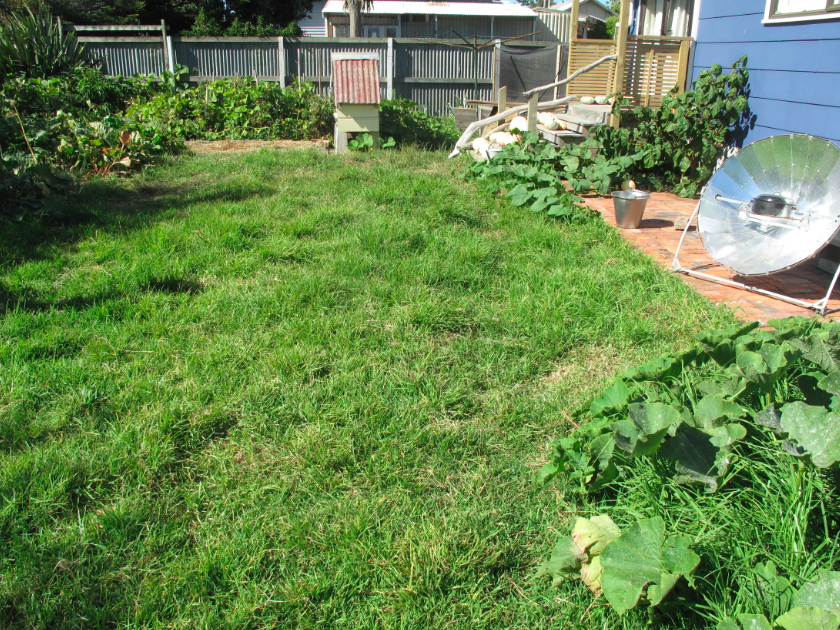
Our lawn, 3rd March 2013, after 3 months of summer drought. 

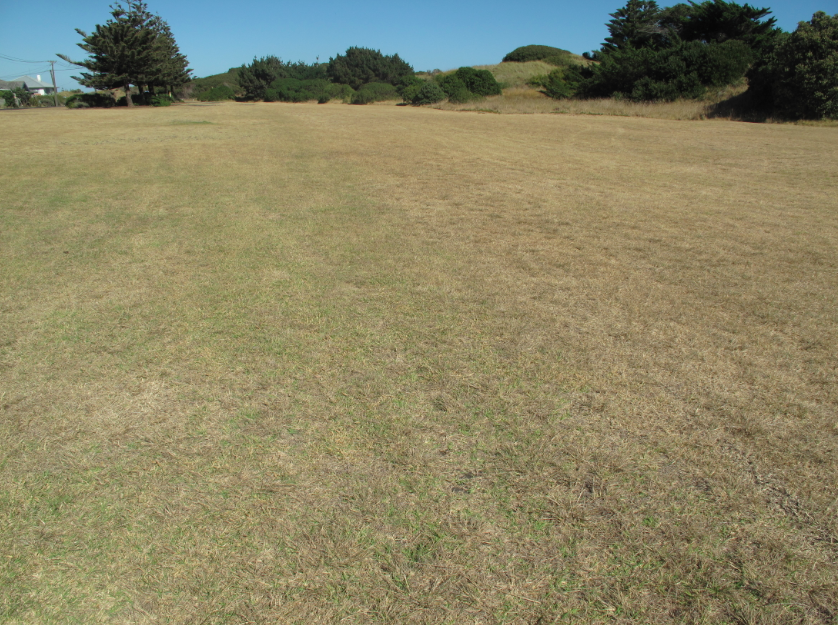
 Castlecliff Reserve, 3rd March 2013, after 3 months of summer drought.
50 meters from our lawn, pictured above.  
Carbon-Neutral. Not that it is a big accomplishment, but we manage our 700 square metre section without the use of a mower. At the risk of offending some readers, I’ll put the next point as delicately as possible: In my opinion, petrol mowers are neither eco and nor thrifty. They cost money to buy. They cost money to run. They cost money to repair. They create noise pollution and air pollution. Just my opinion.
Regenerative. We take a holistic management view of our section wherein we retain about a third of it in grass, but avoid the use of a mower by using chooks and ducks to ‘work’ for us on a seasonal basis. During the colder months – roughly May through August – we ‘tractor’ our fowl across our lawn. You may have heard of a ‘chicken tractor’ before, but trust me, they work just as well for ducks.
If you haven’t heard of a chicken tractor, its just a mobile chook pen, and if I have communicated well with my editor there just may be a picture of one somewhere on this page. As an aside, one of my favorite all-time discoveries is Google Image Search. Type in ‘chicken tractor’ and see what you get!
Rosemary, Amelia and Eunice. 
As the chooks and ducks graze the grass, they stimulate root growth, which makes most grasses healthier. Additionally, their poos fertilize the grass and make it healthier still. These healthier grasses out-compete the opportunistic weeds that once thrived in our poor, dry, sandy soils. The more we have tractored the birds, the healthier the grasses have become, which then are even healthier for the birds to eat. This type of a positive ‘upward spiral’ is often called regenerative.
Productive. To go ‘old school’ on you for a moment, almost every square inch of our property contributes to the growing of food. How, you may ask, can that be when I’ve already stated that a third of it is in grass. Well, sure, the chooks and ducks eat some grass, but all of them prefer layer pellets. As you would.
More significantly, we grow our own mulch on our property. As mentioned above, tractoring the birds across the lawn for five cold months a year improves the health of the grasses. But we do not want to be stepping in duck poo all summer long. For the seven warmer months, we let the grass grow for three to four weeks at a time and then cut it with a scythe. The cut grass is dried and then used to mulch our vege gardens. It’s all part of ‘the circle of life.’ Hakuna matata, bro.
Want to learn more? Check out these upcoming workshops:
The Carbon-Neutral Lawn: 13th July, 3-4 pm, or 14thJuly, 3-4 pm.
How to REALLY Compost: 13th July, 4-5 pm, or 14thJuly, 4-5 pm

Winds and Wind Protection

First the bad news: We had gusts of 126 km/hr last week.

Now the good news: Our roof is still on.

And finally, a question: If homes are built to sustain maximum wind gusts, why aren’t many gardens?

Living about 300 meters from the Tasman Sea, we believe they must be. In these parts, the winds are strong enough to blow the Blacks off the All Blacks.

So we have put a lot of time, effort and money into erecting wind breaks.

We have also braced the windward fences to account for the additional wind load caused by the netting. 

Our neighbours did not.

Their fence came down and pulled part of ours with it.

See here, their fence posts snapped at ground level.

And that force snapped one of our rails.

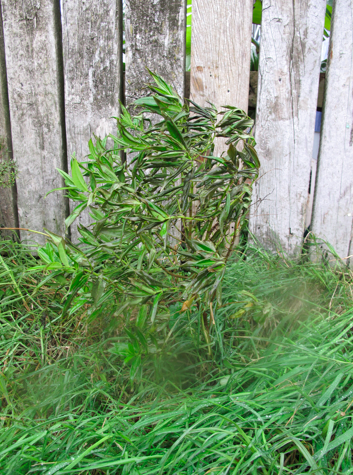
Biologically, here is evidence of wind damage to the ‘wild’ bush lupine growing unprotected in front of our home.

Another legume, tagasaste, also suffered some minor wind burn.

To compare like with like, the next photo is of a native hebe without wind protection.

This hebe is protected from the wind.

Overall, our fruit trees and annual gardens suffered negligible damage. After a storm like last week, I’m glad for our extensive efforts at wind protection.

Peace, Estwing

DIY Double-Glazing

Let me begin with the following statement: Taking pictures of windows is extraordinarily difficult.
Now that that’s established, I’ll follow up with this statement: DIY double-glazing can take many forms.

Regular readers of this column will be well aware of plastic window film DIY double-glazing. Local man, Jason Quinn, was recently selected as a finalist in the Innovation awards for his product, Space Window Insulation.
We have used his product in our home to a certain extent, but lately I have been experimenting with DIY glass double-glazing as a more permanent way to reduce heat loss through windows. I believe this would be considered “retrofit” double-glazing, because we are doing it to our existing windows – both aluminium and timber.
Before I describe the different ways I’ve done this, a reminder: insulation in ‘trapped air.’ In other words, the second sheet of glass or plastic does not add any significant insulating value, it is the air trapped in between. The aforementioned Jason – literally a former rocket scientist – tells me that the optimal air space (gap) to the second sheet – be it plastic or glass – is about 22 mm. Typically, timber windows have a 25 mm gap between the glass and the interior frame, but aluminium windows offer only a 5 mm – 7 mm gap.
So far I have retrofitted five windows in four different ways. The first one was an aluminium window with Space Window Insulation. The good news is that it was cheap and easy, but the bad news is that there is only a 6 mm air space. Then again, 6 mm of trapped air is better than none.
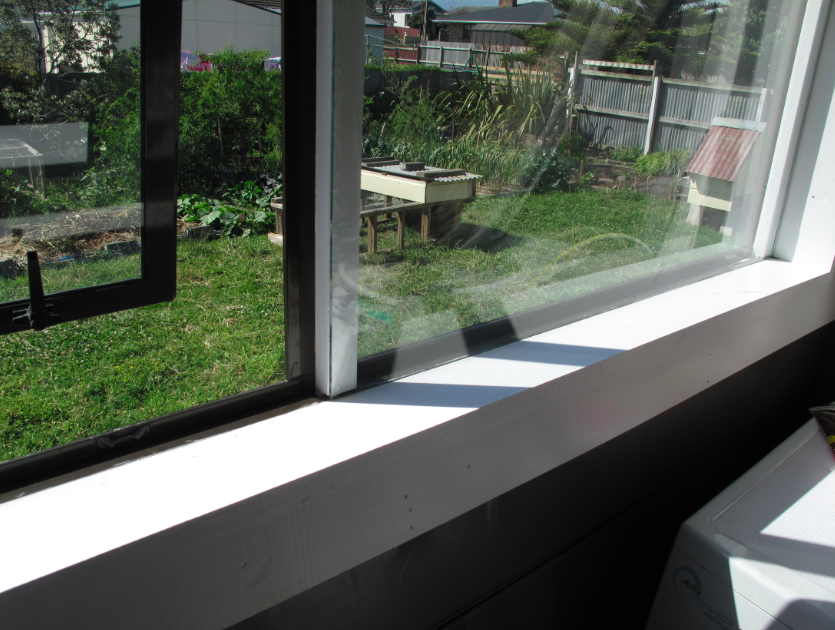
The next window I retrofitted was in our bathroom. The building code required us to have safety glass, but instead of removing the original glass and replacing it with safety glass, I commenced my first attempt at glass DIY double-glazing. Here is where the difficulty in taking pictures of glass comes in. Follow along the numbered photographs as best you can.
1) As with any DIY project, it pays to organize all your tools and materials in advance.
2) I glued vertical timber battens – primed and painted on all sides – to the aluminium frame. These take up the space of the trough at the bottom of the frame, and provide a 22 mm gap between the two panes.
3) I set the glass with a bead of silicone on both vertical battens.
4) I screwed two horizontal battens – top and bottom – into the timber frame to hold the glass against the vertical battens.
This design worked well, so I repeated it on an identical window in our kitchen, but I was forced to change plans when facing our large lounge window because there was no aluminium trough. I could have used timber battens again to create an air space greater than 6 mm, but the process of measuring, cutting, priming, and painting (two coats) is long and drawn-out. Instead, I used a roll of 12 mm adhesive foam to make an 18 mm gap (6 mm + 12 mm) all around the window. Then I simply used timber battens top and bottom to hold the glass in place.
Finally, in our bedroom – where we have timber windows – I used yet another design. Here it was a combination of adhesive foam and right-angle timber battens. It would take a thousand words to explain it, so I’ll refer you again to a photo: 5) side-by-side single-glazing and double-glazing.
Want to learn more? DIY Double-Glazing Workshops: 25thJune, 5-6:30 pm. 29th June, 9-10:30 am. 30th June, 4:30-6 pm. Registration essential: 022 635 0868 – theecoschool@gmail.com

Upcoming Workshops

ECO School Workshops June/July 2013

DIY Double-Glazing Workshops:
25th June, 5-6:30 pm.
29th June, 9-10:30 am.
30th June, 4:30-6 pm.
Choose one that suits you.
This workshop provides examples and advice on DIY retrofit double-glazing including plastic and glass options for both timber and aluminium windows.
Registration essential: 344 5013    022 635 0868 – theecoschool@gmail.com    
Waged $15, Unwaged, $10. 
The Carbon-Neutral Lawn
13th July, 3-4 pm
14th July, 3-4 pm
Choose one that suits you.
Save money and help the environment by managing your lawn as an organic system that produces food and does not pollute. This workshop introduces three techniques we use to improve the health of our land and grow abundant food with little effort while using no petrol or noisy, smelly, expensive lawn mowers.
Registration essential: 344 5013    022 635 0868 – theecoschool@gmail.com    
Waged $10, Unwaged, $5. 
How to REALLY Compost
13th July, 4-5 pm
14th July, 4-5 pm
Choose one that suits you.
Most organic growers worldwide will tell you that growing great fruit and vege requires great compost. From my experience, the best compost is that which I make myself. It also happens to be the cheapest. This workshop provides the best advice on making your own high quality compost, trouble-shooting a compost heap, and the bust uses of compost to enhance fruit and vege production.
Registration essential: 344 5013    022 635 0868 – theecoschool@gmail.com    
Waged $10, Unwaged, $5. 

Moving Warm Air within a Home

Last week I described many of the common pieces of advice I offer householders during the home energy audits I’ve performed as part of Project HEAT (Home Energy Awareness Training). When I walk through the door and meet the householders for the first time, I make two statements:
1) Every home is different and every occupant is different.
2) For a warm, cosy home, holding heat is the least expensive, and generating heat is the most expensive…but there is also the option of moving heat inexpensively.
The rest of this column is dedicated to explaining the addendum to the second statement: moving heat inexpensively.
About half of the homes I’ve audited have a single, fixed heat source at one end – usually the lounge – and cold, damp bedrooms at the other end. This hot lounge/cold bedrooms syndrome is probably what inspired the development of heat transfer units, which consist of insulated ductwork that runs above the ceiling with a small fan to push the warm air where it’s needed.
The electricity required to run a small fan is negligible. If you were to shut off every device in your home and turn on a small fan, the power meter would not even turn. However, if you put an electric heater in a back bedroom, you’d see the meter spin like an old Neil Diamond album. Hot August Night!
But, you point out, installing a heat transfer unit costs hundreds of dollars. True…and that’s why I have an eco-thrifty alternative.
Keep in mind that the idea here is to move excess heat from a room that has a fixed, economical heating unit – a wood burner, gas fire or heat pump – to other cold rooms. What good is having one room at 23 degrees and others at 14?
I have seen dozens of homes that are rectangular in shape, where the heater is at one far end and installed on an exterior wall. Given the age of these homes, it is safe to say the walls are uninsulated. This is a terrific example of terrible design. Even Mark Bachelder, the man who built my farmhouse in the states in 1782 knew enough to put the heat source in the middle! This style of home is called a “Centre-Chimney Cape” (short for Cape Cod).
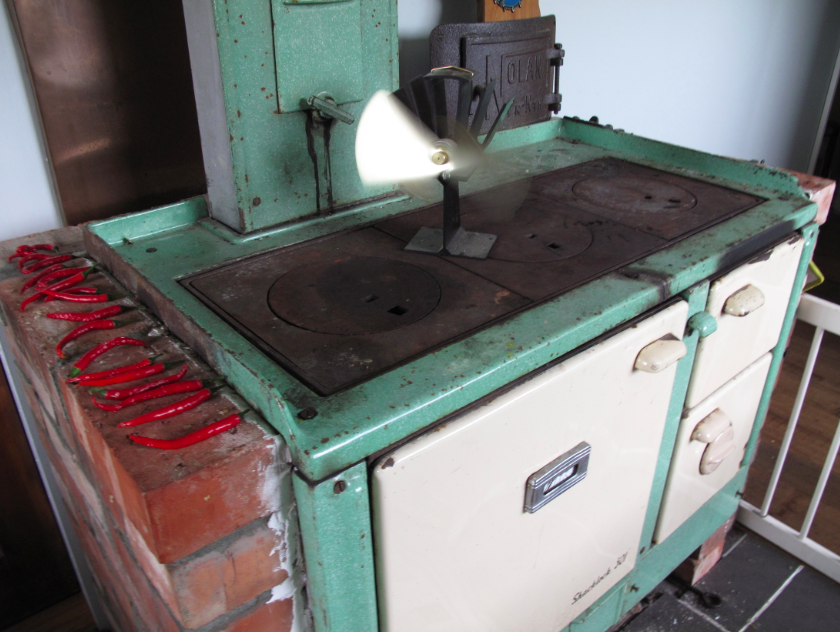
In our home in Castlecliff, we installed the second-hand multi-fuel cooker on an interior wall next to the double-doorway to the lounge. We use an amazing self-propelled device called Eco-Fan to move the heated air from the kitchen into the lounge.
But we had the luxury to redesign our home and place the fixed heater appropriately. For those without this option, here is the eco-thrifty way to move warm air that anyone – owner or renter – could start using today. All it takes is two small desk fans with the bases removed.
I’ll use the common example of a heated lounge and a long hallway with two or three bedrooms at the far end. First, hang one fan in the top corner of the doorway from the lounge to the hall. This takes warm air from the ceiling and pushes it in the general direction of the bedrooms. Cool air will flow along the floor into the lounge where it is heated by the economical heater.
Next, hang another fan in the top corner of a bedroom doorway. This pushes the warm air from the hall ceiling into the bedroom. Switch the fan to another bedroom every 30 minutes between the hours of your evening meal and bedtime. That’s it!
But be aware, if you have a giant hall with high ceilings, it may be better to think about a heat transfer unit that would bypass the hallway. As someone once said, “Every home is different.”
Peace, Estwing

10 Pieces of Advice for Warm, Dry Homes

There are few things less exciting than talking about energy efficiency. Watching bowling on television comes to mind, or perhaps filling out a government form. Also, changing nappies.
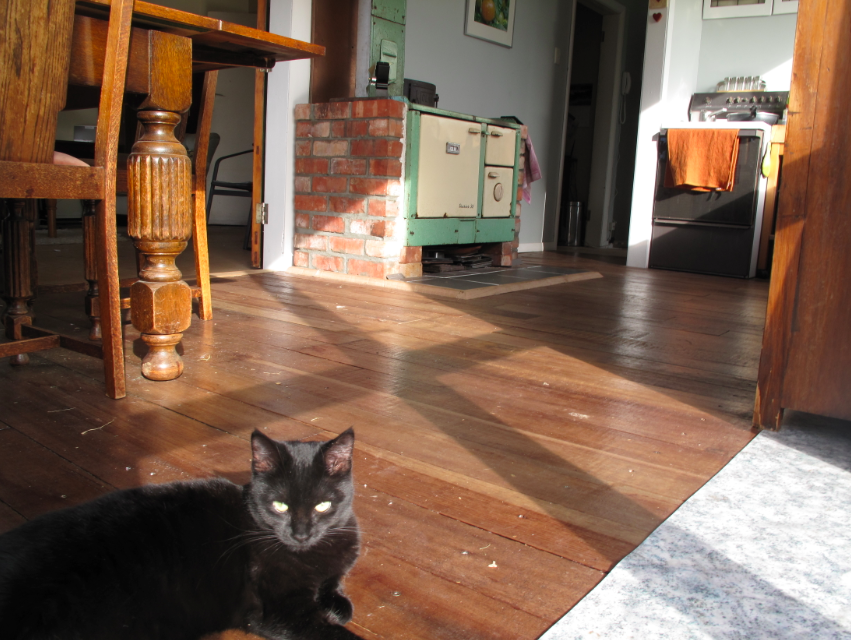
In order to hold your attention, I’ve recruited my cat, Billy T., to assist me. Billy T. knows all about solar gain and insulation. She always finds the warmest spots in our home. 
She is a walking, purring, home energy audit. However, some would deem it inappropriate for me to bring her along during the home energy audits I’ve been performing as part of Project HEAT (Home Energy Awareness Training).
Project HEAT is a collaborative partnership of over 20 Whanganui organisations, businesses, individuals, and The ECO School. So far, the programme has provided 8 neighbourhood presentations, 60 home energy audits, and a DIY workshop on window blankets. This can be considered a strong example of a “by the people and for the people” grassroots initiative. Good on all those partners involved.
The home energy audits are roughly modeled on a programme funded by many Councils across New Zealand called Eco-Design Advisors. I’ve worked with the Eco-Design Advisors from Hamilton City Council and Kapiti Coast District Council. Both have been extremely supportive by offering advice and suggestions.
Over the course of 60 audits, I’ve observed enough poorly designed homes to come up with a standard set of suggestions for reducing heat loss, reducing condensation, and saving power. I’ll share those here in the space remaining, although many of them have already been explained in past columns over the last 14 months, and on our blog over the last 30 months: www.ecothriftydoup.blogspot.com
Windows first, because glazing can account for as much or more heat loss as ceilings. There are five basic suggestions I make to nearly all householders I’ve consulted.
Heat loss through glazing can be reduced by:
• Curtains with pelmets
• Floor-length curtains
• Curtains with the rail fixed to the wall
• Window blankets
• Double-glazing: replacement, retrofit, plastic DIY.
In our home, we piggy-back multiple of these strategies on every window and glass door. For example, for our French doors we have a pelmet, a floor-length curtain, and a window blanket. Next to it is a replacement double-glazed window (our only one) with a pelmet over a Roman blind, and a window blanket. In the lounge, we have used plastic DIY double-glazing, a pelmet, and a floor-length curtain. Each layer adds that much more insulation.
Next, draught-sealing. Sealing draughts can be done by the average person in three ways:
• Foam window and door seal
• Door-mounted draught excluders
• DIY draught blockers
Finally, reducing interior moisture and condensation. The ‘best’ two ways to do this are:
• Lay polythene beneath the home to reduce rising damp
• Run a dehumidifier as needed
We do not use either of these, as we do not have condensation problems because we are on sand (no rising damp) and we actively limit moisture inside our home. But many homes on clay or peat can benefit greatly from properly installed polythene. Additionally, many homes can benefit from running a dehumidifier in the far reaches (aka, bedrooms) that, in many cases, are polar opposite the single, fixed heat source be it a gas heater or a wood burner.
A dehumidifier in a cold, damp bedroom offers three benefits simultaneously: 1) It reduces moisture. Duh! 2) The process of ‘changing’ water from gas to liquid releases heat. (Yeah, Science!) 3) The motor generates heat. Three in one – not bad!
Oh, and one more piece of advice, but it will have to wait for next week. 

Finding Draughts – Plugging Draughts

A couple of weeks ago, Terry Lobb wrote about Passive House – “a worldwide organization promoting sustainable, energy efficient buildings” (4th, May, 2013). The ‘secret’ to Passive House success, she wrote, is that “the houses are airtight!” She then went on with a thorough explanation of how an air-to-air heat exchanger controls the ventilation and ‘recovers’ warmth from the exhausted stale air.
It is all rather cool, and requires good design, good engineering, and great attention to detail in the building process. Think about all of the possible leaks in a home, and then think about sealing every one of them. For a builder, it requires a great understanding of how homes work, and the patience to ensure that all the detail work is properly done.
A whole bunch of little things can add up to something big.
That’s exactly what I have been saying during the first 50 free home energy audits I’ve carried out in Whanganui over the last two months as part of Project HEAT. It’s also how we were able to convert a draughty, cold villa into a warm, cosy home. The biggest difference between our home – and most of the homes I’ve audited – and a Passive House, is the level of thoughtfulness of design, and the level of attention to detail in the construction.
This is why, according to a University of Otago study, 75% of New Zealand homes fail to meet new energy standards, and unhealthy homes contribute to 1600 deaths each year and cost millions in lost productivity. Shocking is the term I’ll use to describe the design and construction of some of the homes I’ve visited lately. But there is hope for even the worst Whanganui homes – like ours was three years ago.
Many of the same principles that go into a Passive House went into renovating our villa. I’ve been writing about them for over a year in the Chronicle, and for over two years on our blog, which is closing in on 300 posts and 60,000 views. 

In it’s most basic form, the ‘secret’ to comfortable, energy-efficient homes comes down to this: good insulation and great draught-proofing. But as with things from vege gardens to wastewater treatment plants, it’s easier to do things properly in the first place than to go back and correct mistakes later.
While it would be nice if all of our homes had been designed and built more thoughtfully, there are always steps we can take to improve what we have. Dollar-for-dollar, draught-proofing is one of the cheapest and most effective ways to slow the loss of heat from a home, which can account for up to 10% of heat loss.
A good way to find draughts in a home is to perform a blower door test. Terry described this as, “a very technical test with lots of data being recorded, but in laymen’s we checked out the airtightness…”
In an attempt to explain it even more simply, I’ll write how I did it in our home. I made a blower door out of two fans, some coated fabric, and a bit of timber. I fitted this unit into our front door and turned both fans on high pushing air outside. This created low pressure within the structure and ‘pulled’ air in through every little gap. Identifying the gaps can be done with a burning candle or incense. Plugging the gaps can be done with a variety of products easily available from building supply stores.
Until the day we all live in Passive Houses, this is about the best we can do.
Peace, Estwing

Curtains: The Good, the Bad, and the Ugly

Last week’s column contained two sentences that have bearing on this week’s column:
1) Up to 30% of heat loss from a home is through glass doors and windows – nearly as much as the heat lost through the ceiling.
2) Thermal curtains are sweet-as, if they are fitted properly.
The sad truth is that most of the curtains I’ve seen in Whanganui are not fitted for high thermal performance, ie: insulation. Recently, Verti, Dani and I spent the night at an accommodation outside of Whanganui, which I’ll use to illustrate my point. The unit in which we stayed was a bit schitzophrenic in that it employed three distinctly different approaches to curtaining: the good, the bad, and the ugly. I’ll start with the bad because it is the most common thing I see in homes where the occupants are not even aware that: 1) it is poor curtaining; and, 2) they are losing heat unnecessarily.

 The Bad
When it comes to holding heat inside of a home, a standard arm-hung curtain rail without a pelmet or floor-length curtains is almost like having no curtain at all. Even the best thermal curtains are practically useless if air can flow uninhibited behind them from top to bottom. This is due to physics (Hurray Science!), and the inverse of a principle we learned in school: hot air rises.
Luckily, it does not take a physicist to figure out that if hot air rises, then cold air sinks. Now that we have the science sorted, on to a tale of loss, betrayal and ultimately sorrow.
The loss comes from warm, indoor air coming into contact with a cold pane of glass. Heat is conducted through the glass to the outdoors, leaving the indoor air colder than the air directly below it. This cold air sinks, creating negative pressure – or a vacuum – between the curtain and window, which pulls warm air from the ceiling down and against the cold glass. This air cools and sinks, causing another vacuum that pulls more warm air down from the ceiling.
Nek minit, a convection current ‘in reverse’ is flowing through the room, cooling it down every winter night of the year. Naturally, a sense of betrayal consumes the occupants of the room when they discover that the expensive thermal curtains they’ve purchased might just be useless! Shortly thereafter, the sense of betrayal turns to sorrow when they realize how long they have been needlessly losing heat and that they should have paid closer attention during physics class in school.
The two common ways to prevent the above from occurring were well-known to our grandparents: pelmets and/or floor-length curtains. Contrary to what most people believe, pelmets are not just a beautiful accessory to a well-appointed home; they are an energy-saving device. Form follows function.
However, due to advances in curtain-hanging technology of which our grandparents never dreamed, a third possibility now exists from preventing the dreaded convection current in reverse. Although I am unaware of the official name of this technology, I have come up with my own: Screw-it.
The Good 
What possibly could be a more elegant description for screwing a curtain rail into the wall directly above a window? I characterize this as the good because it does restrict the flow of air behind the curtain from top to bottom, just not as well as a pelmet or floor-length curtains. But hey, nothing wrong with a bronze when only three medals are being awarded.
As for the ugly, to quote my Himalayan eco-engineer friend, Sonam Wangchuk, “Warm is always beautiful.” If warm is beautiful then cold must be ugly, and lace curtains do nothing to prevent heat loss through windows, even if they are fixed hard against the frame.
The Ugly 
 Peace, Estwing