Category Archives: Eco Thrifty Renovation

Zero Waste Programme for the New Zealand Masters’ Games

Over the last four weeks in this column, I have given example after example of cases where the ‘eco’ choice is also the thrifty choice. I even went so far as to claim that most of the time the environmental-friendly choice is the thriftiest choice. I did not say all of the time, because there are instances where the more sustainable purchase decisions can be more costly, such as buying organic food or photovoltaic (solar electric) panels.
I thought this was also the case with ‘green’ packaging and biodegradable table wear. But my newest heroes at the New Zealand Masters’ Games have proven me wrong – or at least open to new learning. The entire team at NZMG have fully embraced going ‘Zero Waste’ for this year’s event at the Springvale Park Games Village, but the super-est of my new heroes is Simon Watson. Not only is Simon a surfer – chur, bro – but he has put in hours of research into sustainable purchasing – often called pre-cycling – for the ‘disposable’ table wear, cups, and glasses to be used at the event.
Mike Cronin, Games Director, said he was bracing himself for the quote to come in for the eco-products because he, like me, thought it would come in significantly higher than the standard landfill disposable fare. But much to his surprise, and mine, the quote came in significantly lower! Yes, even in this case of buying eco-products instead of bog standard plastic disposables, the eco choice can be a thrifty choice.
Before handing it over to Simon, I’ll invite any and all event organizers in Wanganui to contact me about making their event ‘Zero Waste’ with the help of Hadi Gurton and me. Now, over to Simon.

When I first began researching what was available in terms of recyclable and biodegradable products I was surprised at the wide range of catering items that fit the Zero Waste program. In the end we (New Zealand Masters Games) decided to go with a local company, Edengreenz Enterprises, and the biodegradable products they are able to provide because they were very cost comparable with recyclable plastic and we could source 17 of the 20 food and beverage items we need to serve our food and beverage. In total we will have at least 30,900 biodegradable items go through the NZCT Games Village and hopefully this will spark some interesting conversations about how it is possible that in just a few weeks they could be growing their winter crop of vegetables in compost made up from the cups and plates they were using at the New Zealand Masters Games.
Here at the New Zealand Masters Games we a very passionate about our community and by endeavoring to reduce the footprint left behind by Wanganui’s largest event and New Zealand’s largest multisport event we want to show our local sports clubs and other local events that they too can do their bit for Wanganui by thinking carefully about the items used and how they dispose of them. It costs no more to use these items and although it requires the use of volunteer labor in sorting the material we believe it is a very cost effective way to “go green”. The whole process has been a great learning curve and we are very pleased with what we are going to be able to deliver to our village guests and look forward to showing how our food and beverage doesn’t “cost the earth”.

Join us on Project HEAT

Project HEAT
Home Energy Awareness Training
Project HEAT helps Wanganui residents save energy and money by giving advice on easy, low-cost ways to cut power bills.
Overview: Power bills have risen at a rate higher than wages and benefits for the last 10 years, and that trend is likely to continue. At the same time, many Kiwis suffer from illnesses associated with cold, damp homes. Additionally, power bills make up a larger percent of the expenses for low-income families and pensioners. Our consortium of community groups, businesses and media outlets seek to help all Wanganui households, but particularly those in need.
Project HEAT helps renters and owners alike make their homes warmer, dryer, healthier and less draughty in three ways: 1) presentations in every suburb explaining easy, low-cost ways to save energy at home; 2) home energy audits; 3) instructional DIY workshops that teach how to make and install low-cost energy-saving devices. Warmer, dryer homes improve the health of the occupants, and lower power bills make money available for other household expenses.
Current Partners:
The ECO School
Tree Life New Zealand, Ltd.
Wanganui Chronicle
Wanganui Regional Primary Health Organisation
Sustainable Whanganui Trust
Community Education Service
Sisters of Saint Joseph
Wai Ora Trust
Progress Castlecliff
Anonymous Financial Donor
Timetable:
October, 2012 – January, 2013: Recruit partners: financial, in-kind, venues.
February, 2013: Project HEAT promotion begins.
March – April, 2013: 10 presentations in Wanganui suburbs.
April – June, 2013: 100 home energy audits in Wanganui.
11th May, 2013: DIY workshop.
Contact:
Nelson Lebo
344 5013; 022 635 0868
theecoschool@gmail.com

Eco-Thrifty Gardening

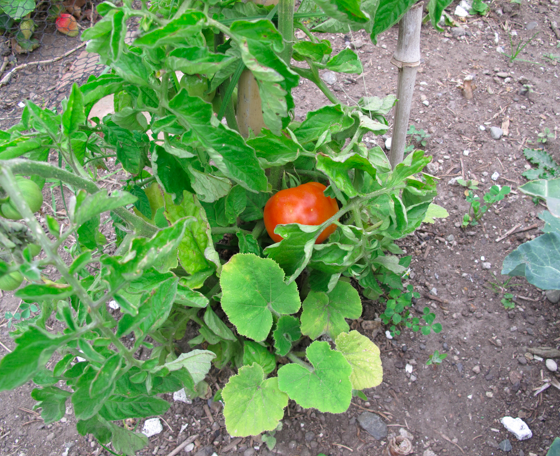
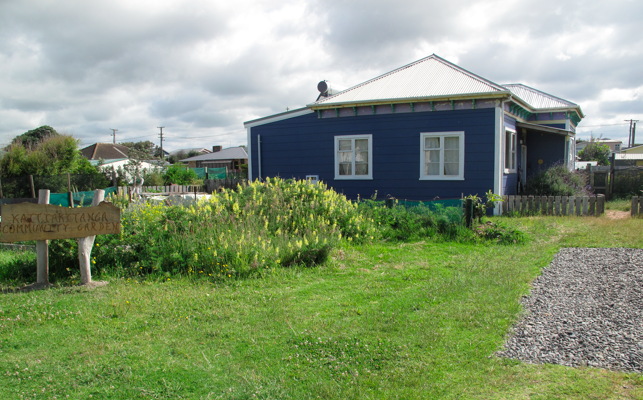
Alongside the passive solar renovation of our 100 year-old villa in Castlecliff, we also ‘renovated’ our section from a weed-infested food desert to a thriving food oasis. Starting with sand, couch grass, kikuyu, convolvulus, and pampas lily of the valley, the process of transformation has been slow, but steady. Now that we are mid-way through our third summer, the property has reached a level of lushness and productivity that gives a feeling of satisfaction – especially when tucking into a big bowl of fresh strawberries.

We were able to achieve these results using much of the same thinking that has provided us with a power bill in the low double-digits. This ‘eco-thrifty thinking’ – similar in many ways to the concept of permaculture – aims for low input and high performance, based upon a solid foundational structure. For the villa, this meant significant investments in insulation, solar hot water, and additional glazing on the north side. For the gardens, this meant investments in wind protection, topsoil, and compost.
All of these investments in sustainable infrastructure serve as prerequisites for long-term high-performance. For the villa, high-performance is measured by thermal comfort and low power bills. For the gardens, high-performance is measured in plentiful, healthy kai! All of these investments can also be measured by payback period – a concept highlighted over the last three weeks of this column.
Without wind protection and a small amount of strategically-placed topsoil, I reckon growing fruit and vege one street behind Seafront Road would be a constant struggle. People in these parts say “sand eats compost.” By this, they mean that compost quickly decomposes and leaches through the porous sand, leaving little nutrition for heavy-feeding vegetable plants.
A top dressing of topsoil, however, binds compost where it can be reached by plants’ roots. Topsoil is also better at retaining water than sand. Our annual vegetable gardens – about 40 square metres – are dressed with 70 – 80 mm of topsoil, for a total of about 3 cubic metres. This purchase from a from a local landscape supplier with free trailer hire cost a couple hundred dollars with a few scoops of compost mixed in. However, this upfront cost will pay for itself over years and years of increased vegetable yields, ie: high-performance.
Improving the performance of the vegetable garden with topsoil is similar to improving the thermal performance of the house with insulation. Topsoil slows the leaching of nutrients out of a garden just as insulation slows the passage of heat through the walls of a home. In both cases, the results can be impressive.
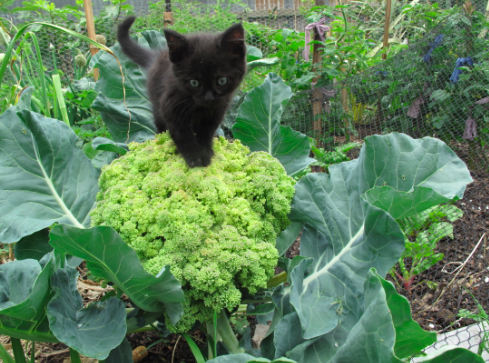
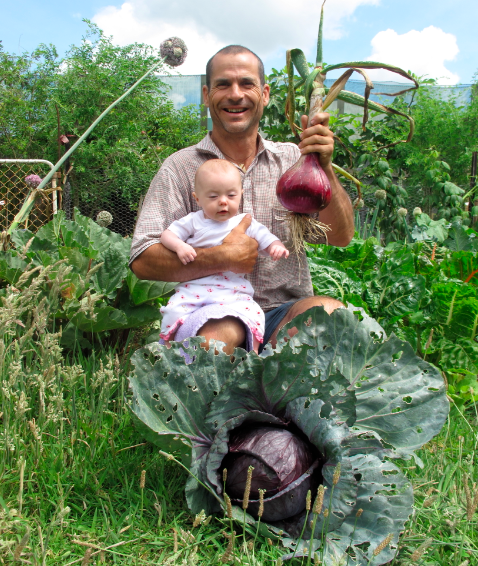
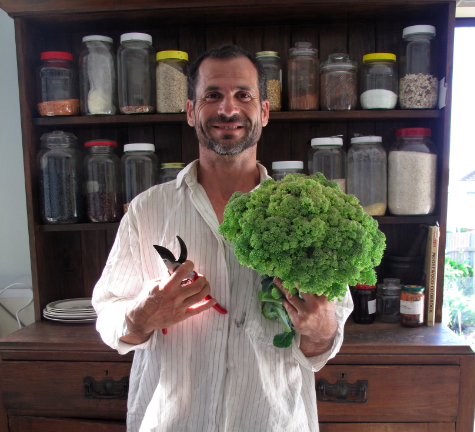
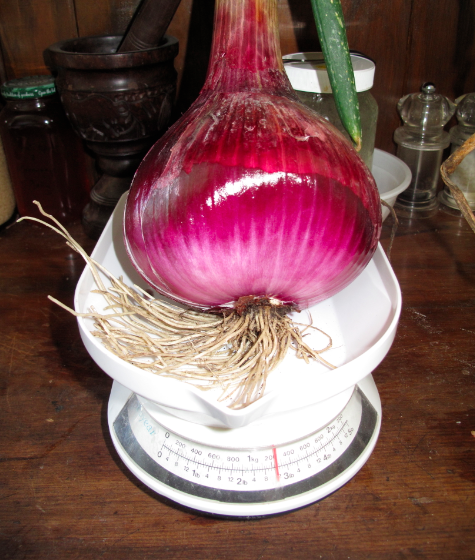
In the last two years, in our 70-80 mm of topsoil, using organic methods we have grown a 4 kilogram cauliflower, a 3 kilogram broccoli, a 3 kilogram purple cabbage, a 1.2 kilogram red onion, and over 500 gorgeous soft neck garlic. 
These, of course, are some of the highlights. We have also had some failures – our first year of potatoes was pathetic, and I have had trouble germinating basil and corgettes this year. On the other hand, we had ripe tomatoes before Christmas without a glass house.
Over the last decade-plus, I have been studying low-input sustainable agriculture (LISA), and experimenting with different methods, tools, techniques and strategies. I think I may have learned a thing or two worthy of sharing with others. 
If you would like to learn about boosting the productivity of your vege garden without significant investments of money or effort, you may be interested in one of the upcoming ECO School events as listed in the sidebar.
Peace, Estwing
19th January, 2:30 – 3:30 pm: Scratch to Patch Garden Tour.
From garbage dump to thriving edible landscape in years. (This tour is scheduled to match Saturday Castlecliff bus service). 10 Arawa Place, Wanganui. Koha
20th January, 3-5 pm: Permaculture Explained.
Permaculture may seem like a long and unfamiliar word. This workshop combines the Wikipedia definition of permaculture with a property tour, using tangible examples to explain the theory and practice of ecological design.
10 Arawa Place, Wanganui.
Sliding scale $15 – $30. $5 discount if you walk or ride a bicycle. Pre-registration and Deposit Required.
27th, January, 4 – 5:30 pm: Growing Great Garlic, Terrific Tomatoes, Brilliant Broccoli and Perfect Pumpkins.
This presentation provides expert advice on maximizing food production using organic methods. Over the last two years in Whanganui we have grown: a 4 kilo cauliflower; a 3 kilo broccoli; ripe tomatoes before Christmas without a glass house; 100 kilos of pumpkins per year with almost no work; the best garlic on planet Earth.
Location Wanganui Garden Centre.
Sliding scale $10 – $20. $5 discount if you walk or ride a bicycle. Pre-registration and Deposit Required. 

Bright Ideas

Happy New Year to all and congratulations to Diane Paterson who answered the quiz question from two weeks ago correctly. For those of you who did not read the Chronicle on the 22ndof December, here is a summary of the question, which was used as a way to explain the concept of payback period.
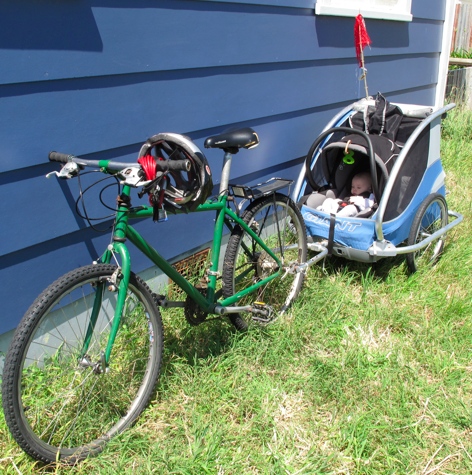
Our daughter’s bike trailer represents an investment in energy efficiency in that it allows us to pedal her around town instead of driving. The IRD mileage reimbursement rate for 2012 was 77 cents per kilometre. (This takes into account all of the associated costs of driving: petrol, insurance, WOF, repairs, etc.) For us, this means a round-trip to centre city in are Subaru sets us back about $11.

The second-hand baby trailer cost $125, plus an additional $60 for minor repairs. How many round trips from Castlecliff to city centre – at a savings of $11 each – would it take to recoup the investment?
Diane wrote:
Hi Nelson,
Really enjoying your column and coveting a home energy audit, should I be so fortunate!! By my reckoning it will take you 17 round trips into town to recoup an investment of $185 on Verti’s baby trailer. $185/11 = 16 trips, $9 remainder.
I noticed you and the family in town with the trailer before Christmas, so I guess you have made a start.
Happy New Year and warm regards to all.
Di P

Payback period is usually expressed in units of time: weeks, months, years. But in this case the unit was the number of driving trips avoided. Probably the easiest way for anyone to see the potential savings made possible through energy efficiency is to use the example of a compact fluorescent light bulb.
A brief version of this ran months ago as a side bar with this column, but at the current auspicious time of the dawning of a new year, little Verti and I will use this opportunity to try to convince some readers to resolve to change a light bulb in 2013. Here goes.
A 25-watt compact fluorescent light bulb (CFL) emits the same amount of light as a 100-watt incandescent bulb. This is a savings of 75% every hour!
Good Idea 
If you currently run one 100-watt incandescent for 10 hours each day, you’ll use 1,000 watt hours (1 kilowatt hour – kWh), or one “unit” of power as your electric bill probably says. Each unit costs around 28 cents.
Replacing that 100-watt incandescent with a 25-watt CFL would mean you use 250 watt hours, or 0.25 kWh, per day, costing only 7 cents. Therefore, your daily savings would be 21 cents by changing one light bulb.
CFLs cost $5 at most stores while incandescents cost $1. The difference of $4 is the up front cost one must pay for long-term savings. The question of the week is: How long will it take to pay back $4 at a daily savings of 21 cents?
400 cents divided by 21 cents per day = 19 days. This is child’s play, right Verti?
Bad Idea 
Every proceeding 19 days you’ll save another $4, for an annual savings of $76.84. Change two light bulbs and it doubles. Change three and it triples. Change four…you get the picture.
Changing just five 100 watt incandescent light bulbs to 25 watt CFLs could save you $384.21. But there is a catch. You need to come up with $25 to buy them. Is it worth it? Anyone resolved?
Helpful tip: I buy my CFLs at one of the major supermarkets in town. Their ‘store brand’ of CFLs comes with a money back guarantee. I save the bar code from the box and staple the receipt to it just in case a bulb does not perform up to standard.
 Peace, Estwing

‘Eco’ is almost always Thrifty, but…

Contrary to what some people may argue, making ‘eco’ choices are almost always also thrifty choices. I have provided dozens of examples eco-thrifty decision making in this column over the last eight months. The most recent one last Saturday profiled our daughter Verti’s first Christmas present: a second-hand bicycle trailer spruced up by a local mechanic.
Keeping the holiday theme going for another week, I’ll focus on our two eco-thrifty Christmas trees: indoor and outdoor.

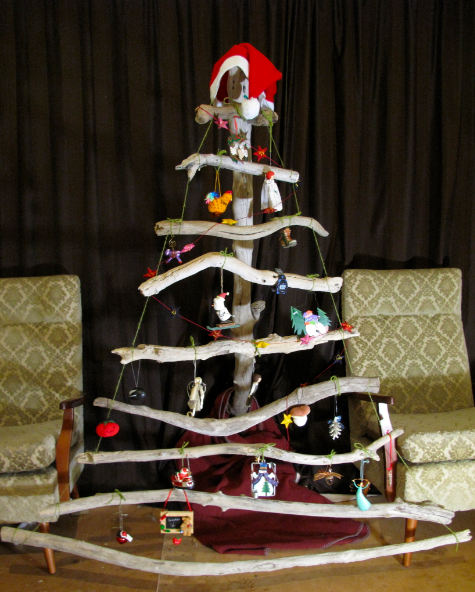
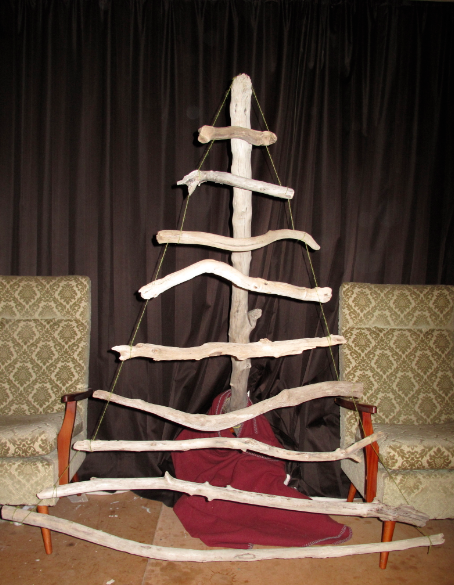
If you are a frequenter of the website Pinterest, you may recognize our Pinterest-inspired driftwood Christmas tree. We walked to the beach from our home just behind Seafront Road, and collected two armfuls of weathered branches. We carried them home, cut them to length, and tied them into a triangle with yarn. Finally, we hung the branches from another piece of driftwood with roots forming a self-supporting base.
Oh, and I almost forgot! Then we put on Neil Diamond’s Christmas album and decorated our eco-thrifty-beachy tree! I suspect it is easy for anyone to recognize the eco-thriftiness of this tree, although it is probably not to everyone’s aesthetic. That’s perfectly fine. To each their own.
But some readers may be surprised that our outdoor Christmas tree – the humble yet effective solar clothes dryer  – has been outlawed in many towns and suburbs across America. This is not a joke. But the States are not necessarily known for their eco-ness or thriftiness.
Using a washing line rather than an electric dryer is like riding a bicycle instead of driving a car: any way you slice it, the former is always both eco-er and thriftier than the latter.
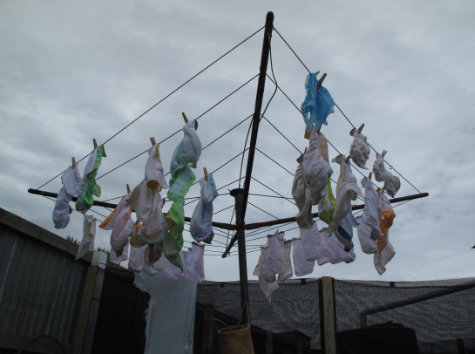
These days, our washing line is decorated with colorful cloth nappies – another example of a choice that is both eco and thrifty. It may be easy to recognize the environmental benefits of cloth diapers, but there are also considerable cost savings over the long run. This brings back the concept of payback period that I’ve written about regarding everything from light bulbs to solar hot water.
The following information comes from www.diaperdecisions.com: (Sorry, this is in US dollars.)
For a period of two and a half years, the calculated cost of disposable nappies is $2,577 (3,123 NZD) averaging 36 cents (0.44 NZD) per change. By comparison, the following versions of reusable nappies offer the following savings. (Includes washing costs).
• Pre-folds and covers: $381 (462 NZD). Savings = $2,196 (2,664 NZD)
• Fitted nappies and covers: $1,263 (1,532 NZD). Savings = $1,314 (1,594 NZD)
• AIO nappies: $1,413 (1,714 NZD). Savings = $1,164 (1,412 NZD)
• Combo cloth nappies: $1,468 (1,780 NZD). Savings = $1,109 (1,345 NZD)
• Pocket nappies: $1,677 (2,034 NZD). Savings = $900 (1,091 NZD)
The website also points out the obvious regarding cloth nappies: they can be used for another child or sold once your bubs is potty trained. Both options increase the potential savings, which build and build over time.
Once again we see that the most ecological choice is also the most economical choice in the long term. This is also true for insulating and draft-proofing a home, energy efficient light bulbs, bicycle trailers, laundry lines, and solar hot water. However, all of these things share one or both of the following characteristics: 1) they require an initial investment of funds; 2) they require an ongoing investment of effort.
For various reasons, these conditions appear to be significant barriers to many people adopting sustainable behaviors. As a social science researcher, these barriers and potential strategies for overcoming them fascinate me. But that, my friends, is a discussion for another day.
Peace, Estwing

Christmas in the Southern Hemisphere

One of the adjustments of living in New Zealand so far has been seeing Christmas decorations around town in the middle of the summer. It does seem that far fewer Kiwi households decorate like they do in the states, but there are some here who really embrace the holiday spirit. These pictures are from a house down the road from Dani and Nelson. There are some angels, reindeer and sled, a snowman (strange when it’s 25 degrees out) and, my favorite, a surfing Santa Claus.


In our house, we’ve drawn holiday inspiration from the beach. Nelson had conveniently dragged a large, free standing piece of driftwood up from the ocean before we arrived. I’m not sure exactly what he had in mind for this furniture sized piece of wood, but it served our purposes beautifully. We went back to the beach and retrieved several more driftwood sticks then threaded them so that they would hang from Nelson’s makeshift tree trunk. All that was left was to decorate our beachy Christmas tree!


Not wanting to culturally exclude our Jewish residents, Molly and, perhaps, Billy T the cat, I also took the opportunity while at the beach to grab a piece that would work as a menorah. Drilling nine holes into the wood was an easy operation and, just like that, we were celebrating Chanukah! The only drawback of this tasteful menorah is that it does tend to catch on fire when the candles burn too low. Nelson was glad when Chanukah was over so he could go to bed without fear of his house burning down… Molly and I also made a giant batch of latkes and broad bean felafel for the holiday.


A very beachy Christmas and Chanukah to everyone!
Jessea and Molly

Eco-Thrifty Thinking

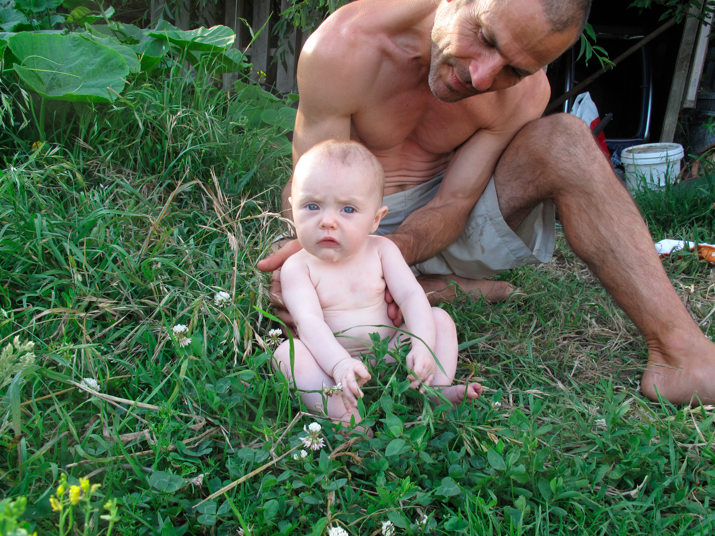
Although our daughter, Verti, came into this world a fortnight late, her first Christmas present arrived two weeks early. As parents, we do not intend to shower her with colourful plastic toys, especially a certain anatomically impossible doll that drives a pink Corvette. (At least she used to in the 80’s, the last time I checked.) So far, her favorite toy was homemade from driftwood – her eco-thrifty play gym – 
and we hope that her vehicle of choice is more of the green, two-wheeled type. All of this is a long way ‘round to her Xmas pressie: a bike trailer.

It is also a way to present another case study on eco-thrifty thinking. Everyone loves a good Christmas story, so here is:
Verti’s First Eco-Thrifty Kiwi Christmas.
Once upon a time in the magical kingdom of Whanganui, there lived a bald little girl called Verti Feliz. She was born on a cold winters’ night in an ancient hovel in the shire of Castlecliff. Ok, enough of that…
I’ll use this case study to remind regular readers and introduce new readers to the characteristics of eco-thrifty thinking (ETT). Eco-thrifty is not eco-chic (think Good Magazine), nor is it cheapo-thrifty (think Dollar Store). ETT seeks a middle ground between being kind to the Earth (Middle Earth?!?) and keepin’ it real regarding affordability. The central mandate of ETT is low-investment and high-performance. This mandate can be quantified using a concept known as ‘payback period.’
Back in April of this year, I introduced payback period in my first column. Put simply, payback period is the time it takes to recoup an investment in energy efficiency in actual savings. For example, the payback period for a compact fluorescent light bulb is 6 months to a year depending on usage. That means that within that time period (6 to 12 months) you’ll save the initial $5 investment, and during every subsequent interval of that time period you’ll have an extra $5 in your pocket.
Verti’s bike trailer represents an investment in energy efficiency in that it allows us to pedal her around town instead of driving her. The IRD mileage rate for self-employed people and reimbursing employees for 2012 is 77 cents per kilometre. What this is meant to represent is the total cost of driving: petrol, insurance, WOF, repairs, etc. For us, that means a round-trip to centre city sets us back about $11. So, people, get your calculators out.
If the purchase of a second-hand baby trailer is $125, and it costs an additional $60 for a local craftsman to rebuild the wheels, then how many round trips from Castlecliff to city centre – at a savings of $11 each – would it take to recoup the investment? (Send your answers to theecoschool@gmail.com before 31-12-12. A randomly selected entry will receive a free home energy audit.)
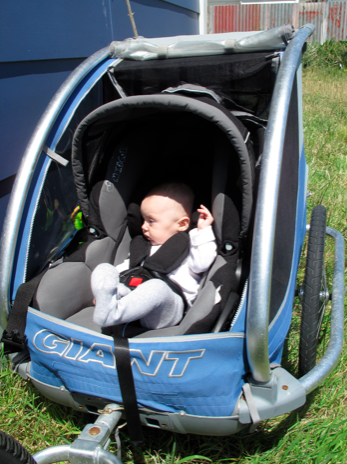
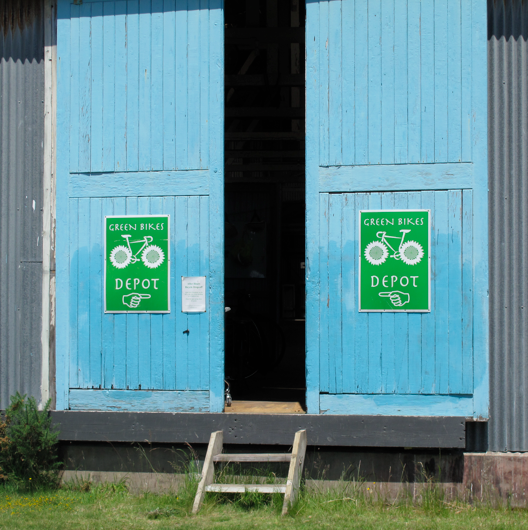
Beyond the financial savings associated with pedaling bubs about town, Verti’s first Xmas pressie also satisfies other characteristics of ETT: reduce, reuse, and support local businesses. We bought the trailer on TradeMe from a Wanganui family that originally bought it from a local bike shop. They benefited from the sale by earning some cash from something they no longer use, and we benefited from a low-cost / high-quality investment. The trailer is a quality brand – Giant – and is built primarily from aluminium and rigid plastic, which suits our coastal position in terms of rust-avoidance. However, a number of the spokes were broken, so I dropped off the wheels at Green Bikes…
where Jonah the Whizzard of Whanganui turns trashed bicycles into two-wheeled treasures. In an especially amazing wheet of Whizzardry, Jonah had them finished and delivered before sunset on the same day. 


This meant the following day Verti could go for her first bike ride with me on the green bike that Jonah built for us over four years ago. Thanks Uncle Jonah! Chur. 

Peace, Estwing

Eco Design Advisors are Super Heroes!

I had the great good fortune recently to spend a lunch hour with Richard Morrison from Kapiti Coast District Council (KCDC). On the surface this may not appear exciting, but the meeting had two things going for it: the lunch was free (thanks to Judith Timpany at the Whanganui Community Foundation), and Richard is the Eco Design Advisor for KCDC. Sharon Duff, from the Primary Health Organisation, invited me to the meeting that was also attended by two representatives from Wanganui District Council, a pair of local builders, herself and Judith.
There is a phrase in our household we use to describe special people: “She/he is the real (sometimes additional word inserted here) deal.” Richard is all that and a bag of chips.
He is passionate, knowledgeable and generous with his time. Richard took an entire day out of his busy schedule to travel to Wanganui and share his perspectives on warm, healthy, low energy homes.
Our patch before
 Our patch after
As I’ve tried to emphasize in this column, Richard’s presentation highlighted the economic savings associated with eco-design. Rising power bills concern us both. While I have written that electricity rates are on track to double in the next 10 years, Richard shared information that they could double in as little as eight! In in the case of our household, a rise from $22/month to $44/month would not break the bank, but for families paying $300, a rise to $600 could be devastating. When this is added to the recent radical increases in homeowners’ insurance, the effects could be profoundly negative for local businesses due to less available ‘disposable income’ of the average Wanganui resident.
And beyond that, as electric rates rise, more people may choose not to heat their homes because they cannot afford to. This would exacerbate an already major challenge facing New Zealand: health problems associated with cool, damp homes. Here is some information from the Eco Design Advisor Network (Participating Councils: Auckland, Hamilton, Palmerston North, Kapiti Coast, Lower Hutt, and Nelson):
New Zealand homes are generally cold, damp, unhealthy and inefficient in energy and water use:
• NZ homes are on average 6 degrees Celsius below World Health Organization recommended minimum temperatures in winter.
• 80% of NZ homes are inadequately insulated.
• 45% of NZ homes are mouldy.
• NZ has the second highest rate of asthma in the world, and an excess winter mortality of 1600, a much higher rate than other OECD countries.
• Cold, damp homes pose serious health risks, particularly for the most vulnerable groups in the community who spend the most time at home.
Unhealthy homes clearly cost the health system, but also cost the economy through lost productivity due to worker illness.
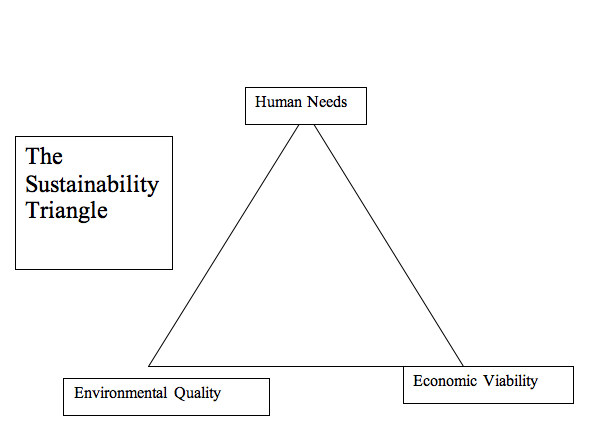
Sustainability is often presented as a triangle including environmental quality, human needs, and economic viability. This is a model I have used as a teacher for 20 years. 
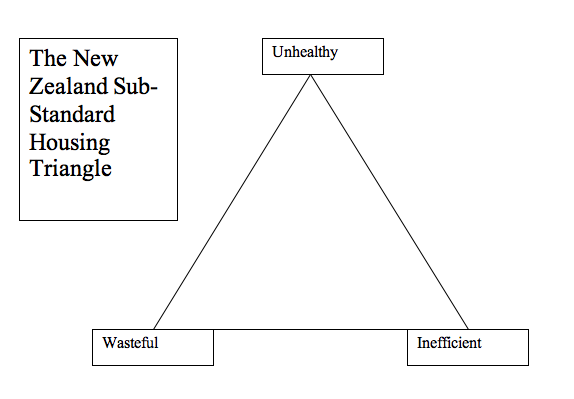
But the more I learn about the majority of housing stock in New Zealand, a different triangle comes to my mind – a sort of Bermuda Triangle where things such as money and health disappear. The three points of this sub-standard housing triangle are: Unhealthy, Inefficient, Wasteful.
The Eco Design Advisors are doing amazing work to combat the Bermuda Triangle of New Zealand homes, and rescuing families from the netherworld of cold and mould. Learn more at their website: http://www.ecodesignadvisor.org.nz
Thanks again to Richard for taking the time to share his insights with our community. Chur, bro!
Peace, Estwing

Retrospective #31Paradox, Smartphones and Spontaneity

As an on-again, off-again, part-time student of Eastern philosophy, I have always been intrigued by the role of paradox. Wikipedia defines paradox as: “A paradox is a statement or group of statements that leads to a contradictionor a situation which (if true) defies logic or reason, similar to circular reasoning.” From my observations, Taoism and Buddhism are full of paradox.
“If you could not laugh at it, it would not be the Tao.”
“If you meet the Buddha on the road, kill him.”
Herein is the paradox that I see relating to the Chinese intern who worked with us during February, March and April of this year. Ji Qiao is a Chinese citizen who attends university in America. The private university he attends charges tuition around $50,000 (US$) per year. That university has an overseas programme in New Zealand. The programme used to be centred in Christchurch, but since the earthquakes it has been centred in Wanganui. Part of the programme engages students in two-days-per-week internships.

Put another way, this Chinese young man’s family pays $50,000 (US) per year to a university in the states for him to work for me in Wanganui for free.
Although this is an unfair characterization, it emphasizes the paradox of the situation.
The next paradox is that although Ji Qiao had never swung a hammer in his life, he was an AWESOME intern. Herein lies the tale of Ji Qiao, his Smartphone, and a pile of wood.
Throughout February and March, Ji Qiao and I worked on various little projects around the property, but he kept reminding me that the one he was looking forward to the most was “paving” – as he called it – the kitchen floor. Finally, following his “spring break” trip to the South Island, the time had come to pave the floor!
What made Ji Qiao such an amazing intern was his genuine enthusiasm and willingness to learn. He used his Smartphone to take notes on new words he learned – plies, bearers, joists – and on one sunny April day, to add up the linear metres of Tasmanian oak I bought on TradeMe (see last week’s Chronicle), and calculate the square metres of coverage we could get out of the random lengths of timber stacked under roofing iron in the yard.
Together, we stacked the oak in groups of lengths within 200 mm of each other. I measured the size of the kitchen while Ji Qiao listed the quantity of boards in each grouping. Then he used his mad maths skills to spin his arith-magic. According to his calculations, we could get 15.2 square metres of coverage from a total of 15.5 square metres of random-length stock. This may not sound impressive on the surface, but what it means is that the total off-cuts would be 300 mm, or 0.02%. That’s low.
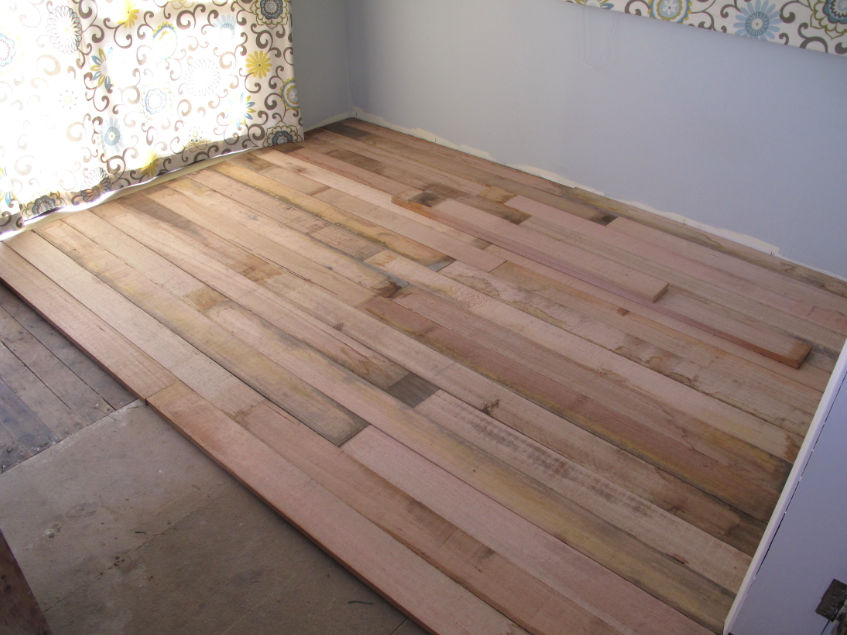
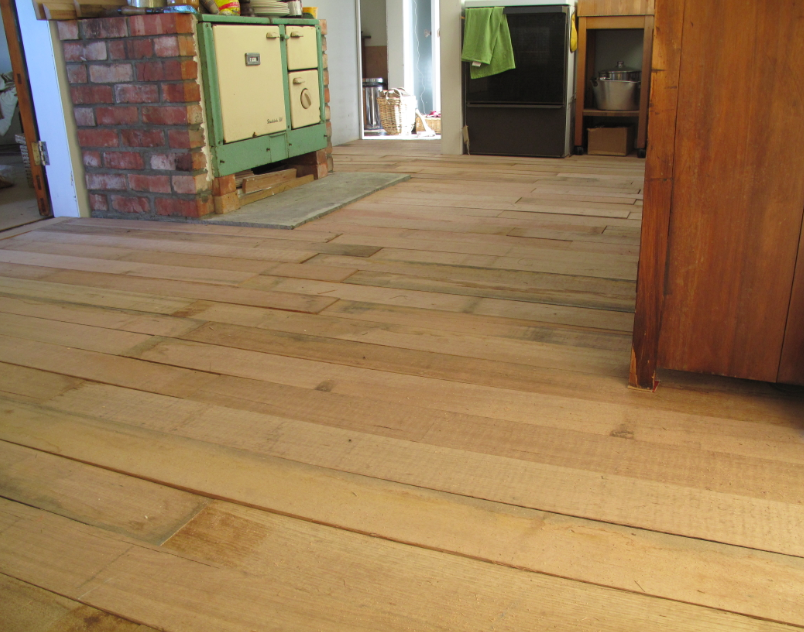
The way we were able to achieve such a small amount of ‘waste’ was by matching short and long lengths, and medium and medium lengths, to the near-exact total lengths required for different parts of the floor. The easiest place to visualize this is to look at the photos in last week’s Chronicle. Barring that, I’ll do my best to explain.

The largest section of floor to cover measured 2.9 x 3.4 metres. We laid the boards in pairs that measured nearest to 2.9 metres, and alternated between short-long, medium-medium, and long-short for the best visual effect. This part of the job went quickly once we had a system in place. But after that, we had to change our strategy as the dimensions of the flooring needed changed around the Shacklock 501, the kitchen bench, and a short entryway. Despite the slowdown, we nearly finished the job in one day, much to the surprise of my wife Dani who returned home from work at 5:30 pm not knowing the floor was on the schedule for the day. And she says I’m never spontaneous! 


Peace, Estwing

Retrospective #30: Change is Good.

1st, December, 2012. Welcome to the first month of the rest of your life. I do not know much about the Mayan Prophesy, but I do know that 2012 was one of the worst movies I’ve ever seen. From what I understand, some people say the world will end this month. Others claim it will be more of a transformation that takes place: the death of old ideas and ways of thinking, not the death of all life on Earth.

I don’t know about you, but I prefer the latter of these scenarios. I prefer it for a number of reasons: 1) I have a bubs who is three months old; 2) I’ve got a little more living to do myself; 3) I reckon there are a good number of old ideas and ways of thinking we’d be better off without.
Yesterday (30th November, 2012) was the official due date of my doctoral thesis, which represents four years of research, careful thought, and a massive amount of writing and rewriting. The gist of my thesis is that school science can be taught in such a way – relevant, experiential, local, solution-oriented – as to improve students’ scientific literacy, ecological literacy, and some students’ attitudes toward studying science. If you were one of those students who did not like science and dropped out as soon as you could, this approach to science teaching and learning is (was?) for you!
Transformation as nature does it
But this week’s column is not about boring you with the finer details of science education research, it is about transformations and seeing things differently. The reason I included the reference to my thesis above is to emphasize that transformation from old ways of thinking to new ways of thinking is not necessarily something to fear or avoid, but to welcome. For example, those students who reported a more positive attitude toward studying science when it was more experiential, local, relevant and solution-oriented experienced a change in their perception of school science. Would anyone argue this was a bad thing?
Transformation as nature does it
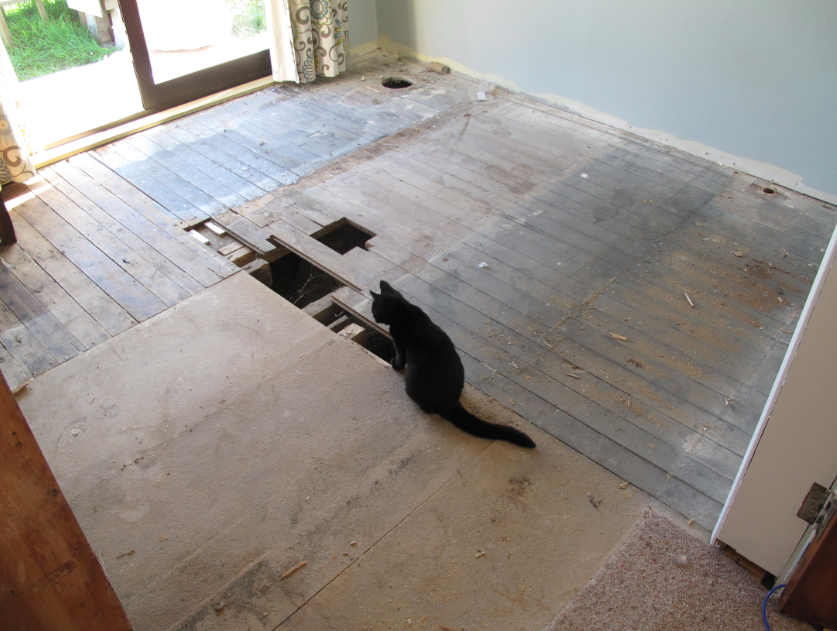
If December, 2012 brings about a change in our collective thinking that results in a more kind, just, fair and sustainable world, who would argue against it? (Actually, I think I may be able to name a few.) The point is that change – while sometimes scary and unpredictable – is often for the best. And that’s how a pile of wood sitting in a warehouse in Aramoho became a kitchen floor in Castlecliff.
Before 

The off-cuts and B-grade Tasmanian oak was not of use to the door manufacturer, so he put them up on TradeMe with a Buy Now price of something like $88. I did not know what I might use the timber for at the time, but I knew it was a bargain. I clicked it up and then I picked it up. And then it sat in our yard under roofing iron for over a year.
Before 
During
I don’t know when or why the motivation struck (probably when I was good and tired of writing my thesis), but one day while my wife, Dani, was at work, our Chinese intern Ji Qiao (don’t ask, it’s a long story) and I transformed the kitchen floor from trashed to treasured. The look on Dani’s face when she returned home said it all: “Change is good.”
After
Tune in next week for the tale of the Chinese intern, his smart phone, and how to get a 15.2 m2 floor out of 15.4 m2of timber. 
Peace, Estwing