Category Archives: Eco Thrifty Renovation

Eating Us out of House and Home

There is an expression in permaculture that goes something like “You don’t have too many snails, you have too few chickens”.

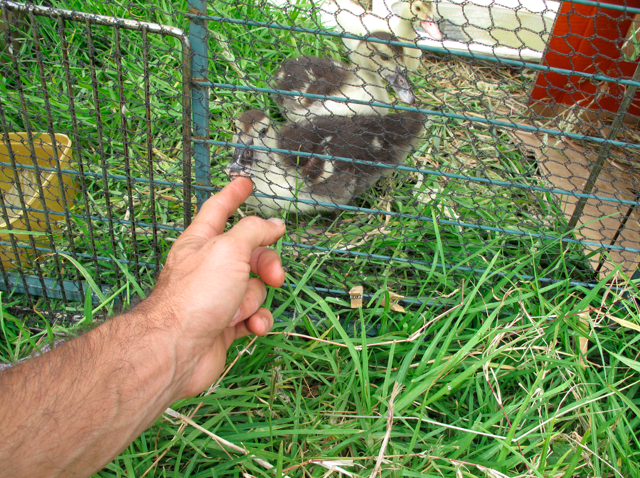
Well, we don’t have a snail deficiency, we’ve got a baby duck surplus.

Our ducklings have just about doubled in size in the week that we’ve had them. Part of the goal of having ducks was to have a protein source that we did not have to buy food for, making small gains in self sufficiency. We thought we had tons of snails. In fact we were crunching them underfoot walking up our driveway after a late night out two weeks ago. But the recent cairina moschata population boost has put a bit of a strain on our small backyard eco-system. Our normal go-to spots for snails have been picked dry by the need to feed our ducklings’ insatiable appetite.
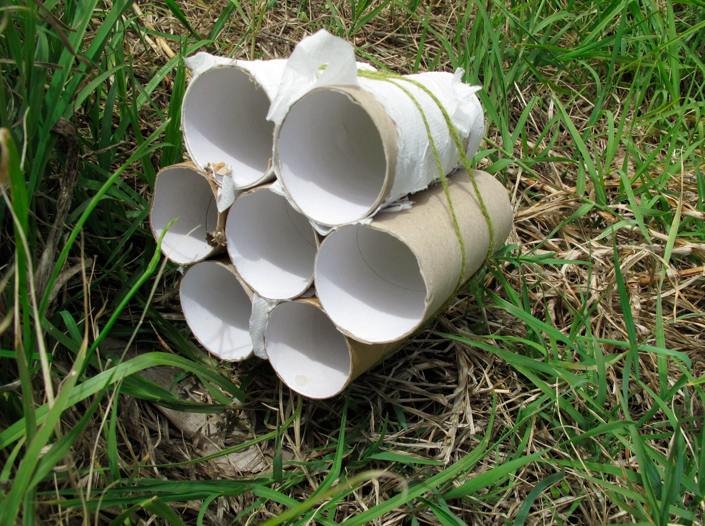
So, after some internet research we have begun improvising some snail traps. Most people use these traps to lure snails away from their garden beds. We are hoping they lure snails out of their summer hiding places, and into an easy collection point.

Here is an example of the bricks and damp cardboard method.

And here is the toilet paper tube cluster method.
From past experience we know that the beer method works well, but we’re a little afraid of the effects of intoxicating our wee babies just yet.

Ducks cannot subsist on snails alone, even when they are eating 20+ per day. So we are supplementing their diet with another resource we had in abundance, seedy grass. We were using grass to line the bottom of the duck’s inside home, an unused bath tub, and found that they really liked eating the grain from the tops of the grass. Thanks to a preoccupied scyther our yard was a veritable sea of waving amber grain, or as the duckies see it, a sea of food waiting to be harvested.
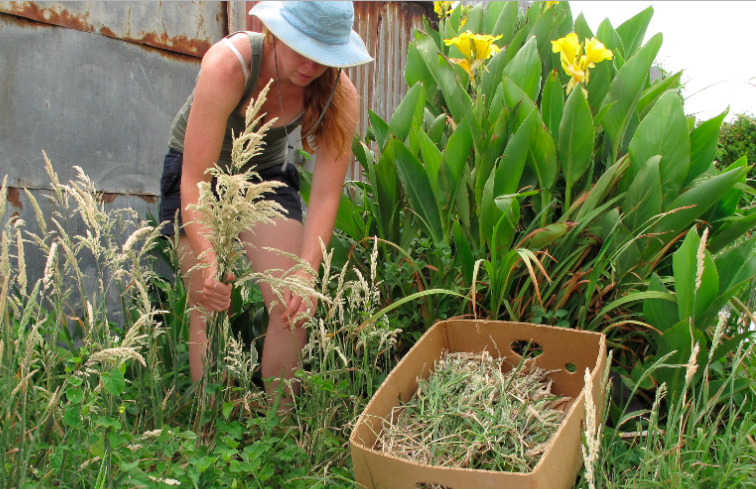
This is pretty perfect since every grain of grass seed is one more future weed waiting to invade our garden beds.

So far the ducks are proving their worth by ridding us of two potential problems, and converting them both to fertilizer. As William McDonnough says “Waste = Food”, or in this case, waste = … more useful waste.

Have you found any good waste = food solutions lately? Pass them on.
A Mid-Summer Night’s Dream

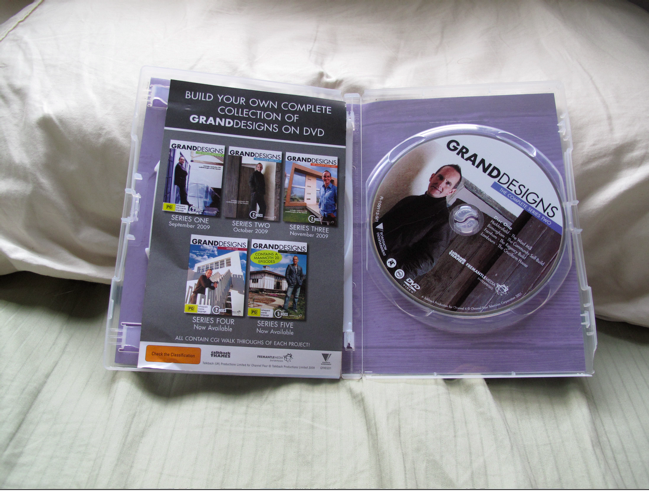
We like to watch old episodes of Grand Designs in bed. The program is highly entertaining, mildly educational, and somewhat addictive. Luckily our friend Tracy has all of the seasons on DVD and is happy to share them with us.

Over the course of watching the first two seasons I can recognize patterns that often form when couples tackle these types of building projects – particularly those that are renovations. Inevitably, the project goes over budget and over time, the couple gets stressed out, and the episode ends with host Kevin McCloud chatting with the couple by candle light in a drafty room because the house does not have electricity or windows yet.

Let me make it perfectly clear that we (now) have electricity and windows, and that our design is anything but grand. (When Kev wants to start ‘Humble Designs’ we’ll be first in line.) When we bought this property we inherited an existing consent for a renovation that included a large deck, verandah, and walk-in closets. We eliminated these but added solar hot water and insulation. That’s the way we roll.
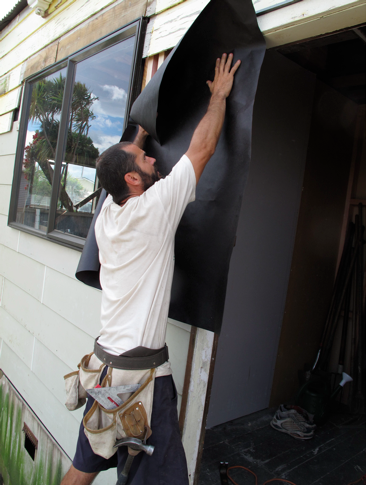
Solar hot water and insulation are about as eco-thrifty as you can get. That is, you can save money and the planet simultaneously. Each one offers a return on investment greater than any term deposit in any bank. The point at which the savings from energy bills equals the purchase price is called the ‘payback period.’ After that, all of the additional savings are untaxed income: money in your pocket.

However, there is a caveat: you have to be able to afford them in the first place. If you can’t pay cash then you end up borrowing money, and the interest robs a part of your savings and extends the payback period. Although the US and NZ governments have schemes to help homeowners include energy efficiency measures, in most cases the result is more borrowing and more debt. (More on debt in a moment.)

In my opinion, the best approach governments could take would be providing zero-interest loans for insulation and solar hot water. These loans would act exactly like a cash purchase for the homeowner who could then repay the government through savings until the payback period is reached and then, as they say here, “Bob’s your uncle.”

While I have no idea why Kiwis use this phrase, I do have an uncle Bob. I do not, however, have a zero-interest loan. Therefore, I have dipped into my life savings to pay for insulation and solar hot water. This is an excellent investment because:
• Energy prices outpace the rate of inflation and there is every indication that this will only continue and even accelerate in the future. Any hedge against energy price rises is simply smart economically. The green benefits are a bonus.

• At the rate of quantitative easing (“printing money”) in the USA, my US dollars are becoming worth less and less everyday. Why leave them sitting in a bank losing value when they can be in my walls and on my roof adding value?

• New Zealand is not immune to debt either. This land of the long white cloud has significant debt issues on many levels that will come home to roost someday in the not-so-distant future. Whether that will look like Greece or Ireland I do not know. But something is bound to give.

• In a world that seems to be spinning out of control economically, environmentally and socially, it gives me peace of mind to have a tiny bit of control over a tiny property on a short street in a small city on a petite island in a big ocean.

We are not wealthy, but we have chosen to spend what money we do have on insulation and solar hot water for the reasons outlined above. We feel good about that decision, but it does not mean that we don’t stress out about going over budget and over time. After watching another uncompleted renovation on Grand Designs last night, I had terrible dreams that kept me tossing and turning in the summer heat.

I got up this morning, made myself a cup of coffee and started writing. I feel better now because I know we are doing this for all the right reasons. We are taking an abandoned house on a derelict section and turning into an urban homestead. We are sharing our story with anyone who wants to listen. And we are having fun doing it.

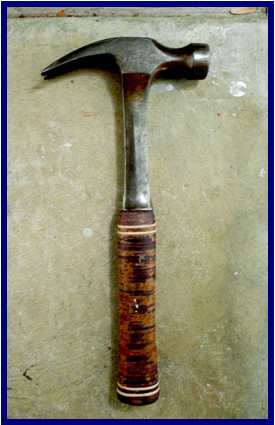
Peace, Estwing

First Harvest in the New House

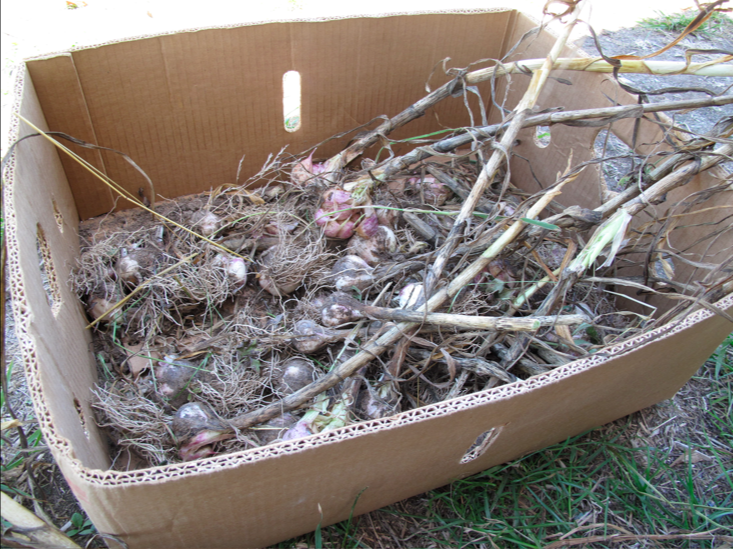
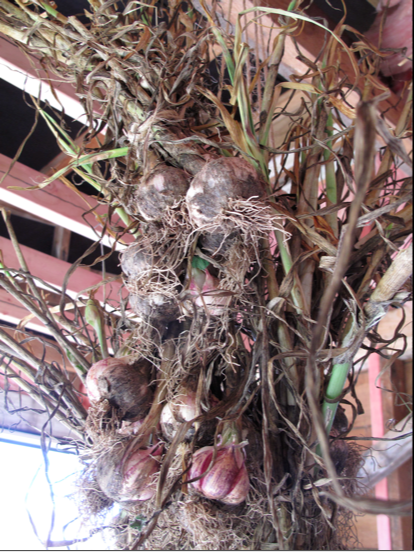
Ok, well technically we didn’t actually grow this on our land. Nelson planted it the day he closed on the house in July, in a paddock that belongs to the famous Hatherly-Joneses of Papaiti. And actually, I suppose we’ve been munching a few random leaves out of our garden for a few weeks now. But this is our first major harvest in Wanganui, which I think is something to celebrate.
And I think it did pretty well, considering we left it to fend for itself, and had to do a bit of an easter egg hunt to find it amongst the tall grass.

Here’s to crops that grow themselves without any need for weeding or watering!


What should we toast with? Garlic bread dipped in pesto, perhaps?

-June Cleverer

R2 E2 (ie: 2nd edition)

Granted, the ducklings, stainless steel nails and Pink Batts are not reused materials, but we are striving to emphasize reuse in this project as discussed in a previous post: R2 (no D2). Corrugated iron is to New Zealand as asphalt shingles are to the USA. A major difference is that iron sheets can be reused in innumerable ways (see below) and then recycled in the end.

Who needs a panel beater?

Baaahd Art

Right on, Mr. 4! (funkypancake.com)

When I re-roofed my farmhouse in New Hampshire, I was in the vast minority of Americans who choose steel roofing over asphalt shingles.

Trollbacken, Summer 2007

But this post is not about new iron, it is about reusing old iron. For example, covering the unpainted/untreated wood from the renovation that we plan to burn this winter.

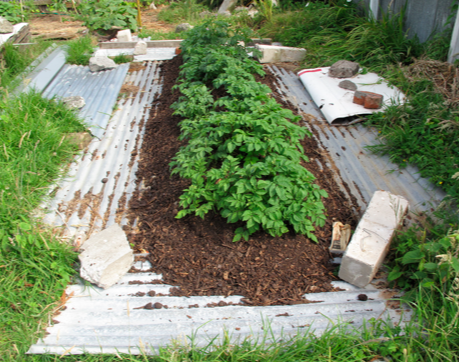
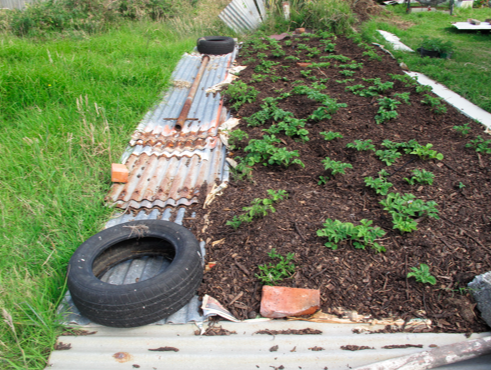
And creating temporary no maintenance edges to our potato patches while we put our efforts elsewhere.

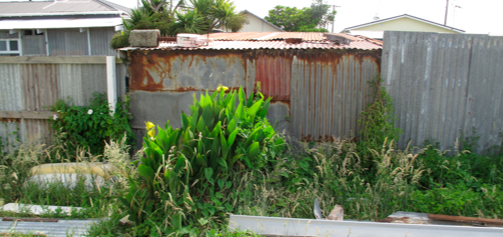
And, although we won’t embrace this ourselves, reusing roofing iron as fencing has been embraced by neighbors all around us.

Eastern boundary

Northern boundary

Southern boundary

We are thinking of reusing roofing iron when we build our chicken/duck run and coop.

Hey Kiwis, any other suggestions?

Peace, Estwing

R2 (no D2)


@font-face { font-family: “Times New Roman”; }p.MsoNormal, li.MsoNormal, div.MsoNormal { margin: 0in 0in 0.0001pt; font-size: 12pt; font-family: “Times New Roman”; }table.MsoNormalTable { font-size: 10pt; font-family: “Times New Roman”; }div.Section1 { page:It is difficult to write about the 3 R’s (Reduce, Reuse, Recycle) as separate entities as they are all part of an interconnected design strategy. For example, by reusing materials we are reducing the need to manufacture new materials as well as reducing the amount sent to landfill and the transportation involved. Thus, by reusing we are reducing our ecological footprint, which includes the carbon dioxide, water pollution, air pollution, soil erosion, and chemicals involved in manufacturing and shipping building materials.

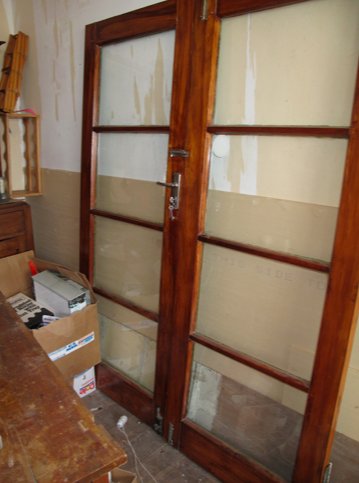
While the building code requires us to use treated pine lumber, stainless steel nails, foil tape, etc., there are still plenty of ways to reuse all manner of stuff both in the house and on the property. For example, second-hand doors and windows are easy to come by on Trade Me and at the local renovation center.

Rimu French doors purchased on Trade Me waiting for installation.

Second-hand windows installed. (House paint is on the way.)

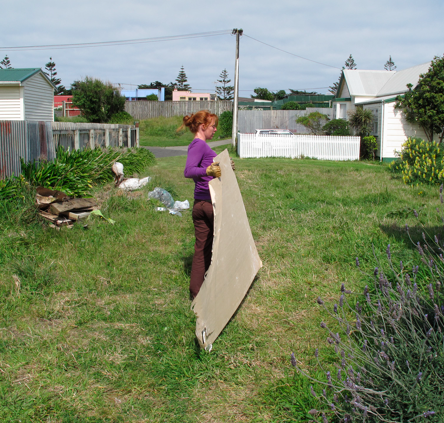
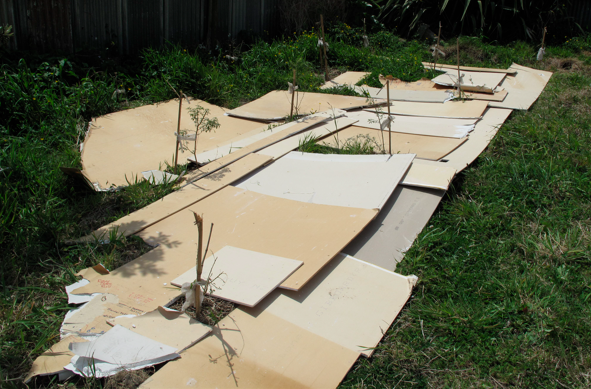
Faced with the removal of half a ton of damaged wall board, we turned a liability into an asset by using it as mulch for establishing our food forest, veggie garden and potato patch. Dry wall is made of gypsum and paper. As long as it is not painted or ‘aqualine’ (tinted green – used in bathrooms and treated with a fungicide) clean wall board can be used as a garden mulch and soil amendment.

Late October.

Late December.

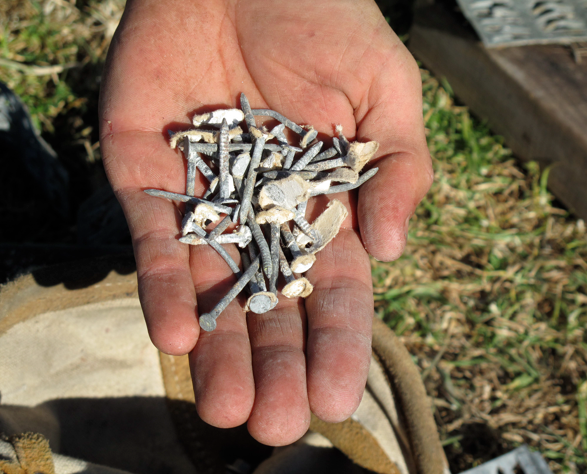
And finally, partially rotted rafters we found in the corner of the yard along with some old roofing paint and gib clouts pulled from the aforementioned wall board provided just the raw materials we needed to resurrect the poor old mailbox we found under the house.


Peace, Estwing

R #1


It does not take much to become “world famous in New Zealand,” and even less in Wanganui. We love Wanganui because it is a city of 45,000 but feels like a small town because everyone (nearly) is so friendly and everyone (nearly) reads the Chronicle.

After one short article (Couple hopes green renovation inspires), we could not enter a shop or get on the bus without someone saying, “I saw you in the paper. Good on ya!” But that was three weeks ago and our quarter hour of fame has faded…or so I thought. As the last of the stainless steel fibre cement nails were driven into the Hardy plank yesterday afternoon, I rushed into Mitre 10 Mega on my way to the police auction and annual holiday spot prize giving at Haywards Auctions. I hardly had time to gag at the price ($30 for 500 grams) when a voice rang out behind me. “I read about you in the paper. I see you in here all the time.”

Following a brief interchange, he said, “You must be a real greenie.”

I took a deep breath and replied, “Actually, I’m an economist.”

Brief silence.

“Look, oil is at 90 dollars a barrel and petrol is pushing 2 dollars a litre. Being green is only going to save you money in the long run. Everything we are doing in our house is to save money in the long run. And as energy prices go higher and higher, we’ll save more and more.”

“Yeah, I know,” he shrugs. “I drive a V8 supercharged.”

Brief silence.

“Thanks bro, I gotta go.”

The point of this story is to introduce the first of our Rs: Reduce. It is hard to explain this concept in the context of Western consumer society. It is like explaining the desert to a whale or the ocean to a cactus. It is like the negative image of a photograph.

Additionally, reduction is not really something you do so much as something you don’t do. You don’t…waste. You don’t waste anything: time, money, energy, materials, water, etc.

By designing efficient systems, buying second-hand goods, investing in energy efficiency, and embracing creative reuse, we have reduced: our construction costs, our carbon footprint, our power bills, our waste disposal bills, and our grocery bills. With those savings we can reduce the time we work for money and increase the time we surf!

Peace, Estwing

The 3 R’s

In the midst of the holiday shopping rush – often called ‘Silly Season’ here in NZ – we have taken a non-traditional approach to…just about everything.

While others fill their yard with festive light displays, we…

While others buy artificial Christmas trees at the Warehouse, we…

While others carefully wraps presents in gift wrap, we…

It seems that in the week leading up to the biggest consumer orgy of the year that I introduce our next three design principles: Reduce, Reuse, Recycle. As you may be aware, the order of this trio is as important as the meaning of each one.

With regards to waste management, we want to first reduce the size of the waste stream, then reuse as much of that waste as possible, and finally recycle whatever is left over that we absolutely cannot use on site. We have already diverted over 90% of the waste stream of this project in this way.

My next posts will cover specific strategies for reduction and examples of creative reuse.

Peace, Estwing

Design Principle #3: Insulation

Before I got side-tracked by our postal and electrical adventures in Neverland (From off te grid to off te radar), I was working my way through our 7 design principles for this project starting with solar gain and thermal mass. As June and I explain in our short video, Introduction to Passive Solar Design, it is essential that insulation work in conjunction with sun-facing (toward the equator whichever hemisphere you’re in) glazing and adequate mass inside the building envelope.

Not rates envelope, building envelope!

If you are familiar with the greenhouse effect you may see a parallel here. Ultraviolet light comes streaming through our windows in the same way it enters Earth’s atmosphere. When it strikes the ground surface of the planet – or the mass inside our home – some of that UV light is transformed in infrared light, i.e. HEAT. We all know that heat rises, and in the case of the Earth it is the carbon dioxide, water vapor, methane and other greenhouse gases that ‘hold’ the heat in and make the planet habitable. Good on ya, CO2!


But the problem we all face now is that too much CO2 and other greenhouse gases are essentially over-insulating this planet and causing a laundry list of potential less-than-desirable consequences. That’s why the proactive and responsible governments of the world are in Cancun, Mexico sorting it all out for us. Good on ya, politicians!

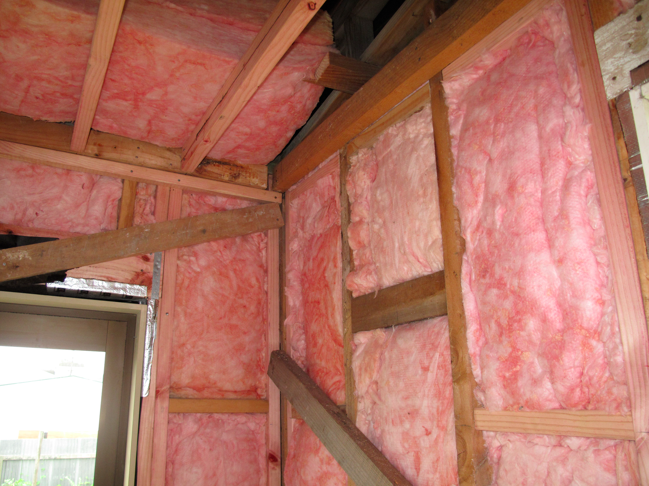
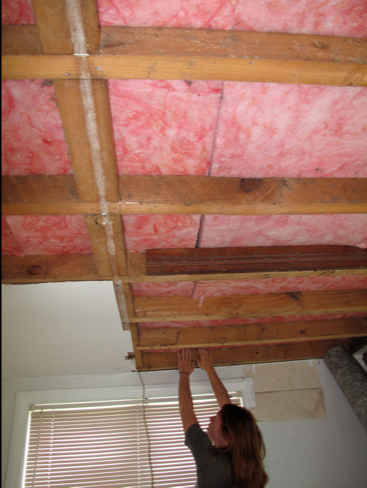
While the results of that meeting are likely to be nothing more than hot air, it is precisely hot air that I am hoping to hold within our home. I wish insulating the attic was as easy as filling it with carbon dioxide. Unfortunately, we have to settle for Pink Batts.


There are pros and cons to each choice of insulation depending on whose advice you seek, and I’ll try to write about that in the future. But today’s lesson is ‘location, location, location.’ Getting the most savings for your insulation investment (being eco-thrifty) is about identifying the low-hanging fruit and picking it first. In the case of insulation, it just so happens that the low-hanging fruit is up high and the high-hanging fruit is down low. In other words, insulate your attic first, your walls second, and your floor last. In this case physics and economics work hand-in-hand.

Relative heat loss through roof, walls and floor of an uninsulated home.

For our do-up down-under, we are insulating the entire attic, all external walls where Gib board has been removed, and under the floor in the northern 2/3 of the house? Why only the northern 2/3? Find out in a future post.

Peace, Estwing

From off te grid to off te radar

Editors note: “te” is Maori for “the”. Te Radar is a famous NZ comedian.

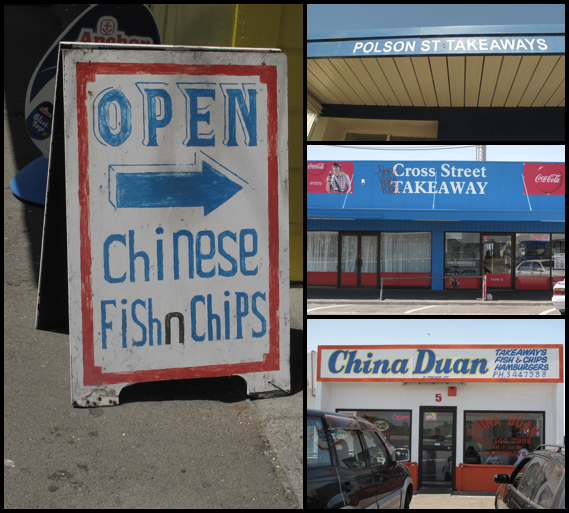
After living off the grid with solar electricity for 8 years on a 38 acre farm surrounded by thousands of acres of forestland, I thought moving to the ‘burbs’ would be simply cosmopolitan: mains power; postal delivery; bus service around the corner; fish and chips around the next corner; and fish and chips around the next corner and the corner after that.


While the bus and fish and chips are working out well, we have had significant trouble with the post and a minor disagreement with Meridian Energy over our first bill. One might think that putting up a post box on a certain street with a certain number would qualify one for mail delivery to that particular number on that particular street.


But one might be wrong. As we discovered, despite a neon-clad NZ Post pedal pusher passing our lonely #10 five days each week, we failed to receive anything in our newly painted post box except circulars which we specifically requested not to receive. Ah, I get it. Everything is reversed in New Zealand: different hemisphere, different lane for driving; fork on the right; toilet bowl flushes opposite. We should have written ‘No Letters’ and ‘Circulars Please!’ on the box. Of course!

Alas, after half a dozen phone calls, a visit to city council, the local post office and NZ Post Central Processing Wanganui, we…think we have it sorted, although we will not know for sure until the national database of postal addresses is updated next month. In the mean time, 10 Arawa Place in Whangarei is enjoying an abundance of wandering mail looking for a home, and our dispute with Meridian awaits resolution.

Our first paperless (that’s why we got it!) electricity bill came in at $144.56 for 510 kilowatt hours (kWh) of electricity. The good news is although the NZ household average electricity consumption is around 25 kilowatt hours per day, this bill represented our use as 16.5 kWh. The better news is that we actually used 0.39 kWh per day for a total of 12 kWh on the month. In other words, we were over-billed by 498 kWh or 98%. There appear to be only 3 possible explanations for this: the meter-reader is blind; the meter reader was intimidated by our high-tech meter box…


…or he/she – like NZ Post – simply could not find 10 Arawa Place, Castlecliff, and so Meridian simply billed us on estimated use.

Turns out the latter was, indeed, the case, and they have promised to send a human being to take an actual reading next month. Better work on the meter box before then.

-M.C. Estwing

Mass-ticate on This

To review, my last 2 blog posts discussed 3 of our strategies for adding thermal mass to the northern side of our home in an eco-thrifty manner. (A reminder to all ya’ll Yankees up naaath, weez in ta southin hemisfiyah.) Those include: a multi-fuel stove with brick surround that will serve multiple purposes beyond thermal mass; an extra layer of gib/drywall/sheetrock on top of the existing layer (see Mas Mass); stackable green wine bottles filled with water added and removed seasonally (see Every Bit Counts). Our next two strategies include an antique cast iron claw foot bathtub and some sort of dark floor tiles/slate/polished concrete.

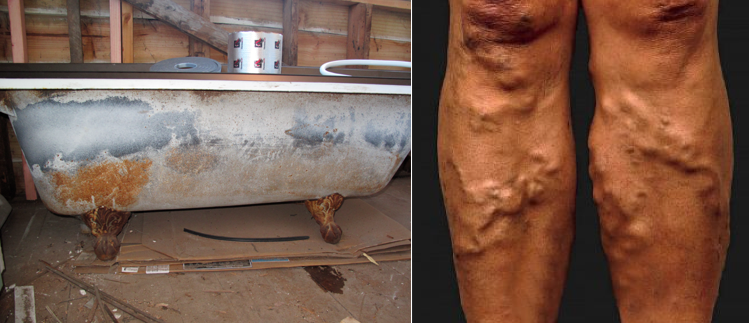
We picked up the tub on Trade Me (Kiwi version of Craig’s List/EBay) cheap as chips and our lovely, lovely friends Murray and Lindy picked up the tub in their truck on their way to our house for dinner.

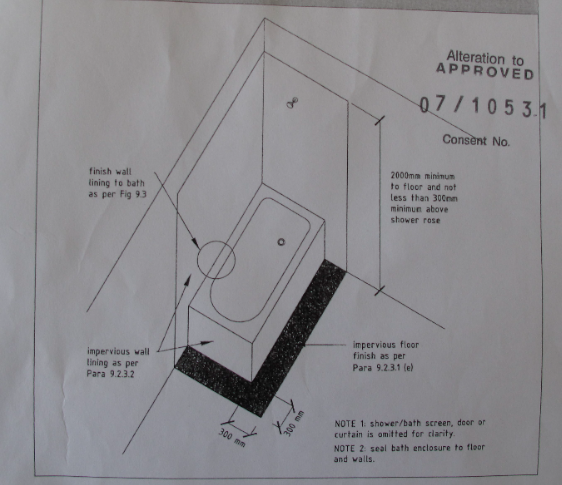
It is a beautiful tub that needs only a little cleaning up. A mixed blessing that I only discovered while looking over our ‘Alteration to Approved Plan’ (future blog post) is that the lovely, lovely feet are destined to disappear behind an ‘impervious wall lining as per Para 9.2.3.2’ as explained in Figure 9.4 of Paragraph 9.2.4 of SH/AS1 for a ‘Simple House’ (Department of Building and Housing, 31 March, 2010).

First of all, the last sentence is the absolute truth. Could a Kiwi builder please post a comment confirming this? Second of all, if this is the regulation for a ‘Simple House,’ I am glad I am not renovating a ‘Complex House.’ But I digress.

The other side of the coin regarding covering the feet is that the ‘impervious wall lining’ would also hide everything above the feet, which is where the tub would require sanding, priming and painting. It’s a little like an old woman with varicose veins simply putting on long pants instead of having expensive surgery and wearing shorts.

The tub’s position in the bathroom was chosen specifically because it will receive direct sunlight during the 3 coldest months of the year but not during the other 9. This solar gain will make a difference – no matter how small – to the thermal comfort of our loo at zero additional cost. I’m just trying to convince my wife to paint the obligatory ‘impervious wall lining’ a dark color – maybe a nice ‘mildew green’ would serve multiple purposes. (See outcome in future blog post sometime in 2015 when the bathroom is complete.)

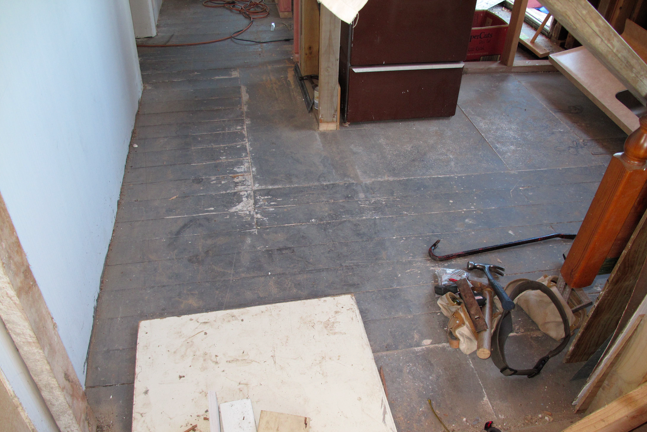
And finally, as we inch our way toward a day when our kitchen and dining room floors will want for something other than borer-infested ancient rimu and a patchwork of particleboard flooring, we troll Trade me, the Wanganui Chronicle and Hayward’s Auction House for a large box lot of – and this is important – matching, dark slate or tile squares.

Patience is another key to eco-thrifty building and with about 10 weeks before the floor must be laid, we can wait and see what comes up. Additionally, while looking at websites about building concrete countertops a thought occurred to me: Could we pour a thin concrete floor over the 15 square meters of the kitchen and dining room? This option could be a) cheaper, b) thicker (more massive), and c) any color we like (just add pigment). I may need to add a few more floor joists, but that would be a small price to pay. Any advice or suggestions on this one?

Peace, M.C. Estwing