Tag Archives: climate change

Things May Not Be As They Appear

Editor’s Note: This is another weekly column in the Wanganui Chronicle.


Timing is everything and you can’t judge a book by its cover. It seems we’re constantly reminded of these lessons. I’ll share some examples this week.

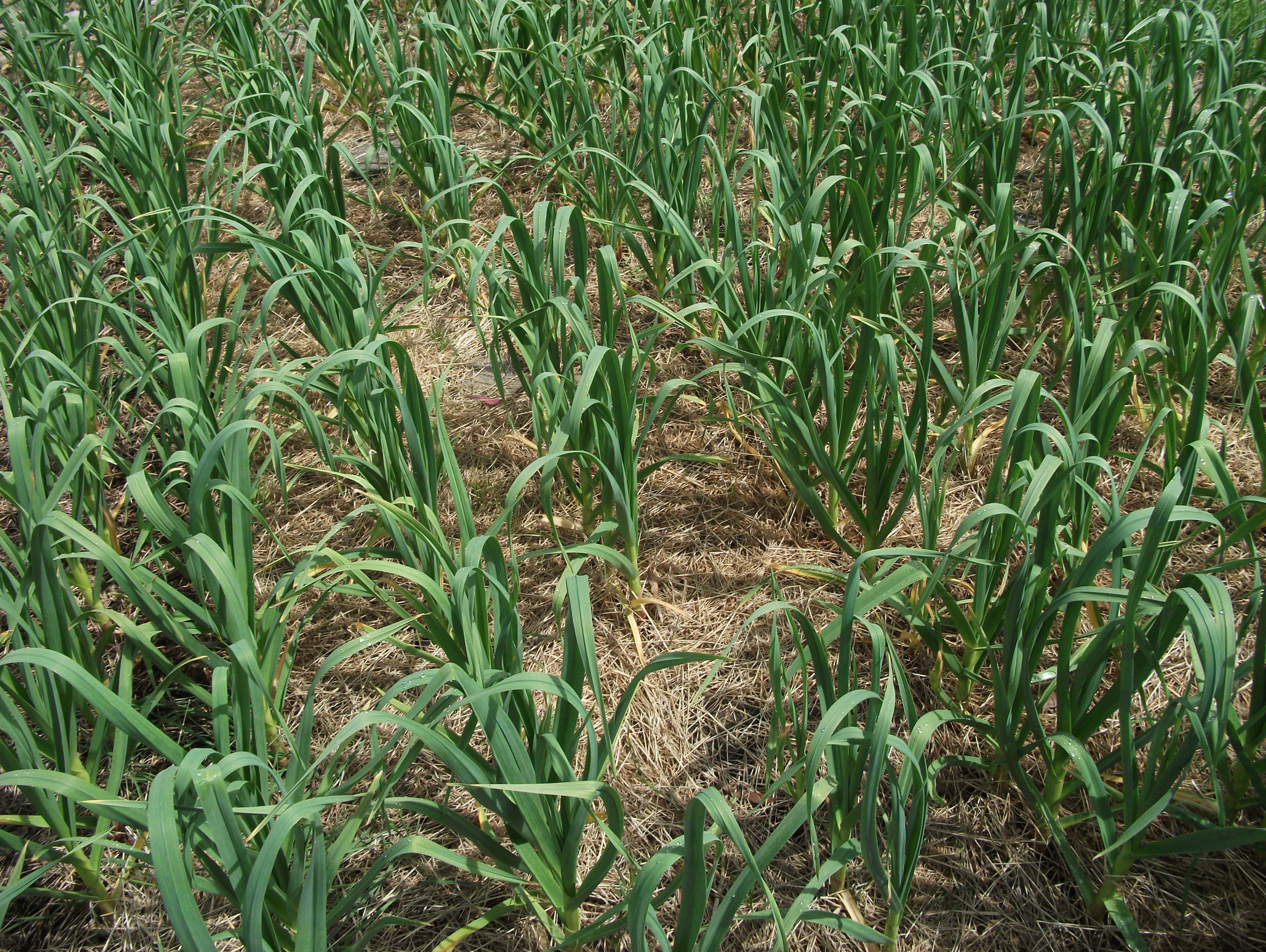
First of all, I faced these truisms late last week when I tried to push the garlic season by digging some bulbs for the Saturday market. On the surface they looked huge – stems thick and green. My hopes were high as I gently lifted the first few from the rich, dark soil only to be disappointed that what emerged did not match what was visible from above.
Screen Shot 2015-12-11 at 10.27.09 am

Yes, I was pushing the season by two to three weeks, but the stems were already so big I thought… Reminds me of another saying: Good things come to those who wait. Like fine wine, the World’s Best Garlic will not be rushed. The flavour is as good as ever, but more time will fill out the cloves. It won’t be back at the market until next week.

Another example of the importance of timing is how global climate scientists managed to manipulate the weather to cause devastating floods in England, southern Norway and India to coincide exactly with the COP 21 climate change talks in Paris. It’s obvious that climate scientists caused the massive rainfalls in England and India because they dumped the same amount – 341 millimeters – in both locations. This is exactly the type of lazy science we have come to expect from the likes of NASA, NOAA, NIWA, and the IPCC.

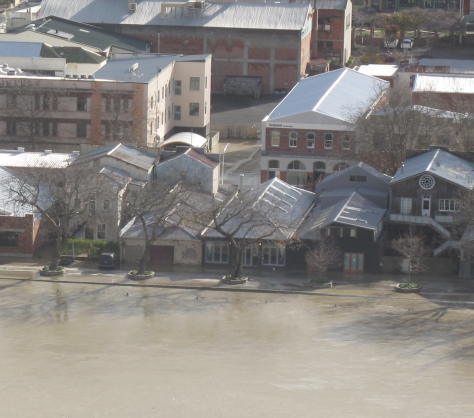
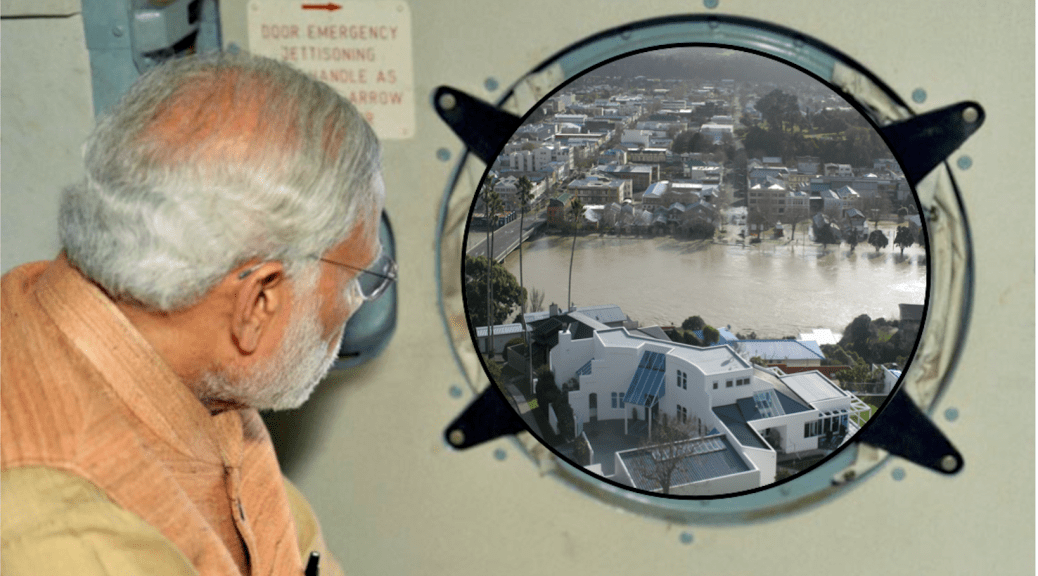
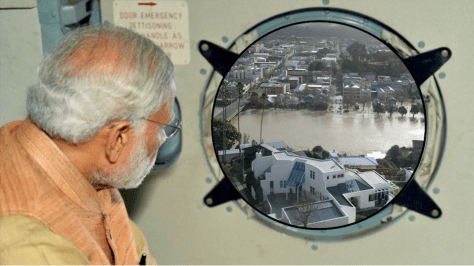
At least we can rely on India’s Prime Minister Narendra Modi, and his press office, for giving it to us straight on the flooding. What most people don’t realize is that Modi made a special trip to Whanganui in June to assess the extent of our own flooding as shown in the accompanying photo.
Screen Shot 2015-12-11 at 10.21.11 am

In the age of Photoshop, many things may not be as they appear.

But seriously, how’s this for timing: the region of Cumbria, England has experienced three record floods in a decade. After the 2009 flooding, residents were told they had experienced a once in a lifetime rain event. Nek minit, Storm Desmond with over a foot of rain in a day. Water levels were half a metre higher than the 2005 flood.

By these measures, Whanganui could experience flooding 50 centimetres higher than this year as soon as 2021. Although there is low probability of this happening, it is not out of the realm of possibility. Cumbria has set a precedent, and even if we stopped burning carbon today there are already decades of extreme weather events loaded into the atmospheric system just waiting for the right time.

England’s Environment Secretary Liz Truss said the increasing frequency of extreme rainfall is “consistent with the trends we’re seeing in terms of climate change.”

Throughout Cumbria, 45 million pounds have been spent on flood defences over the last decade. They were all overtopped, although Floods Minister Rory Stewart claims they slowed the water and allowed more time for evacuations to take place. Timing is everything.

Based on most everything coming across the wires on the environment, economy and society, the only constant we can count on is increasing volatility. As I have written time and time again, the best way to respond to volatility is with resilience, and a particular form characteristic of eco design that I call “pre-silience.”

A simple way to describe pre-silience is a stitch in time saves nine. All this means is that a timely effort now will prevent more work later. For example, a small hole in a shirt can be repaired with one stitch if caught early, but will require many stitches if allowed to tear and grow larger.

Personally, I don’t bother repairing shirts because at the present time they are cheap and abundant from op shops, but I do spend hour upon hour stitching up houses and land. That is to say making both more robust and resilient. I’ve always been attracted to old homes and marginalized land. Repairing both is fun and rewarding work.

Unfortunately, the concept of resilience has yet to arrive in our community to any significant extent, but I believe its time will come. It’s just discouraging that until then so many unrecoverable resources will be misdirected and monies misspent. I’m told that “a stitch in time saves nine” is an anagram for “this is meant as incentive.” But I’m not so sure.
Find the Hoax: Climate Change, Clean Diesel, Household PV Panels

Editor’s Note: Here is another weekly column in the Wanganui Chronicle.


Before I remove myself from the conversation, I’d like to wrap up my part in the discussion of climate change with a couple of key points. For decades we have known that the two largest impacts that individual people have on the environment are driving and eating meat. Compared with these, choosing paper or plastic bags at the checkout counter, or recycling your toothbrush are essentially meaningless. A friend recently called it “polishing the silver on the Titanic.”

Whatever happens at COP 21 in Paris over the next fortnight, I don’t see how drastic changes can be made to transportation or diets within a timeframe that will be meaningful for the next couple of decades. There are two reasons for this.

First or all, any transition would take a long time when we consider the number of cars in the world and the increasing demand for animal-based diets. Second, there is so much carbon in the atmosphere already that even if we stopped releasing it tomorrow the effects of elevated levels of greenhouse gases would persist for decades. We are already locked in a certain amount of warming. Think of it as carbon momentum. This is true whether you drive a Holden or a Prius or take the bus or ride a bike.

The best available data analised by the best scientists show that over the last half century there has been a measurable increase in the number and severity of extreme weather events. In other words, scientists made predictions, collected data, and proved the predictions to be accurate.

In 1969, the lead track of The Rolling Stones album Let It Bleed said it all:

Oh, a storm is threat’ning; My very life today; If I don’t get some shelter; Oh yeah, I’m gonna fade away

The floods is threat’ning; My very life today; Gimme, gimme shelter; Or I’m gonna fade away Screen Shot 2015-11-27 at 10.15.59 am

Weather volatility hurts agricultural economies and costs municipalities near large water bodies. This is true whether you drive a Holden or a Prius or take the bus or ride a bike.

On a final point, climate change has a disproportionate impact on the poor because those with disposable income can buy themselves out of many effects of climate change – in the short term.

Another thing that some people with disposable income do is buy certain ‘green’ products that allow them to maintain their lifestyles but to placate their carbon conscience. One example is “clean diesel” such as Volkswagen’s range of fine German automobiles.

In case you missed it, the latest chapter in the VW fraud story is that the carbon emissions and fuel consumption ratings on 800,000 vehicles were falsely reported to make them look better than they are, including the company’s own green tick of excellence called BlueMotion. Germany’s own Spiegel magazine call the claims “a fraudulent lie.”

Another example of where claims and actual numbers do not add up is solar electric power, also known as photovoltaic or PV. A paper published this year by the Electric Power Engineering Centre at the University of Canterbury concluded that the potential reduction in carbon emissions from PV in New Zealand was minimal, and that many PV panels have a carbon footprint 10 times greater over their lifespan than wind turbines or geothermal energy. These findings suggest it would be better for the environment to simply buy power from a company that provides 100% renewable electricity than to put solar panels on your roof.

Financially, there is only a small sliver of New Zealand households for which PV is a sound investment. Another paper by the Electric Power Engineering Centre found that the only households that get a good return are those with high daytime power use and that do not need to borrow money to purchase the panels. In other words, people who are paying cash and are at home during the day using lots of power.

Dr. Allan Miller, co-author of the study, gave the examples of a large family home with a heated swimming pool or a retired couple running heaters during the day, but only if they do not need to take out loans. The study also emphasised what we have known for many decades: investments should be made in energy efficiency and conservation before even considering solar electricity.

What this all goes to show is that no matter what we do, our community is likely to experience increasingly volatile weather in the coming decades and that many well meaning but ill-informed people are investing in the wrong things. As I wrote in last week’s column, quality matters immensely in the sustainability movement, and so does using the best available data. Unless we are able to leave dogma behind we will never move forward.


Peace, Estwing

Smart, Fearless, Tireless and Resilient: Key Lessons from Sport

Editor’s note: This is another weekly column in the Wanganui Chronicle.


With a few swipes of the thumb, I set the alarm on the “smart phone” for 4:30 and went to bed only slightly less excited than a child on Christmas Eve.

At 5:30 the next morning, my daughter stood in the doorway of the master bedroom saying, “’Scuse me mama and papa.” I opened my eyes, checked the time, and jumped out of bed.

“Come on,” I said scooping her up like a loose ball bouncing on the pitch, “We’re going for an adventure.”

It was halftime by the time we reached Stellar, and we had to park two blocks away. As we walked toward the nightclub turned morning club on this special occasion, I realized with sudden horror that Verti and I were both wearing green tops. Hopefully everyone would be watching the large screen televisions and not notice our hasty wardrobe choices.

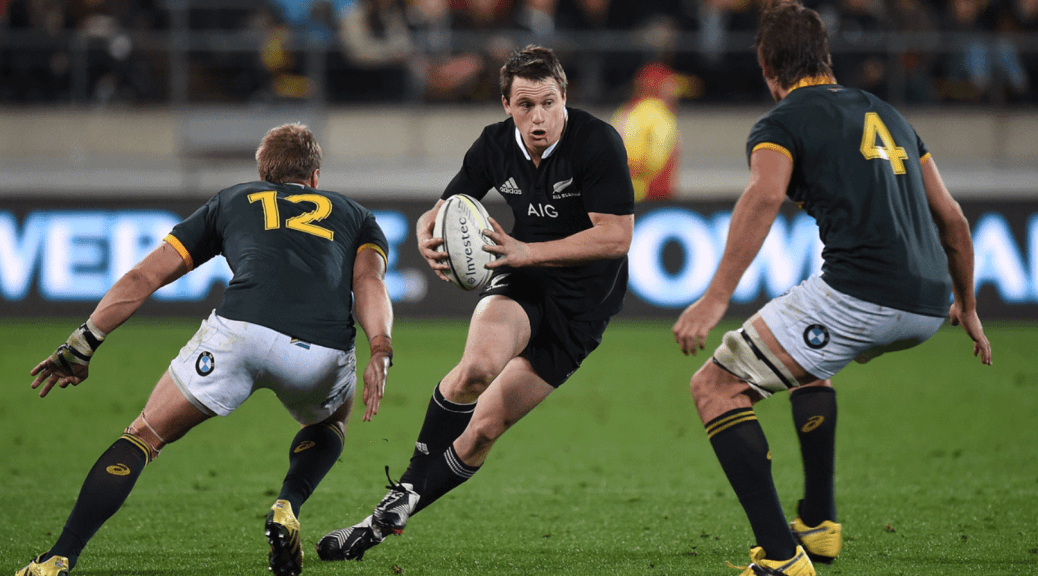
For the most part that was true. All eyes were on the game as the Wallabies clawed their way back from an 18-point deficit following the sin binning of Ben Smith. The tension was palpable for a few tense minutes, until…

The bar erupted as Dan Carter’s sublime drop goal turned the tide, followed by his long distance penalty kick and Beauden Barrett’s thrilling chase of fullback Smith’s kick.

By seven o’clock in the morning I had experienced nearly the full range of human emotion. It was wonderful. And that is the point of it all, isn’t it? Being fully human.

The debate about humanity and technology has existed for well over a century. One of my favourite stories as a child was that of John Henry, “a steel-driving man.” The popular American folk tale has been told in song by Johnny Cash, Woodie Guthrie, Pete Seeger, Van Morrison, Jerry Lee Lewis, Harry Belafonte, Bruce Springsteen, and many others. Screen Shot 2015-11-13 at 10.51.17 am

As the legend goes, John Henry’s prowess as a hammerer was pitted against a steam driven hammer in a race of man against machine. At the end of the 35-minute race, according to americanfolklore.net,

“John Henry held up his hammers in triumph! The men shouted and cheered. The noise was so loud, it took a moment for the men to realize that John Henry was tottering. Exhausted, the mighty man crashed to the ground, the hammer’s rolling from his grasp. The crowd went silent as the foreman rushed to his side. But it was too late. A blood vessel had burst in his brain. The greatest driller in the C&O Railroad was dead.

After his race against David Pocock for the try line, Beauden Barrett was anything but dead. On the contrary, in that moment he and his teammates expressed the ultimate feeling of being fully alive. Here were 15 men running and jumping and tackling and kicking and celebrating. Here were 15 men being fully human. Screen Shot 2015-11-13 at 10.58.03 am

I have always believed that we are most fully human when we engage our brains and bodies and emotions at the same time. That’s what’s so great about sport.

In my opinion, what makes the All Blacks the best is that they create an unparalleled synergy on the field, and that they can bounce back from adversity and find a way to win.

Ben Smith has been my favourite AB since I first picked a favourite. The World Cup final only confirmed it. Along with being smart, fearless, and tireless, he showed true resilience after receiving a yellow card. Within a second of the infraction his hands were in the air acknowledging the mistake. After the TMO review, he accepted the card with a nod.

Returning to the field, Smith’s performance was brilliant, setting up Barrett’s try with a phenomenal kick after picking up a turnover from the attacking Wallabies. At the end of the game, I was pleased to see that he was the one kicking into touch.

As the crowd inside Stellar erupted again, Verti and I made our way out onto a quiet street that was underwater on another Sunday morning just four months earlier.

Like sport, climate change is less about technology and more about humanity. People, not solar panels, will be what tackles this immense foe. Teamwork will be essential for victory. Resilience is critical.

At the end of the day, it’s about people. And even at the beginning of the day, as my daughter reminded me, we can’t always rely on technology for what’s most important.


Peace, Estwing


Sidebar: Who are the leaders on climate change in our community?

Please send me stories of local people stepping up and making a difference.


Ecological Farming is the Most Affordable Option

Editor’s Note: This is another weekly column in the Wanganui Chronicle.

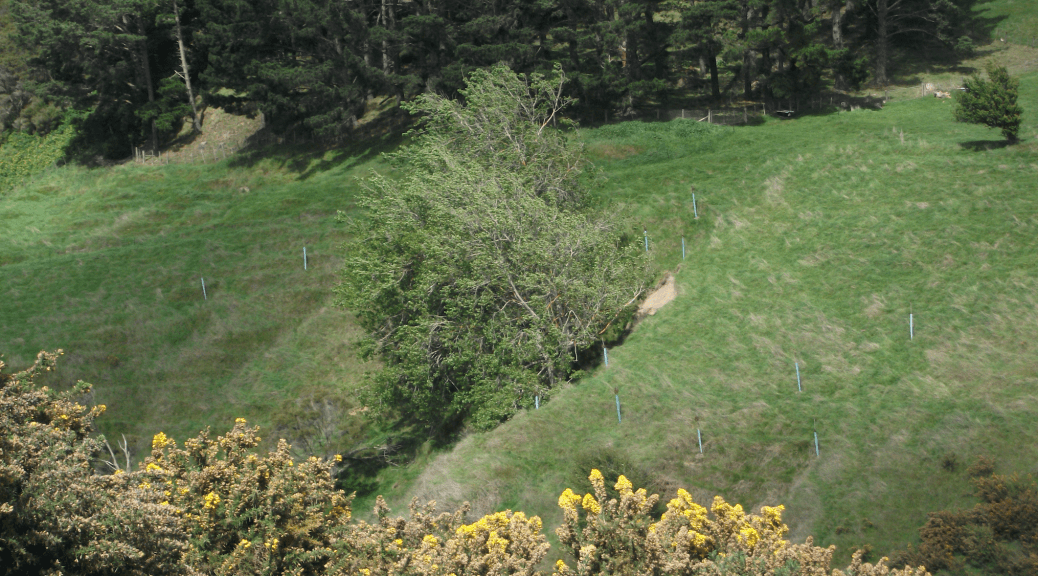
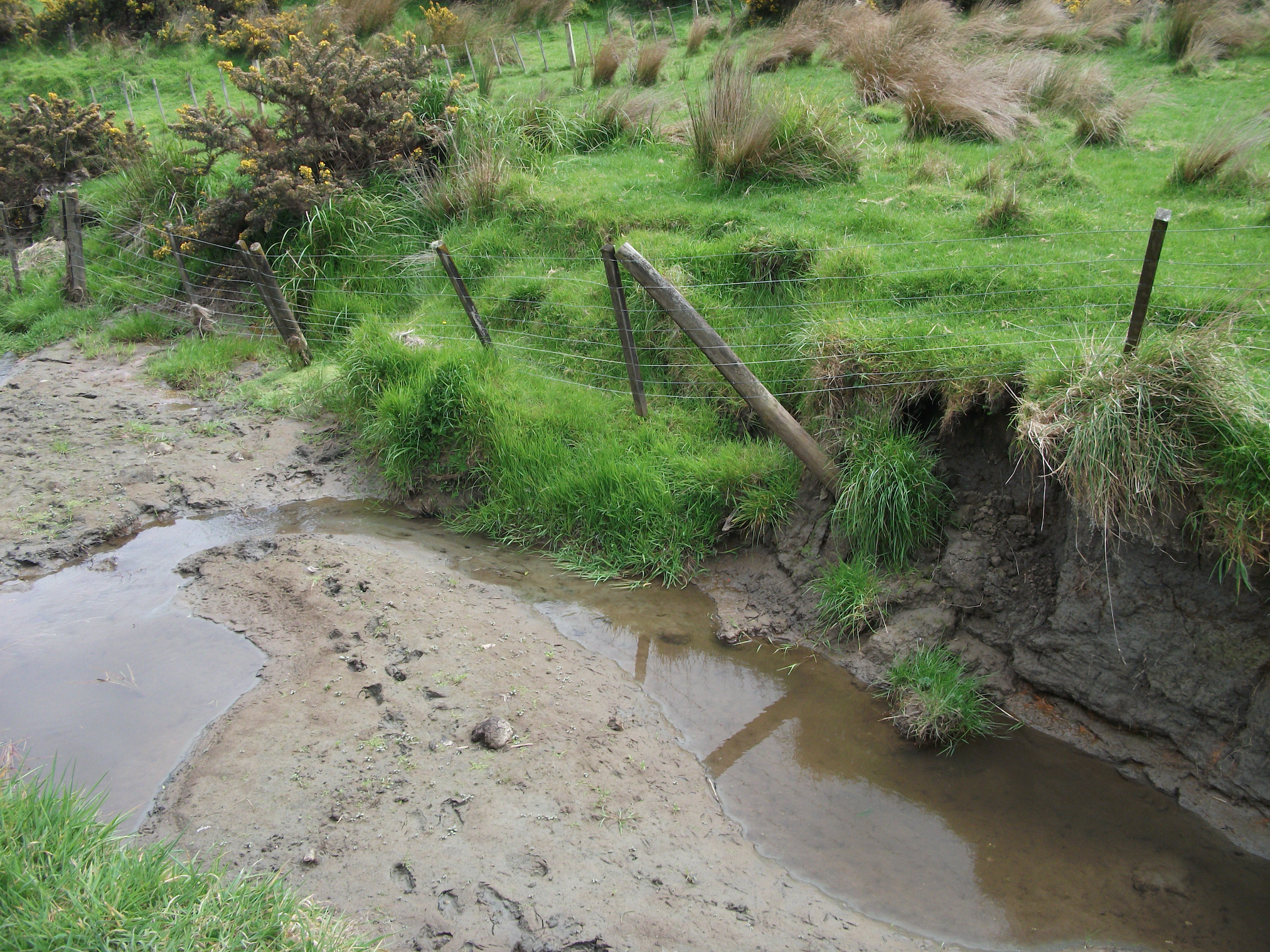
I could not agree more with Wanganui provincial president of Federated Farmers, Brian Doughty, and his recent thoughts on the damage caused to vulnerable slopes due to outdated management practices and June’s weather bomb: “We need, at least, to think outside the square in an attempt to minimise the effects from an ever-increasing number of these storm events because it will happen again.” Screen Shot 2015-11-06 at 9.45.38 am

A difficult and costly repair job after the flood.

From my reading of Brian’s Conservation Comment, he makes two main points in the second half of the piece: 1) climate change will bring more frequent extreme weather events; 2) redesigning our farms to work more closely with nature will save farmers money in the long run. As any regular reader of this column recognises, these are two of the central tenants of eco-thrifty renovation.

When eco-thrifty thinking is applied to the land it can be called “holistic land management” or “permaculture” or “ecological farming.” Whatever you call it, it relies heavily on pattern recognition. Specifically, the patterns that Brian addresses are ridges and gulleys and the best locations to place tracks and fences within the landscape to minimise damage from slips. This is sage advice, and we wish Brian could have been on the committee that chose to move the Sargent Gallery into a floodplain.

Designing with recognition for the patterns in nature has two clear advantages for farmers: 1) higher productivity; 2) greater resilience. In the day-to-day workings of a farm, holistically managed farms are more profitable, and during extreme weather events – either storm or extended drought – are more resilient.

And who would have guessed that ex-farmer and current Letters writer G.R. Scown was an eco-farmer long before it was fashionable?!? I admit to pleasant surprise as he waxed eloquently (Letters, 22-10-15) about worms, soil bacteria, humus, moisture retention and seaweed.

Similarly, I have experienced great results in pasture quality using some of the methods Scown describes along with rotational grazing. The result is a win-win-win situation that includes a healthier mix of pasture species, healthier animals (from eating better plants), and a resilient farm better able to weather both ends of predicted weather extremes.

A recent study by researchers at Stanford and Berkeley published in the journal Nature concludes that, “Climate change could cause 10 times as much damage to the global economy as previously estimated, slashing output as much as 23 percent by the end of the century” (Bloomberg News). Another recent report identifies that “Land degradation is costing the world as much as $10.6 trillion every year, equivalent to 17% of global gross domestic product” (Guardian, 15-09-15).

But none of this would be news to our outstanding regional council. For a long time, Horizons has taken a holistic, proactive and hands-on approach to land management and working with farmers. I have nothing but respect and admiration for the leadership shown by Horizons and the high quality advice and support offered by expert professionals.

I have been impressed with more than one regional councillor’s understanding and advocacy for holistic perspectives on issues ranging from watershed management to environmental education. Getting rid of the “Green Rig”, for example, was an excellent decision.

Screen Shot 2015-11-06 at 9.45.48 am

Poplar poles planted this winter on a vulnerable hillside. 

I have also worked with a number of Horizon’s staff on issues of soils, slopes and tree planting. The advice was top notch and the customer service outstanding. I actually enjoy paying my rates because I know my dollars are doing great work. Speaking of which, I seem to recall reading that the regional rates bill was going to increase by $2 per household to buy more poplar poles for farmers. I reckon that should be doubled because decades down the track we’ll all be better off for it.

– Estwing

The Pope and the Flood: Whanganui, 2015

Pope’s Encyclical: “Laudato Si (Be Praised), On the Care of Our Common Home.”   With the publication of his encyclical last week, Francis’s status as rock star Pope has been elevated to rock icon Pope. The 183-page document, titled “Laudato Si (Be Praised), On the Care of Our Common Home,” will more than likely become remembered as the definitive writing of the 21st Century. I have praised Pope Francis in the pages of the Chronicle before and I will almost certainly praise him again. If there are two things I admire in this world they are courage and positive leadership. The courage and leadership Francis has demonstrated in the past turns out only to be a prelude to that which he demonstrates with this encyclical. Drawing on the best research in economics, science and sociology, Francis identifies the two most pressing issues facing humanity: climate change and income/wealth inequality. For anyone who has followed the research in these areas, the content of the encyclical is no surprise. Even avid Chronicle readers should be well aware that 98% of climate scientists worldwide agree that climate change is influence by human activity, and that wealth inequality exacerbates social problems and drags down economic growth. While these findings are based on the best data examined by the best researchers, they have proven to be politically unpalatable. The fact that Republican candidates for the American presidency are squirming in their seats in response to the encyclical is a sign of the times. Closer to home, we get the expected responses from National, Labour and the Greens, along with Paul Henry’s patented, “I don’t care.” Let’s pause for a quick reality check: Wellington, Dunedin and our own River City have experience historic flooding – ok, let’s call it Biblical flooding as long as this is a discussion about the Pope – in three separate rain events in the course of one month. Call me Noah ‘cause I’m building an ark.

Screen Shot 2015-06-22 at 3.45.32 pm

Was this flood event unexpected? No. Our community should be aware that Horizon’s Regional Council has halved the timeline for major flood events for the Whanganui River. In other words, what was the 100-year flood is now the 50-year flood, and what was the 200-year flood is now the 100-year flood. In light of this, ratepayers are right to wonder why our District Council has poured millions of dollars into developing the riverfront and moving an art gallery directly into harms way. Claiming it did not see this coming would beggar belief given what Horizon’s has advised along with over 10,000 peer-reviewed scientific articles on the topic of climate change. This would truly be the weakest possible response from our local government body to this crisis. If we wanted a non-response we could tune in to the Paul Henry Show. Floods happen, and data from around the world indicates they are happening more frequently and with more severity. Our ‘Katrina moment’ was never a question of if but of when. The Pope knows this. What amazed me was how gently and gradually it came upon us. There were no gales, thunderstorms or lightening. Quiz Night went on as usual Friday at Stellar and the River Traders Market took place Saturday morning across the street. The devastation came to us literally drop by drop, much in the same way wealth and income inequality has gradually widened over the last 30 years, hitting epic proportions – ok, let’s call them Biblical proportions – in the last seven years. The Pope knows this too.

Screen Shot 2015-06-22 at 3.44.45 pm

At the end of the day, what is significant about Francis’ encyclical is not its content. We already know that climate change and wealth inequality are bad for society and bad for the economy. What is significant is the person who has delivered that message with unprecedented courage and conviction. Would it be blasphemy to say this Pope has some serious huevos? For as long as I have lived in The River City, climate change and income inequality have been non-starter issues. Politically, they are perceived as no-go zones, yet we have seen their impacts on our community on more than a few occasions. Because of our unique location and economy, we suffer their effects to a greater extent than other communities. The longer our Council ignores them the greater our problems will become. The Pope even knows this. More than anything, Francis has issued a challenge of courage and leadership. Who in our community will answer the call of Care of Our Common Home’?