A Two-Hour Community Garden

Question: What can you accomplish in half the time I takes to golf 18 holes?

Answer
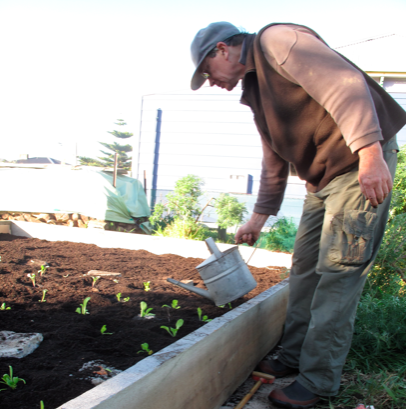
Left: 2:30 pm.  –   Right: 4:30 pm.

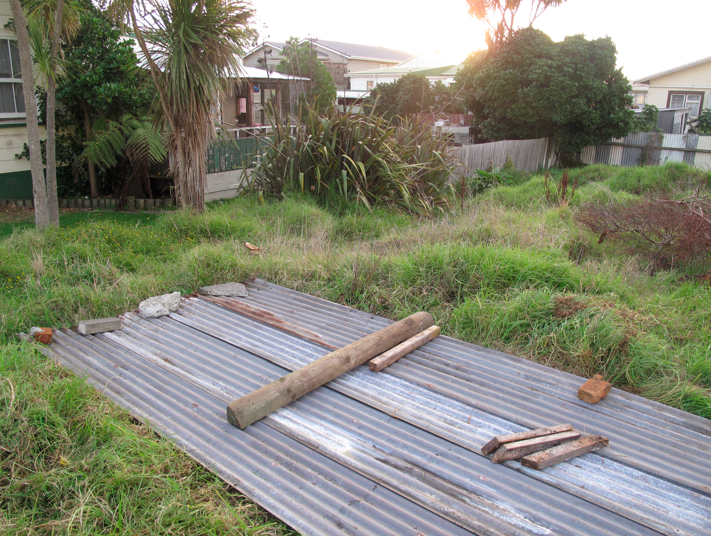
The key to running an efficient working bee is being prepared. This means having all tools, materials and food at the ready before anyone arrives. The transformation seen above is the result of 4 people working less than two hours. But three months earlier the site looked like this…

… before I scythed the grass and then…

… laid roofing iron to weaken the couch and kikuyu grasses.

Three months is barely enough to weaken these grasses enough that they won’t come up through the cardboard and soil. But three months is all I had in this instance because I wanted to hold the working bee near the spring equinox. Here are some pics of the workers after we finished. We were too busy to take any pics while we were working.

Thanks to these awesome workers. Chur Chur!

Special thanks for donations to Loaders Landscape Supplies, Wanganui Garden Centre, Bristol’s Seeds, Sustainable Whanganui Trust, Jergens Demolition, and Mark Christensen / Central Tree Crops.

Peace, Estwing

Retrospective #20: More Lessons From a Long Dead Yankee

Last week I made the claim that eco-thrifty renovation is pragmatic rather than dogmatic. The mandate of ETR is low cost and high performance, but how to achieve that mandate is not predetermined. Some times it means reusing materials. For example, last week I wrote about reusing windows during our renovation, and the week before I described turning an old deck into a fence.
But sometimes it means buying the highest quality, longest lasting products. For example, because we are in the sea spray zone, we replaced out leaky roof with the highest quality roofing iron. Although the initial price was higher than lower quality roofing iron, over the long run this decision will best meet the low cost / high performance mandate. The same can be said for compact fluorescent light bulbs: they cost more at the shop, but save money over the long term.
This kind of thinking is not new. It was around when Mark Bachelder built my former home, Trollbacken, in New Hampshire (USA) in 1782. When I bought the farmhouse in 2000, the home inspector that I hired to report on its condition told me, “This structure is in better shape than a house I inspected last week that is only 20 years old.”

One of the most sustainable buildings is the one that lasts a very long time. Still, even the best old homes need TLC now and again. That was the case for Trollbacken in 2007, when a seven-metre section of sill finally gave in to ‘powderpost beetle’ (borer). By sill, I mean a 300 mm by 200 mm timber beam upon which the entire post and beam structure rests. But to remove and replace it I would have to take the weight of the entire farmhouse off the sill. How do you jack up a 225 year-old home? Very carefully.
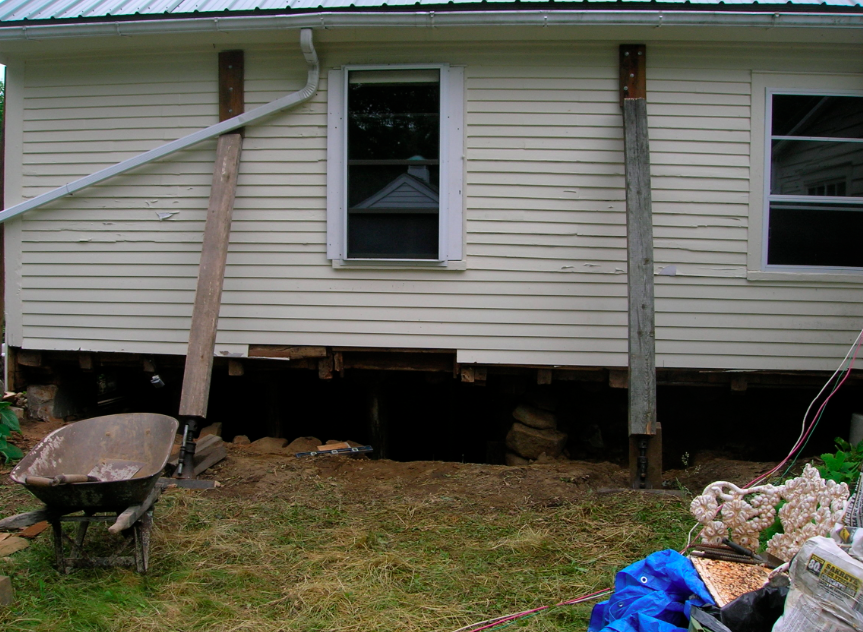
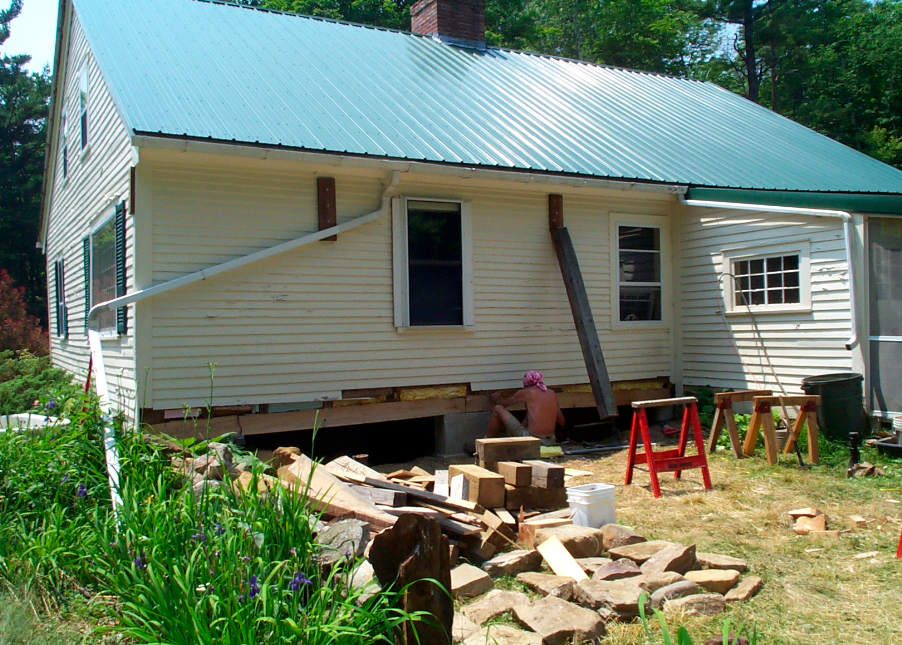
I hired my neighbor and ZZ Top impersonator, Rick, to help me. He had never done anything like this before, but he was willing to give it a go. We fixed heavy blocks with carriage bolts into the top of each post, and then carefully wedged 100 mm by 100mm poles underneath the blocks at an acute angle to allow enough space to work. Then we used ancient screw jacks that I bought at an auction to un-weight the sill by the slightest amount.
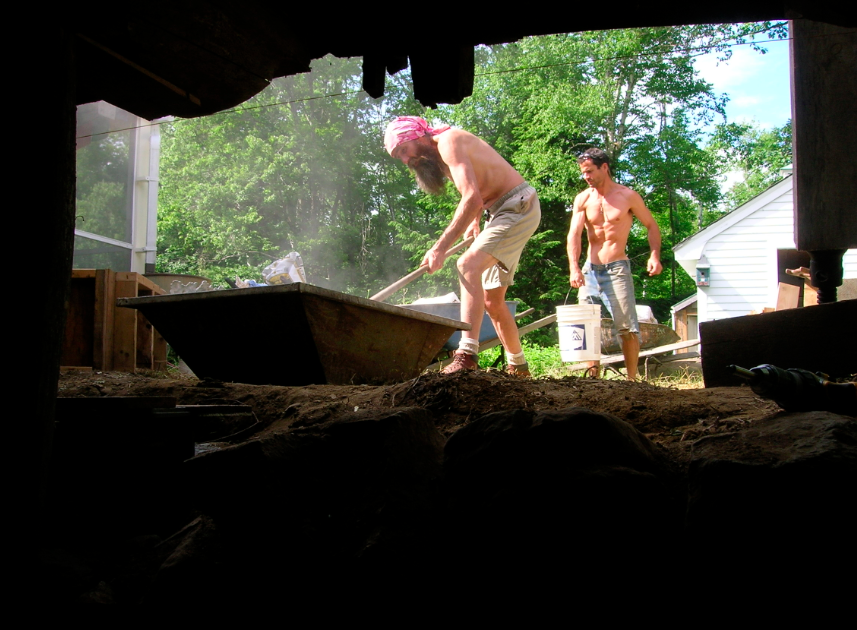
With one quarter of my home hanging by its shoulders I took a chainsaw to its ankles, cutting the sill out in sections. Once this was done, we made forms and poured footers. While Rick and I mixed 38 bags of concrete, we sent Dani into the cellar to ‘tamp’ the wet mix to remove air pockets as we shoveled it into the forms. Although she emerged from the chore hours later speckled, at least she was in the cool shade all day. I remember it was 38 degrees with bright sunshine, and it was difficult to determine who had the worse of the jobs. Although Dani did take a ‘wicked cool’ photo from her subterranean perspective.
Once the footers were poured, Rick and I went to a local mill to pick up a replacement sill we had ordered. Back at Trollbacken, we cut mortises into the sill to match the tenons at the end of each ‘half-round’ floor joist. It was close to 40 degrees the day we installed the new sills and unscrewed the jacks. But it was worth it knowing the Trollbacken might last for another 200 years. 
Peace, Estwing

Learning What Works in Community Sustainability Education

An Ecological Model for Whole Community Sustainability Education
In the last five months, our small city has had the privilege of hosting two of the most outspoken voices on the Internet regarding peak oil, climate change and financial collapse. In April, Nicole Foss spoke to an overflow crowd on debt deflation and building ‘lifeboats.’ In July, Guy McPherson spoke to a capacity crowd on climate change and some predicted consequences. Both talks had the following in common:
• the dominant hair colors of audience members were white and grey;
• most audience members left scared shitless;
• building community resilience is important in the face of climate extremes, energy price volatility, and financial collapse.

Nicole Foss and Raul Ilargi Meijer at our home in April. 
Raul Ilargi Meijer had some interesting back-of-the-house commentary on the first two of these during Nicole’s excellent talk, and shared the story of a community project in Australia that had recently impressed him. But like James Howard Kunstler and other Cassandras on the web, Guy, Nicole and Raul are much better at providing detailed commentary on the potential problems we face than detailed descriptions of how to respond to those problems. I do not see this as a flaw in their approach, but simply as outside their niche in what might be called the resiliency movement. Where these talented thinkers and writers leave off, others pick up. Like any natural ecosystem, diversity in the resiliency movement contributes to robustness and integrity.
But still the question remains: If building community resilience is a sound prescription, what does it look like and how does one make it happen? The Transition Movement offers some frameworks, but the Transition Town model failed in our city four years ago, and most people involved in it avoid talking about what happened. For our community, some different approaches to community resilience appear to be needed. One can find an endless stream of ideas and suggestions on the web that could theoretically work, but few case stories of actual successful initiatives or replicable models based on real experience.
With this in mind, we set out less than two years ago on a project to learn what actually works in our community, and to develop a replicable model for other communities to use as they see fit. The journey has been one of discovery and humility. Many of the ‘sure things’ we thought would work turned out to be complete failures, but other ‘shots-in-the-dark’ found traction in the community. Theory does not equal practice, and pre-conceived notions appear to be less useful than remaining open to any possibility. Ours is an ecological model for whole community sustainability education that is holistic, cooperative and adaptive.

Our first eco-thrifty renovation open house.  
The model is holisticin that it seeks to include every learner in our community from age one to 101, from unemployed to wealthy, from liberal to conservative, in formal and informal settings, and on multiple levels. The model remains open to any possibility that presents itself in a cooperative and adaptive manner, and to any potential partnership no matter how unlikely it may appear on the surface. So far, partnerships have included religious groups, health organizations, adult education centers, Maori groups, private businesses, community groups, newspapers, athletic organizations, schools, permaculture groups, and even the YMCA.

Teaching the science of sustainability to a home school group.  
As implied by this list, the model is cooperative in that it seeks out partnerships within the community for initiatives. It is designed to mimic mutualistic relationships between organisms in nature where both parties benefit. It seeks synergy in relationships where the whole is greater than the sum of the parts. Working together shares the load, and also surrounds us with positive people working for genuine change. Where mutualism and synergy do not exist, initiatives are abandoned, or as described next, modified.

 Aberfeldy School visits The Little House That Could. 
Finally, the model is adaptive in that each initiative must meet the above criteria for cooperative partnership or it will not ‘survive’ in that form. In an evolutionary sense, each initiative starts as the seed of an idea that is shared with members of the community. If the idea finds a partnership, it may proceed to become an initiative. If it does not, it is unlikely to be initiated unless revised. We recognize that in the process of evolution the vast majority of genetic mutations fail. This failure is not necessarily bad, only natural. Looking to nature for our ecological model of community education, we accept a high failure rate of ideas because we know that those that succeed and proceed as initiatives are the most robust in practice, not just in theory.

Sister Noelene talks worms on a community permaculture tour. 
We feel our model and the findings from applying that model may be useful to members of other communities on two levels. The first level involves using ecological design thinking to design an approach to whole community sustainability education as discussed above. Because this model is holistic, cooperative and adaptive, it can be applied to any community in the world. The second level on which others may be interested in this model is through the stories of the many successful community educational initiatives we have implemented over the last 18 months. The case stories illustrate the processes by which different initiatives went through, as well as describe the initiatives themselves. At present we can count over a dozen educational community sustainability initiatives, as listed below.
Connecting with teens at the Youth Forum. 
Over the coming months we will describe many of these initiatives, and in the process shed more light on our ecological model for community education. As always, we seek feedback and mutually beneficial partnerships to advance the model further.
Donated topsoil for the community garden in our front yard. 
Current community sustainability education initiatives:
Eco-Thrifty Renovation
       Blog (www.ecothriftydoup.blogspot.com)
       Open Homes
       Garden Tours
       Workshops
       Newspaper Articles
       Weekly Newspaper Column
Sustainable Schools Programme – In partnership with the Sustainable Whanganui Trust and funding from the Wanganui District Council.
       The Science of Sustainability
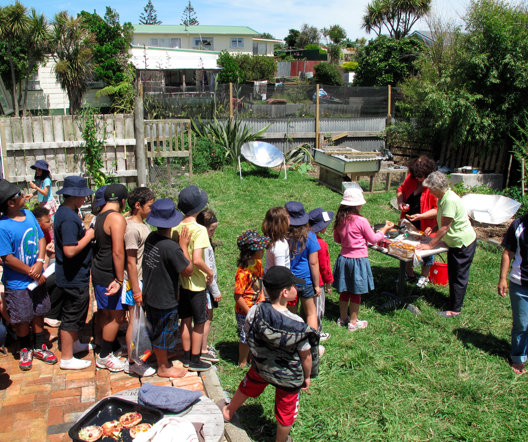
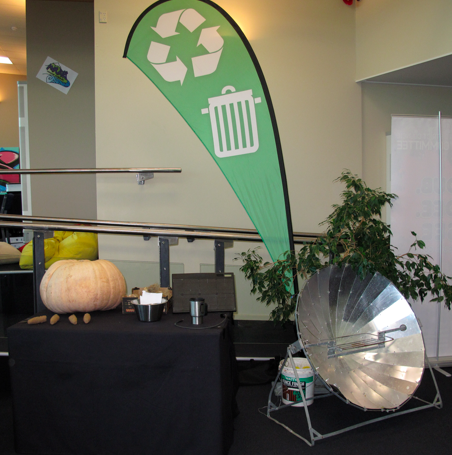
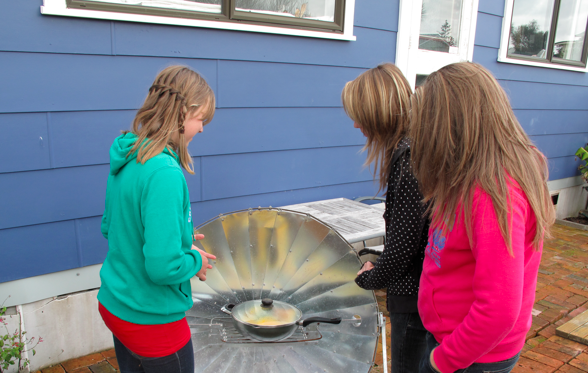
       Solar Sausage Sizzle
Whole Community Holistic Approach to Conservation, Health, and Education Now (WCHA RCHEN – Wacha Reckon?) Network of professionals working in these fields.
Whanganui Youth Sustainability Leadership Project (aka Keen Green Teens) – In partnership with the Sisters of Saint Joseph and the Sustainable Whanganui Trust, with funding from the municipal Waste Minimization Levy.
Castlecliff Conservation Club – Supported by the Port Bowen Trust.
Kaitiakitanga Community Garden – Supported by Loaders Landscape Supplies, Wanganui Garden Centre, Central Tree Crops Assoc., Bristol Seeds, and the Sustainable Whanganui Trust.
Zero Waste Events – Partnering with the YMCA and the New Zealand Master’s Games, with funding from the Positive Futures Trust.
Wanganui Permaculture Tour – In conjunction with the Australasian Permaculture Convergence 11, and Permaculture in New Zealand.
Wanganui Monthly Permaculture Gathering – In cooperation with the Sustainable Whanganui Trust.
Kaiwhaiki Eco-Village Planning – With the Kaiwhaiki Pa Trust
Community Education Evenings – In cooperation with the Sisters of Saint Joseph and the Sustainable Whanganui Trust.
Contact Nelson Lebo via theecoschool@gmail.com
Retrospective #19: Pragmatic, Not Dogmatic

Last week I introduced the last of the design principles that guided us through our renovation: reduce, reuse, recycle. In practice, reuse accounts for 90% of this trio because there is only so much recycling to do, and the act of reusing reduces waste, material use, and costs. While the New Zealand Building Code allows materials to be reused in some cases, it does not in others. If you are planning any work that involves the structural integrity or weather-tightness of your home, please refer to the building code. The friendly folks at Building Control are helpful, knowledgeable, and pretty well awesome to work with.
One example of reuse that saved us thousands of dollars and did comply with the building code was installing second hand aluminium windows that had been stored in the villa along with mountains of rubbish. We looked at the rubbish and saw resources. The real estate agent said the sale came with all chattels, implying it was a necessary evil given the piles of old carpet, broken plasterboard, paint cans, and boxes full of random effluvia. We agreed, thinking ‘Oh boy!’
At some point in the past, the original lounge windows had been smashed by vandals, and roofing iron was later nailed on the inside wall to keep them – but not rain – out. As a result, they broke a hole in the floor and came in that way, and almost all of the studs in that exterior wall were rotted up to 200 mm when we took possession. Looking at the expense of reframing and re-cladding the entire wall, we were eager to save some money by reusing the ‘free’ windows we inherited.
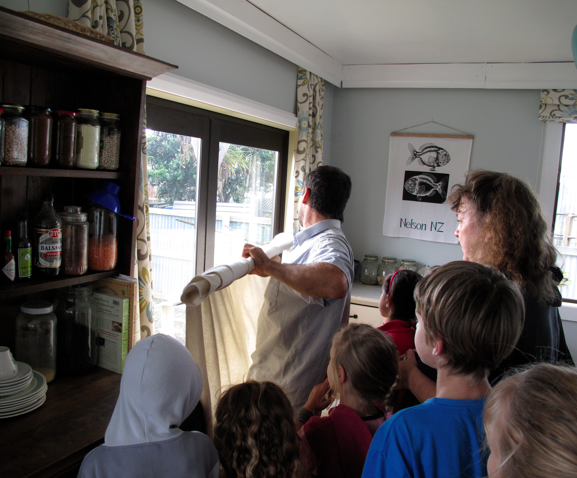
Additionally, we wanted to demonstrate that a drafty, cold villa in Wanganui could be made warm, dry and healthy without going to the expense of replacing all windows with double-glazing. As I have written about on many occasions, we addressed the problem of heat loss through windows with a host of low budget / high performance solutions that match and exceed the insulating value of double-glazed windows alone.
However, contrary to what some readers may think, eco-thrifty renovation is pragmatic, not dogmatic. The mandate of ETR is low cost and high performance, but it can be achieved in many ways. Here are two examples involving windows.

Lounge Window: Left without plastic film – Right with plastic film
  
As described above, the lounge window is a large, second-hand and aluminium framed. This makes it one of the biggest sources of heat loss in our otherwise well insulated home. The pragmatic solution in this case was to install a pelmet and floor-length thermal curtains, as well as plastic sheet window insulation. From the picture you can see how effective the window film is at insulating the pane on the right compared to one on the left without the plastic sheet applied. That picture was taken in late July at about 8 am.
Left: Lounge window. Right: New kitchen/dining window.
Not far from the lounge window is another northeast-facing window. This window brings morning sun into our kitchen and dining room. Initially we installed another second-hand window that was left in the villa, but we later discovered two things: 1) the hinges were stuffed; 2) that of any window, this would be the first one from which the curtains would be drawn each morning. Both of these reasons drew me to a local window manufacturer to order the lowest cost / highest performance double-glazed window I could. For our purposes, this meant a large, fixed, thermally-broken window. The location of the window is near our French doors, so ventilation is not an issue in that corner of the villa. What we saved on hinges and latches paid for the extra expense of having the aluminium frame ‘broken’ by a thick band of rigid plastic. Although this window cost us about $700, because of its location it serves a special purpose by letting in daylight exactly where we spend our mornings while still retaining warmth.
As I said, ETR is more pragmatic than dogmatic. There are many shades of grey.
Peace, Estwing

Crisis, Resilience, Relevance and Transformation

This is an article I wrote for the newsletter for our local currency. I have found many similarities between my research in transformative learning in science education and what I read in articles such as the one referenced in the article below. 
In a nutshell, new learning seems to happen most when the learner recognizes the relevance of that new learning. The recognition of relevance can be brought on by a crisis, as in the article referenced below. These combined can lead to a transformative learning experience, the result of which may be – you guessed it, as shown in the article referenced below – a greater capacity for resilience in the learner. 
Peace, Estwing
The warnings continue to come from Internet prophets like Nicole Foss and Guy McPherson. Although they spoke their words of warning in Whanganui in April and July respectively, their presence on the web remains constant. These modern day Cassandras speak of a future yet unseen, yet if we turn to Greece we may be able to see that future happening now. I read an excellent article from Reuter’s news service about a group of young people who fled Athens to start an eco-village/commune in the countryside. The article can be found on the 30th of August, 2012.
For me, highlights of the article include the following passages:
The commune is one of several ecological initiatives that have benefited as the debt crisis forces Greeks to rethink their way of life – especially the big-spending, consumerist urban lifestyle partly blamed for bringing Greece to the brink.
“As a general trend, the crisis for several people was an opportunity to change the way they think and try to be organized in a different way,” said Theocharis Tsoutsos, professor at the Technical University of Crete who has studied sustainable energy projects.
“For instance, doing things on a smaller scale, creating their own garden, or trying to promote ecological issues on a small scale, or promoting low-cost agricultural initiatives.”
The commune would have found few willing takers among Greeks riding high on an economic boom a decade ago. “People then were more interested in their welfare, making money, the stock market. These people would have been laughed at – Greek society was not ready to hear this kind of message,” he said, adding that other, less developed eco-communes have also sprung up in Greece in recent years.
“Now it’s really relevant. It goes to the core – every Greek knows someone who is moving to these practices.”
My question is, how many people who scoff at REBS now will join it enthusiastically if (whenaccording to Foss and McPherson) high unemployment and austerity come to Whanganui? 

From Homeless Shelter to Home Birth

Our little villa was in rough shape when we bought it two years ago. The roofing iron had 1,000 tiny rust holes. The hot water cylinder and electrical wiring had been stolen for the copper. And every room was full of rubbish.
As bad as all that may sound, the lounge was even worse. The windows had been smashed. The studs in the exterior wall were rotten. Someone had broken a large hole in the floor. And that same someone was sleeping in the corner.
Lounge before renovation. 
This week, at 3:30 am on Wednesday morning, my wife Dani gave birth in that very lounge.
Home birth is a test of will power, stamina and determination. Dani did an amazing job with the help of our midwives Cyd and Jemma. This particular home birth was also a test of our insulation, hot water and old-time Shacklock 501.
Lounge during renovation.  
You may or may not recall that Tuesday was sunny but cold, with a southwesterly blowing just enough to make my afternoon surf choppier than I was hoping for. Nonetheless, when I got home at 3 o’clock it was over 20 degrees inside our kitchen, and we had 240 litres of solar heated water on our roof at 85 degrees. We also had a large cheesy cauliflower and potato casserole on the solar cooker. In other words, everything was normal at the Lebo household…for the moment.
We ate our evening meal, watched a DVD and I went to bed. At 10:30 pm, Dani came in the bedroom and told me, “My water just broke.”
I said, “What do we do?”
She said, “Call the midwife.”
The midwife said, “Get the house warm.”
Although the outdoor temperature had plummeted to 6 degrees at 11 pm, it was still 18.5 inside the lounge at 19 in the kitchen. Nonetheless, stoked the Shacklock with wood and lit a match. Because of its small firebox and brick surround, it usually takes a while for the old coal range to throw enough heat to notice.
Lounge prepared for home birth.  
I kept feeding the fire as Cyd coached Dani through the early contractions. At around 2 am, Cyd called Jemma in as a back-up. When she arrived it was about 3 degrees outside, 20.5 in the kitchen and 19.1 in the lounge.
Cyd said, “This is ok for us, but when baby comes I want it 20 in here.”
No matter how I tried, I could not get the lounge – with its 4 metre ceilings – up to 20 in time. Cyd called for reinforcements in terms of an electric heater that provided the little extra warmth to welcome Verti Lebo into our lounge and into the world.
Verti Feliz Lebo.  
As much as we’ve put our blood, sweat and tears into renovating this old villa, nothing could compare to the special feeling that came over us early Wednesday morning in our little house that could. We know that generations of families have found joy and love in this villa over the last century, but for us, this house became a home.
What, what! Bubs in da house! 

Arohanui to all our friends who have supported us, and offered their well wishes. We will be celebrating the equinox in later September with a garden tour of our eco-thrifty landscape. Stay tuned for details. 
Peace, Papa Estwing

Retrospective #18: Re-Fence

Breaking News: The ECO School now has a Facebook page. Please like and friend it.

ETR for the Wanganui Chronicle, 25-08-12
As I have written in the last three columns, ecological design is holistic. It considers the relationships between elements of a system as important as the elements themselves. Ecological design is all about making connections in our minds based on the interrelationships we observe in the world around us.
In writing, one form of connection is the segue – a literary link. I’ll use the one concept included in the last three columns – multiple functions – to segue onto the last of the design principles we followed during this project: the ‘Three R’s’ reduce, reuse, and recycle.

Where ‘reduce’ is more of an umbrella concept including the reduction of material and energy waste, ‘reuse’ and ‘recycle’ are strategies we can put in place to achieve the reduction of waste and the conservation of resources. In other words, by reusing and recycling, we reduce what goes to landfill, and we reduce the amount of new materials that need to be extracted and manufactured. These are good for both the planet (eco) and the wallet (thrifty).
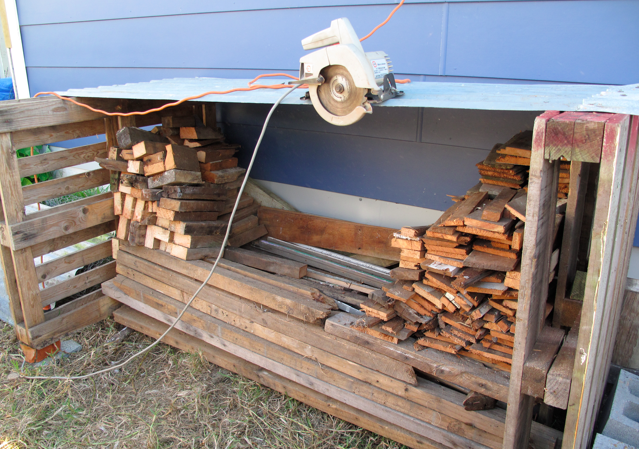
During the renovation we diverted over 95% of all materials from landfill, and spent a total of less than $50 on rubbish fees. On the other hand, we made over $300 recycling scrap metal, and have a big pile of untreated, unpainted ‘scrap wood’ ready for the wood burner. (See Urban Chainsaw post.)
Some framing timber and lots of sarking was too filled with borer to reuse in any other form than feeding the Shacklock. Other native hardwoods that came out of the renovation were ideal for reuse where the building code did not require that certain timber be used. One example is the former deck (aka trampoline) that became an attractive fence that serves multiple functions.
Those functions include: privacy screen; dog-excluder; wind barrier, trellis, and teaching tool. Yes, much can be learned from pulling and straightening nails as our interns John and Amy discovered. 
The most important lesson is the most abstract: mindfulness. Mindfulness 3 R style can be described as materialism, but not the Madonna kind. A materialist recognizes the value and potential of objects. This should not be confused with being materialistic, or addicted to consumerism.
I would suggest that materialists do well at the 3 Rs, and are more likely to frequent op shops, building salvage centres, and auctions. In the case of the latter two, quality products always fetch fair prices, while junky products are nearly always worthless. In other words, in appears that high quality goods are more expensive to purchase new but hold their value longer, but low quality products do not hold what little value they had to begin with.
This brings me back to the former-deck-turned-fence. Although the timber had been exposed to coastal elements for 30 years, most of the individual boards were still sound. Although we could possibly have reused them to build another deck, we preferred to build a brick patio that would serve as a heat sink for subtropical plantings such as banana, Tahitian lime and tamarillo. With the brick patio in place, the deck-turned-fence became a windbreak for the banana and Tahitian lime, both of which came through June frosts fairly well.
Before the brick patio and fence
After: Brick patio and fence on a frosty morning.
In the end, John and Amy learned some things about creative reuse, about construction and about permaculture design. We now have some attractive fences that keep dogs away from our chooks and ducks, block the wind, and allow us to run around naked in our back section. Wait a minute, did I just say that? 

Retrospective #17: Theory and Practice

The last two columns engaged in a slightly higher discussion of a number of fundamental ecological design strategies. Those strategies – called multiple functions and redundancy by permaculturists – are important to eco-thrifty design and to emergency preparedness.
These are by no means new ideas. Who was it that first said, “Don’t put all your eggs in one basket”?
Diversity creates robust ecosystems. It makes strong communities. And it is essential for resilient households in times of emergency and in times of energy and food inflation. Over the last decade, electricity rates have doubled, and there is little reason to suspect that they will not double again in another 10 years.
The feedback that we get consistently about the educational component of our project is that we offer practical examples of all our design principles. For instance, one mum who came along with the Wanganui Home Educators Group on one of their six site visits in June had sent this email:

“A few weeks ago, my family and I visited your house with the WHEG and learnt a lot of helpful energy-saving tips from you. Even though the visit was informal, the presentation was thorough and children of all ages (and adults) could go home with a lot of information to think about and put into practice. It was simple, yet practical and inspiring. Our own home is fairly new and so we already had many of the energy-saving things in place, but through your talk we were made aware of certain things again – our one south facing room does not get its curtains opened for very long at the moment!”

We also got this feedback from some of the children:
“When we went to the Eco House I learnt how to keep our house warm by the sun.  It was a fun visit!  Mum and I are going to buy some woolen blankets for our windows and it is really fun to cook pasta in a box!”
Bethany, aged 8

“I really enjoyed our visit to the Eco House.  I learnt that bricks keep in a lot of heat.”
Nathanael, aged 9
I got similar comments about the slide presentation on 5thof August at the Quaker Meeting House. It is nice to receive such feedback because one of the multiple functions of our eco-thrifty renovation is as an educational project. We have also worked with a number of local and regional schools on a cross-curricular unit called, The Little House That Could. (Funding was provided by Wanganui District Council, and an administrative role was played by the Sustainable Whanganui Trust.)
In the space that remains this week I’ll give one more example of the design principles mentioned above, only with a biological twist. Last week I was helping Mark Christensen transplant raspberries, and he sent me home with two dozen plants of various types: summer-bearing, autumn-bearing, and thorn-less.  

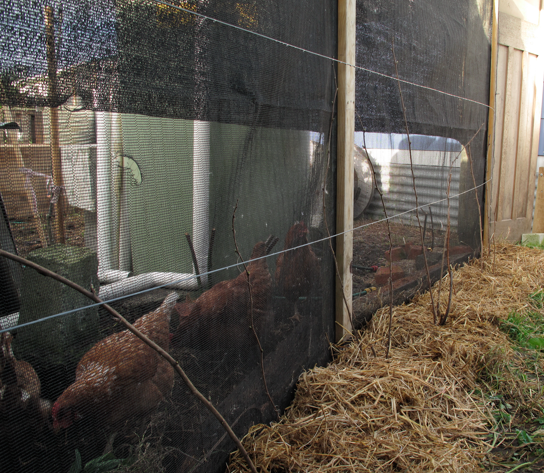
Regarding multiple functions, the photograph shows the raspberries planted in front of wind netting. For its part, the wind netting serves its primary function – breaking wind! – but is also a chook fence and partial view screen for our semi-cluttered side yard. The posts that hold up the netting also support the galvanized wire that will trellis the raspberries. And finally, the raspberries will serve their primary function – in my belly – but also screen the side yard and shade the wind netting from the sun, which will prolong its lifespan.
In terms of redundancy, I’ve planted the different varieties of raspberries in different locations around the section. After all, I don’t know the best place to plant them. Only they can tell me that.

Retrospective #16: More Multiple Functions

Last week raised the bar on the discussion of eco-thrifty renovation: ETR 2.0, if you will. That discussion included the permaculture design principles of multiple functions and redundancy. In other words, each element of a system should serve multiple functions, and each function should be fulfilled by multiple elements. Last week’s column focused on windows, and how their direction and the time of year can affect their function regarding heat loss or gain.
This week I’ll use the same design principles to talk about space heating and cooking, and how a holistic, complimentary design helped us achieve a $20 power bill during the bloody cold month of June.

If you have been following this column, you will be familiar with our antique Shacklock 501 multi-fuel stove in the classic Kiwi-green enamel. Aside from being the centerpiece of our eco-thrifty kitchen, this 300 kg piece of iron, with an additional 400 kg of brick and concrete around, it serves multiple functions in our home. The two most obvious functions are heating and cooking. By stacking these functions on cold, cloudy days we get “double” use (multiple functions) out of the wood we burn, and save electricity because we don’t need to use the electric hob or oven. The Shacklock came in especially helpful during the power failure in March when we stoked it up for the first time and cooked soup and baked bread.
But the Shacklock has another function I described briefly during one of my first columns: thermal mass. Because of the passive solar re-design of our villa – including shifting windows from south-facing to north-facing as described last week – we receive ample heat from sunlight alone on clear winter days. (This is an example of redundancy as our home can be heated by the sun or by wood.) But a critical element of passive solar design that is often overlooked is having enough thermal mass inside of the building envelope to avoid overheating.
We added thermal mass in a number of ways, but the most massive mass, the Master of Mass, is the Shacklock. The low-angle winter sun strikes the cook stove, brick surround and concrete/tile hearth at three times of day through three different windows. Some of this heat energy is ‘stored’ in the mass until the indoor temperature drops overnight, at which point it is released into the room. This is another function that the Shacklock serves when there is no fire burning within it.
As you can see, stacking functions can save resources and power, but what of redundancy? On a warm day we could cook on the electric hob, but if it is also sunny, we could use our solar cooker, even in the middle of winter. This example of redundancy exhibits an even higher level of eco-thrifty thinking (ETR 3.0?!?): complimentary systems.
In other words, whether it is sunny and cold or cloudy and cold, we can heat our home and cook our tea without electricity. If it were sunny and warm, we would probably have a BBQ or stoke up the outdoor pizza oven. If it were cloudy and warm, I would go for a surf and heat up beans and toast on the hob. They all sound like good options to me.
Aside from saving power and money, designing for multiple functions, redundancy and complimentary systems is excellent practice for emergency preparedness. We do not know when the next earthquake or big blow could knock out our services, but we can be ready for when that happens while saving power and money. See, even our multiple functions can serve multiple functions. 
Peace, Estwing

Retrospective #15: The Multiple Functions of Windows

Many of the things I’ve written about over the last three months can be described as the low-hanging fruit of saving energy at home. In other words, they represent low investment and rapid payback. Taken in isolation, each of these works, but taken together there results a synergy where the whole is greater than the sum of its parts.
A home is a system of interacting elements. The greater our understanding of how the elements work together, the higher levels of energy performance our homes can achieve. For us, the consistent $20 – $30 (including line charge) power bills are the result of a holistic approach to renovation. While science and maths play a large role in eco-thrifty renovation, we did not apply any scientific or mathematical formulas when setting goals for the project. We simply wanted to take the worst house possible – a drafty old villa with 12 foot ceilings and no insulation – and see what we could achieve.
Eco-thrifty design is just one type of ecological design. Ecological design – by definition – is holistic. It treats the relationships between elements of a system as important as the elements themselves. Ecological design aims to be as robust as the natural ecosystems it mimics. When we look at native bush in New Zealand we can see that no plant or animal fills only one niche, and that no niche is filled by a single species.

In an ecological design system called permaculture, these dynamics are summarized by the principles of multiple functions and redundancy. In other words, each element of a system (plant or animal) should serve multiple functions (niches), and each function (niche) should be fulfilled by multiple elements (plants or animals).
Graphics for Holmgren’s permaculture principles.
In eco-design we take the lessons we learn from nature and apply them to human environments. The term ecology comes from the Greek word oikos, meaning home. My home (and gardens) is my ecosystem. (With a major renovation, a huge landscaping job, and a PhD thesis I bloody never leave it!)
In our home, as well as yours, windows serve multiple functions: they allow the passage of light and heat; they provide views in and out; and, some can be opened for ventilation. In our home, and I hope yours, there is more than one window to allow these functions.

Here is where the science and maths come in: at this time of year the path the sun travels across the sky (science) means some windows are net energy gainers and some are net energy losers (maths). In other words, northerly windows gain more heat than they lose and southerly windows lose more heat than they gain.
Recognizing this, we “manage” our southerly windows differently than we “manage” our northerly windows. By manage I simply mean when we open and close curtains (if at all) and when we put up and take down window blankets (if at all).
Additionally, the recognition of relationships between seasonal sun angles, windows and heat flow helped us make design decisions about where to add glazing and where to remove it. One of the major aspects of our renovation – requiring consent and now requiring a qualified builder – was adding and subtracting windows and doors. Here is an example of applied eco-design thinking.
Where the kitchen was located when we bought the villa, the window over the sink faced to the southwest. At this latitude, that window was as a heat loser in winter and a heat gainer in summer. Oh boy, the worst of both worlds! Could you imagine working at the kitchen bench in January with the late afternoon sun streaming in? That kitchen would have been unbearable for cooking tea during summer.
Before: Southwest side with old kitchen window (yellow part) bringing in too much summer afternoon sun, and losing heat in winter. 
At the same time, the toilet was located in the northernmost corner with just one tiny frosted window for ventilation. And we can’t even blame this solar-illiteracy on the builders 100 years ago because the villa was moved to this location in the 1980s!
After: Southwest side with old kitchen window removed. Result: cool in summer and warm in winter. 
The eco-design solution (some might say common sense solution) was to swap the location of the kitchen and bath, and to relocate the southwest window to a northeast position. A northeast window is a heat gainer in winter and neutral in summer. In the end there was the same amount of glazing, but in a location supported by sound science and maths. 
New northeast window brings winter morning sun into the relocated kitchen. 

Peace, Estwing