Voice in the Wilderness

Following Paul Brooks wonderful article in the Midweek about our Eco-Thrifty Renovation and the educational programmes we’ve developed along with it I got a short flurry of phone calls and an email. The result was that three representatives of Te Oranganui and one neighbour dropped by for a one-hour tour on a Tuesday morning. They were all grateful for the site visit and for the information I shared. I was happy to meet some new people and to demonstrate how we have managed to develop a warm, dry, energy-efficient home on a small budget. But by the afternoon I was discouraged when I was faced with the miniscule impact of our project when compared with what may be described as the carelessness (or thoughtlessness) of others.

As I rode my bicycle down Puriri Street and Alma Road at 4 o’clock on a brilliantly sunny day I noticed that every street light above me was lit. I would estimate that one hour of all of those lights burning would use more electricity than we use at home in a month. I have seen the lights on Cornfoot Street also lit during bright, sunny days on numerous occasions. Do ratepayers pay for that power? Is our community so wealthy that we can afford to waste energy like that? From what I understand there are about 90 million reasons we should be trying to reduce expenses in our city. The relationship between energy, finance and debt interests me greatly, and I feel quite fortunate to have the opportunity to host a world expert on this relationship in Wanganui on the 10th of April.

Nicole Foss has managed to fit Wanganui into her month-long speaking tour of New Zealand. She has had a busy schedule on the South Island, including talking to many Councils and a radio interview with Kim Hill in Christchurch. She has lectured on energy and global finance in hundreds of locations across North America, Europe, Australia and New Zealand. Her day job is Senior Editor of The Automatic Earth (TAE), where she and co-author and Editor-in-Chief Raúl Ilargi Meijer have been chronicling and interpreting the on-going credit crunch as the most pressing aspect of our current multi-faceted predicament. The site integrates finance, energy, environment, psychology, population and real politik in order to explain why we find ourselves in a state of crisis and what we can do about it.

While living in the UK she was a Research Fellow at the Oxford Institute for Energy Studies, where she specialized in nuclear safety in Eastern Europe and the Former Soviet Union, and conducted research into electricity policy at the EU level. She also has significant previous experience practicing as an environmental consultant.

Nicole will be speaking at 7 pm on the 10th of April at the Meeting Room of the Gonville Cafe/Library. Koha will be accepted to cover travel costs. This event is co-sponsored by The ECO School and the Sustainable Whanganui Trust.

Peace, Estwing

Am I Too Conservative?

I’ll admit that I am conservative. I like to conserve energy, conserve water, conserve money, conserve time and conserve effort. But am I too conservative?

Here is my little story.

I was pleased to hear a certain radio personality express his newfound appreciation for what climate change looks like on the day before the autumnal equinox. He went on to express another conservative opinion about the unsustainable debt held by many local councils. Again, I share his concern. Then he began to talk about another issue and the conservative stance the Green Party had taken on it. Three for three. Good one!

I called him up to congratulate him on his consistent conservative values and what I recognized in each case as the application of the “precautionary principle.” I had barely made my point when he vigorously questioned me on the third issue: the Green Party’s stance on fracking in Taranaki. From my perspective, the Green Party appears to be using the precautionary principle in its approach to fracking. This would appear to be a conservative position.

However, the radio personality accused me of something I did not catch because I was nervous talking on the radio. I suggested that international scientific research on fracking may be considered and that some data from the USA indicates problems associated with fracking. He insisted that no scientific data from anywhere outside of New Zealand should be considered at all. This would appear to be a radical position.

Then the radio personality said that a full, independent scientific analysis had been done to assess the effects of fracking around Taranaki and found no need whatsoever for any concern. He asked if that would be enough evidence for me. I told him that for me – being a conservative and supporter of the precautionary principle – I would seek a second opinion. This would appear to be a very conservative position.

The radio personality said “No, no, no.” For him a second opinion was not important. This would appear to be a non-conservative position. Then he hung up on me without even thanking me for my call or my compliment. What kind of a position is that?

Peace, Estwing


Eco-Thrifty Permaculture Tour April 16th & 17th

This could be the best value for money in all of New Zealand in the area of permaculture education. Sign up soon. Spaces are filling.

Five excellent, but very different permaculture properties in and around Whanganui.

When: 16th April 2 pm to 17th April 5:30 pm

Price: $100 with your own transportation. $140 with transportation provided. Includes dinner on the 16th and breakfast on the 17th. Please provide your own lunch. Price does not include accommodation. See below for information on accommodation and transport from Turangi to Wanganui.

Minimum number for participants: 10 . Maximum number for participants: 20

Registration required before 9th April with 50% deposit (20% non-refundable).

Contact: The ECO School, 06 344 5013; 022 635 0868; theecoschool@gmail.com

Each site is described below in the host’s own words.

Monday, 16th April 2 pm Mt. St. Joseph Retreat Centre

The property has a diversity of uses – a residence for three sisters plus the administration centre, a Retreat Centre, Archives, Hospitality area and a 45 bed Rest Home.

Interconnectedness, relationality, kinship and care are key words permeating our spirituality and our practice. Our vision is for “Fullness of Life for the Earth and her Peoples.”

We endeavour to be bicultural and support the aspirations of the tangata whanua.

The original Peat family homestead gardens have been added to over the years with a mix of surrounding shelter-belt edges, big native trees (totara, rimu, rata, kowhai) and some big exotic trees (redwood, pinus radiata, macracarpa). The southern steep hill is covered with regenerating bush. The eastern hillside is currently being developed as a rather extensive orchard and garden with planned for bird and bee forages. The western hill and valley is being restored as a small wetland. Walking tracks for the public and new native trees are being planted on the adjacent hill.

4:30 pm The Quaker Settlement, 76 Virginia Road, Whanganui.

This is the only intentional Quaker community in the Southern Hemisphere, now 36 years old. Sixteen households encircle the community buildings which are also used as a conference centre by diverse groups locally and nationally. The community of about 30 including children, care for the centre,and run an annual Quaker seminar programme, all on a voluntary basis. As a community we endeavour to recognise the diversity of life, its interdependence and balance, including our relationship with the environment. Much of the land was blown sand dunes which over time is developing into a treed landscape with native tree plantings, a Harakeke (flax) collection, orchards, sheep, chickens and ducks, and community as well as individual vegetable gardens.

Link about Quakers, and the Seminar Programme:

Tuesday 17th April 9:30 am David Aislabie

A network of different timber, nut and fruit trees with native shelter belts creates a mosaic pattern of highly productive “clearings”on this 6 hectare permaculture property. North facing slopes are terraced into permanent raised beds and clover paths (swales) growing a diverse rotation of certified organic vegetables and subtropicals (mainly tamarillos), irrigated via a windmill from runoff stored in 2 large ponds. Soil improvement features green manures and up to 50 tons of compost per year, made in straw yards where pigs and cattle graze.

Note: David took an early permaculture course in NZ and continued his market gardening with a new focus after that. It is one of the best established properties based on permaculture design.


1 pm Mark Christiansen

A 5 acre (2.2 hectare) property developed with a mixture of permaculture, organic and biodynamic principles. Begun 14 years ago as an edible landscape, it developed into a collection of heritage fruit trees, and then progressed into heirloom tomatoes and beans and other vegetables. A focus is on finding out what grows successfully in this area as well as on medicinal/nutritional qualities. Among the collection is the Monty’s Surprise apple, believed to be the best apple in the world for human health.

3:30 pm The Eco-Thrifty Renovation, Nelson & Dani Lebo

An abandoned, derelict villa on a section full of rubbish and weeds has been transformed into an energy-efficient home and fully installed permaculture landscape on 700 square metres in the 12 months ending November 2011. The energy performance of the renovated villa has been outstanding, and the food production (on pure sand) has exceeded expectations. The total budget for the project including purchase of the property, retrofitting and landscaping was under $100,000.

Additional Information:

Dinner, optional overnight accommodation and breakfast at the Quaker Settlement. Book you own accommodation: www.quakersettlement.co.nz

Getting to Whanganui:

Intercity Bus transport from Turangi to Wanganui

Book early through http://www.intercity.co.nz

Sunday, 15th April: Departs 3:15 pm and arrives 7:30 pm. Hotels and backpackers within walking distance of bus depot for overnight accommodation. Book through BBH or YHA.

OR (Better)

Monday, 16th April: Departs 10:45 am and arrives 2 pm. We will pick you up and take you to the first site visit and onto the accommodation venue. We will take you back to the bus depot or nearest accommodation at the conclusion of the tour. Please note there is an extra $40 fee when transport is provided.

A Buddhist Perspective on a Permaculture Perspective

A Buddhist Perspective on a Permaculture Perspective on Science Education.

During my adult life I have come across two perspectives that have greatly helped me make sense of the world: Buddhism and permaculture. Neither were particularly valuable in teaching me new things, but rather in affirming the things bouncing around in my head already. When I first started learning about each of them I found myself nodding in confirmation, and awed at how someone else had written so thoughtfully about the thoughts I had been unable to articulate as lovely as they had. I was not alone after all!

Schumacher College in Totnes, England played a key role in my education on these perspectives. It was in the dining room there I met Bill Mollison over a cup of tea (not knowing who he was), and in the library that I read extensively on Buddhism for the first time. Not only did each perspective help me understand the world better, but each one also helped me understand the other. I could see Buddhist themes in permaculture and permaculture themes in Buddhism.
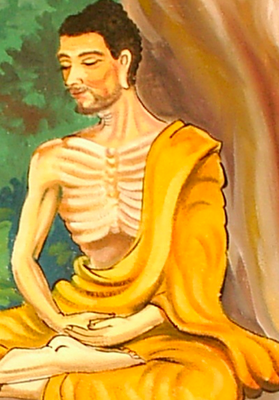
While I won’t go so far as to compare Bill Mollison or David Holmgren to Siddhartha Gautama, I will note that, from my observations, the stories that many permaculturists tell about their ‘discovery’ of and ‘conversion’ to permaculture as similarly transformative. I will also note my belief that the Shambhala Prophecy holds special significance for those permaculturists interested in getting permaculture ideas into their local schools.

The Kingdom of Shambhala is not a geopolitical entity. You cannot find it on a map. It exists only within the hearts of the Shambhala Warriors, who will arise at a time when the Earth is in terrible danger. During this time powerful forces will lay waste to the land and sea with technologies previously unknown. At this time, the Shambhala Warriors arise and enter the halls of power with only two weapons: compassion and a recognition of the interconnectedness of all things.

In the context of permaculture, compassion represents the permaculture ethics and a recognition of interconnectedness can be described as systems thinking. In the present context, schools are the halls of power where compassion and systems thinking have the potential to bring about profound transformation for both teachers and students. At present, most schools are largely transmissive in their approach to education, which simply acts to reproduce the existing unsustainable culture. There are many reasons for this, and the Shambhala way is to strive to understand the condition of schools and teachers in order to transform education.

The first step is to embrace the idea that schools are for student learning. The second is to recognize that – as have education researchers worldwide – the teacher is the chief factor in student learning. The third is to agree that students learn best when learning is relevant and experiential. The fourth is to recognize that many teachers fail to embrace relevance and experiential learning because of pressures ranging from time constraints to national curricula to testing. When a classroom door closes, the teacher alone determines how the time is spent, and if they feel overwhelmed with the status quo then they will be unlikely to take on anything new such as sustainability. Unless, of course, someone comes along to help them with compassion and a systems perspective. This can be the role of the permaculturist interested integrating permaculture ideas and practices into their local schools.

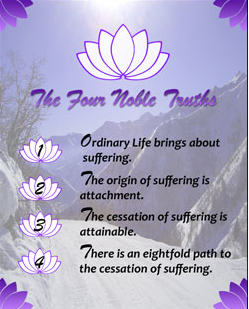
Based on three and a half years of doctoral research after 16 years as a teacher, I submit the following as one possible permaculture approach for junior secondary science. Please note that the underlying emphasis to this approach is that the teaching and learning of science can be improved by making it more relevant and experiential by engaging local individuals involved in the practice of permaculture. Continuing the Buddhist theme, I present this approach in two pieces akin to the Four Noble Truths and the Eightfold Path.
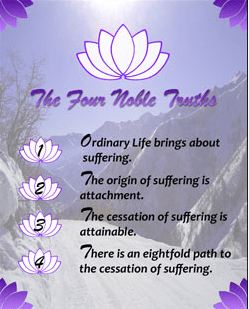
They are the Five Fingers of a Permaculture Approach and the Eight Key Principles.

The Five Fingers of a Permaculture Approach to Junior Secondary Science: permaculture design as means, not end; the transformative nature of permaculture; the science behind permaculture practices; permaculture practitioner as citizen scientist; and, field trips to permaculture properties. It is not that these five characteristics are unique to permaculture, but that all five fall under the permaculture umbrella. There are other ecological design systems and other transformative learning experiences. There are other citizen scientists and other valuable field trips. Through my research I have identified these five ways in which permaculture – as a distinct, well established, international movement – can be used to help improve the teaching and learning of science and to cultivate perspective change in both students and teachers.

The Eight Key Principles: making science relevant; applied science; student-centred teaching and learning; experiential learning; emphasizing interconnectedness; affective experiences; taking actions for the environment; and transformative chronology. These principles do not come from permaculture, but from the rest of my theoretical framework: scientific literacy, ecological literacy and transformative learning theory. These are the key principles for pedagogies that help to improve scientific and ecological literacy and encourage perspective transformation in students. These key principles can be applied independently of permaculture, but in this case they are believed to enhance the Five Fingers of a permaculture approach described above.

On a final Buddhist note, by not trying to teach permaculture there may be a greater uptake of permaculture ideas by students and teachers. This less-is-more approach may appear paradoxical, but that is the nature of Buddhism. Improving scientific and ecological literacy in students while they are in school may lead to adult learners who pursue permaculture naturally and effortlessly. You can plant a seed but you cannot make it grow. You can, however, add compost.

I will be presenting a detailed description of the Five Fingers and Eight Key Principles on the 14th of April at the Australasian Permaculture Convergence in Turangi, New Zealand.

Peace, Estwing
Sustainable Shed

Hi, I am Jiqiao….
Nelson and I worked on this shed for two days from setting all the materials up to putting the rubbish back into it. I have learnt not only having the idea to reuse rubbish but also the damages caused by sun, wind, and rain. To live sustainably, we are supposed to maximize the usage and also, sometimes ignored in such case, the durability of everything. Though this shed is made of all second hand materials, it does not necessarily mean it could be casual and weak. The shed is designed to prevent from wind and rain damages in efforts as much as we can think. You could explore all these details from Nelson’s previous blog.
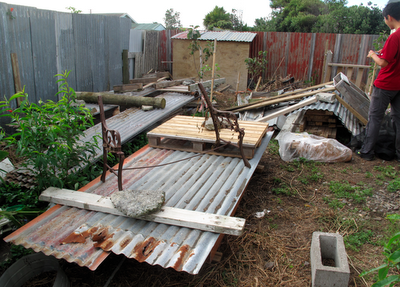
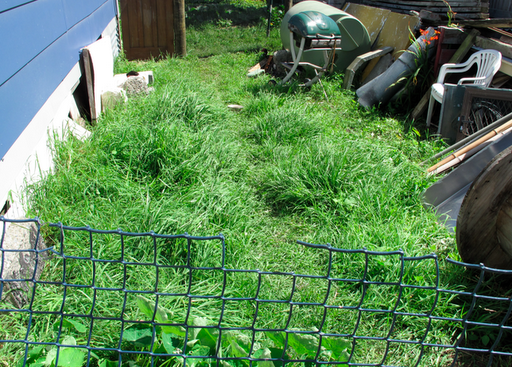
And I really enjoy the neat garden which used to be the following picture…I was looking at those piles and wondering how much painstaking work had to be done to clean them up.


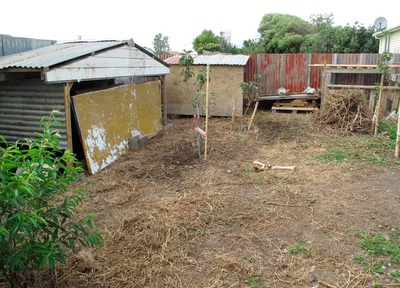
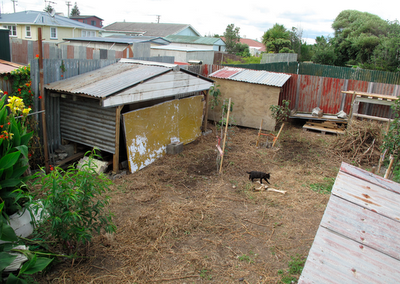
Now we just play a magic! It looks much more comfortable. We also pulled out some weeds while cleaning them up. Most of iron pieces and wood blocks are organized and stored under the shed, and those rust or small pieces were put outside prepared to be recycled.

The cat is playing with bones on the ground~

In the winter grasses will be planted in the yard so that it will also turn to green as other parts of the yards. And other parts of the yard will also be as neat as this one! 🙂
And most importantly, I really appreciate this great opportunity Nelson provides for me! I will be on South Island next month and come back to have some more exciting work!

Truss-Worthy

Eco-thrifty renovation, eco-thrifty gardening and eco-thrifty living are not formulaic. Although we can offer design principles, guidelines, and methods the application of E-T is always through the eyes of the individual. E-T, like permaculture, is a way of seeing. Mostly it is a way of seeing possibilities. It involves a vision to see something beautiful or practical emerge from something that someone else has thrown away. For example…

… last Thursday Jiqiao and I set about converting a pile of reclaimed lumber

… and some partially rotted trusses…

… into a usable shed.

Of the six trusses that had been left on our property when we bought it a year and a half ago, we were able to use three as trusses but the other three we stripped to use as purlins…

… and for the nail plates.

Peeling off the nail plates and pounding them flat for reuse takes time, but saves money and saves the manufacturing wastes of making new nail plates. It is a perfect example of eco-thrifty vision.

But just because something is built of salvaged materials does not mean it should not be meant to last. Of particular concern for the durability of any wooden structure is moisture. Wooden structures need a good hat…

… and good boots. While roofs can be fairly straightforward, foundations offer some challenges regarding ground contact and water wicking upward through materials including concrete and the end grain of wood (think xylem and phloem). The eco-thrifty solution I applied to this potential problem is a modification of a technique I used to use on my farm.

Choosing a concrete block for the foundation, I used the hole in the middle of it as a mortise that will hold a tenon in the bottom of the post in place. For the tenon, I used two pieces of H3.2 off-cuts of treated decking timber. When working with small pieces of wood it is helpful to pre-drill holes for nails otherwise the wood is likely to split when driving a nail through it.

I nailed the H 3.2 treated “foot” onto the bottom of the H 1 4×2 in two steps: first through the “plate” (pictured) and then through the smaller tenon (not picture).

And then the three pieces of wood are set in place.
By the end of the day we turned a pile of rubbish…

… into a weather-resistent shed in which we can put the rest of the rubbish. (If it fits.)

I slid the long sections of the three trusses we stripped into the top of the shed…

… and did some sheet metal origami to keep out wind-driven rain.
For a days work and the cost of a handful of roofing screws we have a shed that measures 4 meters by 1.4 meters. Easy on the Earth and easy on the wallet.
Peace, Estwing

Comrades!


Permaculturists share. It is that simple. It is one of three ethical obligations central to the practice:

Care for the Earth
Care for people

Share the surplus
When we started this project 15 months ago we had nothing to share other than our enthusiasm, our knowledge and experience…and some empty bedrooms. This just happens to be the formula for internship, and we welcomed our first awesome interns John and Amy a year ago right now.

They were absolutely amazing interns and we are grateful for all of their contributions to our project and to this blog. (Example of John’s post. Example of Amy’s post.) Along time went by and then Tom came to us late last year. (Example of Tom’s post.)

Last week I introduced Jiqiao, and mistakenly misspelled his name (Sorry!).

While Jiquao has not yet written a blog post, he has done everything else that we teach our interns in the first days with us. The number one skill we teach is pulling and straightening nails. This takes place on day one for all interns. Not only does it teach a valuable skill (there are specific techniques involved), but it also teaches respect for materials, humility and patience. (Think “wax on / wax off”.)

If possible, we use the salvaged timber and nails to build something right away to teach more skills and let our interns participate in the transformation from rubbish (according to someone else) to something functional and beautiful.

Another skill we teach all of our interns is scything.

Although our section is a mere 700 square meters, we have an abandoned patch out the front of 300 square meters where we can teach scything and encourage the growth of legumes such as bush lupine.

To the right of Jiqiao is a bush lupine, which takes nitrogen from the atmosphere and fixes in the poor, sandy soils. To the left of him is a living hedge consisting of 8 feijoa trees, 8 Jerusalem artichoke plants (sunflower family) and a loquat. These are all relatively wind-tolerant, and so they do not require the protection that we’ve given our 24 other fruit trees. They are planted in a berm of compost built by John and Amy last year. We use the grasses cut out the front to mulch the berm to suppress weeds and retain water.

The final skill we make sure to teach all interns is composting.

We use a hot composting system that has been successful at quickly processing a dead goat, dead ducks and – in this particular barrow load – our oldest chicken, Helen Clark. 😦

Composting is so important to teach because of its role in building soil health and reducing wastes sent to landfill. As well, it teaches humility and patience.
I submit that permaculture is not a set of principles to memorize and apply, but a way of seeing the world and interacting with it. It is a holistic view that contrasts starkly with the dominant reductionist Western paradigm. For those young people who are interested in coming to work and learn with us, it is a slow, experiential learning process. It involves working, reading, talking, reflecting and writing. We feel obligated to offer this opportunity to young people who are willing to think outside of the square and get their hands dirty. We can offer plenty of both here.
On a final note, each of our interns offers us their unique being. We learn from them, we laugh with them, and sometimes we play with them. We will remember Tom for his contributions to our Athletics softball team. We will remember Amy for her fence and incredible painting hanging in our lounge. We will remember John for his sunburn and his unbeatable work ethic. And, so far, my best memory of Jiqiao from last week was when we were underneath the house to do some minor plumbing work and prepare to sister up some bearers. As I explained to him the difference between a post, a bearer, a joist and a plate, he laid on his belly in the dark, covered in spiderwebs among the cat poops taking notes on his Smartphone. Priceless!
Peace, Estwing

Gimme Shelter


I wrote recently about protecting against the predicted increase in extreme weather events associated with global climate change. Not to carry on too much on this issue, but last Friday I attended a local event organized to give Whanganui residents the opportunity to talk about how we – as individuals and as a community – can address the effects of climate change. Before the break-out sessions, we heard a detailed presentation from a river engineer about how our district and regional councils have made their decisions about flood protection on the Whanganui and other rivers. The long and short of it is that:

In 50 years time, the 200 year flood will be the 100 year flood.
This is not a brain-teaser or a trick question. What this means is that currently the flood with a 0.5% chance of happening in any given year (ie, once every 200 years) will have a 1% chance of happening (ie, once every 100 years) in the year 2060. To make a long story short, our councils have decided to build stop banks to the current 200 year flood level, (which, in 50 years will be the 100 year flood level).
That was a very long way to introduce what I have been up to this week with our new intern from China (via Earlham College, USA) Jiquao.

To make a long story short, we’ve been putting up more wind netting to protect our fruit trees and vege gardens.

The winds here are strong…

…. strong enough to knock the Blacks off of the All Blacks! (A feet the Aussies and French could not do!) And strong enough to burn the leaves of our least protected apple trees.

The prevailing winds come from the northwest and can carry a load of salt from the Tasman Sea. They come over the fence in the photo above (with the green netting) and then are channeled between the house and a 2 meter-high fence where they did the damage to the apple tree in the photo directly above. So Jiquao and I erected two wind buffers yesterday:

the one atop the northwestern fence with green (1 meter); and one where the winds are channeled between the house and the iron fence (black, 1.8 meter).

This area has been used for firewood and other temporary storage and will be the location of our rainwater tank (seen above taking an afternoon nap). But as a good, practicing permaculturist, I have planned this newly fenced area to serve multiple functions as a new paddock for our fowl.

Although our ducks are trying it out today…

It will serve as the winter chook yard while I re-seed their present yard with beneficial grasses and allow it to recover from their scratching.

But, as I noted to begin with, the predictions are for more intense storms, which will include stronger winds. So I have designed and built with this in mind, including heavy duty galvanized wire…

… and shoring up the northwestern fence to compensate for the increased wind load due to the netting.

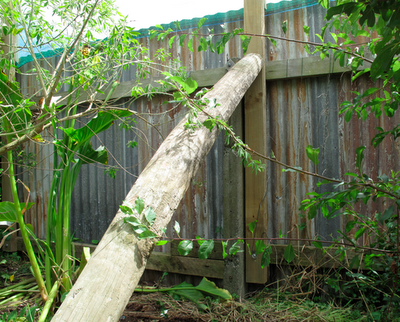
I know what you may be thinking about this ugly brace sticking into our backyard. But, in fact, it is hidden in the food forest / duck pen between our annual gardens and the back fence.
Aesthetics are still important to us, but anyone will agree there is nothing pretty about a blown down iron fence…or an upright iron fence for that matter. Over time, the wind netting will allow our apple, fig and peach trees, along with their tagasaste nurse trees, to grow taller and hide the iron we have to look at every day. Can’t wait.
Elsewhere on the property we have planted Feijoas (see recent photo in this post) that are wind-tolerant into a living hedge. No need for windbreaks there, as the hedge itself will be the windbreak for what we hope will be a blueberry patch in its lee. Can’t wait.
Peace, Estwing

Get Your @#$% Together

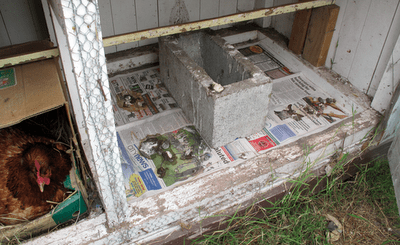
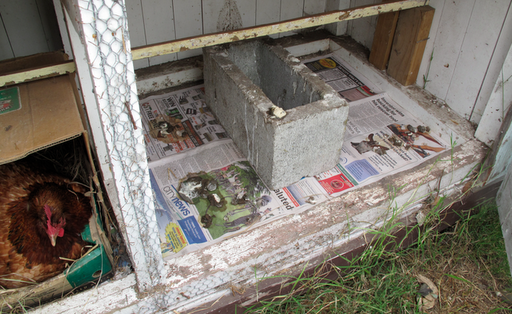
The only thing that makes more poo than chooks is ducks. We currently have 6 chooks and 3 ducks on 700 square metres, which poses problems for animal health, smell, flies and managing their valuable excretions for the benefit of our soils. After much observation, contemplation, trial and error, and learning, I have come up with what I think is the lowest effort / most effective system for keeping our birds healthy and our garden beds fertile. I’ll start with the red shavers. These ladies roost in this small storage shed.

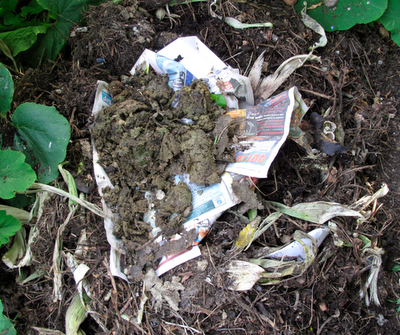
The free weekly paper is nearly the perfect size for two unfolded sheets to cover the entire floor underneath the roost. These papers provide carbon to balance the nitrogen in the manure when the lot goes into the compost pile.

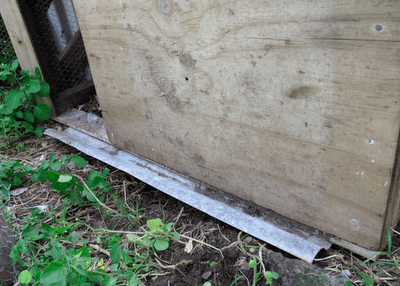
I fork out a depression in the compost pile before putting the “bedding”. Then I head over to the duck pen where they sleep in a shelter under which I placed a small section of roofing iron.

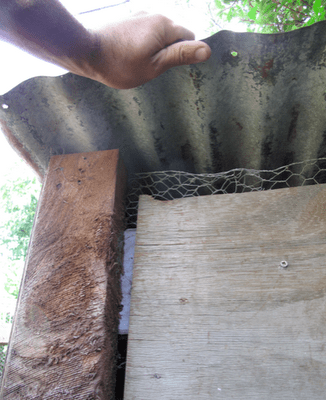
With my left hand I can lift one end of the shelter…

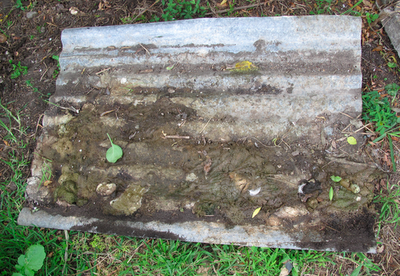
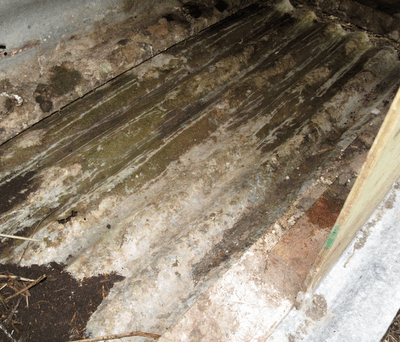
…and with my right hand I can pull out the roofing iron, which has collected a fair amount of their poos over the week.

I can rest the iron on top of the chook “bedding”…

… and use a trowel in the corrugations of the iron to scrape the manure onto the compost pile.

The nitrogen in the duck poo further balances the carbon in the newspaper.

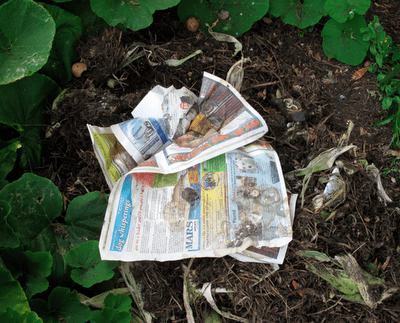
In order to make sure the newspaper breaks down as quickly as possible, I cover it so that its at the centre of the pile where it remains moist.

Then it is back to the duck shelter to replace the iron.

Until I repeat the process again next week.

I do this every week, usually on Saturday. I feel it is very important to keep this regular to keep the birds healthy and happy. It is the obligation of a bird owner.
For our two wee bantams, we tractor them across the grass/clover “lawn” at the back of our section. They eat some grass and fertilize as they go. I shift them everyday. We have noticed a marked improvement in the composition of species making up the lawn: more favorable/palatable grasses and fewer weeds that usually thrive in poor soil conditions. In other words, by tractoring these ladies about our section we are improving the health of our soil organically while they provide us with eggs. Not bad for us or for them.
Does anyone else out there have good poo management strategies? Please poost a comment.
Keeping it real, Estwing

Definitely Eco-Thrifty

We are grateful for the positive feedback we’ve received on the Eco-Thrifty Renovation in the last few months. Thanks to the hard work by our interns and partners we’ve had an excellent first year, which has brought us even more partners who see the real value in the eco-thrifty approach. We are designing two new programs that we’ll share soon on this site.


I recently tried to define eco-thrifty on another website as:

Eco-Thrifty: an approach to lifestyle, building, renovating or growing food that combines low financial outlay with low ecological impact. In a broader sense, the approach is low-input and high performance, be it the productivity of a garden or thermal efficiency of a home. Eco-thrifty seeks to dispel the false impression that green living is for the wealthy. It is a realistic, workable approach for a world of climate volatility, increasing resource scarcity and lingering unemployment and underemployment.

To put eco-thrifty in context, let’s look at some systems that are not low input and high performance. For example, here is a well-known system that is high input and low performance.


“The study said Americans pay more than $7,900 per person for healthcare each year – far more than any other OECD country – but still die earlier than their peers in the industrialized world.

The cost of healthcare in the United States is 62 percent higher than that in Switzerland, which has a similar per capita income and also relies substantially on private health insurance.”

Read more: http://www.dailymail.co.uk/news/article-2065548/U-S-ranks-28th-life-expectancy-pay-MOST-health-care.html#ixzz1epwFJcBS

Why eco-thrifty? These two recent headlines give some reasons.


And finally, eco-thrifty can also be applied to educational programs and projects. For example,


Cool stuff, eh? The ECO-School is committed to offering the highest quality sustainability education affordably. Our mission is to partner with organizations and individuals to create new projects or enhance existing ones.

Peace, Estwing