All posts by Estwing

Cluster Housing Saves Resources, Money, and Reduces Impacts on the Land

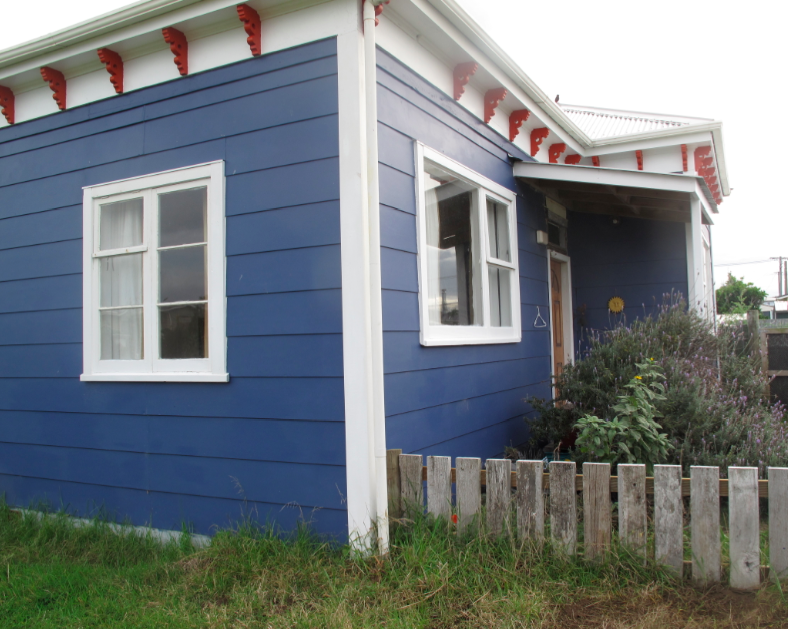
Two living spaces share one wall to conserve resources and energy. 
I was flattered to have been identified recently in the Chronicle (20-04-13) as an “exponent.” I was only left to wonder, am I ‘squared’ or ‘cubed’? My suspicion is the latter, as a Roman numeral 3 – III – sometimes follows my name of official documents. Although it would be rather cool to change it from Lebo III to Lebo3.
The article in question – Plan considers papakainga settlements on Maori land – reported on a Maori Land Court meeting from March 18, and quoted extensively WDC Principal Planner Jonathan Barrett. I remember meeting Jonathan about a year ago, and being impressed by his open-mindedness and willingness to work with groups to rethink some aspects of planning that would serve people and the planet better than a grid-type suburban landscape.
I had been invited to the meeting in question at the last minute, and was not completely sure about the agenda or even who would attend. I was also unprepared to be the centre of attention, not that I minded because the topic was one easily adapted to a discussion on eco-design. And once you get me going on that…
To provide some background, I had been invited to take a look at a piece of land at Kaiwhaiki Pa that had a decades-old development plan but some serious seasonal drainage issues. The existing plan indicated a grid-type layout of homes across the property, including the low areas. From what I recall, there was also a decade-old quote for a drainage project that would cost around half a million dollars.
From my perspective, this was a case of trying to fit a square peg into a round hole. Sure, it could be done, but at what cost? Engineers will tell you, “We can do anything with enough money.”
But a suburban-style development on that piece of land would be unnecessarily expensive, unnecessarily destructive to the environment, and, from my scant knowledge of traditional Maori settlements, culturally inappropriate. The ‘burbs are a Pakeha invention. Maori lived in villages.
From my perspective, the existing plan represented a lose-lose-lose situation. This is the opposite of the way I think and design, so naturally I had some ideas to put on the table based on my philosophy of eco-design, which is holistic, cooperative and adaptive.
From a holistic perspective, the drainage problem could be dealt to in a number of ways. First by looking up the watershed and determining in what ways biology (trees and shrubs) could be used to decrease runoff. Next, a number of ‘gentle’ erosion control methods could be used on the property to slow the flow of water by dissipating its energy. Finally, if part of the land wants to flood seasonally, Let It!
Rough sketch of Kaiwhaiki land. 
By clustering the homes into a village setting on the highest part of the section, hundreds of thousands of dollars could be saved on massive drainage works. At the same time, cluster housing reduces the costs of roading, water and sewage pipes, power lines, and even building materials. When two homes share one wall, each family need only pay for three and a half walls instead of four. At the same time, their heating costs will be reduced because each home would have three external walls instead of four. In other words, the two homes warm each other with an awhi, hug.

Two accommodations at Solscape Eco-Retreat share one wall. 
The design strategy is cooperative at every level. Not only does it involve the pa trust working with WDC, but also it involves humanity working with nature instead of against it. This is the heart of eco-design.
And finally, the design strategy is adaptive, because each group mentioned in the article – Kaiwhaiki, Marangai, and Putiki – will have different wants and needs, and each piece of land will have its unique character that must be honoured. Additionally, such developments in our District could become the new Best Practice for papakainga throughout Aotearoa, and iwi from across the land would visit to learn how they could adapt such an approach for themselves. Now that is exponential!

Peace, Estwing

Anniversary for Eco-Thrfity Renovation Column in Wanganui Chronicle

This weekend marks the one year anniversary of this column – 52 weeks of design principles, advice, maths (payback period), Neil Diamond tributes, and the tiniest bit of humour. I enjoy writing, and when Ross Pringle asked me to consider this column I saw it as a great distraction from my doctoral thesis, and a chance to contribute something to the health and sustainability of our community.
A lot has happened for me over the last year: I became a dad, a doctor, and got the certificate of compliance for our major eco-renovation. Now I am over-educated, under-employed changer-of-nappies.
To mark this anniversary, I’ve decided to bring back the column that started it all. Mind you, this is not the first ETR column, but a column I wrote for the Conservation Comment – which appears on Mondays in the Chronicle – in December, 2011. The wise, and dearly departed (to the South Island) Mr. Pringle recognized something in this piece, and rang with an offer I could not refuse. The rest, as they say, is history, albeit very recent history.

Before 

After
Twenty-Twenty Hindsight: A Year of Living Lightly on the Planet
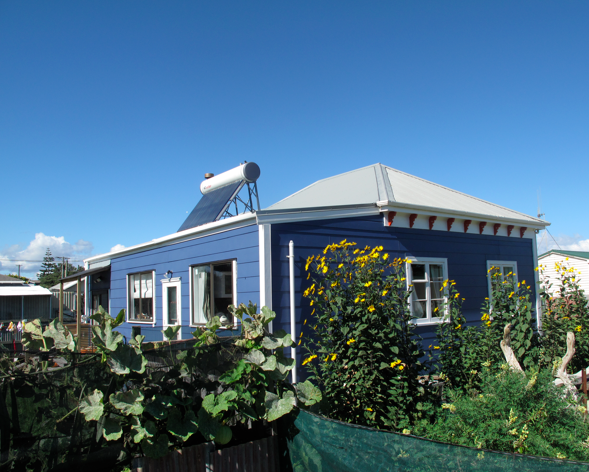
We are now over the 12-month mark of renovating an abandoned villa in Castlecliff into a warm, dry energy-efficient home. When we set out on this low budget / high performance retrofit we had no specific numbers in mind for energy savings and waste reduction. We simply wanted to push the envelope and do the best we could. As it turns out, our power bill has averaged $20 per month (this includes the daily line charge) and we have spent a total of $20 in rubbish fees for the entire year. I’ve come to call this our “20-20 hindsight” but there is no reason it could not also be a 20-20 vision for others to work toward by the year 2020. Of course electric rates will increase by then, but that is all the more reason to invest in efficiency now. (At current rates of annual change, electric rates will double in under ten years.)
The first Conservation Comment I wrote in July explained the design principles we employed for our passive solar renovation that have helped us achieve low energy bills. There is nothing new or unusual about those principles: solar gain, thermal mass, insulation and draft proofing. Similarly, there is nothing new or unusual about the design principles for our approach to resource conservation: reduce, reuse and recycle. The 3 R’s have helped us reduce the cost and impact of the renovation project as well as the cost and impact of our day-to-day lives. Here are a few examples.
While we have followed the New Zealand Building Code and used treated pine, Braceline Gib, building paper, and heaps of insulation, there are also areas where we were able to reduce costs and impacts by reusing materials. Prime examples include the bathtub, vanity, washtub and toilet in the bathroom, and the bench, sink, mixer, drawers, and shelves in the kitchen. Perhaps the most visible example is the vintage Shacklock 501 multi-fuel range that I bought my wife two years ago as a wedding present and we worked with Building Control to find a way to install safely. But my personal favorites are the pelmets that I made from old weatherboards that we removed while re-cladding sections of the exterior. And, like any builder would, we saved off-cuts to use as dwangs or for other small jobs.
Regarding our household waste stream, we compost all of the food scraps and even our fish and chips papers. We save paper to burn in our Shacklock or our outdoor pizza oven (made from an old wood burner) or to mulch our gardens and fruit trees. We reuse plastic bread bags and other small non-recyclable plastic containers. Again, there is nothing special about any of this, other than the fact that we take it seriously and put out one bag of rubbish for every two months. Perhaps the most unusual thing we do at all is emphasize the costs savings rather than simply the environmental benefits. At the end of the day, eco-thrifty living makes dollars and sense.

Free Sunlight, Permaculture Thinking and Abundance

Permaculture is a long word for common sense, and the ethical treatment of people and the planet. It’s a little disappointing that the word itself may put some people off – because it is unfamiliar to them – but any unique worldview requires an individualized name. The term was coined in the 1970s by a pair of Australians as a contraction between permanent and agriculture, indicating their advocacy for a shift toward low-input perennial crops and away from energy and chemical intensive annual crops.
In this way, permaculture is similar to eco-thrifty renovation in that is seeks low input/high performance design strategies and techniques. In both cases, the sun is the most important element of the system: sun grows food; sun can power a home. First, the home.
Now that we are tipping into winter, and the sun is falling on the northern horizon, the passive solar redesign of our villa is coming back from its ‘summer holidays.’ In other words, our home has been redesigned to let the sun in during the winter months and exclude it during the summer months. By considering the seasonal pattern of the sun, we are able to harness free heating when we most need it: May, June, July and August.
I have written in this column about the key components of passive solar design – solar gain, thermal mass, and insulation – and I’ll revisit them in the months to come. But how, you may ask, does passive solar design work? Although we have a wood burner in our home, we only used it about 2 days per week last winter. The rest of the time our villa was heated for free by sunlight.
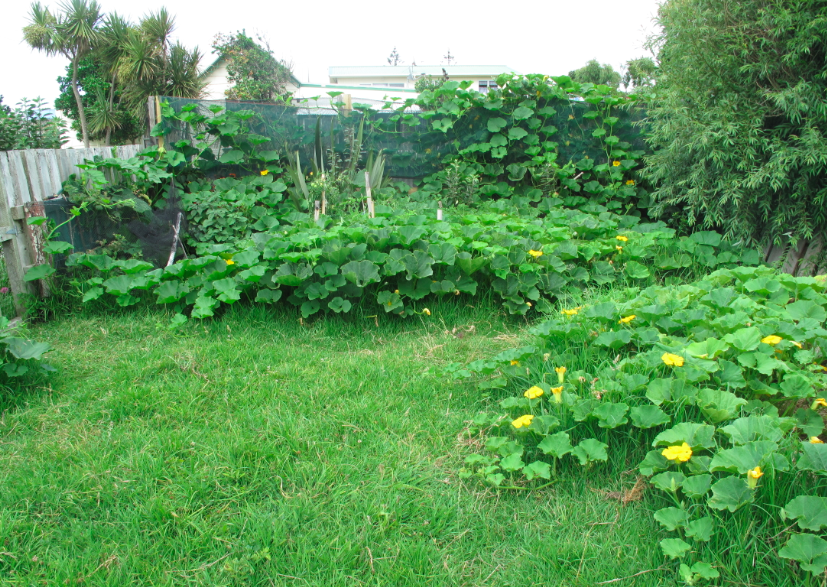
Sunlight also grows much of our food for free. That’s hardly news, but on a small section, we’re able to grow a large amount of food by maximizing sunlight exposure by utilizing vertical surfaces. For example, we let pumpkins climb up our fences, which they naturally do. Why fight it?
By growing five or six vines out of one mature compost pile, and letting them run, we are able to enjoy huge yields with hardly any work. Watering and weeding is virtually eliminated growing pumpkins this way. Low input/high productivity.
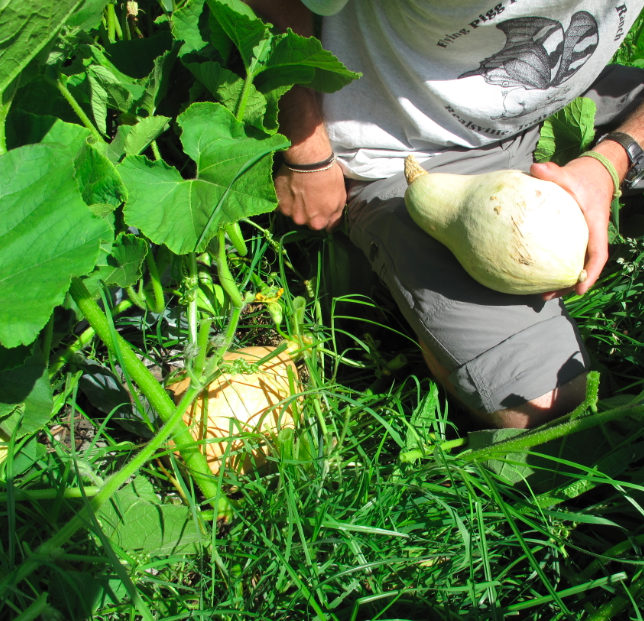
We also use the sun to cure our pumpkins before storage. This simply entails letting them sunbath for three weeks somewhere their bums can remain dry. We use the north-facing steps of our deck.
Once cured, the thick-skinned pumpkins are transferred to a cool, unused bedroom on the south side of our home. There they can remain ‘fresh’ for 12 months or more with no processing or refrigeration. It’s just natural cool storage.
In late February this year, we ate the last of our last-years’ pumpkins after the first of this-year’s pumpkins were ready to harvest. That means we have 12 months of homegrown, healthy, inexpensive, organic pumpkins at our beck and call. Oh, the recipes.
Interested in learning more about permaculture and permaculture ways of thinking? See the side bar for upcoming workshops.
Sidebar:
ECO School Workshops – Autumn, 2013
20th April, 9-5 Thinking Like a Swale: Advanced Permaculture Workshop
27th-28th April. Suburban Permaculture Weekend
5th May, 3-5. International Permaculture Day. Introduction to Permaculture
11th May. Home Energy Savings DIY Workshop
Registration essential: theecoschool@gmail.com; 06 344 5013; 022 635 0868

Reducing Our Ecological Footprint by Reusing

Over the last three weeks I’ve shared a handful of stories from newspapers both international and local. This week I’ll just start the column by referring to an article that appeared in the Herald in mid-March: Kiwis take more than fair share (Jamie Morton, 15-03-13).
This headline may come as a bit of a shock to those who consider New Zealand to be a fair, just, egalitarian nation. (But then again, we do rank among the top countries in income inequality.) This headline refers to a concept called Ecological Footprinting, which measures the overall environmental impact of an individual, a family, a city, or, in this case, a nation. In other words, as the article states: “If the entire world lived like a New Zealander we’d need more than two planets to sustain us.”
The article reports on two papers released by the Royal Society of New Zealand that looked at the following areas: food production, water quality, biodiversity, fisheries, transportation, and climate change. The combined direct and indirect impacts of all of these add up to the Ecological Footprint, which can be reported in “fair earth shares.” A fair earth share is calculated by taking the world’s total arable land, and dividing it by the human population. The current figure is 1.7 hectares per person, while estimates for New Zealand citizens fall between 5 and 8 hectares. 
But even for those of us who have traveled to Africa, India, or parts of Asia, and seen people existing on a fraction of an earth share (1.7 hectares), the concept can remain abstract. I’ll try to simplify it by using a reference that may be more familiar, the 3 Rs: Reduce, Reuse, Recycle. It should be fairly easy for anyone to recognize that ‘doing’ the 3 Rs would shrink his or her ecological footprint.
Recycling, at this point in time, should be a no-brainer for everyone in New Zealand as it saves money, conserves resources, and helps the environment. This is the type of win-win-win situation preferred in eco-thrifty thinking. Yet I am shocked at how little recycling takes place in many of our public places and sporting venues around Whanganui. After the outstanding, world-class waste minimization effort at the New Zealand Masters Games in February, I was surprised to find out that the organisers of other large, public events in our city have chosen not to make efforts at waste reduction.
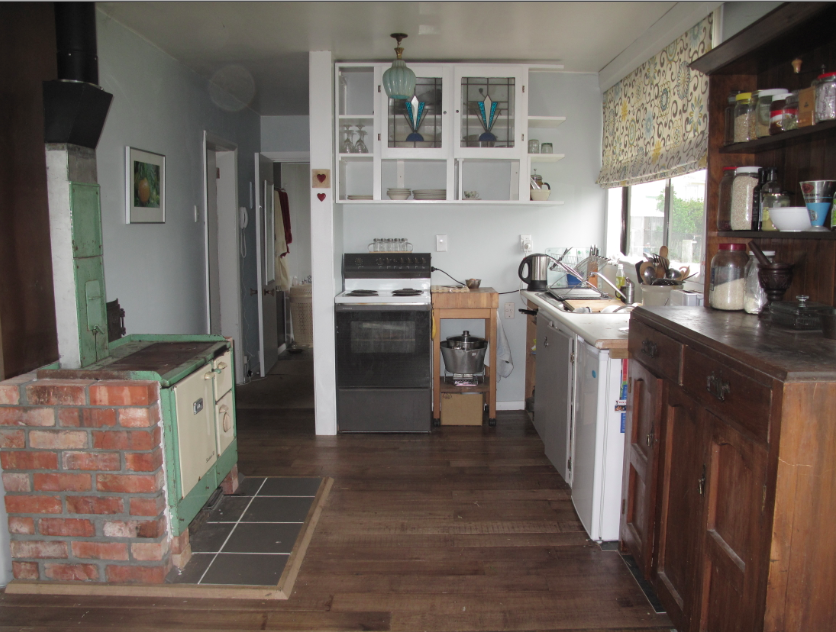
Reducing and reusing, for me, go hand-in-hand. Put another way, by reusing, we reduce. For example, nearly everything in our entire ‘new’ kitchen is second-hand, saving the mining and transportation of new resources, the manufacture and transportation of new products, and the disposal of old products.
 New, second-hand kitchen
Another example is the second-hand flue pipes I bought for our second-hand Shacklock 501. Reusing them saved me about 75% of the cost of buying new flues, saved the large carbon footprint of steel production, and supported a locally-owned and operated business, The Renovator’s Centre.
New, second-hand flue 
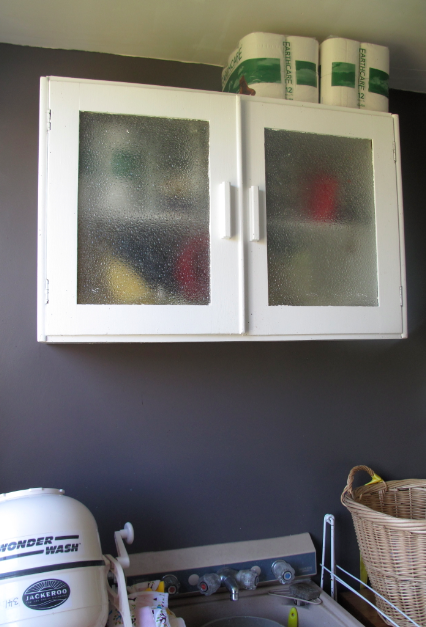
One final example, although I could describe dozens, is our hanging laundry cabinet that was once a floor cabinet, and came to us via Hayward’s Auctions. Although Nicky, the cashier at Hayward’s, was rightly horrified when we told her we planned to paint the rimu cupboard, it turned out alright.
Before 
Some tricks that I used when converting the floor unit to a hanging unit were: 1) inverting it so the original top is now the bottom, revealing the nice side, not the grotty side; 2) taking off the hinges and taping the glass when painting helps to make second-hand items look first rate.
After 
Reducing, reusing and recycling help keep dollars in our community, extend resource reserves for our children and grandchildren, and reduce our impact on the environment. The Win-Win-Wins keep piling up, a lot like the All Blacks. 
Peace, Estwing

Project HEAT Update

Project HEAT: Home Energy Awareness Training
A small consortium of community groups and local businesses have partnered on an innovative programme with the aims of helping Whanganui residents make their homes warmer, dryer, and healthier while saving power and money. This Win-Win-Win situation for people, the local economy, and the planet is the hallmark of the Eco-Thrifty Renovation, the Castlecliff project that inspired Project HEAT.
During the month of March, seven community presentations were held throughout Whanganui. The presentations highlighted seven of the ‘low-hanging fruit’ of home energy savings: compact fluorescent light bulbs, window and door seal, draught excluders, window blankets, hot water cylinder wraps, draught blockers, and the humble but effective ‘straw box.’ Each of these requires a very low upfront investment, which then pays for itself in energy savings in a matter of months or years: representing literally 10% to 200% return on investment!
These community presentations were the first of three stages planned for Project HEAT. The second stage involves a limited number of home energy audits to be performed within the city limits. The audits roughly follow the format used in the Eco Design Advisor programme that is used by Councils throughout New Zealand, the closest to us being Palmerston North. Any household is eligible for a free audit, but priority will be given to those where all decision-makers will be present at the audit, along with at least one adult (friend or whanau) that does not live in the home. This way we can extend the limited amount of funding to reach as many people as possible. To register your interest, either email Nelson, theecoschool@gmail.com, or ring Richard, 927 6635.
The third stage of Project HEAT is a DIY workshop being organized by Community Education Service for the 11th of May. During this workshop, participants will have the opportunity to make their own custom fit window blankets and draught blockers. The workshop may be particularly helpful for those people who do not have their own tools for making these eco-thrifty energy-savers. Contact CES to register: 345 4717.
The success of Project HEAT for the Whanganui community could not have been realized without the critical partnerships we have established. This is truly a project of the community and for the community. Partnering with The ECO School, the current list of local businesses and community groups includes: Tree Life New Zealand, Ltd., Wanganui Chronicle, Mediaworks, Bunnings Hardware, Sustainable Engineering, Ltd., Richard Collins – Freelance Software Development, Community Education Service, Sustainable Whanganui Trust, and the Whanganui Regional Primary Health Organisation. As well the following organizations donated the use of their venues for the community presentations: Josephite Retreat Centre, YMCA Central, Gonville Café Library, Progress Castlecliff (Duncan Pavilion), Wanganui Community Arts Centre, St. Barnabas Church, and All Saints Church. Thank you!

Eco-Thrifty Numeracy

I used to wonder how columnists could come up with relevant things to write about week after week after week. Now that I am a columnist, I wonder how to fit all of my ideas into one column!
Two weeks ago I related a number of eco-thrifty stories from the international press, and last week I hailed the election of an eco-thrifty pope. This week I’ll keep it local, using examples from the Chronicle to illustrate my points. No, I am not going to enter into the ongoing global climate change debate on the editorial pages, although I do find it amusing that one local retired farmer claims to know more about atmospheric science than thousands of practicing climate scientists.
Instead, I’ll pull my examples from the front pages of the Chronicle. I’ll apologize up front by saying they have to do with maths. But then again, two stories involving numeracy graced the front page on the 21st of March: one on rates rises and one on children’s maths learning.
Reading the two articles side by side, one question came to mind: I wonder if children are taught ‘the banker’s rule of 7’? Be aware, this question may have come to mind because my mother and brother are both maths teachers. Maths is in my genes.
 It’s all about the maths
The banker’s rule of 7 is that a 7% interest rate will double any figure in 10 years. It has to do with logarithms that are beyond my current maths skills, and the following equation: n = 70/R
The rule indicates that the approximate number of years (n) for an amount to double is 70 divided by the rate (R).
The common example I have been sharing in this column is the rate of electric fee rises, about 7%.
n = 70/7 = 10 years
In other words, at a constant rate of 7%, the price of electricity in New Zealand has doubled in the last ten years, and is likely to double again in the next ten years. Are children taught this in school? It may have bearing on their adult lives.
Using this handy equation, I turn my attention to the article on rates in which a reported rates hike of 6.5% will be applied to properties valued at $152,000.
n = 70/6.5 = 10.8 years.
Stated in plain English, at this level, rates on modest homes will double in under 11 years, while power is forecast to double in less than 10 years. Add to these the insurance hikes we have seen after the Christ Church earthquakes, and the cost of fixing the ‘pong’, and something has got to give.
Be aware, however, that higher rates rises will be imposed on lower value properties and lower rates rises will be applied to higher value properties. Under this formula, the poor and working class will be paying an increased proportion of Whanganui’s budget year after year.
Why the greater rates hike on lower value homes than higher value homes? 
The rates article appeared less than a week after the Chronicle profiled Sarah, in “Managing life on the bread line” (Saturday, 16-03-13). That article described that after paying rent, power and gas, Sarah “has $130 left to provide food and any other essentials.” Given the current rates rises, many struggling families like Sarah’s will find it even more difficult to cope. 
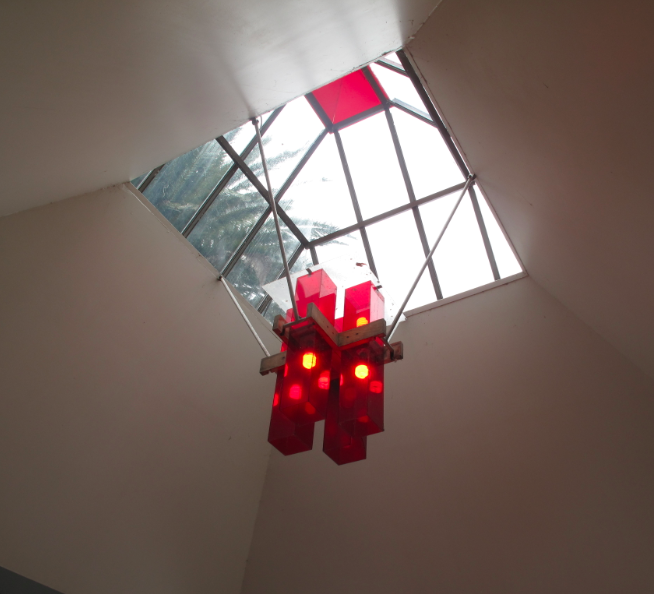
I wonder what Sarah, and other low-income householders think about paying a higher portion of our city’s budget year-on-year, for things like running lights in front of the Central Library during daylight hours. I was pleased to hear recently that by mentioning this apparent waste of power and money in my column a few weeks ago, I have instigated a bit of a debate. Reportedly, some say the lights are on for “security reasons” (during hours of bright sunshine and heavy foot traffic?). Another reported explanation is that the light fixture is art. I admit that I had not thought of that when I first noticed the bulbs illuminated on a bright, sunshiny day two and a half years ago and mentioned it to library staff.
If eight light bulbs burning directly under a glass skylight with sunshine beaming through it is indeed art, I would suggest two potential titles: “Ironic”, or “Money to Burn.”
Ironic? Or money to burn? 
For excellent, free advice on how to protect your family against electric rates rises, please see the sidebar.

Peace, Estwing
Sidebar:
Project HEAT: Home Energy Awareness Training
Neighbourhood presentations highlight seven excellent, low cost / high performance strategies that anyone can use to make homes warmer, drier and healthier while saving power and money.
30th March, 1-2:30 pm. Wanganui Community Arts Centre, City. (Taupo Quay)
4th April, 7-8:30 pm. All Saints, 70 Moana Street, Wanganui East. 

Autumn Workshops

ECO School Workshops
Autumn, 2013
20th April, 9-5 Thinking Like a Swale: Advanced Permaculture Workshop
27th-28th April. Suburban Permaculture Weekend
5th May, 3-5. International Permaculture Day. Introduction to Permaculture
11th May. Home Energy Savings DIY Workshop
More details below.
Registration essential: theecoschool@gmail.com; 06 344 5013; 022 635 0868
Thinking Like a Swale: Advanced Permaculture Workshop
Water has been a teacher to humanity for millennia. Now that humanity faces unprecedented challenges, water remains our teacher, particularly in the form of the humble yet powerful swale. Beyond its function of slowing the flow of water through a landscape, the swale can be used as the design inspiration for sustainable homes, abundant small-scale food production, community resilience, teaching and learning, and more. This workshop provides examples of ‘thinking like a swale’ and encourages participants to engage this type of thinking in their own lives and communities.
20th April, 9-5. $60, includes lunch.
Suburban Permaculture Weekend, 27th-28thApril
This two-day workshop covers the main aspects of a suburban permaculture installation: an energy-efficient home; low-input / high-productivity vege gardens; food forests; water management; poultry; and, community relationships. The weekend translates theory into practice, using an exemplary suburban permaculture property, the Eco-Thrifty Renovation: www.ecothriftydoup.blogspot.com
Tutor: Nelson Lebo has developed one of the most sustainable rural properties in North America and one of the most sustainable suburban properties in New Zealand. He holds a PhD in permaculture education.
27th April, 10 am – 28th April, 5 pm.
Cost: $160 per person, $260 per couple. Includes meals. Free camping available, or choose other local accommodation.

Eco-Thrifty Popes and Buddhists

Extra! Extra! Read all about it! Vatican goes Eco-Thrifty! Pope shuns chauffeur-driven limo for the bus.
I am humbled by the humility of the newly elected pope: Francis the 1st. I am not a pope-watcher, and usually have no more than a peripheral interested in the comings and goings of the Vatican, but just one sentence changed all that: “The Argentine is known for taking the bus to work and cooking his own meals in his small apartment.” This was in stark contrast to the one thing I knew about his predecessor, Benedict XVI: that he wore designer red shoes.
I confess that I am not a Catholic, but I fully-endorse the teachings of Jesus, especially those in support of the poor and those condemning moneychangers. Over the last decades the wealth gap between these two groups has expanded to a breadth that would make ancient Roman elites blush. This gap prompted the Occupy movement (the 99 percent), countless European protests in the last 4 years, and probably the Arab Spring. Good on the Cardinals for electing a pope who appears to put social justice issues – including the impacts of globalization on the poor – at the forefront of the Catholic Church.
And choosing the name Francis: icing on the cake, but not a decadent cake, more of a pancake with a pat of butter and maybe a tab of real Vermont maple syrup.
While not a practicing Buddhist, I have Buddhist tendencies, although you may not believe it if you have seen me play softball for Whanganui’s Athletics Softball Club. One of my favorite ‘teachings’ from Buddhism is an eco-thrifty ‘lesson’ that goes something like this:
When their robes become too worn to wear, the Buddhist monks use them as blankets on their beds. When they become too worn for blankets, they use them as mats on the floor. When they become too worn to use as mats, they use them a chinking in the walls to keep our draughts.
Along those same lines, we have come up with a use for old towels and off-cut bits of wood for draught-proofing the bottom of the doors in our home. This is a variation on what can be found in everyone’s Gran’s home: the cloth tube filled with beans. I prefer my version for a few reasons. First, a piece of timber wrapped in a towel has a square edge whereas a bean tube – even when squidged up against a door – still has a rounded edge. In most cases – even our wonky home – the junction between a door and a floor is a right angle. Second, my version can be made virtually for free, as almost everyone has some odd bits of timber or can get them from a friend, or even free from a lumber yard. And old towels, everybody has one or two of those. Third, call me crazy but I believe food should be used for eating and not draught-proofing. (Also, what if the mice eat it?)
Another method of draught-proofing doors (and windows) is applying a ‘store-bought’ foam seal. At less than $4 for two rolls at a number of local merchants, this approach is practically free. This is suitable for all timber doors and windows where you can feel draughts, but most aluminium doors and windows are manufactured to be draught-proof.
These strategies for low-cost / high-performance energy savings are included with many others in the Project HEAT presentations that are making their way through Whanganui one suburb at a time. Please see the sidebar for more upcoming events.
Peace, Estwing

Can We Mimic the Success Stories in Energy Savings?

Over the last two months I’ve been collecting articles on energy that relate to many of the topics I write about in this column. At this point I have enough of them to share some recent developments and innovative programmes from around the world.
But first I’ll start with a bit of a no-duh for anyone who has ever visited the United States of America. Forbes magazine reports, “America: The worldwide Leader in Wasting Energy.” Writer, Eric Savitz, suggests “Chronically low energy productivity – the level of output that our economy achieves from the energy we all consume – is costing U.S. businesses and households an estimated $130 billion per year.” I don’t know much about N.Z. business and industry energy-efficiency, but I would suggest that household energy waste here would be comparable per capita to the U.S. That’s the bad news.
The good news is that individual states in the U.S. are implementing innovative programmes, and saving businesses and residents millions of dollars. Savitz reports that one small Massachusetts community helped families save over “$10 million in electric and gas bills by providing personalized information, with neighborhood benchmarks and advice about how they can use less energy.”
In another state, and another magazine (Yes!, probably a lot like NZ’s Good Magazine), Erin McCoy reports that Kentucky in saving power, cutting carbon emissions, and creating jobs by facilitating a win-win-win situation between homeowners, contractors, and the planet. A programme called How$mart provides home energy audits, works with contractors to perform the recommended work, and then checks the work to make sure its been done properly. The average How$mart home has cut energy usage by 20%.
Translating the two articles above to a Wanganui context, this could mean $8.5 million in savings per year (homes only, not business or industry).
NZ average household electricity use: 10,000 kWh/year (Waitakere.govt.nz, 2008)
20% of 10,000 kWh = 2,000 kWh
2,000 kWh X $0.25/kWh = $500
$500 X 17,000 homes in Wanganui = $8.5 million
In my opinion, the coolest thing about taking this perspective is that this money already exists in our community, and we don’t have to ‘attract new dollars’ as Council seems continually trying to do. Instead, we would be retaining dollars now sent to power companies in Auckland, Christchurch or Wellington.
The other cool thing is that investments in energy savings today pay themselves back at faster rates in the future as power prices rise. In other words, the faster rates rise, the faster energy-efficient investments pay for themselves through savings. For example, under ‘normal usage’ a compact fluorescent light (CFL) bulb now pays for itself in about 6 months (200% return on investment!) As electricity becomes dearer, the payback period for CFLs gets shorter.
And what is even cooler, Consumer magazine reports that the Energy Efficiency and Conservation Authority has introduced minimum performance standards for CFLs (05 Feb, 2013). “All general-purpose CFLs must pass requirements for energy performance, light quality, bulb durability, mercury levels and their impact upon the country’s electricity networks.”
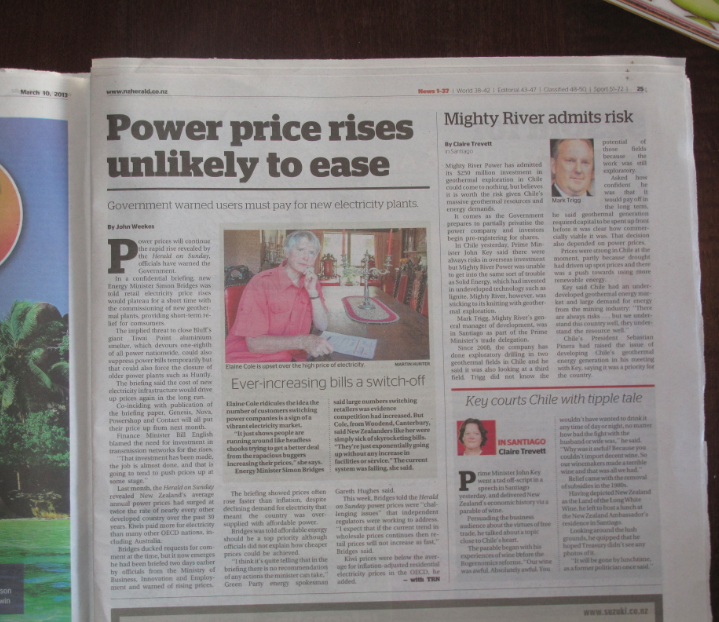
Now the bad news – not so cool – comes from an article I read in the Herald on Sunday, 10thMarch in Nelson’s Café in Stratford. The headline: Power price rises unlikely to ease: Government warned users must pay for new electricity plants.

Given my observations on governments’ ability/inability to embrace sustainability (shared in last week’s column), and my experience with innovative power programmes overseas, I would argue that a simple strategy of eco-thrifty education/incentives/management would render this headline unnecessary because saving power is cheaper than producing power.
Take the 34 million kWh potentially saved in Wanganui per year, and add Feilding, Marton, Bulls, Turakina, etc. and the amount saved is more than the output of a new electricity plant, and at a fraction of the cost. Does that make sense?
The power companies themselves were pushing this type of strategy 25 years ago in Massachusetts, USA, and reaping the financial benefits of not building costly new plants. But here we are 25 years later in ‘clean, green New Zealand’ and the main strategy appears to be building costly new plants. Does that make sense?
At this rate, N.Z. may replace the U.S. in the Forbes headline at the top of this piece: “The worldwide Leader in Wasting Energy.” Unlike our All Blacks, Black Ferns, and the recent Black Sox world championship victory in Auckland, I suggest this is one category we may not want to be number one.
Peace, Estwing