Category Archives: Eco Thrifty Life

Reactively Proactive


I had great hopes for the Copenhagen Climate Conference in December 2009…and then I was very disappointed. In the two years since, it has become clear that most governments worldwide no longer consider carbon reductions as an approach to dealing with climate change. Rather, the focus seems to have shifted to adaptation.

That saddens me because we are now essentially condemned to deal with the predicted extreme weather effects of climate change instead of trying to avoid them by reducing emissions.

I consider this a lack of will. It gives me little hope that humanity will have the will to deal with other pressing environmental, economic and social issues facing us.


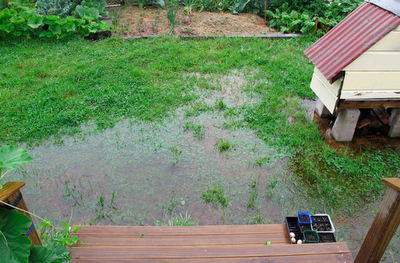
We are feeling an increasing rate of extreme weather events in our community.

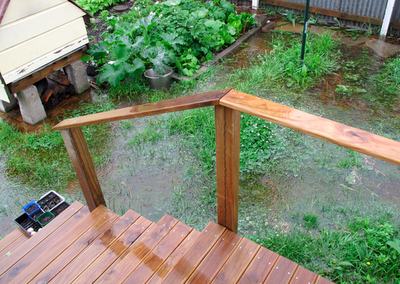
And out our back door.
January 1, 2012

We are on pure sand, and January is usually a dry month.

Yet we had standing water that remained for hours. Permaculture founder Bill Mollison is famous for saying, “The problem is the solution.” A partial solution to our flooding problem can be dealt to by collecting and storing some of the water.

This 1,000 liter water tank is not large enough to take all the excess water during a major rain event, but it will take some. And it will serve other functions too. A major principle of permaculture is redundancy. Currently we only have one water source: city mains. Yet if there is an earthquake like the ones in Christchurch, we would be left high and dry. By having the capacity to collect and store our own water we protect ourselves against natural disasters.
Additionally, we have had some extreme wind events lately which prompted us to put up wind netting last month.

But that was not enough. I recently purchased 20 more meters to install soon.

I have come to the conclusion that governments cannot be depended on to avoid disasters be they environmental or economic. Therefore, we need to protect ourselves. Investing in wind netting and water tanks are just two examples of protecting against weather extremes. Wind breaks and water storage are central to permaculture landscape design. Even on our 700 square meters we are designing for resiliency in these ways and others too. I’ll explain some of those another time.

Peace, Estwing

Brains Not Brawn in the Garden

At the ECO School, we believe in making the highest quality sustainability education affordable. Money should never be a barrier to getting top notch information to people of moderate means, and delivering that information expertly by making it logical, practical, relevant, easy to understand, and teaching to multiple intelligences.
We reach the world through the Web, and we reach out in our community (and those communities where we are invited) by working with teachers in schools, presenting to community groups, running workshops and offering consulting services. Most of our local initiatives are payable 100% in REBS, our local currency, meaning anyone can join that network and attend a workshop “on credit” and “pay” for it later by offering their own talents to the REBS network. And on top of that, all of our workshops and consulting services are designed to help people save money. In most cases, the cost of the education pays for itself in a matter of months, and after that it is all savings. Compare that to the average US or NZ university degree!
By far our most popular and most successful workshop has been “Organic Weed Control: Human Scale Design and Management” aka, “Low-Maintenance / High-Productivity Gardening.” We’ve trained over 300 people over the last four years in Australia, USA and New Zealand with excellent feedback. We will be offering this workshop on Sunday, November 13th from 1 to 5 pm here on Arawa Place. Some aspects of the programme include:
• Designing garden beds with the mantra, “Tools, Timing, Technique.”
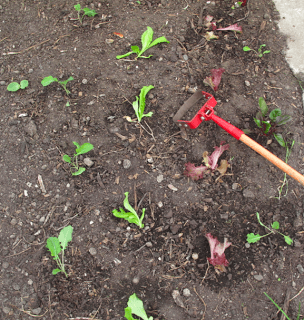
• Improving germination rates in chunky soils.

• Tips for transplanting, spacing, staking, propagating and pruning tomatoes.
• The judicial use of mulch, and growing great garlic and onions.

• Super lazy, super productive pumpkin patches.
• Eco-thrifty compost making. For more details, click here.
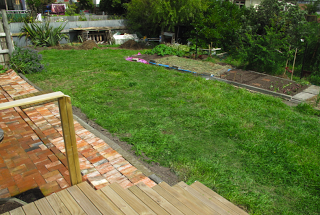
And while you’re here, check out the rest of or eco-thrifty landscaping…
… including our almost finished brick patio. (John and Amy, Come back and help us complete it!)
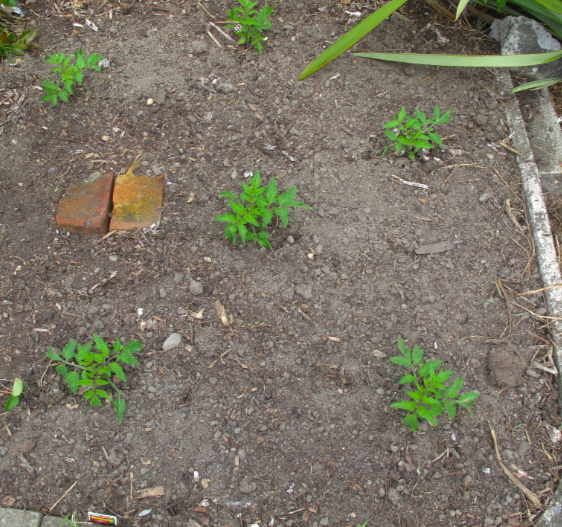
And, most importantly, someone tell me the name of this plant. It has a thick, perennial woody root but the foliage dies back in winter. It grows everywhere in our sandy section.

Pre-registration required. Contact us through the ECO School. As always, discounted rate for our neighbors in Castlecliff.
Peace, Estwing

Mutually Beneficial

We are in the unique position in that we are both permaculturists and educators. Our home is our classroom and a working model for sustainability. Our school – The ECO School – is perhaps the smallest, lowest budget non-profit on Earth. We are trying to grow it so that it can be financially sustainable, but our business model is outside of the mainstream and many people do not understand it.
The approach we take at The ECO School is an ecological one. We seek to enter into mutually beneficial relationships with individuals or organizations to provide the highest quality of education for sustainability for entire communities: from children through seniors. In nature this is called symbiosis, and more specifically mutualism. Synergy is another way to describe it: the whole is greater than the sum of its parts. In permaculture this is sometimes called “regenerative design.”
We don’t walk in to an organization, school or business and say “this is what you should do.” We say, “What are your needs and how can we help you? Here are some ideas for you to ponder, but you decide what direction we take together.” In other words, we can help others do what they do better… as long as “better” means more sustainably. Here are three recent examples:
Solscape Eco-Retreat in Raglan is in the process of developing into an education and conference centre. They launched an exciting new educational initiative a week ago today, so we went up to help our dear friends celebrate this important milestone. At the same time, we were able to run workshops at Solscape over the weekend as part of Raglan’s Sustainable September calendar of events. We were able to bring the highest quality of education for sustainability to Solscape to help raise their profile as a leading facility in this area, and we were able to reach out beyond our normal audience in the greater Wanganui area and earn some money. (Well, it covered our travel expenses so we had a free weekend away with friends.)
The Green Space in Hamilton is a meeting venue run by other friends. I knew they had done an eco-renovation of which they were proud. Since Hamilton is near Raglan (and where I am an enrolled PhD student) I asked our friends if they would like to tag team a workshop for Hamiltonians. Again, the goal was for a mutually beneficial relationship where the Green Space gets local exposure, attendees get an excellent, low cost educational experience and I get to do what I love to do.
This afternoon I will be heading to Kakatahi School to help a cluster of rural schools plan a term 4 curriculum based on the sustainable use of energy. In this case, the principal contacted me to arrange for this professional development programme made possible by grant writing by the Sustainable Whanganui Trust and funding from the Wanganui District Council. This is a four-way partnership that permaculturists may call a “guild.” All four entities benefit from this initiative and at least three schools will be in attendance.
Just in case you are interested in innovative, cross-curricular sustainability education, here are a few ideas I sent to the cluster to think about before our meeting this afternoon. I treat my curriculum design work like I do my permaculture landscape design work, starting with a client brief. This client brief came directly from the principal.

Brief: The topic that we would like to use for our planning would be: How can we be more sustainable in relation to Energy? (in our homes, schools, on our roads and on our farms). Each school has slightly different needs, but I think for our first meeting it would be useful to plan a unit of work for a term, based around the Energy theme. Each school could then adapt the unit to suit. It would be an Integrated Unit incorporating Science, Maths, English, Social Science and the Arts. It would be in the context of Education for Sustainability.

Preliminary ideas: Energy is everywhere around us all the time. Integrating energy across the curriculum should not be difficult, but the challenges will be meeting the needs of different schools, different age levels and different learners. I can provide ideas and support for teachers to adapt specific lessons for their students. Below is a short list of possible approaches. These can be clarified and expanded upon at the cluster meeting on the 30th.

• I have a professional development workshop called Eco-Maths that uses a PowerPoint slide show to provide ideas on how the teaching and learning of maths can be based on eco-design and home energy use. This workshop is designed to spark ideas that can be further developed by teachers with support from me or a local engineer, or green architect, etc.

• Our eco-thrifty renovation project has an active blog: www.ecothriftydoup.blogspot.com. I could set up a “kid-friendly” version of the blog, that classes to go to and post questions to which I could respond.

• I am an advocate of concept mapping as a teaching tool. I believe it is especially well suited for complex issues like energy. I would be happy to share some ideas on concept mapping.

• Some lessons on solar energy for Level 1 students can be found on the attached example of cross-curricular lesson planning at a Wangnaui primary school.

• I can share some ideas on science activities on various aspects of energy.

• I have an excellent, colorful graphic that compares the efficiency of different forms of transportation. If you have a colour copier it would be worth reproducing.

Peace, Estwing

Equinox

Balance is something many of us struggle to maintain in our lives. With the profound unsustainability surrounding us, the task often appears that much more difficult. This project seeks to find the balance between eco and thrifty but finds – much of the time – that they are one and the same.
Lakota star quilt was a wedding gift.
The equinox is a great global reminder about balance, and a time for us to celebrate the sun.
Since our monthly Wanganui Permaculture Gathering (the third Wednesday) fell on the 21st, we decided to have an “alternative cooking” party with our solar cooker, rocket stove and pizza oven. Our friends brought a thermette (if you don’t know it, Google it) and a wood-buring BBQ.

Peace, Estwing

Citizenship Day (?!?)

I discovered this week on my Yankee Magazine calendar (thanks mum) that the 17th of September is Citizenship Day. There was no further clarification as to whether this citizenship extends beyond New England, or the USA, but I will assume that this is a global event. And so I’ll write about being a global citizen.
When thinking about what it means to be a global citizen, I submit that the permaculture ethics are a good place to start: earth care, people care, fair share. As a matter of fact, that may even be a good place to end. Through this lens, let’s look at an example of poor citizenship.
This data comes from a recent article in Forbes: Wasting Away: Our Garbage by the Numbers. One of the saddest bits about this is that I recall numbers like this when I started my career as an environmental educator 20 years ago. But back then the amount of garbage the average American produced was “only” 4 pounds. It is interesting that the current number is 4.4 pounds, because that is 2 kilograms. I have not seen the number for New Zealand, but I suspect it would be similar.
The three Rs (reduce, reuse, recycle) are so fundamental that I won’t write extensively on them except to say that global citizens would take them into account with every purchasing decision they make. During our renovation and in our domestic life we produce next to no rubbish: about one bag every two months.
I’d like to challenge global citizens to raise the bar for global citizenship beyond the 3 Rs by taking serious steps at energy conservation. We have had great success with our passive solar redesign and are using less than 10% of the electricity of even what is considered a “low user” (8000 kWh/year) in New Zealand.
This is the power bill that came this morning, after a month that included the coldest week in New Zealand recorded history. During this record cold spell, with no supplemental heating except electric, we averaged just over 2 kWh per day.
Even a “low user” can average over 21 kWh per day year round. Presumably, that may vary from 15 kWh per day in summer and 25 kWh per day in winter. By comparison, our 2 kWh appears to fall into the truth-is-stranger-than-fiction category. But its true. You can see the bill above. That is the power of sunlight, thermal mass and insulation.
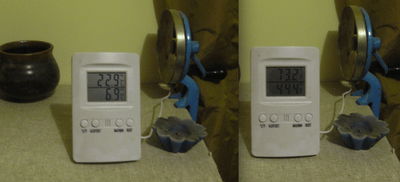
Indoor/Outdoor Temperatures in C and F at 6 pm, Sept. 4th.
Indoor/Outdoor Temperatures in C and F at 6:30 pm, Sept. 6th.
And we’re not even done insulating and draft-proofing yet.
Global citizens who are concerned about drought in East Africa, flooding in Pakistan and Bangladesh (formerly “East Pakistan”), and rising sea level in Tuvalu should feel an obligation to cut their energy use even if much of it comes from renewables like here in NZ. Even renewables have “side effects.”
Our friends in Raglan are fighting the wind mills proposed for the coastline to the north. I’ll be there a week from today helping them start that fight from home one kWh at a time.
Peace, Estwing

9/11 Yesterday/Today

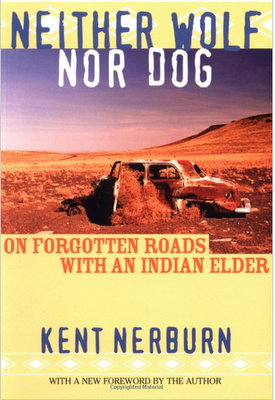
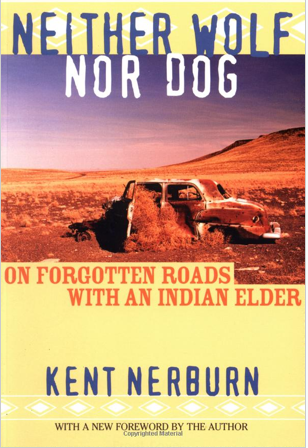
As with birthdays, wedding anniversaries and holidays, we met the 10-year anniversary of the plane crashes of the 11th of September divided. Days arrive a day earlier in New Zealand than they do in the USA. As we awoke on Sunday, 11-09-11 in Wanganui, NZ, our families were enjoying an autumn Saturday afternoon in New Jersey, Washington DC, Pennsylvania and Massachusetts. As I write these words on Monday, 12-09-11 in Wanganui, memorial services are taking place on Sunday, 11-09-11 in New York City and elsewhere around the country. Living between two worlds reminds me of an amazing book about the Native American experience called Neither Wolf Nor Dog.

Being dedicated to the sustainability movement but living in a patently unsustainable world gives me the sense of inbetweenness that many Native Americans and Maori feel regarding cultural identity. I don’t mean to imply for a moment that I can identify with being a colonized people, but I share a feeling of not belonging to the dominant culture and not living a 100% alternative lifestyle. Like many people, I walk in two worlds and often stumble.
Even though many of our friends and neighbors think our lifestyle is extreme in the extreme (“their %$#^@ mad” as one of our good friends recently put it) I consider our lifestyle fairly normal. We have mains power, mains water, internet service, a mobile phone, a slow-cooker (crock pot), a refrigerator, two circular saws, two electric drills, two computers, a printer, a digital camera, hot and cold running water, and a car. Of that list, for most of my time on my farm in New Hampshire I had only seasonal cold running water, a computer, sometimes a mobile phone and sometimes a car. By comparison, I feel absolutely cosmopolitan now.
And so it was with a sense of privilege that I accompanied my lovely wife on our bicycles to the Castlecliff Club on Friday evening to watch the opening ceremonies and first game of the Rugby World Cup being held here in Aotearoa New Zealand. It is said that rugby is a hoodlum’s game played by gentlemen while soccer is a gentleman’s game played by hoodlums. When I think of that juxtaposition it reminds me of what it means to embrace voluntary simplicity. Although the two of us hold 4 and 2/3 tertiary qualifications, we live well below the poverty level. In a sense, we are “gentlemen playing a hoodlums game.” But of course it is not a game (and we ain’t no gentleman neetha’). This is our life, and it is a very good life at that. It is just surprising how few people are genuinely interested in saving money and preserving the health of the planet.
Among the events we chose for our Sunday the 11th of September were: planting native shrubs and grasses in the local dunes; kareoke practice; softball team AGM and muster; priming trim boards for interior doorways and windows; and going to the Castlecliff Hotel to watch the USA play Ireland in their first round rugby match. It was billed as an emotional match for the USA as the team was playing on 11-09-11 in NZ. And the boys put up a good first half against a strong Irish club. The score was closer than most would have predicted, although the US kept it that way with a stingy defense and a lucky last second score.
Watching rugby from the perspective of an American footballer can be counter intuitive. Football is usually considered a game of possession, and rugby – I’m told – is a game of position. Pinned down at their own goal line, a football team would never punt on first down. But it is common in rugby to punt the ball voluntarily to improve the field position while giving up ball possession. Again, I am reminded of voluntary simplicity. Our material possessions are not as important as the position of our relationships with friends and neighbors (although they may think us a bit odd).
This perspective of position over possession became acutely clear to us as the game was winding down in conjunction with my second Lion Brown. A woman who Dani had just met at Kareoke practice (conveniently held at the same venue) came up and offered to buy us a round of drinks. “No thank you,” we said, “we’re just heading home.”
“OK,” she said, “then just take the money.” She held a twenty dollar bill toward us.
“No. No. That’s alright,” we said.
“I just won the jackpot and I have to share it or else it will never come back to me.”
“No, really, that’s OK.”
“You have to take it. Its an offering. You have to take it.”
We reluctantly accepted and walked outside.
I don’t want to read too much into this interchange, especially because it was an intercultural exchange and I cannot offer insights into the motivations of someone brought up within a more indigenous worldview than mine. But I suspect that the sustainability movement has more in common with traditional Maori and Native American perspectives than what most people recognize. I’m curious what you might think about the relationship between the permaculture ethics of earth care, people care and fair share, and the concept of the potlatch ceremony, or giveaway. From Wikipedia:
A potlatch[1][2] is a gift-giving festival and primary economic system[3] practiced byindigenous peoples of the Pacific Northwest Coast. This includes Haida, Nuxalk,Tlingit, Makah, Tsimshian,[4] Nuu-chah-nulth,[5] Kwakwaka’wakw,[3] and Coast Salish[6]cultures. The word comes from the Chinook Jargon, meaning “to give away” or “a gift.”


What do you think?


Peace, Estwing

Hauling Brass

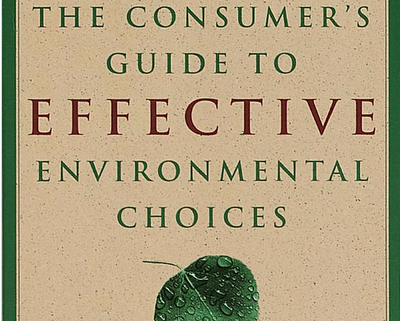
In 1999, a pair of researchers published a book called The Consumer’s Guide to Effective Environmental Choices.
In this book, the authors use stacks of data to say, basically, don’t worry about paper or plastic. If you really want to have a small ecological footprint do two things: Drive your car less and eat less meat. These two actions far outweigh other “consumer” choices. And how many people took them up on their advice?
Apparently not enough. From my two decades of experience as an environmental educator, these are the two things that most citizens of wealthy nations (and particularly the English speaking ones, USA, Australia, Canada and New Zealand) least want to hear. Even many self-styled Greenies in these countries embrace dubious claims about bio-fuels rather than take the bus or ride a bike.
The energy returned on energy invested (EROEI) of ethanol is very low. In other words, it takes about a gallon of diesel to make 1.1 gallons of bio-diesel. The numbers vary depending on whose study you look at. And in the meantime, global food prices skyrocket because globalization has dismantled most of the corn growing around the planet in favor of American exports. In the Asia-Pacific region, I’ve read that rainforests have been cut down in Malaysia for palm plantations to make palm kernel oil for bio-fuels in Europe.
And there are other problems with driving, as a member of my family – to be unnamed – recently discovered.
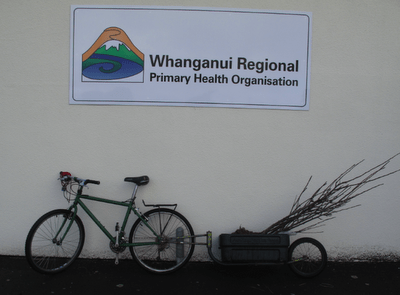
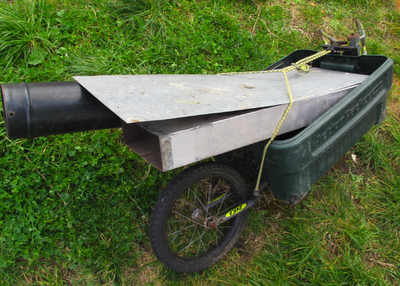
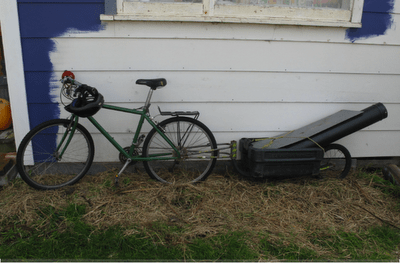
And so it was with great pleasure that I set off recently on a rainy, winter afternoon to run some errands. I loaded up the BOB trailer with some bits of your flue pipe that needed to be joined by a welder.
And, naturally, as soon as I got the bike loaded the rain intensified.
So I did not take any photos until I reached my destination…
… where a welcoming committee was waiting for me.
I managed to make it there with the load intact.
I dropped off my flue sections with Jonah, man of many talents, and headed to my next destination.
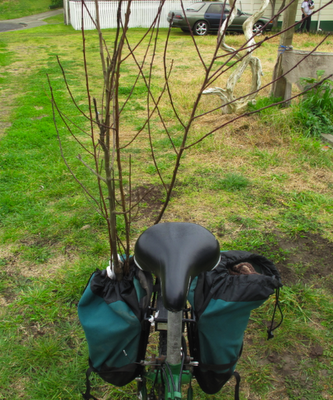
The PHO was giving away fruit trees. I was contacted about distributing them in our neighborhood, Castlecliff, which is lower decile. I picked up the apple trees, but they had run out of peach trees. But the next week they had been restocked with peaches, so I went back for a few.
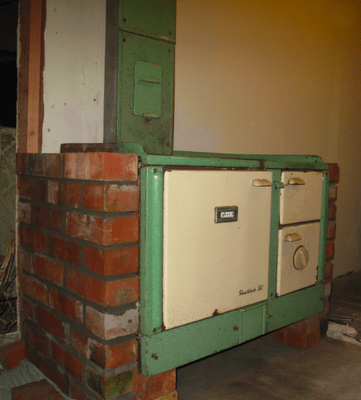
The total round trip was about 10 kilometers (6.2 miles) on flat roads. Even in the rain it was not a bad ride. After all, I had a warm, dry house to return to with heaps of solar hot water, and soon to be a functional wood-burning stove thanks to Jonah’s handiwork.
For as long as the book mentioned above had been around, and for the level of concern that many permaculturists claim to have about climate change and peak oil, I’ve always been amazed at how few choose to ride bicycles or buses instead of driving. As a matter of fact, I can count on one hand the number of permaculturists that I know who regularly choose alternative (to the car) modes of transportation. Does anyone have any ideas why this is? I’ve never been able to figure it out.
For a boy who grew up on the outskirts of Detroit, my heart goes out to the unemployed auto workers who suffered the mismanagement of General Motors, Ford and Chrysler. I’m in the Michael Moore camp on this one. (He, as you’ll recall, is from Flint, Michigan). I wonder how I’d feel now if I still lived in the Detroit area. Perhaps its easier to shun driving when your local economy does not depend on the automobile industry. Could be. But now, I live around the corner…
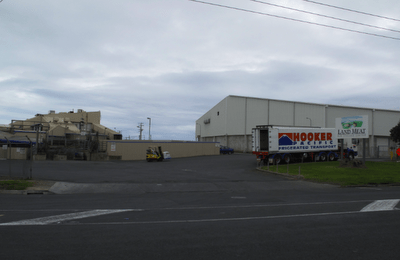
… from the meat works. This facility is less than a kilometer from our home. Many of our neighbors work at Land Meat and at the Mars Pet Food factory next door that does, I’m told, 1 million dollars of business per day. What does it mean to support your local economy while shrinking your ecological footprint? Where are the trade-offs?
On a whim, I stopped by the local butcher shop where I had heard they developed a “healthy sausage” that contains somewhere between a quarter and a third vegetables to make it lower in fat and calories, but still tasty. I asked the manager if he would donate some of this product to support a Solar Sausage Sizzle in local schools. He appeared interested while we were chatting, but I have not heard from him with a firm commitment yet. Stay tuned…
Where do you see the intersection of permaculture, diet, and transportation?
Peace, Estwing

Multiple Functions

One of the more popular permaculture principles is known as “multiple functions.” Put simply, every element of a system should serve multiple functions. I have posted previously on this principle and will probably do so again. We embrace the idea of multiple functions often on our section. But we have recently acquired an element that surely excels at it. Our Aussie cuzzies will be especially interested in this.
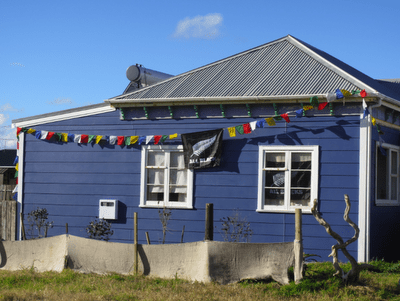
It can be a thermal curtain…
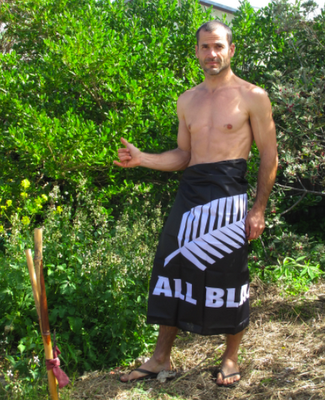
…a sarong…
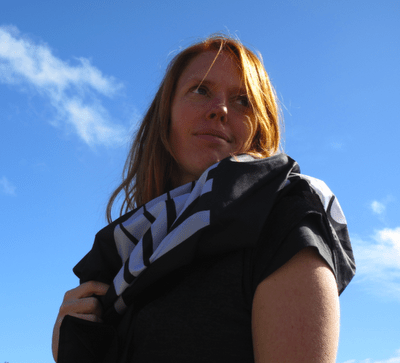
… a scarf…
… a doo-rag…
… a shower curtain…
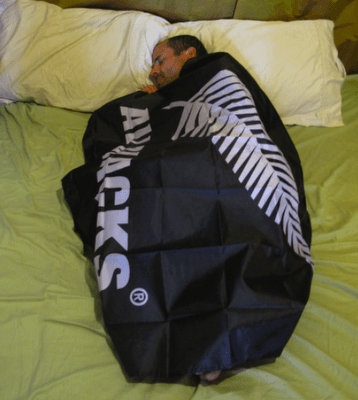
… a blanket…
… a surfboard cover…
… a cape…


… a grudge…


… or a prayer.


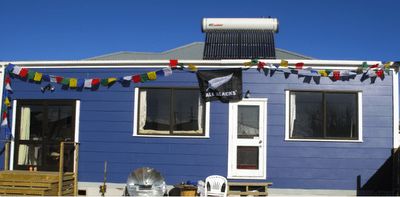
Go the All Blacks!
Peace, Estwing

The Failure of Environmental Education

I ran across this book today. The title is what has haunted me for the last five years.
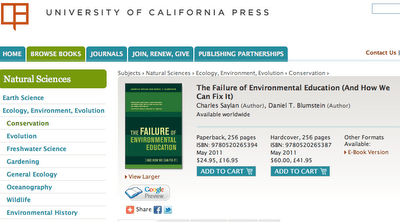
This is the publishers description available at: http://www.ucpress.edu/book.php?isbn=9780520265394
At a time when wild places everywhere are vanishing before our eyes, Charles Saylan and Daniel T. Blumstein offer this passionate indictment of environmental education—along with a new vision for the future. Writing for general readers and educators alike, Saylan and Blumstein boldly argue that education today has failed to reach its potential in fighting climate change, biodiversity loss, and environmental degradation. In this forward-looking book, they assess the current political climate, including the No Child Left Behind Act, a disaster for environmental education, and discuss how education can stimulate action—including decreasing consumption and demand, developing sustainable food and energy sources, and addressing poverty. Their multidisciplinary perspective encompasses such approaches as school gardens, using school buildings as teaching tools, and the greening of schoolyards. Arguing for a paradigm shift in the way we view education as a whole, The Failure of Environmental Education demonstrates how our education system can create new levels of awareness and work toward a sustainable future.
Interestingly, one of the main reasons the failure of EE has haunted me is that my teaching practice in a school included organic gardens, using school buildings as teaching tools, and efforts at greening the campus grounds. And it still failed. Now this may be down to my rubbish teaching skills. But I did get plenty of positive feedback from a diversity of sources and a number of teaching awards. And I do not mean to say that this is not where schools should be headed. I was lucky enough to work at one with excellent token environmental programmes that benefited a small minority of students tremendously. But there was no systemic change. So instead of settling for tokenism any longer I left teaching to become a student. My research is still along the lines of Saylan and Blumstein, but more looking at the barriers and opportunities to actually do what they are proposing. It is neither straightforward nor easy.
One of the recent barriers I’ve come up against – not in my PhD research per se, but in other EE efforts I’m involved with – is what I am calling the Ego-movement. I’ve been saddened and discouraged by the amount of damage that those within the eco-movement inflict on others in the movement. Don’t we get enough thrashing from the outside? Why do those within the eco-movement hold the movement back because of ego? It’s a cryin’ shame. No really, it does make me want to cry, and it is a shame on our movement.
I am an eco-designer. I design systems with the intention that they be adaptive, exploratory and symbiotic. The business model of the ECO School is synergy. In other words, we seek to enter into symbiotic relationships where both parties benefit and the resultant whole is greater than the sum of the individual parts.
• What I have learned while trying to implement this ecological vision for environmental education is that most people and organizations have little or no interest in working cooperatively.
• What I have learned by taking an exploratory (evolutionary) approach to building symbiotic relationships is that most people and organizations do not answer emails which express an interest in working cooperatively. From a large number of emails sent to Transition Town groups, permaculture groups, conservation groups, environment centres, etc., my response rate is well below 20%. I understand that people are busy, but if you put your email address on your website, I would suspect that you may expect to be contacted. I find it very sad that so many of those who place themselves in leadership positions in the eco-movement cannot bring themselves – at a minimum – to say, “Thanks for the inquiry. Sounds cool, but it does not suit our present needs.” In some cases where websites explicitly call for input, those in control fail to thank contributors or even acknowledge their input.
• What I have learned about email lists, Meet-up groups, and newsletters, is that many of them are not democratic. Many of the leaders of the eco-movement who control these networks for the dissemination of sustainability information do not share the power democratically. In my opinion, sustainability networks belong to the people, and they should decide what they want to learn about or not.
• What I have learned about answering all email enquiries I receive is that many people do not make an effort to thank me for my time and effort. From what I understand, everyone has their opinion on whether saying thank you on email is appropriate or not. Call me old fashioned, but when I know that someone has gone out of their way to provide information for me or to compliment me on something I’ve done, I write a thank you note. At very least, it builds good will in the eco-movement.
One final note which may come as a surprise to those outside of academia. Since I have become a PhD student I have sent about half a dozen emails to researchers in the fields of science, psychology, and education. And I have gotten a response from every single one. Some say that academics have big egos, but they do not appear to get in the way. And so the sadness is greater that in the eco-movement, ego does appear to get in the way.
While this does not relate specifically to my research, I am still very interested in learning why this unfortunate situation (the ego-movement) appears to be retarding advances in the eco-movement. If you have any ideas or insights, please post them in the comments section or email me at the ecoschool. I promise I’ll thank you.
Peace maker, Estwing
The Third (!?!) Law of Thermodynamics

I’ve taken over editing the monthly River Exchange and Barter System (REBS) Newsletter from my wife because she gets busier by the week with work at the YMCA. It has given me the opportunity to think and write about ways of retaining wealth in our community. Below is the article I wrote for the September Newsletter.

Peace, Estwing
Energy is often defined as the ability to do work. In many ways, money – or wealth of any kind – is also the ability to do work. In other words, I can pay someone like Jonah to help me install my stove, or I can buy petrol to put in my car. A big difference between these two is that when I pay Jonah the wealth stays in the community, but when I buy petrol most of the wealth leaves the community. However, I can’t really pay Jonah to bring my wife home from work on a day she works later than the last bus. (Come to think of it, I probably could but she may not enjoy the ride in his bamboo bike trailer).
The point is, the work that energy or wealth can do is not 100% transferable back and forth. But sometimes it is. Going back to the example of the multi-fuel stove, the work that Jonah did will translate sometime in the future into energy savings in the form of reduced home heating costs.
Additionally, the wood that we will burn will likely come from the land cared for by Melinda and Murray. Therefore, any wealth transfer for home heating goes to these three “locals” and not to Meridian Energy in Christchurch (I believe).

And the same can be said for another form of energy delivered to Wanganui nearly every day for free: sunlight. Sunlight can heat homes quite effectively, and simple insulating and draft-proofing efforts can help hold the heat in overnight. These efforts may be labor intensive, but if the labor is local then the wealth stays in the community. Over time the homeowner makes up the upfront cost in energy savings. And then those savings can be reinvested in the community. For example, our electric bills are so low that we treated ourselves to an afternoon of local rugby. Go the Butcher’s Boys!