Category Archives: Eco Thrifty Life

Addicted to P

We have an addiction to P in our home. (Note: In no way do I mean to diminish the real problem of P addiction in NZ – indeed, in our neighborhood – or in the USA known as “meth.”) The P addiction in our home is all about permaculture. Please be aware that permaculture is not the only ecological design system that exists on this glorious planet, but some say that it is the most comprehensive. To that, I add the most documented. Permaculture has over 30 years of books, magazines, and even a few peer-reviewed papers, as its chronicle. This is particularly useful for those (ie, me) writing doctoral theses on ecological design in science education.

The P addiction in our home results from an approach to permaculture not as a set of principles to memorize and apply in a formulaic manner, but rather as a way of seeing the world. In other words, permaculture as systemic, not systematic. This perspective, for me, results from decades-long involvement in ecological design and a learning disability that was misdiagnosed (ignored) in my youth. In other words it is a combination of nature and nurture. I was born with a brain that is better at seeing at the space in between things than the things themselves. While this may have contributed to my success as an All-American lacrosse attackman (ie finding my way between large defensemen), it also inspired my second grade teacher to alert my parents that I would never read. Luckily, they were both teachers themselves, and sent me to a tutor instead of to the meat works (to work, that is, not to contribute my flesh).
Ethical note: NOT my second grade class. This looks like 4th grade. Wait, maybe 6th grade.

Regarding nuture, I’m not referring to the 17 years of private school or to the amazing support given to me and my brother by our parents. If anything, the rigid, traditional schooling I experienced for much of my life suppressed my potential for systems thinking. The main lesson I learned from school is that it was all a game, and the playing field was tilted in favor of certain brains and away from others. My brain was an other, and I struggled mightily not to drown (below C-level) through primary school, middle school and into high school. Around the time I hit my stride in lacrosse, I also figured out how to play school. Interestingly, some psychologists suggest that certain people outgrow their ADD after going through puberty. I don’t know if that was the case for me because I’m definitely still ADD. Instead, I think that I figured out how to succeed in a reductionist paradigm by taking a systems approach. Although I considered earning good grades a game, I never took it as seriously as lacrosse because I did not respect it. It was more of a joke, where sport is serious business.

It was not until I had graduated from university (Magna Cum Laude, now that is a joke) until I came to the unfortunate realization that I hadn’t learned how to do anything in all those years at school. I could not grow a garden. I could not prune a tree. I could not build a house. Seventeen years of private education and all I got is this lousy scroll! No, the nurturing of a more holistic perspective did not occur until I began learning how to grow food, prune trees and build – ok, renovate – houses. A garden, a tree and a house are not things. They are systems, and we can never hope to understand them from a reductionist perspective. And for me, luckily, the seed I was born with was not terminated by a “Round-Up Ready” education. I’ve heard that certain seeds can remain viable for decades and even centuries. By those standards, 17 years appears fair to middling.

But I reckon that was good enough because it germinated in the humus of a pumpkin patch and the dust beneath a crosscut saw. And during the ensuing 17 years (and then some) I’ve nurtured a holistic perspective by actively practicing systems thinking. It was not easy at first, but with practice strides came. As I took up running marathons I made the easy connection between exercising my body and exercising my mind. At the same time, as a professional science teacher (go figure) I began to develop systemic pedagogies. In other words, teaching ecology in ecological ways. The release of creativity inspired me as a teacher and inspired many of my students. (Some still preferred reductionist approaches to teaching and learning. Most likely because they were familiar to them, and that they had found numerical and alphabetic success under them.)

And around that time I found a Masters program developed and delivered by the amazing Coleen O’Connell and Cloe Chun. Mind you, I had no intention of ever going back to school as a student. But they were willing to embrace a different paradigm for education that resonated with me. I can vividly recall Coleen selling the Masters in Ecological Teaching and Learning to me at the Society for the Protection of New Hampshire Forests building in Concord. I listened politely and told her, “I do all those things already.” She replied, “And you should get credit for them.” I was sold, especially because my employer paid for the degree.

I really must thank Coleen and Cloe for helping advance my education practice, which has lead me here to this computer in this foreign land and an email address that ends in ac.nz. And I must thank the New Zealand government for offering affordable tuition to international doctoral students and very reasonable health coverage. And most of all I must thank my supervisors Chris, Kathrin and Richard. But especially Chris for being an awesome colleague and friend.

Centre for Science and Technology Education Research community garden great potato harvest of 2011.

To his credit (and maybe his regret) he encouraged me to do my research “in a permaculture way.” This half-sentence of advice has made the process of PhD research more dynamic, more enjoyable, and hopefully more robust. For example, the methodology chapter in most theses is direct, dry and formulaic. In other words, dull to read and boring to write. Thanks in part to Chris’ advice, a holistic permaculture perspective, and drugs (not P), I have had a lot of fun writing this chapter.

Three a day keeps distraction away.

I have engaged with the material and, in my opinion, created something entirely original. Many synergies exist between permaculture and education research. It is just a matter of creating a guild.
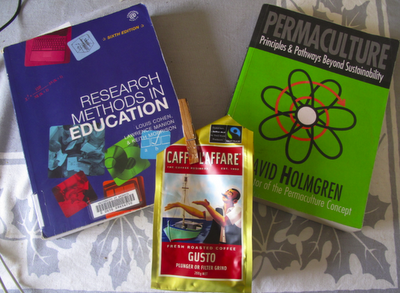
The whole is greater than the sum of its parts.

Oh, that was exhausting. For you too? This post takes a different approach than previous posts. If this is your first read, take some time to explore others. There should be something here for everyone. Maybe not Rick Perry.

For a snippet of the methodology chapter, see below. Please note it is an unedited first draft that I wrote this morning on 3 pots of organic fair trade coffee. I’d appreciate any insights or feedback. I may even acknowledge you in my thesis.

Peace, Estwing

The P of METHedology

4.7 Validity and Reliability

Many tables have four legs, but stability requires just three. A guild of three complimentary plants – such as the Hopi “Three Sisters”: corn, beans and squash – provides a stable cultivated ecology for growing food. A ship lost at sea can find its way using three beacons by a process called triangulation. In research, triangulation allows for stable (robust) findings and locates conclusions out of an ocean of data. Stable research is said to be reliable (Cohen et al., 2007).

But triangulation in every case described above is not a linear progression. In other words, two plus one does not represent the same incremental increase as one plus one. For example, a table with one leg benefits little from adding one more leg, but hugely from adding a third. Corn and squash planted together do not thrive like they do when beans are added to fix nitrogen in the soil to feed them. And a lost ship is still lost with only two points for reference. In all of these cases, there is a tipping point of integrity reached by triads when symbiosis turns to synergy. The whole becomes greater than the sum of the parts, and the system punches above its weight. Three, it appears, really is a magic number (Johnson, Year?)

In the world of research, triangulation is defined as the use of two or more data collection methods (Cohen et al., 2007). Campbell and Fiske (1959) contend that triangulation is a mighty way to demonstrate concurrent validity, and the process is deemed more or less essential for those doing qualitative research. Mixed method, or multi-method, approaches in social science research provide a number of advantages. For instance, blah blah…more here…

While major advances in validity and reliability occur between one and two, and two and three forms of data, subsequent improvements tail off quickly thereafter. A more-the-merrier attitude turns to four’s-a-crowd. That said, redundancy is bad neither in research nor permaculture. If one plant in a guild succumbs to an insect pest or disease, or if one method is found to lack validity, then an extra component in the system suddenly proves helpful. In fact, ecological validity in education research requires the consideration of as many characteristics and factors involved in the subject of study (Cohen et al., 2007). Brock-Utne (1996) promotes ecological validity when studying the adoption of new educational policies in actual classrooms. I submit that, when politics and scale are removed, that is essentially what I did in this case. In other words, I developed a new approach to teaching science, provided it to a teacher, and then attempted to chart what actually happened in his classroom. However, ecological validity can run up against boundaries determined by ethical considerations such as anonymity and non-traceability (Cohen, et al. 2007). These considerations were paramount for this study, which took place in a small school in a small town in a small country.

To be continued…

and continued…

and continued…

Times for Permaculture

There is a fantastic article on permaculture in the New York Times that is well worth reading.
I especially love the Lexus ad at the top of the page.

Of particular interest to me as an educator are the many references to transformative learning experiences that tend to accompany peoples’ discovery of permaculture. Permaculture is a holistic, regenerative design system that can be applied to rehabilitating degraded land…
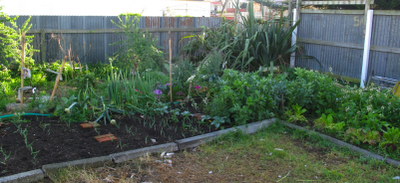
Transformed from a weed-infested yard full of rubbish.

…a falling down house…
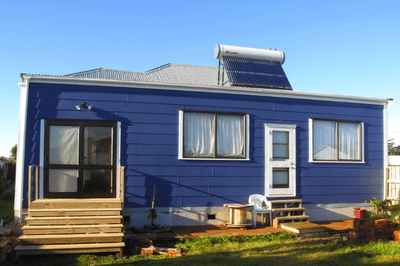
Transformed from the verge of collapse to a warm, cozy home.
…or a dysfunctional, unsustainable culture.
The belief in perpetual growth without consequences must be overcome.
For learners of all ages, permaculture can be both the journey and the destination. And the truth is, we never really arrive. It is all about embracing certain levels of sustainability, peace of mind, and joy. Here are a few gems I picked out of the article that just might make their way into my dissertation. (See link above for source.)

“It’s an ecological theory of everything,” Mr. Cody said.

The ethic of permaculture is the movement’s Nicene Creed, or golden rule: care of the earth; care of people; and a return of surplus time, energy and money, to the cause of bettering the earth and its people.

In its effort to be universal, permaculture espouses no religion or spiritual element. Still, joining the movement seems to strike many of its practitioners as a kind of conversion experience.

As a system, permaculture impressed him as panoptic and transformational. “It shook my world,” Mr. Pittman said.

“I don’t know that anyone has ever done a double-blind study of permaculture,” said Mr. Pittman of the national Permaculture Institute. “Most people in permaculture are not that interested in doing those kinds of studies. They’re more interested in demonstrating it. You can see the difference in species diversity and yield just by looking at the system.”

As Mr. Weiseman observed, permaculture may be a “leap of faith.” But not leaping might have its own consequences.

“We know what’s right,” Mr. Weiseman said. “We know what’s best. We feel this thing in our bones and in our heart. And then we don’t do anything about it. Or we do. And I did. And it’s bearing fruit.”

And I thought all the NYT was good for was mulching the garden…
Peace, Estwing

Memories

I was reminded recently that I have now spent three full years living and studying in New Zealand. I came to pursue PhD research in permaculture education at the University of Waikato in Hamilton. Before I enrolled in December, 2008, Dani and I spent 3 months house sitting in Wanganui. We liked the city and our friends here so much that after 2 years in the Hamilton area (2009 & 2010), we moved back to Wanganui and started this project while I write my dissertation. But those aren’t the memories I’m talking about.
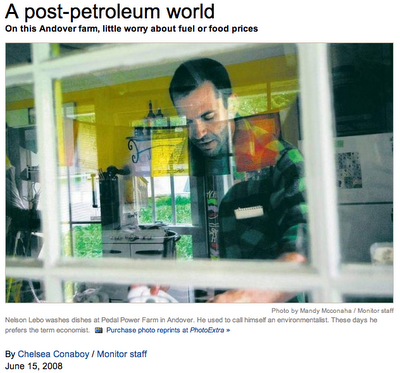
Just before flying into Auckland in June, 2008, I just missed my 15 minutes of fame back in New England. As I was sitting in the LA airport waiting to catch my connecting flight, I got an email from a TV news reporter from Boston. He wanted to do a story on my farm based on a recently published article in the Concord Monitor.

With gas at $4 per gallon, most people in New Hampshire can feel their wallets draining along with their car tanks. Not Nelson Lebo. He doesn’t have a car. He’s not worried about the cost of home heating oil either. And soaring food prices? Not much of a problem.

Lebo, 40, lives in a 1782 farmhouse in the woods of Andover that he has dubbed Pedal Power Farm. He heats it with wood cut from the property. He gets around on a bicycle. He grows much of his own food and buys locally otherwise. He gets his electricity from solar panels.

Lebo is no typical homesteader, content to stay tucked away in the woods, living off his land. He thinks he has ideas the rest of us could use. And he’s ready to share them.

“I’ve been living in a post-petroleum world for the last 18 years,” he said. “Everyone else is going to start living in a post-petroleum world next year.”

Lebo has been a fixture in Andover since he was hired to run Proctor Academy’s environmental program in 1991. He stopped working at the private school last year because of a herniated disk, but he still manages the organic gardens there. He was a part-time dorm parent this year.

But his teaching days are far from over. Let Lebo talk, and he will engage you for hours – he verges on ranting – about energy policy, American consumerism and the design principles around which he has built his life. One thing you won’t hear much of is a holier-than-thou attitude.

He said he doesn’t want to make people feel guilty about how they live. (He pointed out that he wears his hair in a crew cut and used to coach football, evidence of his own mainstream credibility.) He wants to encourage people to live differently. That, he said, is his “duty and obligation.”

He and girlfriend Dani Lejnieks are moving

to New Zealand this summer, where Lebo will pursue a doctorate in environmental education, looking at how to apply permaculture principles – which say that human societies can be designed to mimic natural systems – to education.

Lebo thinks people should have less of an impact on the Earth as they become better educated. The way he sees it, most people become bigger consumers as they become bigger earners.

During his last few weeks in Andover, Lebo has been holding seminars at the farm, inviting a few people at a time to see how he lives. He has gone to some attendees’ homes afterward, charging $40 per hour, to help them find ways to conserve energy. Some of his clients have been focused on living greener. Others want to save money.

Lebo said he used to call himself an environmentalist.

“Now I tell people I’m an economist,” he said. “And not only that, I’m a conservative economist.”

After years of being perceived as “just the kook at the end of the road,” he said, his ideas – his way of living – are in high demand.

“It feels like my whole life has come to this moment,” he said.

A ‘lazy farmer’

Modern society has been designed around fossil fuels, Lebo said as he stood in front of his home on a recent sunny afternoon. But those fuels are running out.

“We, as a culture, will look back in 100 years and curse the designers,” he said.

A moment earlier, he was praising one designer: the man who built his Old College Road home 226 years ago. He noted that the house, which he bought eight years ago, faces southeast, so the first rays of morning sun hit the front windows. The chimney in the center of the Cape-style home heats the whole house and is insulated from the cold.

The road in from Route 11 climbs a hill past several large, regal Victorian homes and sweeping green fields. It turns to dirt and narrows once and then twice, becoming bumpy and dark under the thick canopy of trees. The road crests a hill and continues into the small valley where the farm sits.

Story continues if you are interested: http://www.concordmonitor.com/article/post-petroleum-world?CSAuthResp=%3Asession%3ACSUserId%7CCSGroupId%3Aapproved%3ABA4A9537C4BF4594E11F4B09D8217743&CSUserId=94&CSGroupId=1

It is not 100% accurate, but it gives the idea of what my farm was all about.
Peace, Estwing

Act Locally, Share Globally

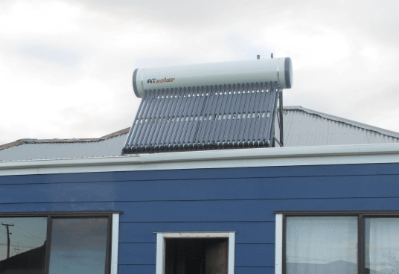
I am a natural skeptic about new technology. I am not an “early adopter.” I am more Amish in my approach – carefully weighing the costs and benefits before choosing what is appropriate. The technologies we’ve chosen to embrace for this project have well-documented results for return-on-investment in terms of energy savings. Examples are insulation and solar hot water.
Education also embraces certain technologies. And naturally, I am skeptical about those as well. It took me years to appreciate the power of blogs and podcasts. But now I am sold on their educational value. One of my favorite podcasts is called Two Beers with Steve.
I have done a number of interviews with him in the past, but this one is designed to coincide with my do-dig garden series: Part 1, Part 2, Part 3.
While I remain skeptical about much of the use of the internet, I think it has been a great help to us sharing the success of this project with a world wide audience. Our goal is to demonstrate that being green is not expensive. On the contrary, not being green is expensive! We enjoy a high quality of life with very low energy and food bills, and we are actively involved in making our local community more sustainable. Some of our experiences may be considered useful by someone on the other side of the planet. The web allows us to share our story with them with a very low carbon footprint.
So as the environmental movement evolves, I propose the next stage of evolution involves acting locally and sharing globally. Governments and corporations won’t do it for us. We need to help one another learn how to be green and save some green.

Peace, Estwing

No-Dig (Part 3): Ground Preparation

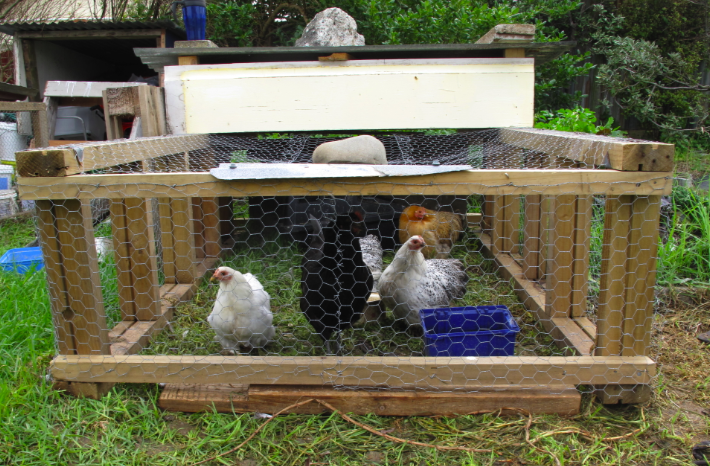
In the first post of this No-Dig series I described how decompressing the soil with a garden fork is the first step of the process. While that’s true, there are some ways to prepare the site even before forking it over. Currently we are “tractoring” ducks…

…and chooks in areas where we plan to install beds. The fowl eat the grass and fertilize the future garden bed. Because we have two particularly aggressive grasses and other invasive weeds, it is important for us to knock them back before putting in new beds.

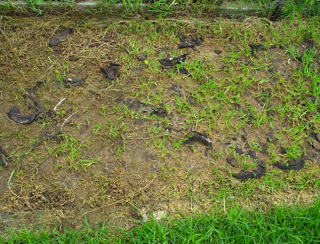
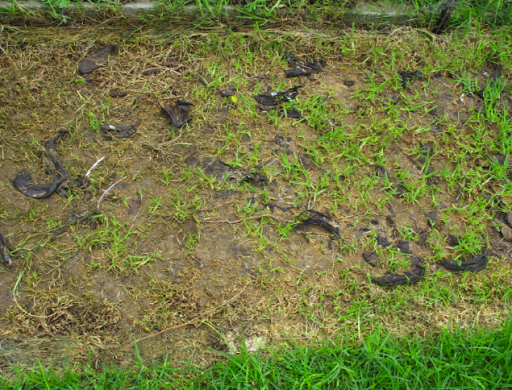
After the birds have done their job, the former lawn looks something like this. (Note the banana peels. We get “baking bananas” for $2 a box from a local veggie shop. We eat some and feed some to the ladies.)
But you may not have birds or even want them. Or maybe your municipality is even silly enough to outlaw them. Other techniques I’ve used include covering the ground with black plastic for extended periods of time (1 month to 4 months). Because plastic is UV sensitive, I extend its useful lifetime by covering the plastic with weeds. This serves multiple purposes. Along with making the poly sheets last longer, it is a way to dry out the weeds for later use as mulch and it looks much more attractive than a sheet of plastic laying in the yard.
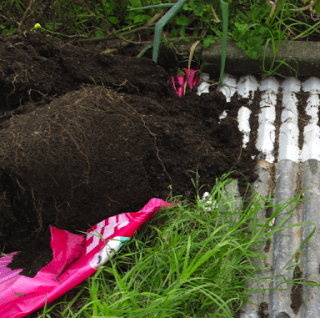
And finally, to continue the local, abundant and free theme from the two previous posts, we happen to have heaps of roofing iron on our section. We use it to knock back aggressive grasses and weeds before bed building. Just make sure you weigh it down to protect against gusting winds.


Referring back to the first post in this series once again, the bed that I built on the solstice started out looking like this.


The iron had been there for about 3 months and the pile of topsoil on top of the Pink Batts plastic had been there for about a month. Although you can see a little bit of cacuya grass between them, I pulled that foliage off before placing an extra thick layer of newspapers there.
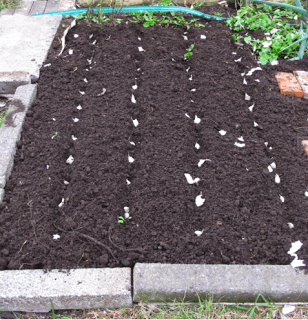
And in no time 100 garlic were in the ground.
An easy no-dig installation should be part of an easy, low-maintenance/high-productivity management system. And the key to that, in my decade plus of experience, is managing weeds. Two important parts of easy weed management are never stepping in the beds (see #1 in this series) and building in low maintenance edges (see #1 in this series).
I have run many workshops in 3 different countries on low-maintenance/high-productivity organic management. If you would like to host one in your area, please contact us. If you are a publisher, this management system is waiting for a book deal.
It is a great time to be building beds in both the Southern and Northern Hemispheres. Get on to it!

Peace, Estwing

No Dig (Part 2): Pocket Garden

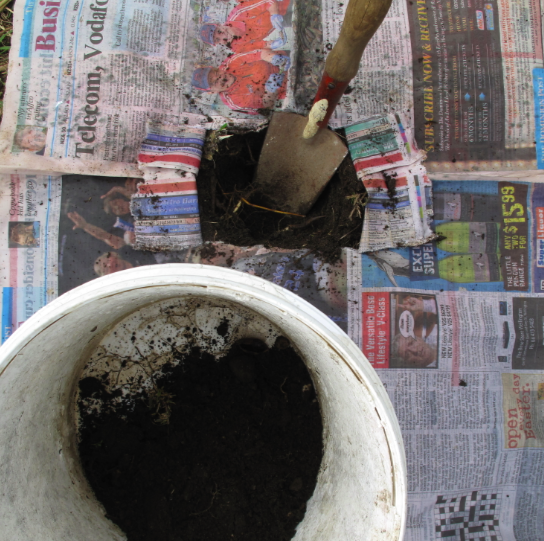
This is a technique I developed a few years ago that is fast, inexpensive and attractive. The materials you need are: wet newspapers, a trowel, a bucket of compost, an empty bucket, seedlings, and a bale of hay/straw.
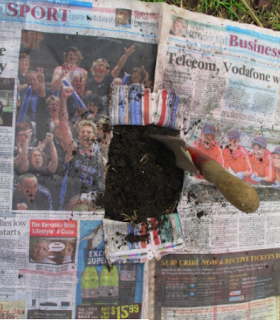
Step 1: Lay out newspaper on the lawn as explained in the previous post, and cut a capital H in the wet newspaper with the trowel.
Or a capital I if you prefer.
Step 2: Fold back the paper like opening French doors.
And dig out the sod and soil to the volume of a 1 litre/quart yogurt container. Carefully put the soil into the empty bucket so as not to allow weed seeds in the soil on top of the newspaper.

Step 3: Fill the 1 litre/quart hole with compost.
Step 4: Plant the seedling, water thoroughly, and fold back the newspaper.
Step 5: Mulch with hay or straw.
* Note that we don’t buy in hay or straw because we use tall grasses that we cut with a scythe and harvest with a rake. I have used wood chips as a mulch on one job, but that was only as a very low-budget approach in that particular case.
With a stack of newspapers and a few bales of hay/straw you could convert an entire lawn to garden in a weekend.

Peace, Estwing

No-Dig Garden Beds (Part 1)

I’m told that in the land of the long white cloud (Aotearoa/NZ) garlic is planted on the shortest day of the year and harvested on the longest. Fair enough. That’s more or less what we’ve done for the past two years. But last week I managed to land right on the 21st. It was a beautiful day and I spent a couple of hours building a new garden bed, taking pictures, planting garlic and missing an afternoon meeting that slipped my mind. Oops.

Even though it is the middle of winter here and the middle of summer in the northern hemisphere, it is still a fine time to put in a garden bed. On my farm in New Hampshire, I remained seeding fall greens (spinach, kale, Swiss chard) through the second week in August. If you have a small garden and want to expand it, or you want to start a garden on your lawn, here are a few things I’ve learned over the last 12 years of building beds.
* Please note that we use a number of techniques to prepare the plot before putting in a new bed, but those are not required. It is quick and easy to go from lawn to garden in one afternoon. I’ll explain those prep techniques in another post.
Step 1: Decompress the soil. Assuming you’re converting lawn to garden, the soil will inevitably be compacted by years of foot traffic, mowing, etc. Use a strong (thick tines) garden fork and plunge it into the soil on an angle about like this.
Push down on the handle so that the soil is just “fluffed” a little bit as such.
Work backwards so you don’t compress an area you’ve already decompressed.
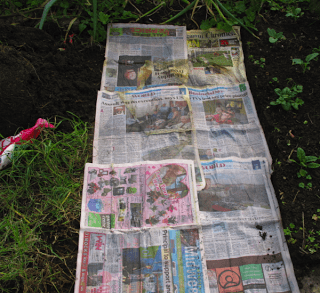
Step 2: Sheet mulch. We use newspapers (no glossy inserts), cardboard and scraps of unpainted and untreated plasterboard/drywall (Gib/Sheet Rock). It is handy to have wet newspapers, especially on windy days. You can put a stack of newspapers into a wheel barrow and run a hose over them, or…just leave them outside for a few weeks like we do.
Lay out the newspapers 3 to 6 sheets thick with generous overlap (50 to 100 mm) between each sheet. Don’t be stingy with these. In our present world old newspapers are abundant.
Here I am building the new bed adjacent to an existing bed. Edges tend to be high maintenance areas, so I design to minimize them.

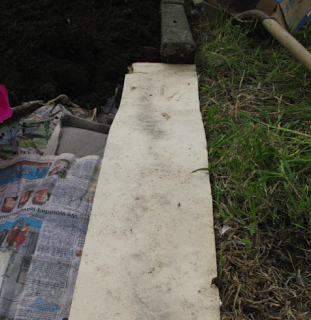
Because we have some very aggressive grasses that tend to invade our beds, I “reinforce” the edge with a bit of plasterboard.
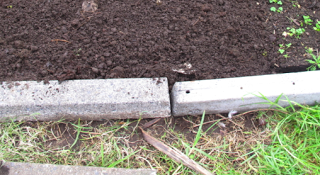
Step 3: Deciding on siding. Almost anything can be used as sides for a raised bed. You don’t even need sides at all. But many people prefer them. I like to use whatever is local, abundant and/or free. In the past I’ve used bricks, blocks, scrap wood, stone, and beams from a barn that was torn down. At present we are using a combination of concrete edging we got on Trade Me and concrete fence posts we got for free at the transfer station. I would recommend against using treated wood, but I’ve seen plenty of people do it.
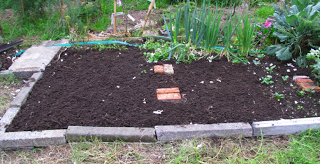
Step 4: Fill ‘er up! Many people like to use a “lasagna method.” There are lots of recipes you can find by Googling. I prefer to use whatever is local, abundant and/or free. We make lots of our own compost that we use generously. But in this case we had some leftover topsoil that was just sitting in a pile conveniently next to where I decided to build this bed.
We also happened to have plenty of sheep manure that we bartered for French doors that we did not need.
I raked the soil and manure flat in the bed. Please note that I usually make beds no wider than 1.2 meters so that I can reach halfway into them from each side without ever stepping in the bed. This is crucial in low maintenance garden management. Never step in the beds!
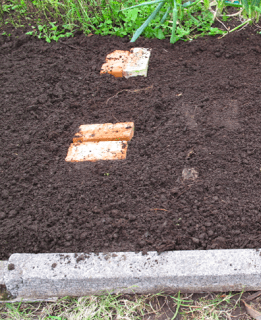
But in this case where the bed is wider than 1.2 meters, I placed bricks as stepping stones for access to the middle of the bed.

Step 5: Plant. Depending on what techniques you use, you can direct seed or transplant into the bed straight away. Here I planted seed garlic just wider than a stirrup hoe, which is my main weed management tool.

Over time the grass under the bed will rot down into a “green manure.” The worms will happily munch away and stir it up, and the roots of your vegetable plants will thrive in the loose, fertile soils.
Other options: In the next post I’ll explain another technique that is even faster and cheaper.
Peace, and get planting, Estwing

Compost Post

Following up on the post of 12th June (Perfection), here are more details on our methods of composting organic matter. You may recall that we diverted over 95% of materials from landfill at the Connecting Families Day run by YMCA Wanganui. Alongside paper recycling and drink bottles recycling, the bulk of material came in the form of compostable organic matter: napkins, sausages, bread, apple cores and paper cups.


In anticipation of this organic matter coming onto our land, I “feather a nest” by forming a large rectangular bowl with grass cut on a neighbor’s property and “donated” to us by the landscaper. Into this bowl I easily dumped the organic matter collected at the YMCA event.


Then I added half a coal bag of sheep manure we bartered for with a surfing friend. The nitrogen in the manure will balance the high carbon content of the paper cups and napkins.


Then I covered the lot by raking grass over it to prevent wind from blowing the cups around and to allow the compost to “cook.” By turning the pile once every 48 to 72 hours, it will hold temperatures between 50 to 60 degrees Celsius (122 – 140 F) and be completely decomposed in about a month.


Then we’ll have roughly a cubic meter of beautiful, healthy compost ready for our spring planting.

Peace, Estwing

So Happy Together

Imagine me and you, I do…

Warning. Mooshy romantic post ahead. Read at your own peril.

Due to a volcanic ash cloud covering a large band of the southern hemisphere, my return back from the USA to New Zealand was delayed for 4 1/2 days. While I did enjoy my time in Sydney, something was missing from my days.


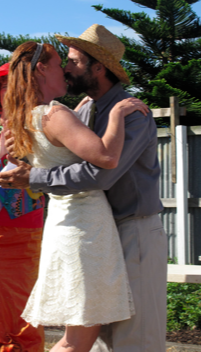
That’s my man. And while I was away having a month of vacation time with our family and friends, he was here. Working hard. Making our home prettier, comfier, and keeping the Eco School going. He is amazing. And I missed him.

Imagine how the world could be
So very fine
So happy together
Glad to be back in the en zed. Even more glad to be here with my honey. I look forward to getting back on the blog more regularly and updating you with our winter projects.


-June Cleverer

Add it up.

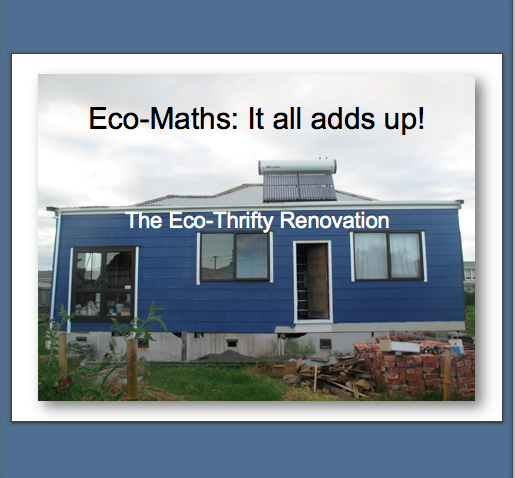
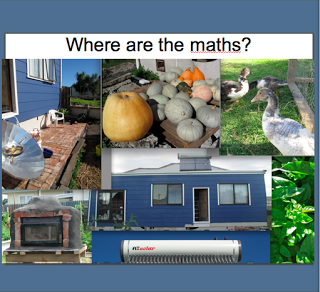
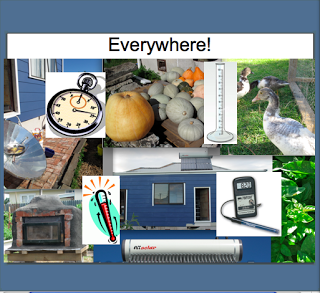
After excellent feedback on our first schools programme, The Science of Sustainability, we have developed a new programme we’re calling Eco-Maths. This will be delivered to primary and intermediate teachers in the form of a professional development session in about a month. Here is a preview:

Hey teachers…

Want to include sustainability in your lessons but don’t know how?

Want to engage students in real life application of maths?


This is your chance. This training session uses eco-design and home renovation to teach mathematical concepts through saving energy and money.

Topics covered:

Area, Volume, Ratios, Percents, Units, Graphing, Rates, and More.


Date and Time: TBA

Location: TBA

Peace and Pythagorus, Estwing