

Although I have been in the field of EE/EfS for 25 years, I am new to the field of EE/EfS research. I can still recall sitting in a lecture theatre in 1986 while a professor covered the problems of the world from deforestation to ozone depletion and everything in between. That course gave a new direction to my life (other than sport) that I have been following ever since. Over the last two decades I have been a secondary school environmental and science teacher, a wilderness trip leader, an organic farmer, and green builder. In 2008 I decided to combine these experiences into PhD research that draws on them all. The challenges my research seeks to address are the high rate of attrition in science classes beyond the compulsory years, and the low uptake of EfS in high schools. As a result, both the scientific literacy and ecological literacy of many post-secondary learners is sub-optimal. While a whole school approach is recommended and appears appropriate for many primary schools, at present it does not appear to be viable for most secondary schools. The approach I’ve developed to engage students in science while incorporating high quality EfS into a Year 10 science classroom in New Zealand is to set the science learning within the context of environmental problem-solving and ecological design through the use of local permaculture projects. Transformative learning theory, systems thinking, social constructivism, and experiential learning play key roles in this research.


A recently completed project with Wanganui High School used the Eco-Thrifty Renovation with senior students in a Level 3 sustainability course. The project was used as an example of a “sustainability initiative” for the students to assess on its merits. Two class meetings at the school were followed by a site visit. The project received much praise from students and teacher alike. The teacher said he would definitely get his Level 2 class out for a site visit.

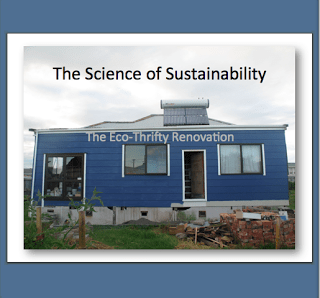
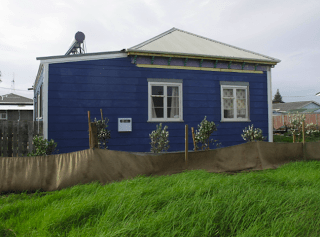
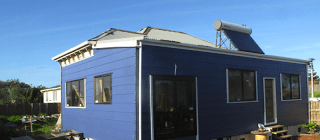
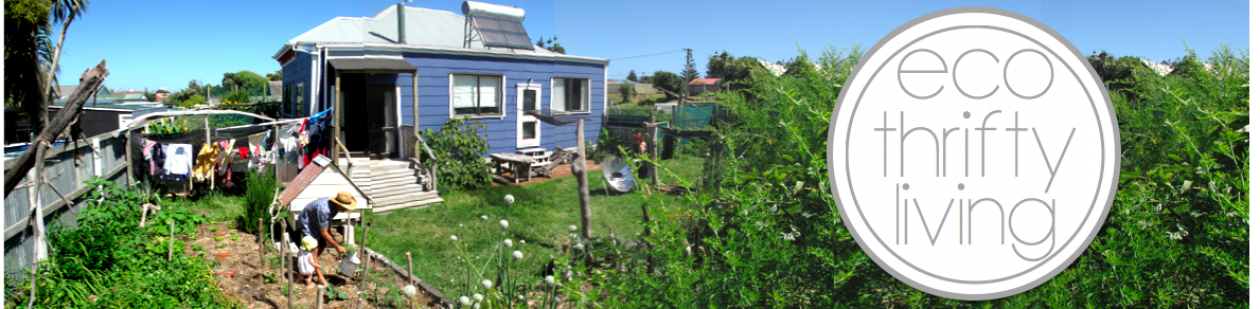
The current project – The Science of Sustainability – at Wanganui Intermediate School involves over 700 students. In coordination with the school’s science teacher, The ECO School has designed a programme to get students excited about the upcoming science fair through highlighting the science – physics, biology, chemistry – of a permaculture installation: The Eco-Thrifty Renovation. The scientific topics highlighted include passive solar design, solar cookers, rocket stoves, insulation, thermal drapes, compost, aerated compost teas, organic food production and various aspects of bicycling. Response has been excellent so far.
We’ve also had meetings with primary school teachers, but term 1 has proved a difficult time to ask them to take on anything new. We continue to meet with primary schools as term 2 appears more favorable regarding work load. Funding for these programmes comes from Wanganui District Council and is administered by Sustainable Whanganui. Thank you!
Peace, Estwing


We ran a new workshop this weekend with excellent response from participants. The workshop – Solar and Energy-Efficient Cooking – is part of an ongoing workshop series by The ECO School.
We covered a number of different solar cooker designs and cooking techniques during the first half of the workshop. But for those who have not yet made their own cooker, or for cloudy days, we introduced a number of other energy-efficient cooking techniques. Central to many of those techniques is the straw box.

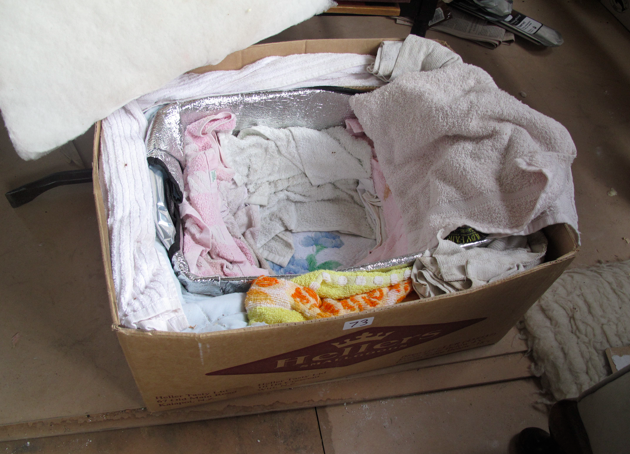
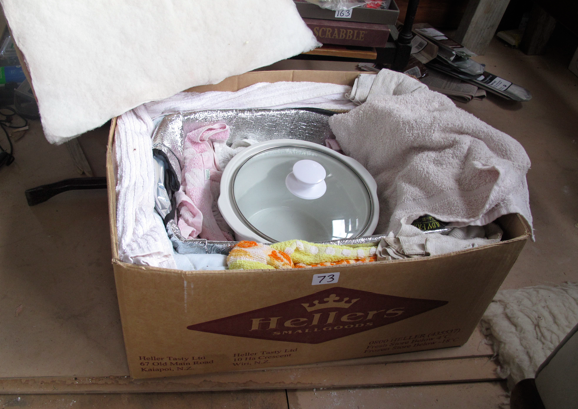
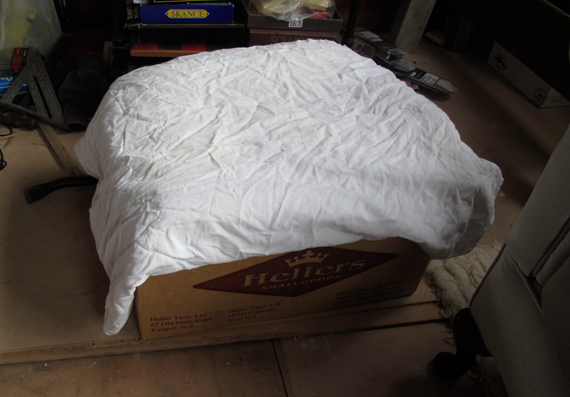
Our straw box happens to be full of towels, not straw. But we still call it a straw box. The key to a good straw box in insulation on all 6 sides.
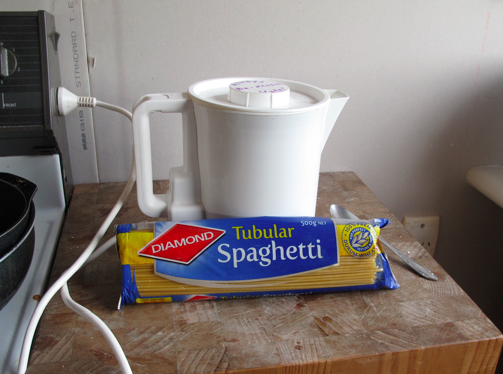
A great example of using a straw box – not to mention an excellent energy-saving cooking technique – is what we call “10 watt pasta.” This cooking technique uses a small fraction of the electricity of boiling pasta for 10 minutes on a hob (stovetop). Here’s how to make it.
1) Boil a jug. Because the heating element is inside of the container, heat transfer is more efficient than heating a kettle or sauce pan of water on the stovetop (hob). We fill the jug with our solar hot water which comes from the tap at a high temperature using no electricity.

2) Pour over pasta until covered and place in the straw box.

3) Cover the straw box and wait 20 – 25 minutes. Stir once at 10 to 12 minutes. For al dente pasta, remove at 15 minutes and stir at 8 to 10 minutes.

The pasta comes out perfectly cooked as long as you drain the water at the prescribed times. Use the intervening 25 minutes to make a healthy sauce from fresh veggies and herbs from your garden.
Bon apetito! Estwing

Why burn limited fossil fuels manicuring a show piece?
Why buy and maintain an expensive, loud, polluting machine?
Why pay $2.10 per litre ($3.60 per gallon in the US) to run that machine?
Why contribute further carbon dioxide to an already overwhelmed atmosphere?
Why spend hours on land care that yields no food?
Problems: Global food prices are at a record high and rising. Oil has been above $100 per barrel for weeks and rose $3 today on increased concerns on the Middle East and North Africa.
Solution: Being “eco-thrifty” means going green and saving money. We use no oil to maintain our 700 square meter section using the following low-maintenance/high productivity techniques.
Growing Food
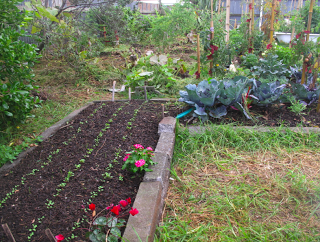
Once a weedy lawn, now a productive garden and burgeoning food forest.
Tractoring Ducks

Ducks eat grass and turn it into eggs, flesh and fertilizer.
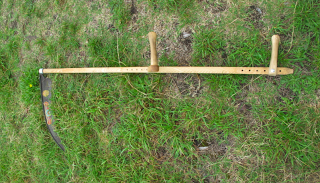
Scything

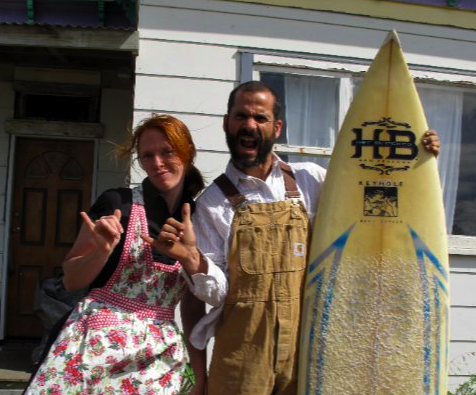
Interns Amy and John learning how to harvest carbon-neutral mulch.
Please people. Stop the mowing madness! For the good of your wallet and the planet.
Peace, Estwing