Category Archives: energy efficiency

Changes: Light Bulbs and Other

The day I bought my small farm in New Hampshire, USA, I worked all afternoon digging out some shaggy looking yew bushes from in front of the 210 year-old farmhouse. The bushes had been broused by hungry deer all winter when the snow depth reached about a metre.

Not far from the farmhouse was a thick stand of hemlock trees growing in a boggy area. Once the ground was frozen and the snow depth started to increase, the deer “yarded” under the hemlocks for shelter at night.

During the day, the deer spread out looking for food. From this perspective, my yew bushes were like the fish n’ chips shop down the street, only without the tomato sauce.

But possession day, 1st June, 2000, was sunny and warm. An afternoon of digging and rooting with a pick axe earned me a tidy front garden, a sore back that lasted three days, and a sunburn that lasted a week.

The first day at my second property in Castlecliff also left me with a sore back and a sunburn, but for completely different reasons. Yes, a squatter had been “yarding” in our lounge over the southern winter, but my lumbar pain had nothing to do with fixing damage he/she had done.

The salt air had perforated the iron roof of the villa with a thousand and one holes, many in the form of little halos around the lead head nails. The first order of business of our eco-thrifty renovation was to put on a new top-of-the-line roof, which meant tearing off the old iron sheet by rusty sheet. Twelve hours later and I was ready for fish n’ chips, aloe vera soothing cream, and a good night’s sleep.

Partly as a result of our eco-thrifty renovation project in Castlecliff, our blog with 400 posts documenting the process from soup to nuts, this weekly column in the Chronicle, and the education work we have done in the community, I have taken a position in another provincial city. It is an amazing job for which I am well suited, but the travel takes a toll on me, my family, and the planet. In order to shorten the distance traveled we have shifted to a new home.

The bad news is that we have to leave our beloved home in Castlecliff after three and a half years of blood, sweat, tears, blisters, sunburn, laughter, dancing, singing, home-birthing and love. The good news is that our new home – a 1930s bungalow – is also in need to eco-thrifty renovation that may fill this column for many months to come.

The other good news is that on my third property I have finally wised up enough to avoid sunburn and a sore back. After shifting furniture and sundries with the help of many friends, I set myself to the real work of the day: changing the light bulbs.
Screen shot 2014-08-08 at 9.58.19 PM

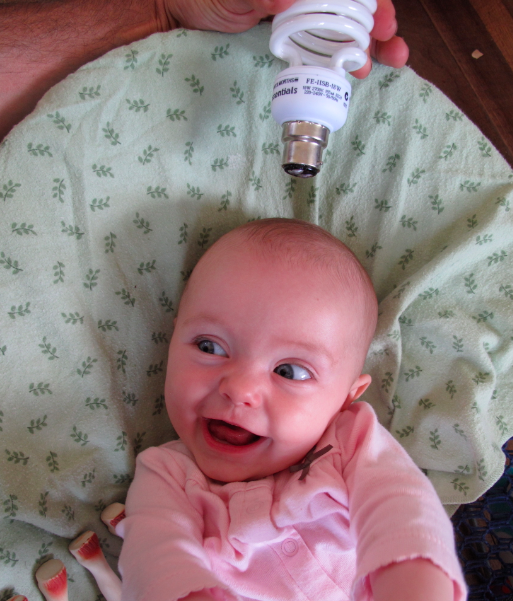
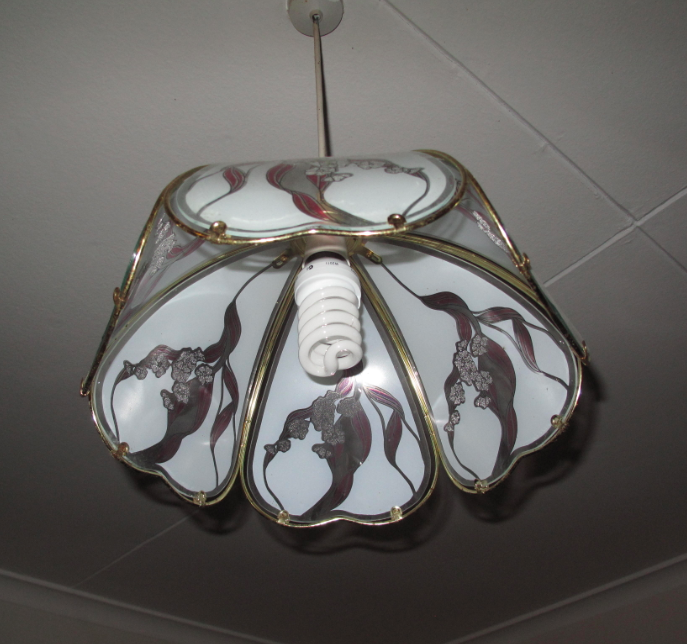
Don’t laugh, there were a lot of energy-guzzling incandescent bulbs that had to be swapped out, and the bayonet type socket can be tricky to insert into a hanging ceiling lamp. After about a dozen bulb swaps, my back was a fresh as ever, although my wrist may have been temporarily fatigued. With age and a herniated disc in my back I have wised up and taken on new ways.

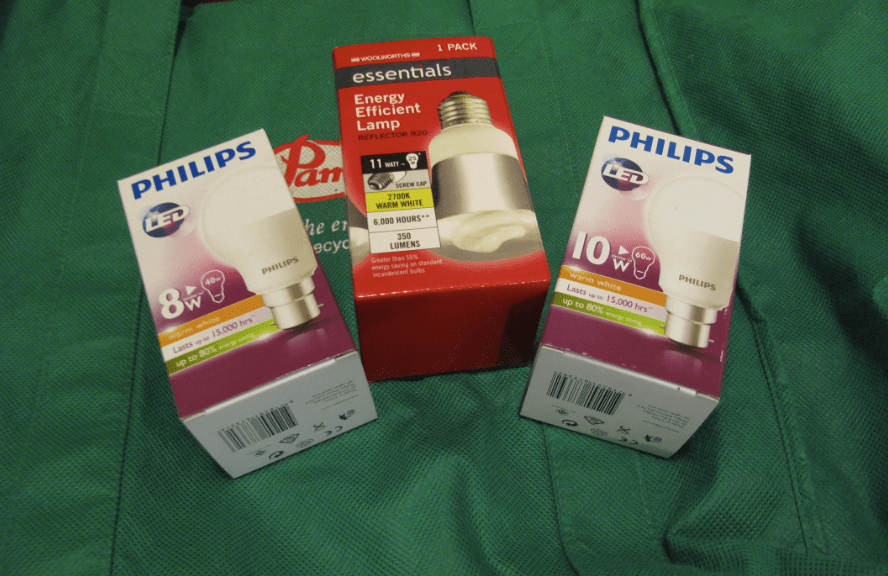
And speaking of new, I am happy to report that I have made my first purchase of LED (light-emitting diode) bulbs. But at around $15 each, I want to be assured they will last a decade and save me over $100 each in power. What if they burn out early? What if they are of low quality?

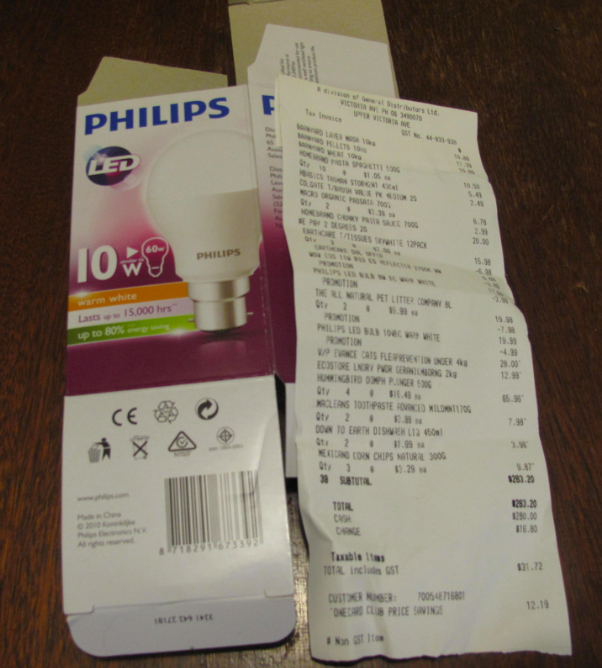
Here is a little trick I have done with my CFL lightbulbs in the past and will continue to do with the LEDs. Take the cash register receipt and staple it to the folded up box with the bar code. Stash this away in that drawer where you keep warranty forms, insurance policies, instruction manuals, etc. If at any time you feel the bulbs have not lived up to their potential, dig out the receipt and head back to where you bought them. Screen shot 2014-08-08 at 9.58.06 PM
Innovation Comes in All Sizes

In Wednesday’s Chronicle, we saw some local examples of innovation. But innovation, like many things, is in the eye of the beholder.

When we think of the term innovation, we might think of things that are “new and improved,” or represent “a breakthrough” in technology or thinking. It all sounds like a bad advertisement on talk radio: “New and improved! A breakthrough in technology! Call in the next 30 seconds and we’ll add a second for half price!”

In many cases the breakthrough turns out to be a minor tweak of an existing product, and the innovation is actually in the OTT marketing of it. (OTT is, in and of itself, an innovation in communication technology!) From this perspective, innovation appears to be more about getting people to buy things they may or may not need than improving lives or advancing humanity toward a more positive future.

Fortunately, there are other perspectives on innovation, one of which is about doing something better. For example, coming up with a medical diagnosis technique that is less invasive for patients by using medical imaging rather than exploratory surgery. While the imaging technology would have a high up front cost, a hospital would save money over time by scheduling fewer and fewer costly surgeries. Win-Win.

Ironically, many innovations that improve some people’s lives result in a net loss of jobs by replacing other human beings with machines. While the example of replacing surgeons with MRIs and CT scans is a poor one, I recall another innovation from my childhood on the outskirts of Detroit when robotic arms began replacing auto workers and causing high unemployment in the Motor City. The next innovation by General Motors was to close plants in Detroit, Pontiac and Flint, Michigan and open plants in Mexico.

This type of innovation often enriches the innovators but impoverishes many others, and adds to the large and widening wealth gap by increasing income inequality. False narratives from self-proclaimed “Job Creators” have been proven wrong by objective analysis, but the narratives remain among the hard right just as Trickle Down Economics is still embraced despite no robust research ever confirming this weak economic theory actually works.

This all begs the question: What type of innovation actually creates jobs and keeps dollars circulating in the local economy?

I’m sure that Chronicle readers may come up with a few, but of those, which would actually lead to net job creation rather than simply employing six people in a new way only to un-employ eight people in an old way? Don’t get me wrong, I am all for creating jobs in Whanganui even if it means jobs lost in other centres. It’s just that we need to look at innovation from a holistic perspective if we want to be honest about it.

From a holistic perspective, I cannot think of a better innovation than the Eco Design Advisor Service offered by the councils of Auckland, Hamilton, Kapiti Coast, the Hutt Valley, Nelson, Invercargill and Palmerston North.

The service helps owners and renters make their homes warmer, dryer and more energy efficient. The service offers independent, expert one-on-one advice free of charge to all residents. It was created by the Building Research Association of New Zealand (BRANZ) to inform and empower anyone who lives inside of a dwelling to make the best decisions regarding energy performance, comfort, water conservation and materials. It is not hard to see how this service would help create jobs in these communities and keep dollars circulating locally.

Innovative, eh? Seems others agree. The Eco Design Advisor Service was recognised in April with the Carter Holt Harvey Innovator of the Year Award from the Building Officials Institute of New Zealand (BOINZ). Two more councils are looking at adding the programme as it goes from strength to strength.

New! Improved! A breakthrough! Act now!

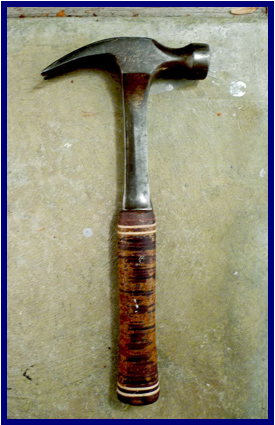
Peace, Estwing

R-E-S-P-E-C-T for Materials and Energy

In 1982, when I was 14 years old, Aretha Franklin moved into my neighbourhood. She had come back to Detroit to assist with the care of her ailing father who ultimately died two years later.

 Screen shot 2014-05-09 at 8.32.01 AM

Like all things great and glorious, Franklin experienced a resurgence in popularity during the 1980’s following an amazing cameo appearance in The Blues Brothers (1980). She was inducted as the first female performer into the Rock and Roll Hall of Fame in 1987.

 Screen shot 2014-05-09 at 8.32.29 AM

What does any of this have to do with eco-design?

R-E-S-P-E-C-T, find out what it means to me.

From my perspective, good eco-design is about maintaining a high level of respect for energy and materials. The reason that good eco-design is so rare in New Zealand housing, I suspect, is that most homes were built at a time when energy, wood, steel, concrete and glass were inexpensive.

When things have a low monetary value placed on them, human beings tend to respect them less than when things hold high monetary value. This can partially explain the abundance of poorly designed dwellings across the country and throughout Whanganui.

Screen shot 2014-05-09 at 8.29.00 AM

Maintaining respect for energy and materials when they are universally cheap is difficult. We can think of some idealistic hippies and back-to-the-landers in the 1970s, but few of them were able to carry on through the cultural and consumer shifts during the 1980s and 1990s. They can be forgiven.

More recently, the costs of energy and building materials have been increasing faster than wage rises for over a decade, with a particular jump in petrol prices since 2008. By now it should be common knowledge that power has doubled in price over the last 10 years, and mathematicians may suggest it is likely to double again in another decade.

From a purely fiscal perspective, we might see more eco-design creeping into the home building and renovation industry in two ways: smaller homes that require fewer materials to build and less energy to operate; well-designed ‘passive’ homes where the building materials are arranged in such a way as to result in very low energy use dwellings.

 Screen shot 2014-05-09 at 8.28.48 AM

Our renovation may be considered a passive solar retrofit because we took a big old cold villa and transformed it into a warm, dry home heated almost entirely by the sun. The term passive implies that our home simply sits there taking in solar energy like a parked car or sunbather.

Converting a bog standard villa to passive solar requires three basic elements: more glazing that faces the equator than the nearer pole; thermal mass (ie, heavy stuff) inside of the building envelope that absorbs warmth during the day and emits it at night; and, insulation that reduces the rate at which heat escapes the building envelope. Screen shot 2014-05-09 at 8.29.13 AM

We add draught-proofing to these three design elements, but the bottom line is that plugging draughts is just plane common sense and one of the cheapest things anyone can do to keep the warmth in and the cold out. Screen shot 2014-05-09 at 8.29.24 AM

Over the next four weeks I’ll write in detail about these passive solar design strategies and how we applied them during our renovation. ‘Cause that’s what R-E-S-P-E-C-T means to me.

Peace, Estwing

Our Weekly Newspaper Column Marks Two Years

This weekend marks the two-year anniversary of this column – 104 weeks of eco-design thinking, advice, maths, science, Neil Diamond tributes, and the tiniest bit of constructive criticism. To mark the anniversary, I’ve decided to remind myself and readers how this column came about in the first place.

In February 2012, former editor Ross Pringle rang me to ask if I’d be interested in writing for the new-look Chronicle that would launch in late April. He said that a column I wrote for the weekly Conservation Comment – which appears on Mondays – in December 2011 struck a chord.

Funny thing, I hurriedly wrote that column for Peter Frost who was trying to fill a gap in the Conservation Comment rotation of writers because someone could not produce a piece that week. Here is just the beginning of that column from two and a half years ago followed by updates and an exciting announcement.

Screen shot 2014-04-18 at 9.44.28 AM

Twenty-Twenty Hindsight: A Year of Living Lightly on the Planet

“We are now over the 12-month mark of renovating an abandoned villa in Castlecliff into a warm, dry energy-efficient home. When we set out on this low budget / high performance retrofit we had no specific numbers in mind for energy savings and waste reduction. We simply wanted to push the envelope and do the best we could.

As it turns out, our power bill has averaged $20 per month (this includes the daily line charge) and we have spent a total of $20 in rubbish fees for the entire year. I’ve come to call this our “20-20 hindsight” but there is no reason it could not also be a 20-20 vision for others to work toward by the year 2020. Of course electric rates will increase by then, but that is all the more reason to invest in efficiency now. (At current rates of annual change, electric rates will double in under ten years.)”

Screen shot 2014-04-18 at 9.39.19 AM

That was then and this is now. Our power bill has skyrocketed to $25 per month on average, but our rubbish fees have decreased to about $15 annually. 25-15 hindsight?!? Not so catchy.

But since it is an election year, I’ve decided to start my own political party. All important, as one would expect, is the name. It’s got to be something people recognize; something people like; something people will be remind of constantly.

The Chocolate Party? The All Blacks Party? The Sex Party – no, scratch that.

I know, I’ll call it the Internet Party. Everyone knows the internet. Everyone loves the internet. What could possibly be wrong with The Internet Party? Oh, taken already, eh?

Which leaves me with no option than calling it the Eco-Thrifty Party. Based on my calculations, we can offer our followers up to $50 per week (in power savings) in their pocket – almost as good as what Labour has pledged. We can pledge to out conservative the National Party by employing the Precautionary Principle when engaging any science and/or technology that may have consequences that ultimately outweigh the benefits.

Calling on my American roots, we also pledge a free-range chicken in every pot, home-grown tomatoes in every salad, an energy efficient light bulb in every socket, a bicycle in every garage, and free, independent ‘Healthy Home’ advice for every resident of Whanganui.

Screen shot 2014-04-18 at 9.30.49 AM

Screen shot 2014-04-18 at 9.30.40 AM

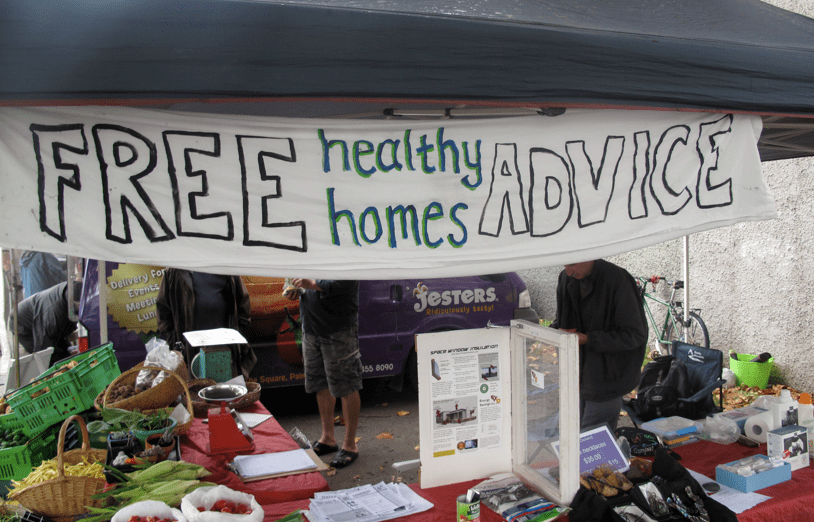
Seriously, we are offering free, independent ‘Healthy Home’ advice for every resident of Whanganui. No politics required.

Nelson Lebo is not the founder of the Eco-Thrifty Party, but does enjoy parties as long as he can be home and in bed by 9 pm. He is co-founder of The ECO School. 

Upcoming Events:

Warm, Dry, Healthy Homes. 19th April, 10 am – 1 pm. Drop in advice at the River Traders Market, River Exchange and Barter System (REBS) stall, Taupo Quay.

Seven Easy Steps to a Low-Energy Home, 22nd April, 6:30-7:30 pm. Community Room behind Gonville Library, 46 Abbott St.

Window Blanket DIY Workshop. 4th May, 3-5 pm. Duncan Pavilion. Please register.


Project HEAT Offers Free Eco-Design Advice

As much as I love living in Whanganui, I must admit that Palmerston North has impressed me. From the Palmerston North City Council website:

“Palmerston North has a strong focus on becoming a sustainable city. Reducing the city’s energy consumption is critical to this goal. Ensuring that homes in Palmerston North are warm and healthy will also build towards a sustainable community.”

From a job vacancy posted by PNCC:

“The overall purpose of council’s strategy is to facilitate a decrease in the amount of non-renewable energy used by households. This role plays a key part in achieving this through the provision of advice and information within the community on sustainable building, energy efficient retrofit and design on a one-to-one basis to residents.”  Screen shot 2014-04-12 at 7.17.53 AM

By contrast, two efforts to establish a similar programme with Wanganui District Council have been less inspiring. The first came in the form of a comprehensive Community Contract application with letters of support from six well-respected community groups. It was declined due to its lack of relevance to the WDC 10-year plan. (Never mind that power prices have doubled in the last ten years.)

The second effort came in the form of a visit from Richard Morrison, who serves the role described above for Kapiti Coast District Council. He presented to WDC and then to a small group of interested local professionals including myself. I may never forget the words of the council staff member representing WDC administration following Richard’s presentation.

“There is concern that the job title sounds too green.”

And with that definitive statement, effort number two bit the dust.

Job title: Eco Design Advisor.

The following councils have full-time permanent eco design advisors: Auckland, Hamilton, Palmerston North, Kaptit Coast, Hutt Valley, Nelson, and Invercargill.

Screen shot 2014-04-12 at 7.17.44 AM

In the wake of these two failed efforts to work with WDC to help Whanganui residents improve the health and energy efficiency of their homes, Project HEAT came into existence through a casual conversation followed by an anonymous donation.

Project HEAT (Home Energy Awareness Training) provides free, independent advice to Whanganui residents on how to save energy and money while making their homes healthier. Last year, over 400 Whanganui residents benefited from free presentations on eco-thrifty ideas for the home, free home energy audits based on the eco design advisor model, and low-cost DIY workshops.

Screen shot 2014-04-12 at 7.18.24 AM

Feedback was overwhelmingly positive. Of those who completed the survey following a home energy audit, all said they would recommend the service to a friend. Comments included:

Practical, objective, low cost suggestions from someone who isn’t trying to sell you any particular product. You feel like you are getting genuine well-researched advice that you can trust.

It made me think about how to keep the heat in versus keep heating a cold home.

Lots of different tips to save energy. It’s great to have a selection of improvement ideas. I’ll use different solutions in different areas. Awesome!

Practical, functional advice.

Practical solutions with a real space to visualize solutions.

Excellent explanations re: heat loss and cheap, effective solutions. How to fit a window blanket.

Thanks to additional anonymous donors along with other partners who have been recognized elsewhere in the local press recently, Project HEAT is back for 2014. Expanded programme offerings will include the above along with free drop-in advice at certain community events as well as the Saturday River Market – starting today!

Watch the sidebar to this column over the next four months for upcoming events.

 Screen shot 2014-04-12 at 7.18.11 AM

Sidebar:

Free Eco-Design Advice:

Warm, Dry, Healthy Homes. 12th April, 10 am – 1 pm. River Traders Market, River Exchange and Barter System (REBS) stall, Taupo Quay.

Permaculture: Working with Nature: 13th April, 2 pm. River Room Community Arts Centre, Taupo Quay.

Warm, Dry, Healthy Homes. 19th April, 10 am – 1 pm. River Traders Market, River Exchange and Barter System (REBS) stall, Taupo Quay.

Eco-Design, Payback Period and Savings

Editor’s Note: This is more or less the 100th weekly column I have written for our city’s newspaper, the Wanganui Chronicle.  Screen shot 2014-03-29 at 6.58.46 AM

Nearly two years have passed since I was invited to write this column, which brings us to what is approximately the 100th edition of Eco-Thrifty Renovation.

Since starting the weekly column  23 months ago, we have received our certificate of compliance for the renovation, I have been capped a Doctor of Philosophy by Waikato University, we witnessed the birth of our first child, and saved approximately $5,000 on electricity when compared to the average NZ household.

Yes, $5,000, not a misprint.

Savings earned from investment in energy efficiency is known as ‘payback’, and the time that it takes to recoup the investment is known as ‘payback period’.

For example, a compact fluorescent light bulb that costs $5 will usually “pay for itself” in energy savings over the course of about 12 months depending on use. This means the payback period is 1 year, representing a 100% return on investment. During the second year that $5 is in your pocket.

We’re not specific about exactly how much we save from each of our many energy efficient investments. We simply look to our monthly power bill – ranging from $17 to $31 – to gauge our performance against average domestic users.

While I have been writing this column for 23 months, we have lived in our Castlecliff home for 40 months, meaning our total energy savings thus far is approximately $9,000: roughly 1/3 of our investment in passive solar redesign, solar hot water, and energy efficient appliances.

This puts us on track for a payback period of under 10 years. In other words, we will essentially “double our money” by saving the same amount we initially invested. After the payback period, every dollar saved is a dollar in our pocket: hundreds each and every month.

In the meantime, the faster power prices rise, the shorter our payback period becomes: 9 years, 8 years. Some people might say we have “future-proofed” ourselves against rising prices. We have achieved all this by using eco-design to work with natural energy flows.

Investing is good design saves energy and money, but sustaining bad design costs energy and money.

Screen shot 2014-03-29 at 6.58.16 AM

For example, a recent article in the Chronicle indicated that Wanganui District Council decided to bulldoze the beach as its management strategy 12 years ago. At a reported cost of $25,000 per year, simple maths tells us ratepayers have contributed $300,000 during that time and we still have the same poorly designed beach, with a high probability of higher ‘grooming’ expenses in the future.

This is like having a big, draughty villa full of energy-gobbling appliances and light bulbs, and paying hundreds of dollars month after month for power, and after 12 years being in the same situation. Alternatively, after 12 years we will have saved over $30,000 on power, paid back all of our investment, pocketed the savings, and have a warm, dry, low-energy home.

Using an imaginary time machine, let’s travel back and consider that council made the decision 12 years ago to invest in a beach redesign that worked with natural energy flows instead of against them. As long as we’re pretending, let’s say we take the $300,000 with us.

Back in 2002, say we invested $100,000 in a beach eco-redesign that resulted in $7,000 annual maintenance instead of $25,000. This resulted in yearly savings of $18,000 and a payback period of five and a half years. From the sixth through 12th years we saved $18,000 per year for a total savings of over $108,000. (Please note, these estimates are used for explanation only.)

By 2014, we could look forward to saving $18,000 or more per year moving forward. Additionally, we would have “future-proofed” ourselves against rising diesel prices and what the vast majority of climate scientists have predicted will be increased extreme wind events, as we’ve already seen this spring and summer.

While hindsight is 20/20, eco-design thinking and payback period allow us to ‘travel’ into the future and look back at what decisions will be most cost effective. It’s worked brilliantly for us.


Peace, Estwing


The Third (!?!) Law of Thermodynamics

I’ve taken over editing the monthly River Exchange and Barter System (REBS) Newsletter from my wife because she gets busier by the week with work at the YMCA. It has given me the opportunity to think and write about ways of retaining wealth in our community. Below is the article I wrote for the September Newsletter.

Peace, Estwing

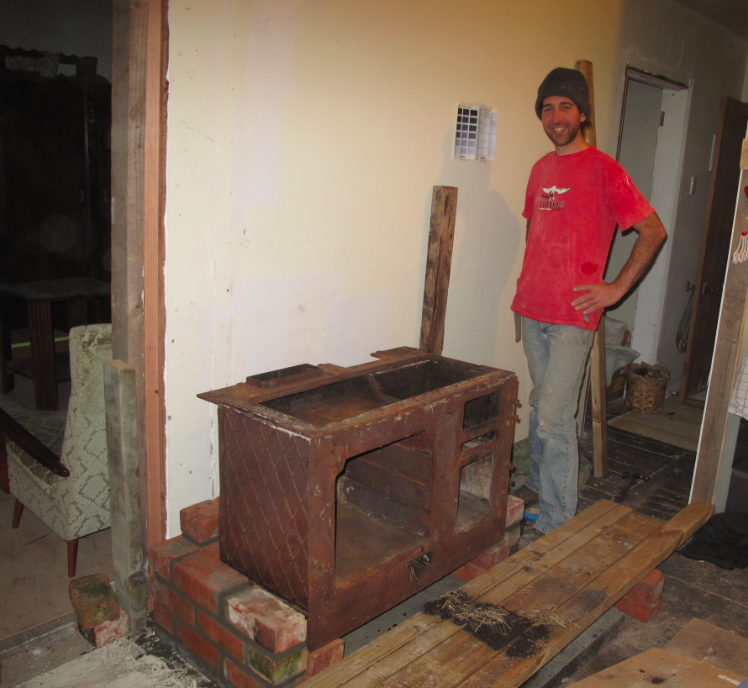
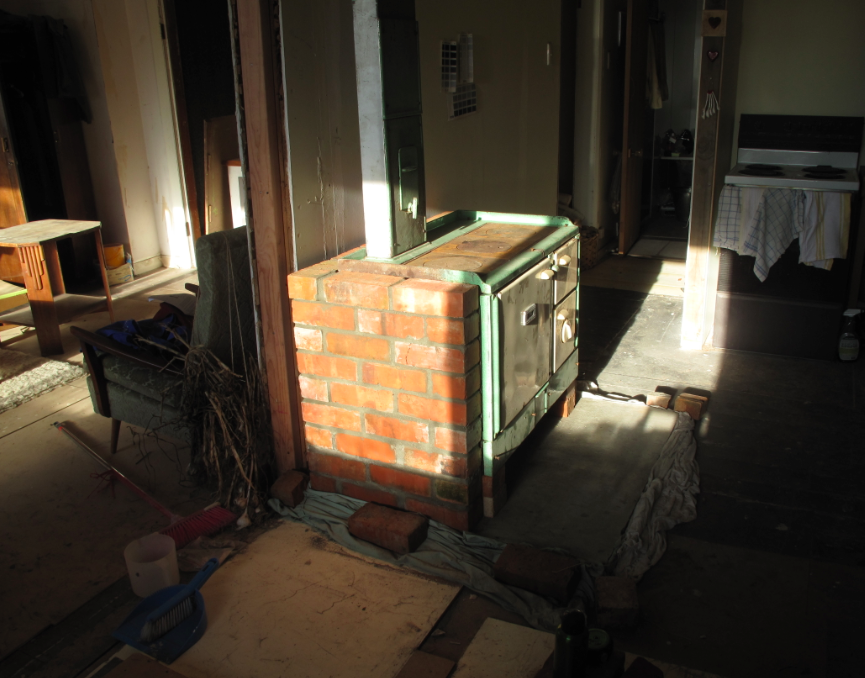
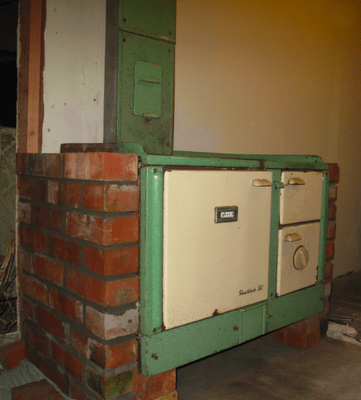
Energy is often defined as the ability to do work. In many ways, money – or wealth of any kind – is also the ability to do work. In other words, I can pay someone like Jonah to help me install my stove, or I can buy petrol to put in my car. A big difference between these two is that when I pay Jonah the wealth stays in the community, but when I buy petrol most of the wealth leaves the community. However, I can’t really pay Jonah to bring my wife home from work on a day she works later than the last bus. (Come to think of it, I probably could but she may not enjoy the ride in his bamboo bike trailer).

The point is, the work that energy or wealth can do is not 100% transferable back and forth. But sometimes it is. Going back to the example of the multi-fuel stove, the work that Jonah did will translate sometime in the future into energy savings in the form of reduced home heating costs.

Additionally, the wood that we will burn will likely come from the land cared for by Melinda and Murray. Therefore, any wealth transfer for home heating goes to these three “locals” and not to Meridian Energy in Christchurch (I believe).

And the same can be said for another form of energy delivered to Wanganui nearly every day for free: sunlight. Sunlight can heat homes quite effectively, and simple insulating and draft-proofing efforts can help hold the heat in overnight. These efforts may be labor intensive, but if the labor is local then the wealth stays in the community. Over time the homeowner makes up the upfront cost in energy savings. And then those savings can be reinvested in the community. For example, our electric bills are so low that we treated ourselves to an afternoon of local rugby. Go the Butcher’s Boys!

Intersections

I reckon life is all about finding balance. And because we live in a dynamic world, the balance point is always changing. On this project we are looking for balance not only between eco and thrifty, but also factoring in the New Zealand building code and the potential for wide applicability across society and across the world. In other words, we are looking for the intersection of eco, thrifty, legal, replicable, beautiful and attractive to people other than already committed Greenies.


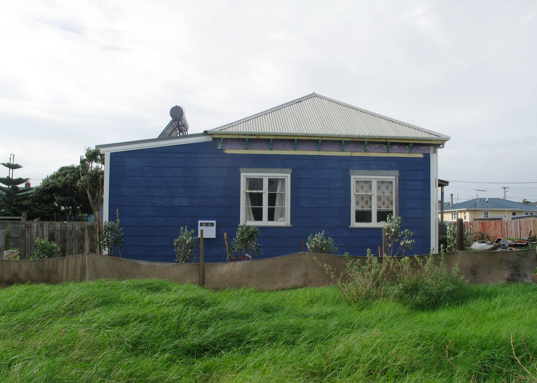
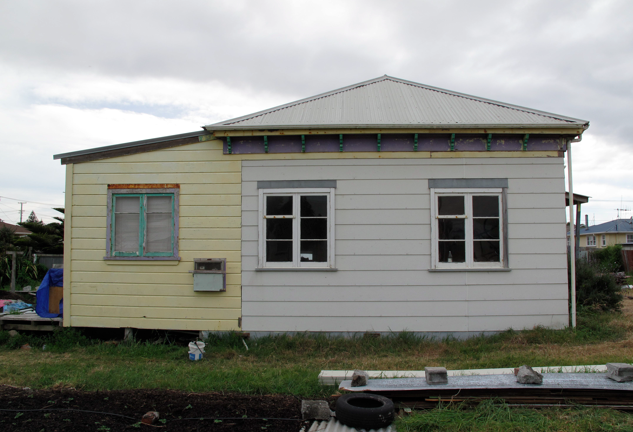
To my knowledge this is a unique endeavor. This project represents an everyman’s/woman’s approach to permaculture. There are lots of examples of eco-villages and perma-farms and expensive bespoke eco-homes. But in the foreseeable future, the vast majority of people will never live in such places. Most people in OECD nations live in places like this.


Well, much nicer than this actually. But we did not want to be accused of cherry-picking.


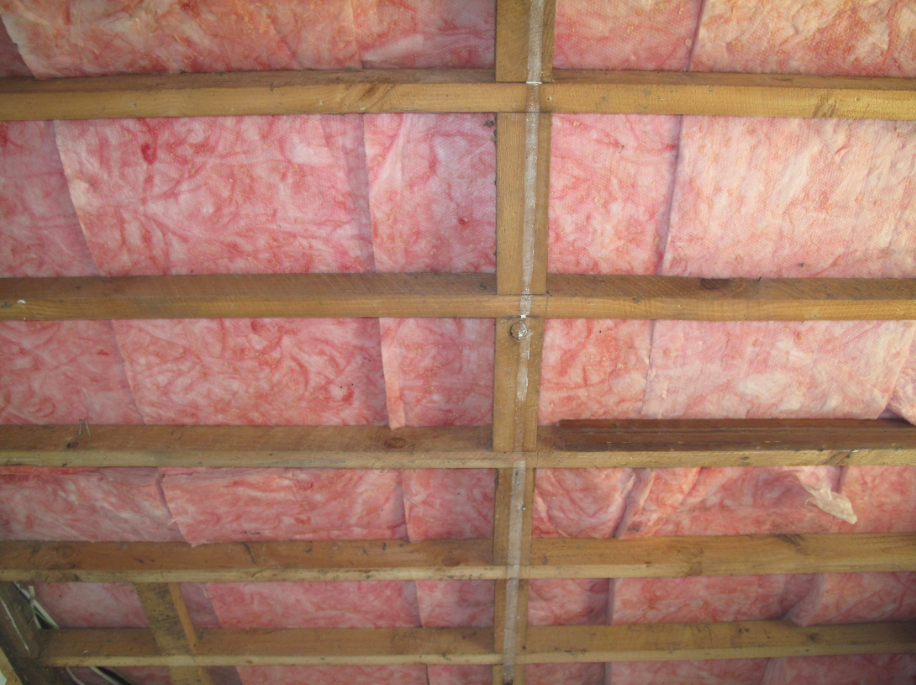
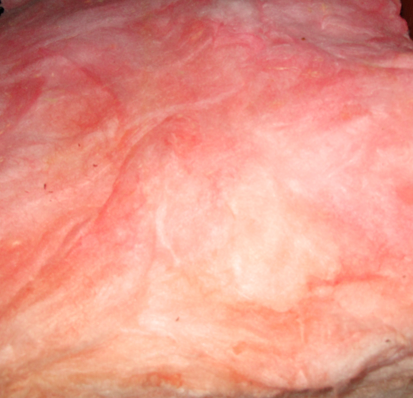
In response to Richard’s comment on the last post, I’ll give an example of the intersection mentioned above using insulation. Pink Batts are widely available, recognized by almost everyone, cost-effective, meet the NZ building code and contain up to 80% recycled content. Meeting (and exceeding) the NZ building code is essential to this project. So the options of insulation included Pink Batts, polypropylene batts, and wool batts. (We did not consider blown in cellulose too closely because we wanted to do the job ourselves to ensure quality installation and to keep costs down.) Polypro batts are made from recycled plastic and the wool batts are made from…wool. Both are more expensive and less available than Pink Batts.

Some people like polypro batts because they are so soft and easy to handle. But in terms of insulation, handling should be (!) a one off. I do not mind handling Pink Batts. Once they are installed, I don’t plan to touch them ever again.

Some people claim that wool batts are the most eco option possible. I question that thinking. Have you seen the unsustainable ways sheep are grown in NZ? A holistic look at the ecological footprint of wool batts must include soil erosion, herbicides, and nitrogen fertilizers. Some might argue that the ecology, soil health and water health of NZ would be much better off with fewer sheep.


In the end, the insulation intersection for this time and place and the goals of this project was Pink Batts. For the equivalent cost of polypro or wool we were able to exceed the building code at a higher r-value. In other words, we have a warmer house at the same cost. By using an innovative installation technique (see Bridge to Nowhere), we reap the benefits and can share this under-utilized approach with others to replicate from Auckland to Alberta.

Peace, Estwing

Still the One

We have had an amazing run of mild weather this autumn and early winter. Even up through Matariki – the winter solstice (fewest hours of sunlight for the year) – we have not needed any supplemental (electric or otherwise) heating for hot water or our living space. This has allowed us to keep our electricity use around one kilowatt hour per day for the last eight months. Our last bill was remarkably low. We used only 23 kilowatt hours in 30 days.


$15.72 includes a 38 cents/day line charge.

But those “cheap as chips” power bills are likely to hibernate until September, as we face two cold months ahead, and most immediately cool, cloudy weather and rain for the next 10 days. But I thought I’d share some of the best approaches we’ve chosen to save energy and money. From big picture to detail, they include:

Passive solar design: Increased glazing on the north side (toward the equator) for free heating.

(Morning photo: Drapes are still closed.)

Insulation: Holds that heat in at night.

Fiberglass insulation has up to 80% recycled content and is affordable.

Thermal drapes and pelmets: This is another form of insulation that happens to open and close daily. Mindfulness makes these much cheaper than double-glazing if you are conscientious about opening and closing them at appropriate times.

Pelmet is an old weather board from the exterior. (Ripped to 150mm and inverted.) Will be painted white to look like a crown molding.

Solar hot water: Electric water heating is one of the biggest additions to a power bill.

One of the best investments I’ve ever made. Thanks Allen!

Under-the-bench-fridge: Our refrigerator sips power while many others gulp it.

Small is beautiful! Big enough if you keep yourself organized.

Compact flourescent light bulbs: This hardly needs to be said, but CFLs use 1/4 the power of incandescent bulbs for the same amount of lighting.

Old reliable. I’m looking at LEDs, but the quality has to go up and price down.

We use heaps of other strategies for saving power, but those will be highlighted another day. Which of these can you implement in your home? What other great energy saving strategies do you employ?

Oh, the sun just came out. Gotta go open the drapes… – Estwing

10 Watt Pasta

We ran a new workshop this weekend with excellent response from participants. The workshop – Solar and Energy-Efficient Cooking – is part of an ongoing workshop series by The ECO School.

We covered a number of different solar cooker designs and cooking techniques during the first half of the workshop. But for those who have not yet made their own cooker, or for cloudy days, we introduced a number of other energy-efficient cooking techniques. Central to many of those techniques is the straw box.


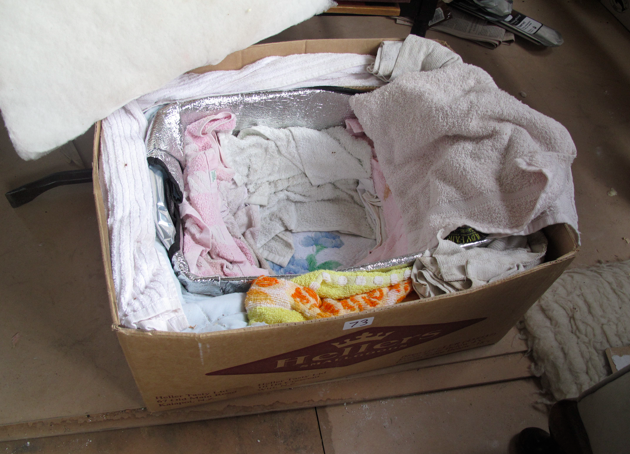
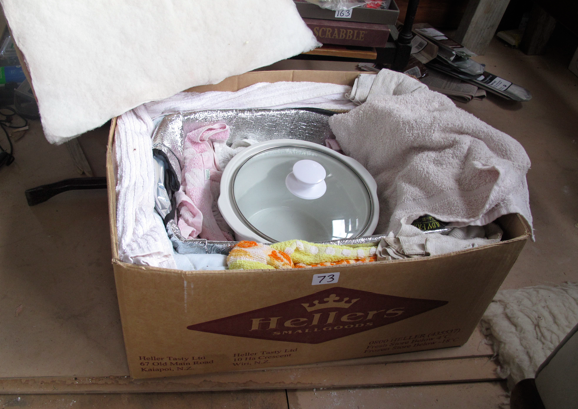
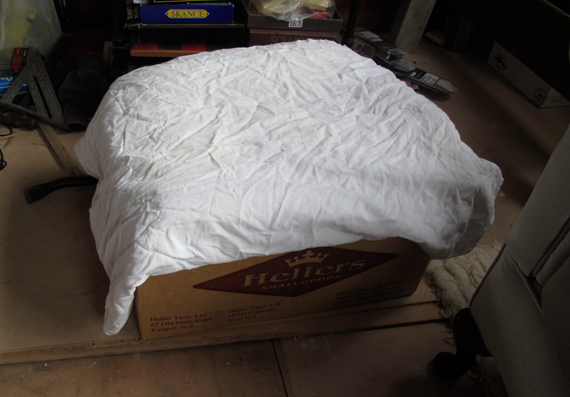
Our straw box happens to be full of towels, not straw. But we still call it a straw box. The key to a good straw box in insulation on all 6 sides.

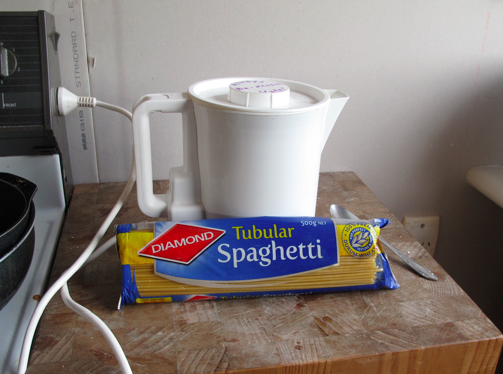
A great example of using a straw box – not to mention an excellent energy-saving cooking technique – is what we call “10 watt pasta.” This cooking technique uses a small fraction of the electricity of boiling pasta for 10 minutes on a hob (stovetop). Here’s how to make it.

1) Boil a jug. Because the heating element is inside of the container, heat transfer is more efficient than heating a kettle or sauce pan of water on the stovetop (hob). We fill the jug with our solar hot water which comes from the tap at a high temperature using no electricity.


2) Pour over pasta until covered and place in the straw box.


3) Cover the straw box and wait 20 – 25 minutes. Stir once at 10 to 12 minutes. For al dente pasta, remove at 15 minutes and stir at 8 to 10 minutes.


The pasta comes out perfectly cooked as long as you drain the water at the prescribed times. Use the intervening 25 minutes to make a healthy sauce from fresh veggies and herbs from your garden.

Bon apetito! Estwing