Category Archives: Eco Thrifty Renovation

Retrospective #29: Kitchen Vision

This is the 29th in a series of articles appearing in our city’s newspaper, the Wanganui Chronicle
Last week I wrote about transforming a tired, old kitchen cabinet into a fresh, new kitchen cabinet. The key elements in that process were: 1) vision; 2) patience; 3) resourcefulness. In many ways, these are the same elements required when taking on a major home renovation. If you’ve ever seen the British television programme, Grand Designs, you will know that those couples who lack a clear vision and/or are impatient usually exhibit the most stress. While this makes brilliant entertainment, it does not make for a good renovation process.

All renovations require vision and patience, but not all renovations require resourcefulness. Let me explain.
Under one scenario, you could hire an architect who helps you with the vision and a builder who asks you to be patient. The builder asks you to be patient because renovations almost invariably take longer and cost more than anticipated (see Grand Designs). This approach to renovation does not necessarily require resourcefulness because most (but not all) architects and builders will assume that they are working with all new, off the shelf products, materials, and accessories. In most cases, if you want to do something out of the ordinary, it will end up costing more in labour due to the extra time required. There is nothing wrong with this scenario, and it can result in beautiful, functional living spaces.

By contrast, an eco-thrifty renovation (ETR) involves vision and patience, but also requires resourcefulness. (You may recall that three of our seven design principles are reduce, reuse and recycle.) In many cases, the resourcefulness involved in ETR actually increases the level of vision and patience required (ask my wife). An example of this would be our $2,500 kitchen that took over a year and a half to complete. Aside from some structural elements required by the building code, nearly everything else is second-hand. Despite that (maybe because of it) we now have one of the coziest, most comfortable kitchens I’ve ever been in.
Before
Alongside the hanging cabinets I wrote about last week, other reused components include: the kitchen bench; the cabinet under the bench; the electric oven; butcher block; Welsh cupboard; Schacklock 501 and the bricks in the surround; light fixtures; pelmets; and, it may be argued, the Tasmanian oak floor. The floor, while not technically made from reused or second-hand (ie, previously used for another purpose) materials, is made from off-cuts and B-grade timber that I bought on Trade-Me from a door manufacturer in Wanganui. The floor – which will be the topic of next week’s column – is another great example of resourcefulness, vision, patience…blood, sweat, and tears. So make sure to tune in next week.
After
Because we reused second-hand components in the kitchen, and I did most of the work myself, the bulk of the $2,500 went to plumbers. Besides that, I hired one friend to do the Gib-stopping and another to do the brick-laying. Money well spent in my opinion! Other expenses include the Shacklock 501 ($250 on TradeMe) and the refrigerator ($300), which we purchased new for two reasons: 1) we had recently been through a bad experience with a second-hand washer; and, 2) most second-hand refrigerators have low Energy Star ratings. After an electric hot water heater, a refrigerator is likely to be the largest energy user in the average home. Part of our strategy for low power bills is to use an under-the-bench fridge with a high Energy Star rating. It uses about ¼ of the power of a standard full-size fridge. Plus, all of the squatting down to get a cold beer has given me buns-of-steel. Look for my workout video on YouTube! 
Peace, Estwing
Retrospective #28: Beauty from Vision

For the last couple of weeks, I’ve been writing about many of the aspects and levels of ‘resilience’ addressed by eco-thrifty design thinking. One of those articles focused on the peace of mind provided by a low-energy and low-resource home, and the other talked about the growing global movement towards resilience to storms: both literally in terms of damaging storm surges such as Hurricane Sandy in New York, and figuratively like the damage caused by financial ‘storms’ such as the global financial crisis which appears focused in Europe.
While examples of resilience can be gleaned from around the globe and connections can be made to our local context in Wanganui, I do not mean to overshadow another important component of eco-thrifty design thinking.
There is no reason things cannot be made as beautiful as they are resilient.
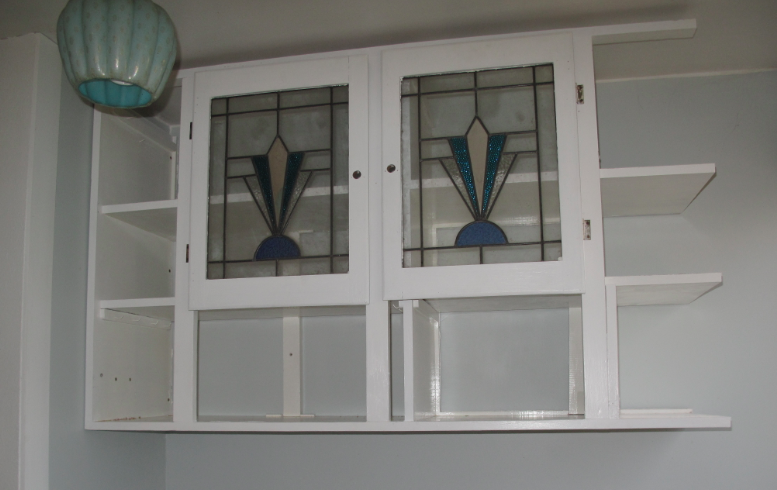
This also gives me the opportunity to thank Terry Lobb for her kind words three weeks ago when we swapped columns. Terry wrote about the aesthetics of our $2,500 eco-thrifty kitchen by focusing on a number of key elements including the cabinets over our hob with their leadlight doors that reminded her of fantails.

I love fantails, I love those leadlight doors, and I love where we got them: Hayward’s Auctions. Not only is the weekly auction great entertainment, but bargains can be had of an eco-thrifty nature: low cost and high performance. We paid a fair price for the leadlights – about $50 for the pair – but ended up with a design element in our kitchen that punches above its weight. In other words, the value we receive from these beautiful doors far outweighs the price we paid for them.
This is not to ignore, however, the fact that we had to sand back the wooden frames, and then carefully apply two coats of primer and two coats of paint. The other thing I had to do was build cabinets to suit them. It took me nine months from purchasing the doors to realize the cabinets had been here all along. I just had to remove part of the forest to see the trees.
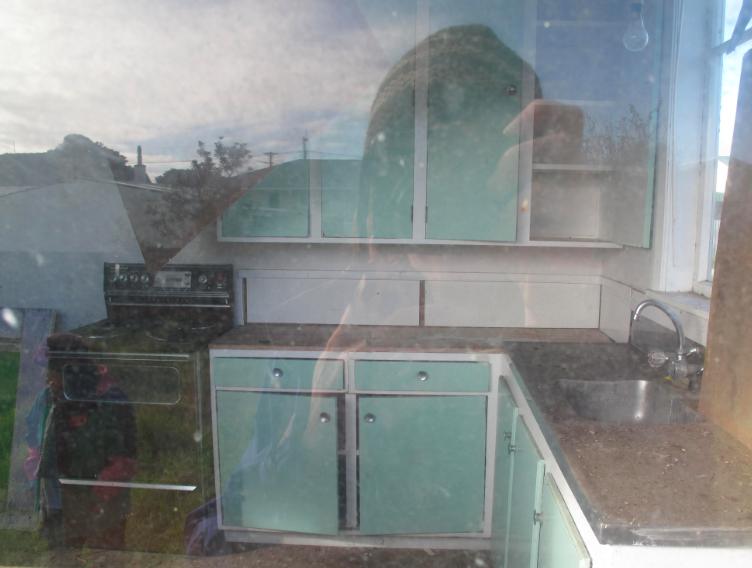
During the process of turning the old kitchen into the new bathroom, we had to take down the old cabinets with their classic 1950’s Kiwi-mint-green doors. While that color is bound to make a comeback one day, it is not today. 
We removed the unit and put in a back room to serve as miscellaneous shelving. And there it sat until one day, for no particular reason, I had a vision.
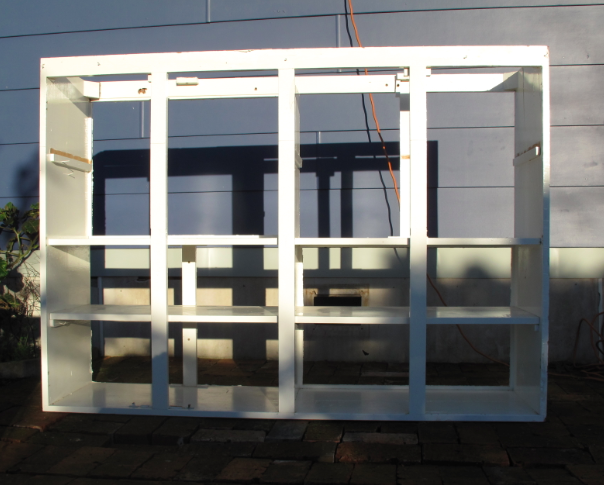
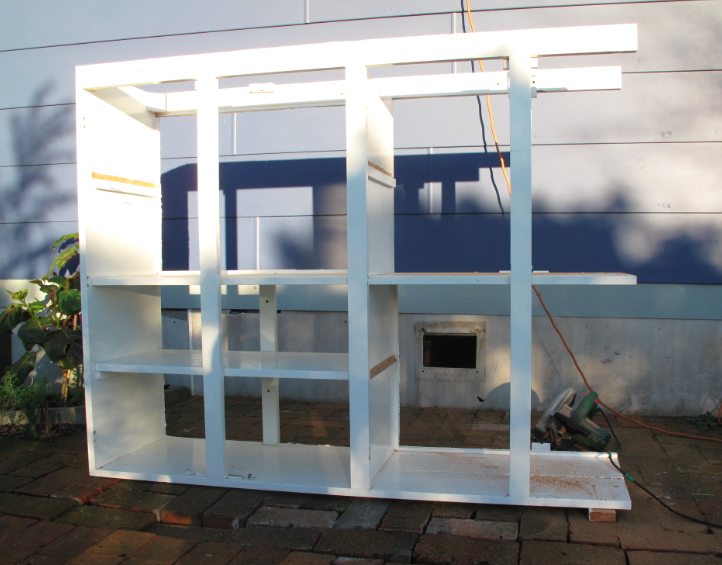
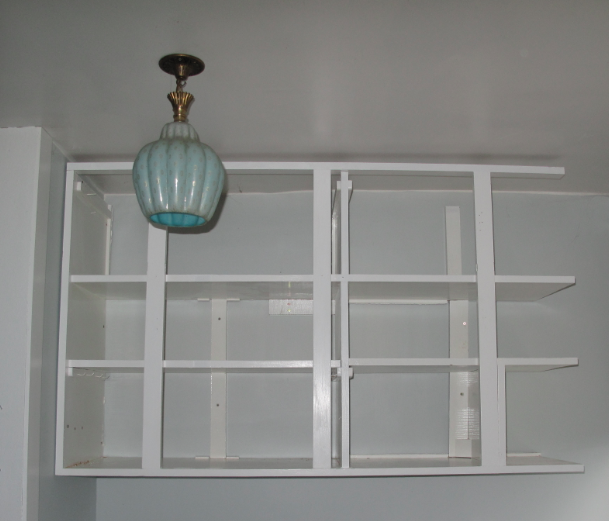
The vision was that by cutting away at the cabinet and reshuffling some of the bits, this old rimu unit could see new life in a new kitchen in the same old home. The process was almost exactly like pruning a tree, a process that also starts with a vision. The series of photos show how the process unfolded.
First, I removed the Kiwi-mint-green doors and took the cabinet outside. I carefully measured and marked where I wanted to remove parts of the old cabinet that was too big for our new kitchen. 
Next, I pruned away some off the length. 
Then some off the height. 
Then – and this was the hardest part – I had to reshuffle some of the bits so that the new, smaller doors would be centered on the pruned (smaller) version of the cabinet. 
Like any form of renovation, the work may proceed slower than building something new because we are forced to work around pre-existing elements. However, when care and time are taken, the results can be worth the effort. 
Peace, Estwing
Permaculture Garden Tour

Scratch to Patch Permaculture Garden Tour: From garbage dump to thriving edible landscape with over 100 perennial fruit trees and bushes in under 2 years.

Saturday, 17th November, 2:30 – 3:30 pm: (This tour is scheduled to match Saturday Castlecliff bus service). 10 Arawa Place, Wanganui. Koha

Sunday, 18th November, 2:30 – 3:30 pm: 10 Arawa Place, Wanganui. Koha

Front lawn before 
Front lawn during
Front lawn after
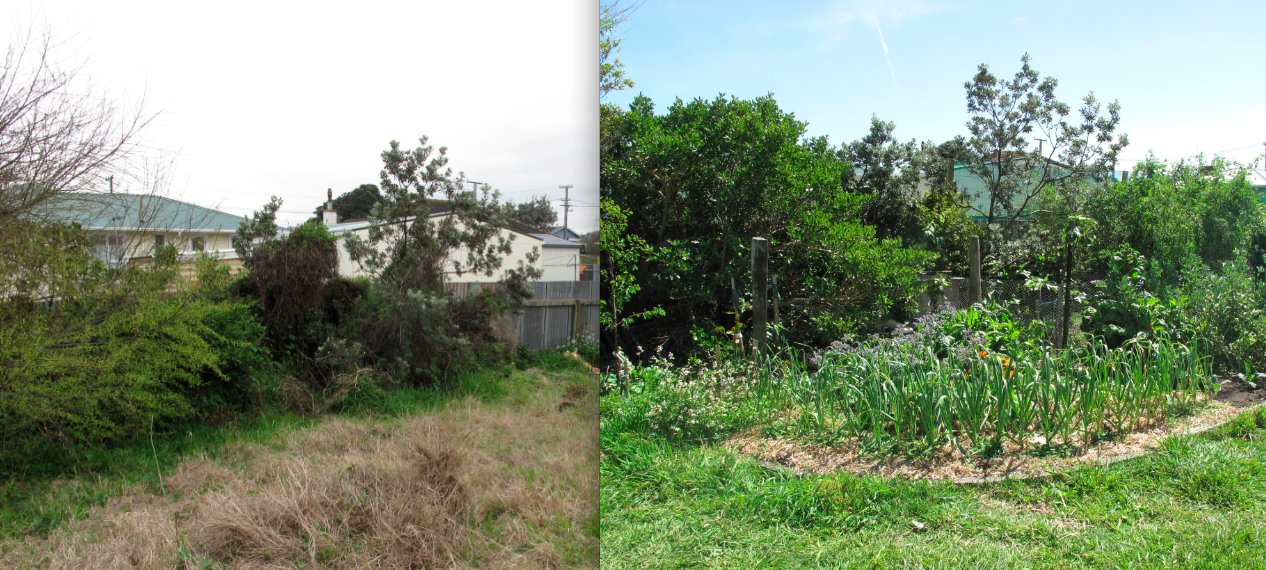
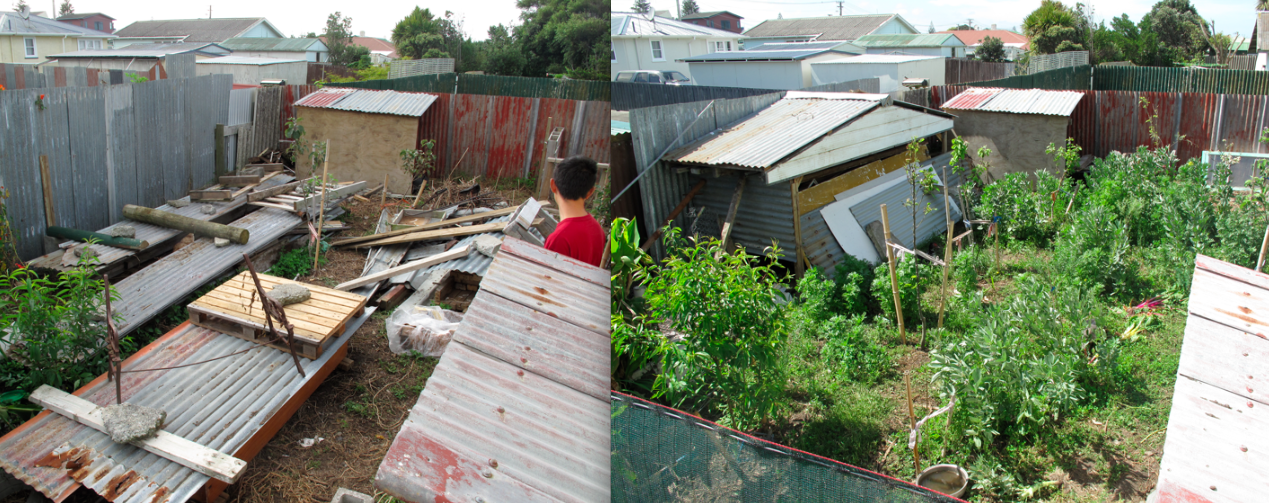
Back yard before and after

Side yard before and after

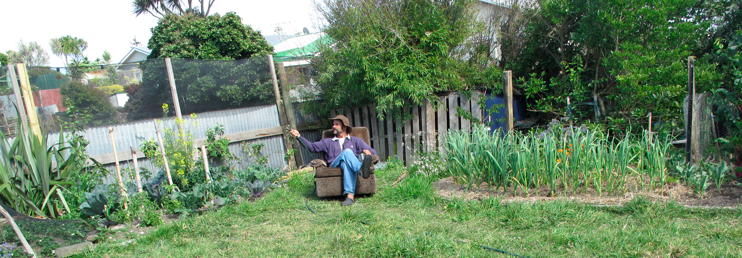
Lazy gardening

Peace, Estwing

‘Storms’ & Resilience

I’ve written lately about some of the big ideas behind eco-thrifty renovation including the amazing power of design (Chronicle 27-10-12) and ways in which a low-energy home can empower the occupants by allowing them to worry less about raising power bills (Chronicle 3-11-12). What these two big ideas of eco-thrifty design have in common is the notion of resilience.
Resilience is the ability to weather a storm, to persist in the face of adversity, to ‘roll with the punches.’ Resilience is a cornerstone of Aotearoa/New Zealand. The first human settlers to come here – both Maori and European Pakeha – left familiar, comfortable surroundings to venture to a new (for them) land. Each group – in their own way and in their own time – had to remain resilient to all that the Land of the Long White Cloud could dish out.
For both, that often meant storms, or as the media like to call them, ‘weather bombs.’ Early Maori structures and the current Building Code both consider high winds and driving rains. In both cases, this is called appropriate design. You will recall, however, a time in New Zealand history when such appropriate design and construction was not practiced. That time is remembered as the era of ‘Leaky Buildings.’
But, as Bob Dylan, warns, “The times they are a-changing.” As someone who has followed discussions on global climate change for over two decades, I’ve been interested recently (the last three years) that the dialogue has turned from one of ‘prevention’ to one of ‘adaptation.’ Adaptation, in this sense, means planned resilience. From what I can tell, world leaders have resigned themselves that humanity lacks the collective will to keep carbon dioxide levels below what is considered ‘safe’ by the vast majority of climate scientists. The result, as documented in a flurry of recent pear-reviewed papers, is an increasing incidence of extreme weather events.
This was the prediction, and now data has born it out. What’s left for us to do is ‘batten down the hatches.’ Aotearoa / New Zealand has always be buffeted by storms, it’s just that now those storms are likely to become more frequent and stronger. A corollary to this – for those shocked by the increase of home insurance premiums due to the Christchurch quakes – is that we will all pay more to clean up after those storms.
One recent ‘storm’ that most Europeans are paying dearly for is the so-called ‘Global Financial Crisis.’ Like predictions on climate change, the GFC was also forecast but the warnings were ignored. Greeks, Spaniards, Irish, Brits, Portuguese, etc are paying for the storm through the appropriately named ‘austerity measures’: cutbacks in education, health services, libraries, swimming pools, etc.
Funny that many of the same things are happening in the states but no one dare use the word ‘austerity.’ Instead, the high and mighty politicians who racked up 16 trillion dollars in debt suddenly talk about the need for ‘fiscal responsibility.’
Be it York or New York, Las Cruces or Las Vegas, Athens or Atlanta, communities of people are getting together and creating local resilience to global finance in the form of local currencies, time banks and barter and exchange systems. These have become particularly popular in Greece as it is on the leading edge of financial and economic turmoil.
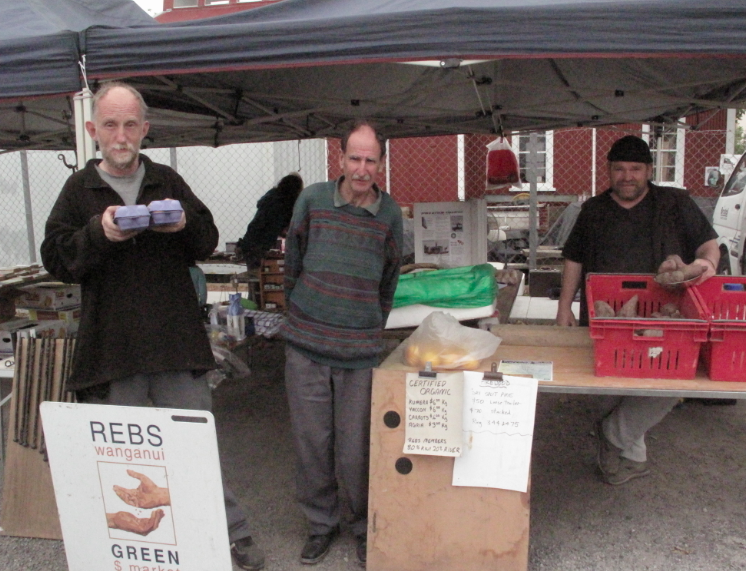
Not that turmoil has anything to do with it, but Wanganui appears to be way ahead of even the Greeks regarding local financial resilience. The River Exchange and Barter System (REBS) has been in operation for over 20 years. You may have seen the stall at the Saturday market and wondered, “What’s that about?”
Well, here is the opportunity for you and your mates to learn more and to have some fun at the first ever REBS Quiz Night and Info Session. It’s only $20 per team of 3 to 5, but pre-registration is required.
Wednesday, 14th November. 6:30 – 8:30 pm
YMCA St. George’s campus
$20 per team of 3 to 5.
REBS members and non-members welcome!
Prizes!
To register your team, ring Donna on 345-7282

Resilience on Many Levels

I was fortunate to have the opportunity to speak recently to members of Balance Whanganui – a peer support group for mental health and addiction. They were an excellent, engaged group during the nearly two-hour presentation on eco-thrifty renovation. It was particularly enjoyable for me because they laughed at all of my jokes.
It was also enjoyable because I had the opportunity to draw parallels between healing a home and healing a mind. At its core, we have transformed a fragile and vulnerable structure into a robust and resilient one. This is, from my understanding, an aim of mental health treatment. “Life,” some say, “is less about what happens and more about how you respond to it.”
Homes and people are both subjected to external forces beyond their control. A home is subjected to wind, rain, earthquake, rates rises, electrical rate rises, and burglary. A person is subject to the pressures of social situations, financial stress, mood swings, rugby results, unexpected repair bills, family pressures, and the weather. In both cases, steps can be taken to build resiliency.

With the help of Building Control, we have made our home more resilient to wind, rain, and earthquake by following the New Zealand Building Code. We have made it resilient to rising electrical rates by investing in energy efficiency and solar energy. We have made it resilient to burglary by installing a home security system, but there is not much we can do about rates rises, which, along with electricity rates, outpace wage rises.
In the process of making our home more resilient, I have also improved my mental health. Like some other people, the sources of stress in my life are worries about: increasing energy and food prices, environmental degradation, financial uncertainty, Richie McCaw’s ankle, and social inequity. Through the process of renovating and living in our old villa and planting gardens, I have been able to address my concerns about rising energy and food prices, and in the process, financial uncertainty – to a certain extent. I also feel that I am doing my part to help the environment and to help low-income families and pensioners learn about easy, low-cost / high performance energy saving strategies.
A resilient home helps cultivate a resilient mind. In other words, I am more at ease because my home can better resist rising food and energy prices, and increasing severe weather events. (The conversation in the States right now is about how ‘resilient’ New York City was, is, and will be to extreme weather events such as Hurricane Sandy.) But I’m afraid Richie’s ankle will continue to linger on my mind.
I believe one of the great strengths of McCaw and the All Blacks is mental toughness. In sport, mental toughness is an expression of mental resilience: overcoming adversity be it injury, penalties, earlier mental mistakes, or the pressure to maintain a winning side.
Sport is often used as a metaphor for life, and now I’m putting forward the idea that making a home is also a metaphor for life. Energy wasting homes put the occupiers at the mercy of power companies while energy efficient homes help the occupiers take control.
The metaphor can be extended to the community level, as our city collectively faces many of the same worries as individuals. If each home in Wanganui saved just $10 per month on their power bill – quite easily accomplished – an additional $2 million dollars would be retained in our community each year rather than being sent to power companies in Wellington, Auckland and Christchurch. Additionally, warm, dry, low-energy homes have health benefits that would improve certain respiratory illnesses. And, as indicated by the positive feedback I received from the members of Balance Whanganui, I believe many residents would feel empowered by gaining a certain level of control over their power bill.
With all of this in mind, it only increases my sense of bewilderment as to why the Wanganui District Council would turn down an application to Community Contracts to bring home energy saving education to every suburb in the city. The application had the support of six community groups, but was turned down as the idea of providing easy to understand, practical advice and education to residents was not well aligned with the 10-year plan. With power bills tracking toward doubling in the next ten years, I wonder why it’s not.
Peace, Estwing

Design is Da Bomb!

Design is one of the most powerful forces in the universe. But like any powerful force, it can be used for good or for evil. It can even be ignored, but, I would argue, at our own peril. Put another way, to fail to design is to design to fail.
Mind you, I didn’t used to think this way. I didn’t think about design or its power at all. Designers, in my mind, were stereotypes of effeminate fashionistas or flamboyant interior decorators I’d seen in movies. 
The Bird Cage. Awesome film!
All that changed the day I heard William McDonough speak at Dartmouth College (USA) about 15 years ago.
“Design is the first signal of human intention. As designers, we promote a positive vision of the future, based upon the belief that many of the environmental problems we face are, at root, design challenges.” – William McDonough
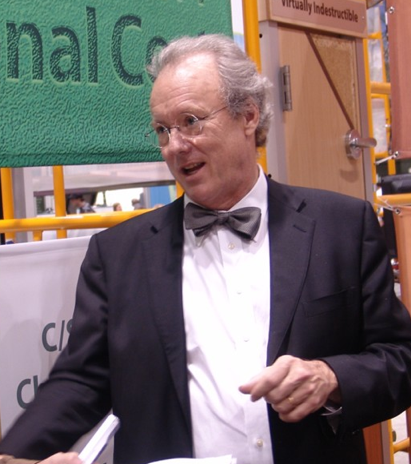
Not only was McDonough one of the best speakers I’ve ever had the pleasure to hear, but, in my opinion he is also one of the best thinkers alive today. (And he wears a bowtie!) 
If you are familiar with TED Talks, you can look up McDonough’s TED Talk on the internet and get an idea of what I mean.
Already a McDonough groupie, I was thrilled with the publication of his book, with German chemist Michael Braungart, in 2002, Cradle to Cradle: Remaking the Way We Make Things.Cradle to Cradle emphasizes McDonough’s mantra “waste equals food,” but also makes an important distinction that serves as a quantum leap for the sustainability movement: the difference between eco-efficient and eco-effective.

Eco-efficiency, for McDonough, means doing things that are still damaging the planet’s life support system and consuming non-renewable resources, but doing so more slowly than before. He puts it rather bluntly:
“Being less bad is not being good.”
One of the reasons I admire McDonough is that he is pushing the envelope on design thinking but basing it all on the best available science and modeling his designs on how natural ecosystems function. When looking for models of eco-effectiveness we need only turn to a forest, a wetland or a coral reef. Time Magazine described his way of thinking this way:
“His utopianism is grounded in a unified philosophy that – in demonstrable and practical ways – is changing the design of the world.”
If you have been following the Eco-Thrifty Renovation column alongside this one each Saturday, you know I am a huge fan of ‘practical’ and ‘demonstrable’. In other words, I favor what works over what might theoretically work. The proof, as they say, is in the pudding, although I have absolutely no idea where the phrase came from. However, I do likes me some good pudding!
As an environmental science teacher, I used to pose the question to my students: Who has a better track record for making sustainable systems: humanity or nature? Oddly enough, I always got the same answer.
But eco-design thinking is not limited to the fields of architecture or manufacturing. Forty years ago, a pair of Australians, Bill Mollison and David Holmgren, developed an eco-design system called permaculture to address sustainable food production. Since then, permaculture design has been expanded to cover economics, finance, transportation, energy, technology, and even health and spiritual wellbeing. Personally, I’ve just completed a four-year doctoral study applying permaculture design and practice to junior secondary science as a way to engage students in authentic, relevant science learning experiences. Eco-design thinking permeates the 400-page thesis from the theoretical framework through the methodology and curriculum design and even the data analysis, interpretation, results and conclusions.
Although it is likely that only four people on Earth will ever read the thesis –  my two supervisors and two examiners – the real value of writing is the thinking that goes into it. Over the last four years I have been amazed at the extent to which eco-design thinking can be pushed in education and in research. I realize that many readers may have little interest in either, but I use this example to show the breadth and depth of the potential application of eco-design thinking.
Think about your life or your job. Are there ways that design – “the first signal of human intention” – can be applied? What are your intentions anyway? Are you fulfilling them? How can thoughtful design help you do so? The possibilities are as endless as the interrelationships of a thriving native bush ecosystem…possums not included.
Peace, Estwing

Retrospective #24: Win a Solar Sausage Sizzle at Your School

The sun is amazing. It provides the energy for plants to grow. It provides a comfortable temperature for life on earth. It provides the energy to heat our home and to heat our water directly with its rays, and indirectly with the wood we burn in our Shacklock 501.
Rays from the sun and the energy from plants are referred to as ‘current sunlight’ energy. This term is used in contrast with ‘ancient sunlight’ energy, which refers to fossil fuels that formed from plants that lived (and got their energy from the sun) millions of years ago. Ancient sunlight energy includes oil, coal and natural gas.
Current sunlight includes our daily sunshine along with firewood, food, animal fodder, methane from anaerobic decomposition, etc. Current refers to a human time scale while ancient refers to a geological time scale. Current sunlight energy is generally considered renewable while ancient sunlight is non-renewable.

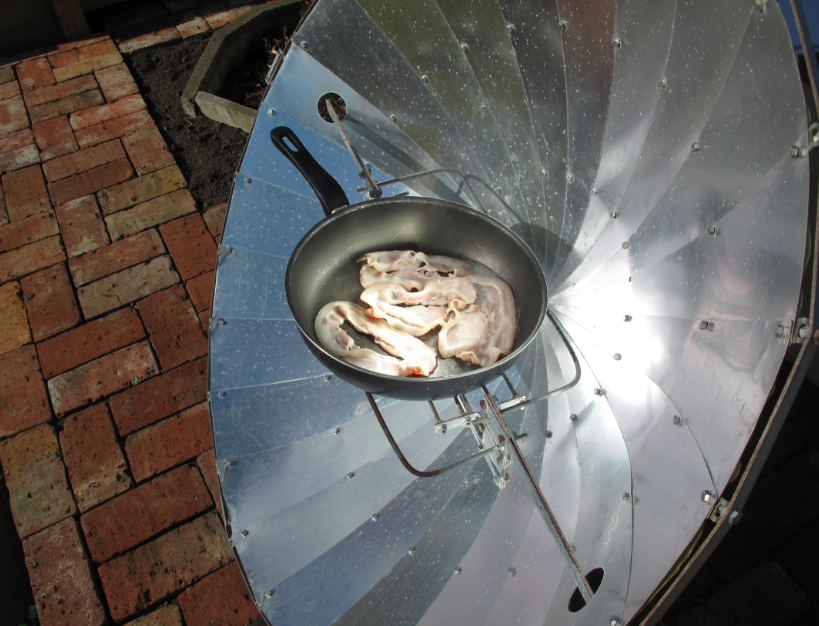
At our home in Castlecliff, on occasion, the sun also cooks our tea. I consider the solar cooker I bought in India six years ago (for about $NZ 120) one of my most valuable possessions. It traveled from India to the States with me, and from the States to here. (It was manufactured in Thailand.) By my calculations, it has nearly circumnavigated the globe.
Over the last half-decade, we have cooked nearly everything on our solar cooker: potatoes, kumara, pumpkin, rice, pasta, veges, cheese burgers, bacon, apple crumble, pizza, banana cake, sausages, and on one occasion, a leg of goat.
True story: One Sunday afternoon last October a goat leg was hung from our front door knob in a plastic shopping bag. We were out the back at the time, but we had no idea who left it. I asked our neighbours if they saw anyone drop by. One of them said, “A green van pulled up and a guy said, ‘Is this where Nelson lives?’.” That was the only clue we had until about six weeks later when a friend of a friend said to me at the Saturday market, “How’d you like the goat?”
Truth be told, it was good, even though we had never cooked goat before. Our only experience with goats before that was composting one that we found at the Castlecliff beach next to the swimming area. But that is another story. We asked around for advice on cooking goat and the best we got was “slowly.” As it turned out, four hours in a roasting pan on the solar cooker with olive oil, garlic, rosemary, spuds, onions and carrots was about perfect. Highly recommended.
Our solar cooker also serves as a valuable educational tool. While it is unrealistic to expect very many families in Wanganui to take up solar cooking, by dramatically demonstrating the power of the sun in this way, it opens up conversations about other uses of solar power like space heating, water heating, and electricity generation.
Children are especially interested in the solar cooker when it is full of sausages for them to eat. Last year I was able to visit some Wanganui schools for a Solar Sausage Sizzle with funding provided through the Sustainable Whanganui Trust’s Sustainable Schools Programme funded by the Wanganui District Council. 
This year I have a limited amount of funding to do the same, so I would like to offer a contest for two primary classrooms and one intermediate classroom. Children should draw a picture of a solar home and label the important bits. The three winning entries will receive a lunchtime sausage sizzle during term 4. Post entries to The ECO School, 10 Arawa Place, Castlecliff, 4501. Entries close 29th October.
Peace, Estwing
ETR Q&A: Part 3

This Q&A series originates from a list of questions I received by email from a Frenchman traveling and learning in New Zealand. Feel free to look back at previous Q&A posts if you are interested. Answers continue below.

-I haven’t seen such a clever idea for a sun cooker! What is the material of the shell (mirrors? Aluminium sheets?)? Would it be possible to have a draft of the cooker?
This solar cooker is made from sheet aluminium on a galvanized steel framework. I bought it in Ladakh, India, in 2006, but I believe it was manufactured in Thailand or Vietnam. 
The internet is awash with solar cooker designs, instructions and opinions. Oh, and by the way, I do remember seeing one for sale in France called Le Grille Solair for 299 Euros. (This one cost me about 50 euros, or 100 NZD.) 
-Have you got a workshop in your house? Where did you supply all the tools you needed?
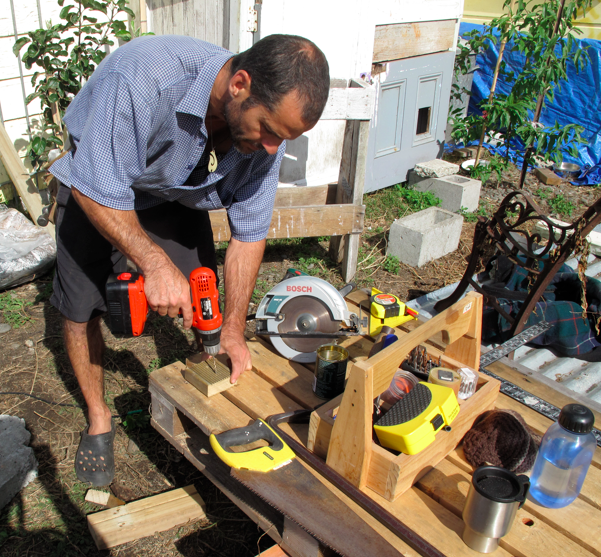
When renovating, it’s best to take your tools with you. I have a number of tool boxes that I can carry to where I need them. 
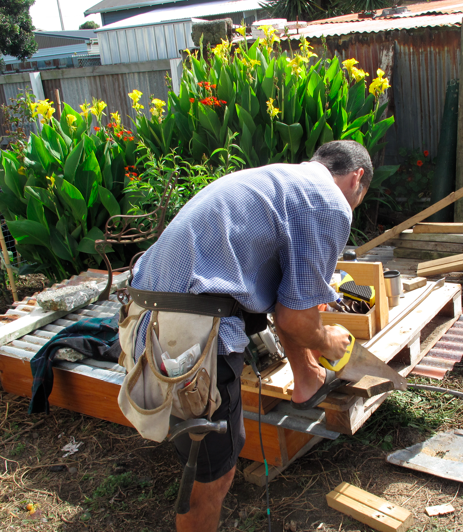
The most important tool carrier is the one on my bum. I like to have a hammer, tape measure, chisel, pliers, screw drivers, nail punch, and a variety to nails and screws within reach at all times. 
Most of the tools came second hand from the local auction and pawn shops. A very few power tools I bought new because they had a 2 year warranty and I knew I would be using them a lot. Some power tools are amazingly inexpensive. I hate to say it, but they can be seen as essentially ‘disposable’.
-How much did it cost for your whole renovation? What is your living area (you can include the Deck outside if ou want)?
Good question. We have not tallied everything yet. However, it is probably in the range of $30,000 NZD. This includes a top of the line new roof ($5,000), solar hot water ($4,400), insulation ($3,000), all new plumbing ($3,000), wood-fired cook stove ($2,000), and all new wiring ($2,000). Aside from the exterior French doors ($1,300), all other items were under $1,000, but they quickly add up. 
Indoor living area is 110 square metres. The deck is just 2.2 square metres, but the brick patio is about 12 square metres. 
To be continued:
-What would be your 3 main advices to renovate a house without spending too much money?
-What would be your 3 main advices for a low maintenance-productive garden (fruits trees, chicken moaner, mulch)?
-What were your main mistakes/issues during the renovation?
-How long did it take to renovate the house? (2010 to 2012?)?
Peace, Estwing
Retrospective #23: Drawing in the Light

Last week I wrote about the north corner of our home, and its transformation from a dark toilet to light-filled breakfast nook. A large part of that transformation was installing aluminium exterior French doors featured in last week’s column and the only ‘store bought’ double-glazed window that I wrote about four weeks ago. Together, these fill our kitchen and meals nook with free light all year long, and with free heat in the winter.
I was recently asked if solar energy was a realistic option, to which I replied, “There is no reason that a new home built in Wanganui need rely on any heat source other than the sun and internal ‘waste heat.’ By waste heat, I mean the heat generated by electrical appliances inside the home such as refrigerators, computers, washers, etc. This heat usually comes from motors or fans. I do believe that some builders in Wanganui are doing just that. But I digress.
A feature of north-facing windows that I have not highlighted yet is free day lighting. There are stacks of studies showing that natural lighting improves worker productivity in factories and offices, and that it improves student performance in school and may even reduce disciplinary issues. Ah, Vitamin D!

We have drawn natural daylight deeper into our home by cutting French doors into the wall between the kitchen and lounge. While I normally provide ‘before’, ‘during’ and ‘after’ pictures, in this case the before picture is of a wall – not too exciting for the Lifestyle section of the Chron. However, from the two shots provided, you can get an idea of the transformation that the wall experienced and the resultant brightening of the previous dreary lounge. This type of work required consent when we did it, and now requires a licensed builder.
View from external French doors through a doorway cut through the wall.  
You may recall the before-during-after photos of the lounge that accompanied the article featuring the birth of our daughter, Verti, in that very lounge (Chronicle, 01-09-2012). While the curtains were closed during her birth at 3:30 am on the 29th of August with an outdoor temperature of 3 degrees Celsius, the lounge windows get excellent winter morning sun when it decides to shine. But until we cut the French doors, that was the only sunlight the lounge received all day long from May through August. By afternoon, the lounge would be dark and growing colder by the minute.
The dark lounge with only a northeast-facing window.
Now, with the French doors, the lounge is light all day long, and even receives some direct rays of later afternoon winter sun that comes in over our kitchen bench, over the Shacklock coal range, through the open French doors and all the way to the southeast corner of the lounge: a distance of 10 metres.
View from external French doors through internal French doors.  
While the doors are usually open, there are times when closing them supports our eco-thrifty mandate of low-input / high-performance. For example, when I get up on particularly chilly mornings before sunrise to hunker down with a vat of coffee and my doctoral thesis, I stuff the firebox of the Shacklock with scraps of wood leftover from the renovation, shut the French doors to the lounge, and enjoy the dry heat radiating toward the breakfast nook. Closing doors and heating only certain rooms is common practice in New Zealand, but practically unheard of in the states where ‘central heating’ and ‘central air conditioning’ are the norm. While this practice is in no way unique to eco-thrifty renovation, it is one more piece in the puzzling challenge of how to live well, save money and help the planet.
From my recollection we paid about $350 for these second-hand rimu doors on an online auction. If you are the couple in Aramoho we bought them from, wacha reckon? Have they found a good home? I can’t imagine what the cost would be of having doors like this made these days. We feel it was money well spent. 
Peace, Estwing

ETR Q&A2

Kia ora koutou,
Here is a comment that I received via email from someone who met two of my old friends and mentors in New Hampshire. 
I’ve enjoyed reading your posts at The Automatic Earth, and was surprised a few months ago when you described your former home on Ragged Mountain, as my family and I moved to New London 18 months ago.  I poked around on the internet, looking for Trollbakken, reading an article about you in the Concord Monitor, and so forth.  I mentioned you to my “peak oil” friend here, Larry Rupp, who said, “I know Nelson!”  Then yesterday I caught up on your blog and saw last month’s post about replacing the sill beam at Trollbakken and, looking at the pictures, thought “hey, that’s Rick Estes!” whom I’ve enjoyed talking with when he’s been at my house cleaning chimneys and installing a wood stove.  Not to mention my several Proctor acquaintances.  And that I attended one of Nicole Foss’ early talks when she first hit the road, at Rhinebeck, New York, back in April 2010, I think.  Just thought I’d share, to be filed in the “small world” category.
Congratulations on your baby and best of luck with your many projects.
Thanks for the kind words. We enjoy looking at Google Analytics and seeing where in the world people are reading the blog. I also recently received via email a list of questions from a fellow Frenchman. I answered some of those questions last week, and I’ll continue to answer some of them today.

All photos taken this morning. Please note the picture formatting on Blogger is acting wonky today. Sorry. 


– Is your garden supply all your vegetables& fruits? 
Not at this point, because our fruit trees have have been in the ground less than 2 years, and in some cases less than one. However, we have had apples (4 last year), guavas, figs, lemons and feijoas. This year looks promising in terms of fruit set. 
We have peaches and plums forming, heaps more figs, hundreds of apple blossoms…


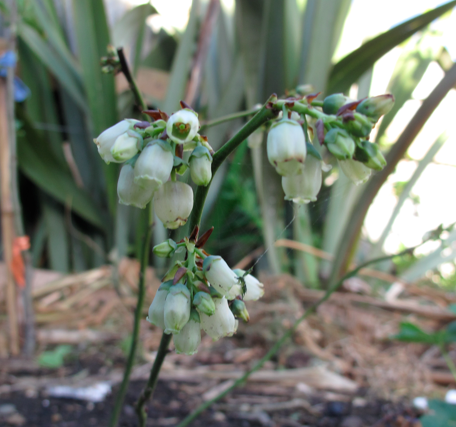
… as well as pear, nectarine, grapefruit, tamarillo, blueberry, and orange blossoms at the moment. 


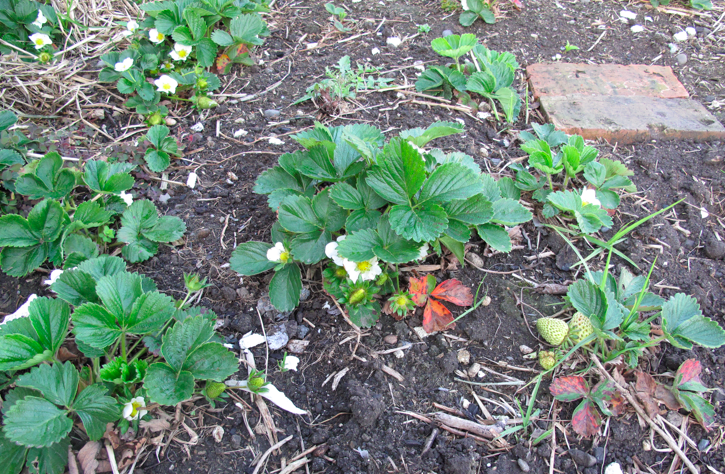
We have already had our first strawberries, and expect continual production from now through Feburary. 

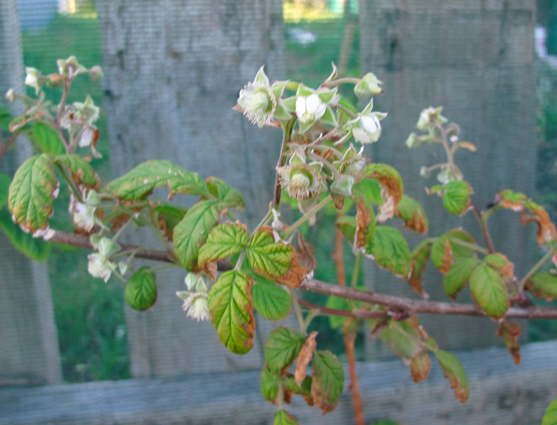
We also have raspberries fruiting, and should have grapes forming soon. 

This year we should get most of our fruit from our 700 m2 section, and next year we should get all of it. 
Regarding vegetables, I’d say we get most of them from our gardens. Although we have had trouble growing potatoes due to cylid aphid. Bear in mind that we started from pure sand, so growing large quantities of vegetables has meant building garden beds with topsoil and compost. We have been continually expanding our garden beds since we arrived less than 2 years ago, including a community garden in our front yard. 
– What is the area of your garden? 
Good question. I have not measured it, and have not intended to. My best answer is ‘big enough.’ 

– How do you keep the water in your garden (use mulch, thickness?)?
We use a combination of top soil (about 70 mm), compost, carbon (newspaper and cardboard), and a little hay/straw. When we sheet mulch, we use ample newspaper (free and abundant) but only enough hay to cover the headlines. This system has worked extremely well for us. Last summer we only had to water the garden once or twice. This would be unthinkable on sand. 

Peace, Estwing
More questions to be answered next week: 
-I haven’t seen such a clever idea for a sun cooker! What is the material of the shell (mirrors? Aluminium sheets?)? Would it be possible to have a draft of the cooker?
-Have you got a workshop in your house? Where did you supply all the tools you needed?
-How much did it cost for your whole renovation? What is your living area (you can include the Deck outside if ou want)?
-What would be your 3 main advices to renovate a house without spending too much money?
-What would be your 3 main advices for a low maintenance-productive garden (fruits trees, chicken moaner, mulch)?
-What were your main mistakes/issues during the renovation?
-How long did it take to renovate the house? (2010 to 2012?)?