Category Archives: Eco Thrifty Renovation

Double Century

The ETR blog reaches its 200th post today with a celebration of other local permaculture projects. As you are aware, we had the pleasure to host Nicole Foss and Raul Ilargi Meijer at our home last week.

Nicole gave a well-attended talk in Whanganui last week prior to the Australasian Permaculture Convergence in Turangi the 11th-15th of April. We went up to the convergence late on Friday the 13th and came home Sunday morning the 15th to prepare for a tour that we were hosting of local permaculture properties. On our way out of Turangi we stopped by a developing permaculture property called Awhi Farm where I built a frame three years ago for a cordwood structure.

The frame was the first permanent structure on the property which was an abandoned transportation department yard. We used trees from the site to make traditional timber frame mortise and tenon joints for the post and beam structure.

It is amazing what they have done on the property in three years, as is always the case with permaculture properties such as those on our Whanganui tour, including the Mount Saint Joseph Retreat Centre.

This was followed by a twilight visit to the Quaker Settlement, where there was particular interest in a top bar bee hive.

And a yum dinner of pizza, chili, ham soup, salad and real bread.

The following morning we were off to Kai Iwi and an excellent example of a permaculture market garden.

And then to Mark Christensen’s amazing heritage apple orchard, home of the world’s healthiest apple: the Monty’s Surprise!

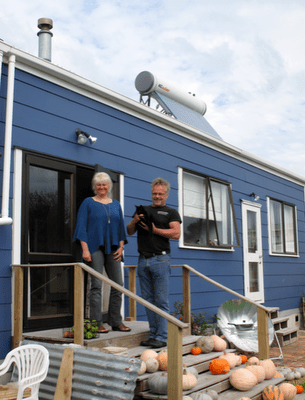
We trundled down to Castlecliff to look at the eco-thrifty renovation and then back into town for another twilight tour of the vertical gardens.

Our Australian, Malaysian, Chinese, German and Kiwi guests were amazed at what we have going on in our community. We have a lot to be proud of our local permaculturists. Good on them.
A note on some upcoming blog posts: The editor of our paper, the Wanganui Chronicle, has asked me to write a weekly column revisiting the steps we took during our eco-thrifty renovation. The column starts this Saturday and will run at least into August. I will post each column here as they come out. If you know of anyone who may be interested in the retelling of our story please pass along this information.
Peace, Estwing

TAE @ ETR

Huge props to Jiqiao for writing and posting on Tuesday all on his own with no editing from me. Where was I? I had to run to the bus station to pick up a couple of GFC (global financial crisis) analysis superstars, Stoneleigh and Ilargi from TAE (The Automatic Earth).


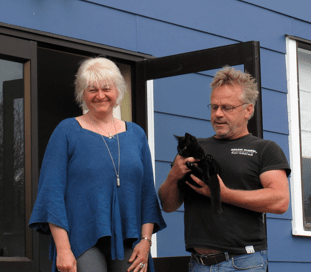
Their real names are Nicole Foss and Raul Ilargi Meijer, and they were kind enough to stop over in Whanganui on their tour of New Zealand. Nicole’s talk (Raul plays the role of stage manager, roadie, and background cynic) was well-received by an over-capacity crowd of nearly 70 at the Community Room of the Gonville Cafe/Library on Tuesday the 10th of April. (Luckily we had friends who brought in extra chairs and a PA system on less than an hour’s notice.) Those in attendance remained attentive through 2 hours plus, which included a lively Q&A session. We got home well after 10 and stayed up to nearly midnight chatting and playing with our cat, Billy T. James.

Were Stoneleigh and Ilargi star-struck by Billy T.? Who wouldn’t be?
We were all up at 7 the next morning drinking coffee, musing on the 200+ decline of the Dow Jones and… playing with Billy T. Fun was had by all and we consider ourselves lucky to have had TAE visit our ETR (Eco-Thrifty Renovation).


Peace and preparedness, Estwing

Having as much fun paving the floor as much I have learnt

Hey this is Jiqiao back to work! I have looked forward paving the floor for several weeks before I left to South Island. And it just comes true! Nelson and I have spent three solid days working on it from sorting materials, calculating, cleaning, paving and screwing. The work, however, is still not done yet-we need polish and apply a layer of oil to protect the wooden floor.
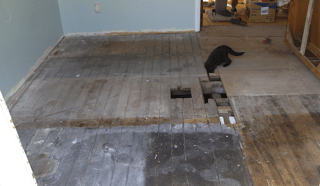
Here is what the floor look like before. The cat is playing on it with these holes. She jumped up and down, making herself dirty and having so much fun! But we do not unfortunately. The holes leave cold air coming through under the house. During the winter, this poor insulation means we need more energy to heat up the house. Therefore, paving the floor is necessary considering sustainability.

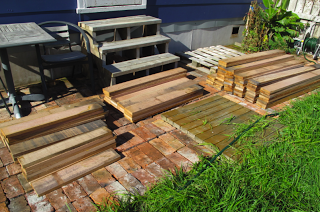
Guided by sustainable renovation principle, we bought all of our wood on auction from a door factory off-cuts with only $80 for 91 blocks of wood in long and short. Their length range varies from ~60cm to ~180cm. We sorted all of them in the yard by different length. This is important preparation to make sure that we know our resource well to make decisions and also help the following work goes smoothly. And indeed, it turns out that, thank to the sorting, our work on the first day was highly productive.


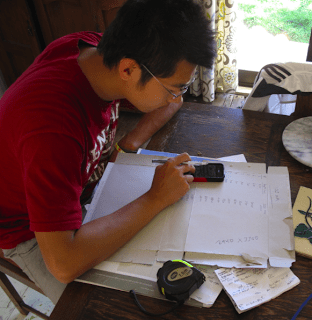
After sorting all boards well, we recored average length of each pile and number of boards of it. Then calculation helped us make decision and maximize material use. We were thinking pave the floor in the dining room, including areas under refrigerater and oven, and a part of the hallway. But we were unsure if there is enough wood. There comes necessary calculation. Knowing the width and total length of all blocks by adding average length of each pile up, I calculated that the maximum area we can cover is 14.7 square meters, which was just a little extra over the desired areas. This means we need to be conservative, as we always be, on cutting boards.

The way we figured out to maximize the limited materials was to try to match up a pair so that the least off-cut is needed. While Nelson was cutting the wood and pave indoor, I was measuring the length of each piece to match them up in pairs. This working pattern was very efficient. We started from one side of the wall to the center.

As I said the insulation is very important to save energy, this is a good example of conservative life and insulation. We put used rags in the gap between the floor and stove to stop cold air coming up. This idea first comes from those frugal monks. They use cloth to clean face. After it gets too dirty and old, monks use it to mop the floor. Then when it turns to real rag, monks use them for insulation like what we are doing now! They perfectly showed how reusing thing are sustainable and helpful. As we always believe, one’s rubbish can be the other’s cherish.


We were surprisingly lucy that all boards fits in well with work to reshape the wood. Then I started to screw the floor into the joist so that it is stable and quiet when people walk on it.


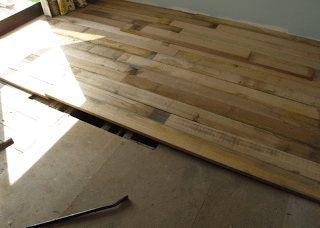
And here we go! Beautiful new floor even without sanding and polish. You get natural luxury, aesthetic appreciation, and good insulation for only $80! Such good deal can never be found if you are not a sustainable builder. By the way, all the off-cuts from saw were put in composed pile to fertilize the garden. I was impressed by the huge pumpkin from Nelson’s organic garden~
Soon we will polish the floor and apply a layer of oil on it so that the wood will last long. Recently the materials used in kitchen such as PVC are popular and fashionable, but never last longer than wood nor being healthy. Reduction of using such non-recycle material will also reduce carbon footprint. The wood floor, after many years, will get to old and by the time we can burn it, making it true that dust to dust, ash to ash.

With a Little Luck

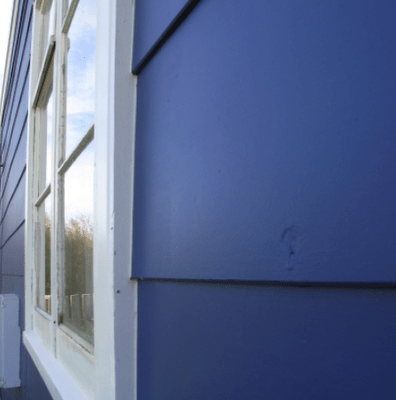
We’re due for our third weather bomb in five weeks (a fortnightly foreboding forecast). In preparation for this latest blow I was finishing up some scribers to insure that wind-driven rain would not get in beside our windows. In the picture below, the scriber is the lapped piece of wood that serves as Yin to the weatherboards’ Yang. Making scribers is very labour intensive as each one has to be individually measured and cut.

While I was putting the last coat of paint on the last four scribers, a song came on the radio that I’ve probably heard a hundred times before: Paul McCartney and Wings, “With a Little Luck.” Yeah, whatever, we could all use a little luck…but then I heard a line in the song I had never really noticed before. It leapt out of the melody and grabbed my attention.
The willow turns his back on inclement weather;
And if he can do it, we can do it, just me and you
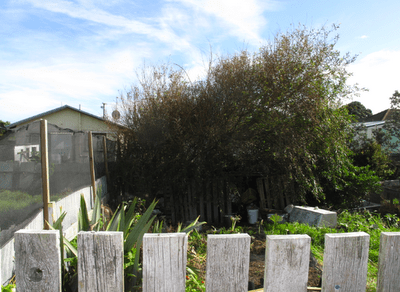
And I thought of the willow in the western corner of our section.
Unfortunately, due to the sun angle in this photo you can’t get the full truth and imagery of McCartney’s words. This tree grows on about a 45 degree angle, but still it is the tallest tree on our property. It’s survival strategy is to turn its back on inclement (love that word, especially in a rock ‘n roll song) weather. Perhaps the reason that line resonated with me more than ever before is that this has become my strategy for survival as well. This strategy takes a number of forms, from the literal to the figurative.
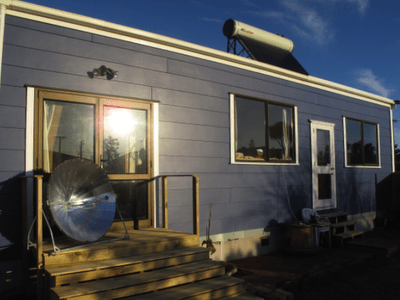
First and foremost, our home has be redesigned with its face to the sun and its back to the cold southerlies. (We added glazing to the north and removed glazing from the south.) Ironically, the smiling “face” of our home is our backyard and the “back” is the front door.
That’s OK, because much of our world is upside down now, it only makes sense to design for 180 degrees away from the status quo. That is another way of turning one’s back to inclement weather. In other words, it means saying “No thank you” to consumerism, debt, globalization, etc. Someone like Nicole Foss warns of a financial storm that will be a weather bomb of a different kind. Taking a lesson from the willow, one strategy is to turn one’s back to it. I don’t take this from a survivalist perspective, but more from a ‘Transition Culture‘ perspective.
I mention Nicole not just because of her message on The Automatic Earth, (she writes under the pen name, Stoneleigh) but also because she and her partner Raul (Ilargi) are coming to Whanganui next week to speak to our community.
I also mention Nicole and Raul because the name of their website, The Automatic Earth, comes from a Paul Simon song with the lyrics: “The boy in the bubble and the automatic earth.” I think that is cool, because they write about economic bubbles, debt deflation, etc.
As for us, we write about sustainable living, debt avoidance, low budget/high performance building/renovation and food production. We write about practical ways to turn one’s back on inclement weather of all kinds, be they weather bombs, financial tsunamis, volatile energy and food prices, etc. Perhaps I should change the name of this blog to, With a Little Luck.
Indeed, along with the best possible preparation for the challenges ahead, it will also take a little luck, and – as the lyrics below make clear – people working together. We are all about building community and I know Nicole and Raul put a big emphasis on that as well.
With a little luck, we can help it out.
We can make this whole damn thing work out.
With a little love, we can lay it down.
Can’t you feel the town exploding?
There is no end to what we can do together.
There is no end, there is no end.
The willow turns his back on inclement weather;
And if he can do it, we can do it, just me and you,

And a little luck, we can clear it up.
We can bring it in for a landing,
With a little luck, we can turn it on.
There can be no misunderstanding.

There is no end to what we can do together.
There is no end, there is no end.
The willow turns his back on inclement weather;
We can do it, just me and you.

Below you’ll find a series of images that show some of the recent ways we’ve been turning our back on “inclement weather.”
Peace, Estwing
Curing pumpkins for winter storage.
Biggest red onion I’ve ever seen. Go compost!
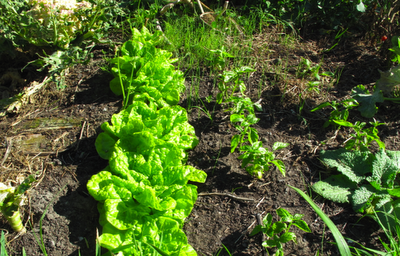
Salad greens awaiting Nicole and Raul.

1,000 litres of water storage.


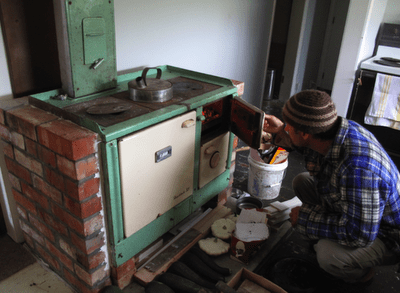
Inaugural lighting of Shacklock 501 coincided with a 6 hour power outage.


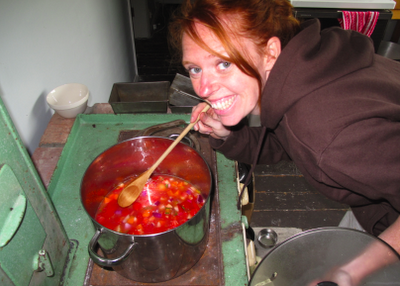
We baked 3 loaves of bread and made a huge vege soup to celebrate the power outage.

Voice in the Wilderness

Following Paul Brooks wonderful article in the Midweek about our Eco-Thrifty Renovation and the educational programmes we’ve developed along with it I got a short flurry of phone calls and an email. The result was that three representatives of Te Oranganui and one neighbour dropped by for a one-hour tour on a Tuesday morning. They were all grateful for the site visit and for the information I shared. I was happy to meet some new people and to demonstrate how we have managed to develop a warm, dry, energy-efficient home on a small budget. But by the afternoon I was discouraged when I was faced with the miniscule impact of our project when compared with what may be described as the carelessness (or thoughtlessness) of others.

As I rode my bicycle down Puriri Street and Alma Road at 4 o’clock on a brilliantly sunny day I noticed that every street light above me was lit. I would estimate that one hour of all of those lights burning would use more electricity than we use at home in a month. I have seen the lights on Cornfoot Street also lit during bright, sunny days on numerous occasions. Do ratepayers pay for that power? Is our community so wealthy that we can afford to waste energy like that? From what I understand there are about 90 million reasons we should be trying to reduce expenses in our city. The relationship between energy, finance and debt interests me greatly, and I feel quite fortunate to have the opportunity to host a world expert on this relationship in Wanganui on the 10th of April.

Nicole Foss has managed to fit Wanganui into her month-long speaking tour of New Zealand. She has had a busy schedule on the South Island, including talking to many Councils and a radio interview with Kim Hill in Christchurch. She has lectured on energy and global finance in hundreds of locations across North America, Europe, Australia and New Zealand. Her day job is Senior Editor of The Automatic Earth (TAE), where she and co-author and Editor-in-Chief Raúl Ilargi Meijer have been chronicling and interpreting the on-going credit crunch as the most pressing aspect of our current multi-faceted predicament. The site integrates finance, energy, environment, psychology, population and real politik in order to explain why we find ourselves in a state of crisis and what we can do about it.

While living in the UK she was a Research Fellow at the Oxford Institute for Energy Studies, where she specialized in nuclear safety in Eastern Europe and the Former Soviet Union, and conducted research into electricity policy at the EU level. She also has significant previous experience practicing as an environmental consultant.

Nicole will be speaking at 7 pm on the 10th of April at the Meeting Room of the Gonville Cafe/Library. Koha will be accepted to cover travel costs. This event is co-sponsored by The ECO School and the Sustainable Whanganui Trust.

Peace, Estwing

Am I Too Conservative?

I’ll admit that I am conservative. I like to conserve energy, conserve water, conserve money, conserve time and conserve effort. But am I too conservative?

Here is my little story.

I was pleased to hear a certain radio personality express his newfound appreciation for what climate change looks like on the day before the autumnal equinox. He went on to express another conservative opinion about the unsustainable debt held by many local councils. Again, I share his concern. Then he began to talk about another issue and the conservative stance the Green Party had taken on it. Three for three. Good one!

I called him up to congratulate him on his consistent conservative values and what I recognized in each case as the application of the “precautionary principle.” I had barely made my point when he vigorously questioned me on the third issue: the Green Party’s stance on fracking in Taranaki. From my perspective, the Green Party appears to be using the precautionary principle in its approach to fracking. This would appear to be a conservative position.

However, the radio personality accused me of something I did not catch because I was nervous talking on the radio. I suggested that international scientific research on fracking may be considered and that some data from the USA indicates problems associated with fracking. He insisted that no scientific data from anywhere outside of New Zealand should be considered at all. This would appear to be a radical position.

Then the radio personality said that a full, independent scientific analysis had been done to assess the effects of fracking around Taranaki and found no need whatsoever for any concern. He asked if that would be enough evidence for me. I told him that for me – being a conservative and supporter of the precautionary principle – I would seek a second opinion. This would appear to be a very conservative position.

The radio personality said “No, no, no.” For him a second opinion was not important. This would appear to be a non-conservative position. Then he hung up on me without even thanking me for my call or my compliment. What kind of a position is that?

Peace, Estwing


Eco-Thrifty Permaculture Tour April 16th & 17th

This could be the best value for money in all of New Zealand in the area of permaculture education. Sign up soon. Spaces are filling.

Five excellent, but very different permaculture properties in and around Whanganui.

When: 16th April 2 pm to 17th April 5:30 pm

Price: $100 with your own transportation. $140 with transportation provided. Includes dinner on the 16th and breakfast on the 17th. Please provide your own lunch. Price does not include accommodation. See below for information on accommodation and transport from Turangi to Wanganui.

Minimum number for participants: 10 . Maximum number for participants: 20

Registration required before 9th April with 50% deposit (20% non-refundable).

Contact: The ECO School, 06 344 5013; 022 635 0868; theecoschool@gmail.com

Each site is described below in the host’s own words.

Monday, 16th April 2 pm Mt. St. Joseph Retreat Centre

The property has a diversity of uses – a residence for three sisters plus the administration centre, a Retreat Centre, Archives, Hospitality area and a 45 bed Rest Home.

Interconnectedness, relationality, kinship and care are key words permeating our spirituality and our practice. Our vision is for “Fullness of Life for the Earth and her Peoples.”

We endeavour to be bicultural and support the aspirations of the tangata whanua.

The original Peat family homestead gardens have been added to over the years with a mix of surrounding shelter-belt edges, big native trees (totara, rimu, rata, kowhai) and some big exotic trees (redwood, pinus radiata, macracarpa). The southern steep hill is covered with regenerating bush. The eastern hillside is currently being developed as a rather extensive orchard and garden with planned for bird and bee forages. The western hill and valley is being restored as a small wetland. Walking tracks for the public and new native trees are being planted on the adjacent hill.

4:30 pm The Quaker Settlement, 76 Virginia Road, Whanganui.

This is the only intentional Quaker community in the Southern Hemisphere, now 36 years old. Sixteen households encircle the community buildings which are also used as a conference centre by diverse groups locally and nationally. The community of about 30 including children, care for the centre,and run an annual Quaker seminar programme, all on a voluntary basis. As a community we endeavour to recognise the diversity of life, its interdependence and balance, including our relationship with the environment. Much of the land was blown sand dunes which over time is developing into a treed landscape with native tree plantings, a Harakeke (flax) collection, orchards, sheep, chickens and ducks, and community as well as individual vegetable gardens.

Link about Quakers, and the Seminar Programme:

Tuesday 17th April 9:30 am David Aislabie

A network of different timber, nut and fruit trees with native shelter belts creates a mosaic pattern of highly productive “clearings”on this 6 hectare permaculture property. North facing slopes are terraced into permanent raised beds and clover paths (swales) growing a diverse rotation of certified organic vegetables and subtropicals (mainly tamarillos), irrigated via a windmill from runoff stored in 2 large ponds. Soil improvement features green manures and up to 50 tons of compost per year, made in straw yards where pigs and cattle graze.

Note: David took an early permaculture course in NZ and continued his market gardening with a new focus after that. It is one of the best established properties based on permaculture design.


1 pm Mark Christiansen

A 5 acre (2.2 hectare) property developed with a mixture of permaculture, organic and biodynamic principles. Begun 14 years ago as an edible landscape, it developed into a collection of heritage fruit trees, and then progressed into heirloom tomatoes and beans and other vegetables. A focus is on finding out what grows successfully in this area as well as on medicinal/nutritional qualities. Among the collection is the Monty’s Surprise apple, believed to be the best apple in the world for human health.

3:30 pm The Eco-Thrifty Renovation, Nelson & Dani Lebo

An abandoned, derelict villa on a section full of rubbish and weeds has been transformed into an energy-efficient home and fully installed permaculture landscape on 700 square metres in the 12 months ending November 2011. The energy performance of the renovated villa has been outstanding, and the food production (on pure sand) has exceeded expectations. The total budget for the project including purchase of the property, retrofitting and landscaping was under $100,000.

Additional Information:

Dinner, optional overnight accommodation and breakfast at the Quaker Settlement. Book you own accommodation: www.quakersettlement.co.nz

Getting to Whanganui:

Intercity Bus transport from Turangi to Wanganui

Book early through http://www.intercity.co.nz

Sunday, 15th April: Departs 3:15 pm and arrives 7:30 pm. Hotels and backpackers within walking distance of bus depot for overnight accommodation. Book through BBH or YHA.

OR (Better)

Monday, 16th April: Departs 10:45 am and arrives 2 pm. We will pick you up and take you to the first site visit and onto the accommodation venue. We will take you back to the bus depot or nearest accommodation at the conclusion of the tour. Please note there is an extra $40 fee when transport is provided.

A Buddhist Perspective on a Permaculture Perspective

A Buddhist Perspective on a Permaculture Perspective on Science Education.

During my adult life I have come across two perspectives that have greatly helped me make sense of the world: Buddhism and permaculture. Neither were particularly valuable in teaching me new things, but rather in affirming the things bouncing around in my head already. When I first started learning about each of them I found myself nodding in confirmation, and awed at how someone else had written so thoughtfully about the thoughts I had been unable to articulate as lovely as they had. I was not alone after all!

Schumacher College in Totnes, England played a key role in my education on these perspectives. It was in the dining room there I met Bill Mollison over a cup of tea (not knowing who he was), and in the library that I read extensively on Buddhism for the first time. Not only did each perspective help me understand the world better, but each one also helped me understand the other. I could see Buddhist themes in permaculture and permaculture themes in Buddhism.

While I won’t go so far as to compare Bill Mollison or David Holmgren to Siddhartha Gautama, I will note that, from my observations, the stories that many permaculturists tell about their ‘discovery’ of and ‘conversion’ to permaculture as similarly transformative. I will also note my belief that the Shambhala Prophecy holds special significance for those permaculturists interested in getting permaculture ideas into their local schools.

The Kingdom of Shambhala is not a geopolitical entity. You cannot find it on a map. It exists only within the hearts of the Shambhala Warriors, who will arise at a time when the Earth is in terrible danger. During this time powerful forces will lay waste to the land and sea with technologies previously unknown. At this time, the Shambhala Warriors arise and enter the halls of power with only two weapons: compassion and a recognition of the interconnectedness of all things.

In the context of permaculture, compassion represents the permaculture ethics and a recognition of interconnectedness can be described as systems thinking. In the present context, schools are the halls of power where compassion and systems thinking have the potential to bring about profound transformation for both teachers and students. At present, most schools are largely transmissive in their approach to education, which simply acts to reproduce the existing unsustainable culture. There are many reasons for this, and the Shambhala way is to strive to understand the condition of schools and teachers in order to transform education.

The first step is to embrace the idea that schools are for student learning. The second is to recognize that – as have education researchers worldwide – the teacher is the chief factor in student learning. The third is to agree that students learn best when learning is relevant and experiential. The fourth is to recognize that many teachers fail to embrace relevance and experiential learning because of pressures ranging from time constraints to national curricula to testing. When a classroom door closes, the teacher alone determines how the time is spent, and if they feel overwhelmed with the status quo then they will be unlikely to take on anything new such as sustainability. Unless, of course, someone comes along to help them with compassion and a systems perspective. This can be the role of the permaculturist interested integrating permaculture ideas and practices into their local schools.

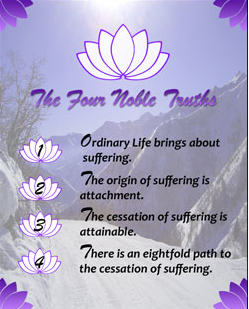
Based on three and a half years of doctoral research after 16 years as a teacher, I submit the following as one possible permaculture approach for junior secondary science. Please note that the underlying emphasis to this approach is that the teaching and learning of science can be improved by making it more relevant and experiential by engaging local individuals involved in the practice of permaculture. Continuing the Buddhist theme, I present this approach in two pieces akin to the Four Noble Truths and the Eightfold Path.
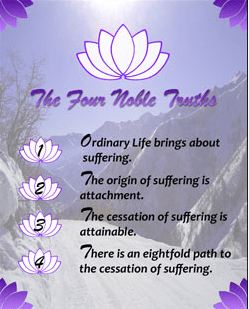
They are the Five Fingers of a Permaculture Approach and the Eight Key Principles.

The Five Fingers of a Permaculture Approach to Junior Secondary Science: permaculture design as means, not end; the transformative nature of permaculture; the science behind permaculture practices; permaculture practitioner as citizen scientist; and, field trips to permaculture properties. It is not that these five characteristics are unique to permaculture, but that all five fall under the permaculture umbrella. There are other ecological design systems and other transformative learning experiences. There are other citizen scientists and other valuable field trips. Through my research I have identified these five ways in which permaculture – as a distinct, well established, international movement – can be used to help improve the teaching and learning of science and to cultivate perspective change in both students and teachers.

The Eight Key Principles: making science relevant; applied science; student-centred teaching and learning; experiential learning; emphasizing interconnectedness; affective experiences; taking actions for the environment; and transformative chronology. These principles do not come from permaculture, but from the rest of my theoretical framework: scientific literacy, ecological literacy and transformative learning theory. These are the key principles for pedagogies that help to improve scientific and ecological literacy and encourage perspective transformation in students. These key principles can be applied independently of permaculture, but in this case they are believed to enhance the Five Fingers of a permaculture approach described above.

On a final Buddhist note, by not trying to teach permaculture there may be a greater uptake of permaculture ideas by students and teachers. This less-is-more approach may appear paradoxical, but that is the nature of Buddhism. Improving scientific and ecological literacy in students while they are in school may lead to adult learners who pursue permaculture naturally and effortlessly. You can plant a seed but you cannot make it grow. You can, however, add compost.

I will be presenting a detailed description of the Five Fingers and Eight Key Principles on the 14th of April at the Australasian Permaculture Convergence in Turangi, New Zealand.

Peace, Estwing
Sustainable Shed

Hi, I am Jiqiao….
Nelson and I worked on this shed for two days from setting all the materials up to putting the rubbish back into it. I have learnt not only having the idea to reuse rubbish but also the damages caused by sun, wind, and rain. To live sustainably, we are supposed to maximize the usage and also, sometimes ignored in such case, the durability of everything. Though this shed is made of all second hand materials, it does not necessarily mean it could be casual and weak. The shed is designed to prevent from wind and rain damages in efforts as much as we can think. You could explore all these details from Nelson’s previous blog.
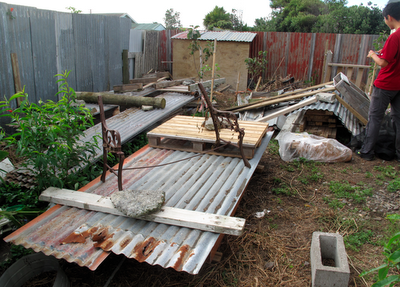
And I really enjoy the neat garden which used to be the following picture…I was looking at those piles and wondering how much painstaking work had to be done to clean them up.
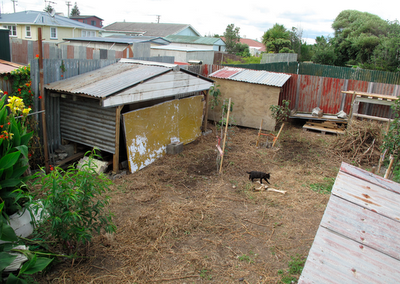

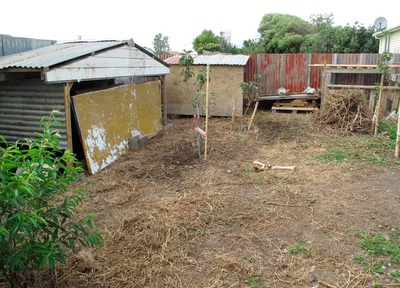
Now we just play a magic! It looks much more comfortable. We also pulled out some weeds while cleaning them up. Most of iron pieces and wood blocks are organized and stored under the shed, and those rust or small pieces were put outside prepared to be recycled.

The cat is playing with bones on the ground~

In the winter grasses will be planted in the yard so that it will also turn to green as other parts of the yards. And other parts of the yard will also be as neat as this one! 🙂
And most importantly, I really appreciate this great opportunity Nelson provides for me! I will be on South Island next month and come back to have some more exciting work!

Truss-Worthy

Eco-thrifty renovation, eco-thrifty gardening and eco-thrifty living are not formulaic. Although we can offer design principles, guidelines, and methods the application of E-T is always through the eyes of the individual. E-T, like permaculture, is a way of seeing. Mostly it is a way of seeing possibilities. It involves a vision to see something beautiful or practical emerge from something that someone else has thrown away. For example…

… last Thursday Jiqiao and I set about converting a pile of reclaimed lumber

… and some partially rotted trusses…

… into a usable shed.

Of the six trusses that had been left on our property when we bought it a year and a half ago, we were able to use three as trusses but the other three we stripped to use as purlins…

… and for the nail plates.

Peeling off the nail plates and pounding them flat for reuse takes time, but saves money and saves the manufacturing wastes of making new nail plates. It is a perfect example of eco-thrifty vision.

But just because something is built of salvaged materials does not mean it should not be meant to last. Of particular concern for the durability of any wooden structure is moisture. Wooden structures need a good hat…

… and good boots. While roofs can be fairly straightforward, foundations offer some challenges regarding ground contact and water wicking upward through materials including concrete and the end grain of wood (think xylem and phloem). The eco-thrifty solution I applied to this potential problem is a modification of a technique I used to use on my farm.

Choosing a concrete block for the foundation, I used the hole in the middle of it as a mortise that will hold a tenon in the bottom of the post in place. For the tenon, I used two pieces of H3.2 off-cuts of treated decking timber. When working with small pieces of wood it is helpful to pre-drill holes for nails otherwise the wood is likely to split when driving a nail through it.

I nailed the H 3.2 treated “foot” onto the bottom of the H 1 4×2 in two steps: first through the “plate” (pictured) and then through the smaller tenon (not picture).

And then the three pieces of wood are set in place.
By the end of the day we turned a pile of rubbish…

… into a weather-resistent shed in which we can put the rest of the rubbish. (If it fits.)

I slid the long sections of the three trusses we stripped into the top of the shed…

… and did some sheet metal origami to keep out wind-driven rain.
For a days work and the cost of a handful of roofing screws we have a shed that measures 4 meters by 1.4 meters. Easy on the Earth and easy on the wallet.
Peace, Estwing