Category Archives: Eco Thrifty Renovation

Local Currency Rocks!

Over the past few months the global economy has ridden a roller coaster ride of spiking and easing prices on everything from oil, to currencies, food commodities. While this has led to lack of confidence in major economic systems, it has also led to rising interest in Local Exchange and Barter Systems and Alternative Currencies.

We are fortunate here in Wanganui to have a local currency system in place. Our local currency is called the River Exchange and Barter System, or REBS for short. Our network is made up of 162 members who offer a wide range of services, from childcare to gardening to electrical work. The network averages over $3,000 worth of trades per month with over $200,000 in trades occurring since the system’s birth.

Local currency is one key way of building resiliency in a community. It helps community members realize the wealth of services available locally, and also helps identify community weaknesses. We seem to have a glut of gardeners in our system, but no plumbers. We work hard to support the REBS system by allowing our workshops to be paid for in REBS and using those REBS to then buy food and other goods at the market. It is a definite win-win.

I thought I might give a glimpse at some recent news stories that centre on alternative currencies and local exchange and barter systems.

Here’s one from the New York Times:

Amid Recession, A Return To Bartering
The New York Times – December 8, 2010.
“The concept of bartering often conjures an aura of myth: Jack’s storied magic beans,… [but] in the wake of the recession, bartering has captured a renewed interest among the cash-strapped or habitually thrifty… The hope is that not only will people benefit from an experience achieved through cashless means, but that they’ll also widen their career circles as well.”

And another from the U.S.:

Slow Money’s Gaining Momentum
The Concord Patch – February 1, 2011,
“Imagine if you could buy a cup of coffee from Starbucks in your town at a discount with local community money…The concept of local dollars isn’t new and was used briefly during the depression to stimulate spending in local communities. Slow Money, founded by Woody Tausch, is modeled on the 20-year old slow food movement and promotes investing in small food enterprises and local food systems.It also focuses on connecting investors to their local economies…”

And here’s one from across the pond:

Totnes: Britain’s town of the future
The Guardian – Sunday 6 February 2011
“Totnes in Devon might be the most forward-thinking eco settlement in the world. As fossil-fuel reserves dwindle and the economy contracts, will resident-led Transition Towns become the way that we all live?
…A local currency is central to the Transition plan. ‘Think of a leaky bucket,…any time we spend money with a business that’s got more links outside the community than in it, we leak money from the local economy. What local currency does is allow that wealth to bounce around in that bucket.’ “

And talk of a regional currency right here in Austral-asia. Not quite an alternative currency, but interesting nonetheless:

Businesses keen on common economic zone
“Many New Zealand businesses think the idea of a trans-Tasman currency and economic zone is hot… MYOB’s business monitor surveyed over 1000 local businesses on possible policies ahead of this year’s election and the concept of a common economic zone and currency with Australia garnered one of the most surprising responses…Forty-two per cent of Kiwi business owners surveyed were in favour of the concept”

And finally the local currency system developed by some creative youths in the U.K.:

Fruit is becoming ‘alternative currency’ in youth prison

The Independent – Monday, 31 January 2011,
“Children in young offender institutions in England and Wales are often given poor-quality food, leaving some so desperate for healthy meals that fruit has become an alternative currency in one prison…Young offenders are able to purchase additional food, including bags of fruit, from prison shops… Some boys bulk-buy fruit and exchange it for phone cards.”

Perhaps the end of summer is not the time to set up a fruit-based exchange system, with peaches and nectarines in surplus right now. But during the winter I could see this currency rivaling REBS in value. Happy Trading!

@font-face { font-family: “Times New Roman”; }@font-face { font-family: “Arial”; }p.MsoNormal, li.MsoNormal, div.MsoNormal { margin: 0in 0in 0.0001pt; font-size: 12pt; font-family: “Times New Roman”; }h2 { margin: 12pt 0in 3pt; page-break-after: avoid; font-size: 14pt; font-family: Arial; font-style: italic; }a:link, span.MsoHyperlink { color: blue; text-decoration: underline; }a:visited, span.MsoHyperlinkFollowed { color: purple; text-decoration: underline; }table.MsoNormalTable { font-size: 10pt; font-family: “Times New Roman”; }div.Section1 { page: Section1; 
Tubbin’ Tomatoes Update

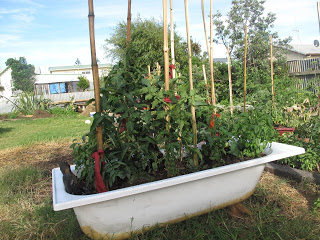
Well the water excess water has drained out of the bathtub and the tomatoes are rocking along. It is amazing to see plants we thought might not make it spring back to life. We used bamboo split into quarters as stakes. Currently, these tomatoes are looking like they are going to be some of our most productive plants. Interestingly enough, one of Nelson’s composting experiments seems to have emerged from the flooded tub… Are those the boots of the intern that went missing?!
-John the Intern

One Part Clay Three Parts Sand… Oh Yeah, and a Wood Burner.

The coveted backyard oven completes any permaculurist’s garden much like a gazing ball counters the bleakness of a properly manicured lawn. The oven melds the flavors of a garden the same way a gazing ball reflects the finely shorn grass upon which it sits. Crisp and defined, preferably with a thin crust and lots of cheese.

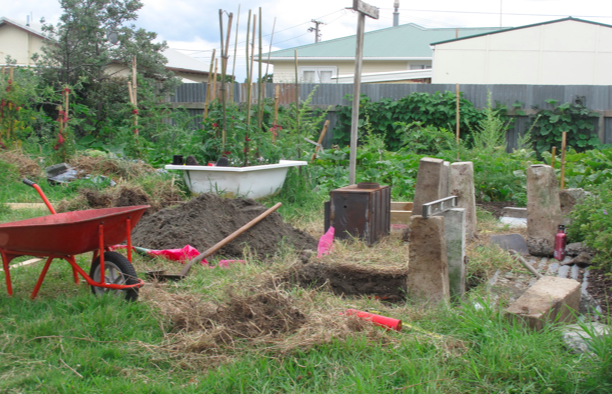
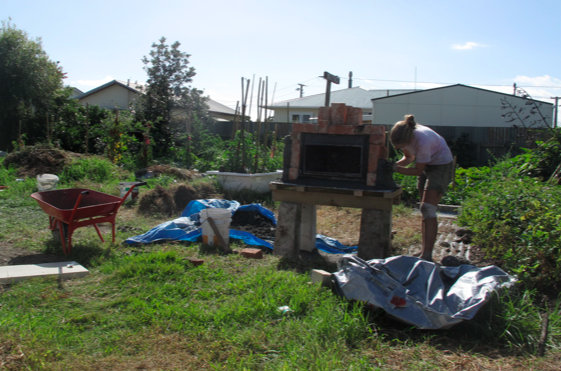
Designing one of these creations is a contentious and debated topic, much like choosing the color of your gazing ball. Blue or green? In either case, neither ornament is completely permanent. I like to keep a large selection of colors in my garage to reflect the type of day I am having. In the case of the oven, none of the materials are permanently fixed, so they are quite easy to take apart and rebuild should problems arise. This being said, we built a permanent base to hold the weight of the oven and any future modifications. It is important to choose a location that fits the site. Our oven is located far enough away from the house avoid smoke sparks becoming a hazard to anyone inside, yet close enough to the kitchen door to provide easy access to a cook carrying food to and from the house. We also faced the oven door away from the prevailing winds so the oven will not lose too much heat when the door is opened.

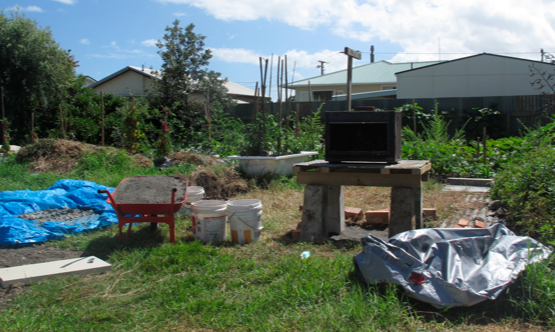
We began building by excavating the lawn under the oven. Then four concrete posts, scavenged from a pile left in the back corner of the lot, were placed into the excavated rectangle, squared up, and leveled.
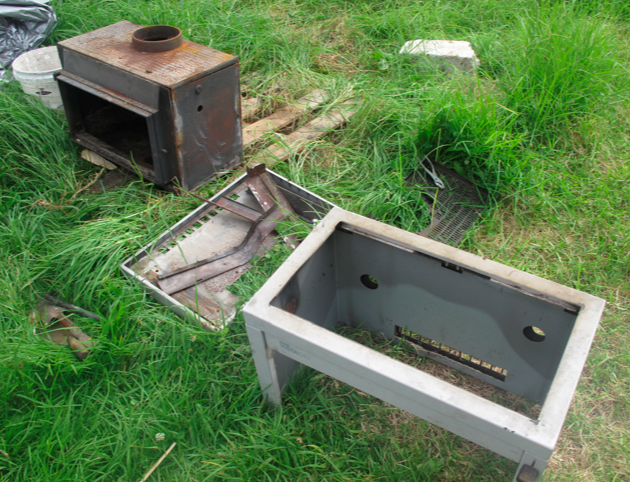
On top of the posts, we placed a frame of treated wood, covered with a sheet of old roofing iron. Many people build foundations out of stone or bricks to resist heat and insulate the oven. So far the wood frame has held up fine, and the space under the oven is a great place to store wood, fire tools, and a tarp to keep the rain off. After making the frame, we were ready to begin creating the oven.My quick Google search led me to the conclusion that earth oven construction seems to be plagued by many ailments. Cracking and collapse are common, and problems that affect one builder do not affect another. Also, it is difficult to find a standard mud recipe, let alone recommended shapes and dimensions. In our search to find the perfect design, we decided to use an old wood burner as an interior frame for the oven. Although boxy, the iron structure provided a solid the frame that mud lacks, including a tight fitting door for efficiency. The wood burner required that the exterior paneling and air intake be stripped off before the iron firebox could be used.
The firebox was set into a layer of mud on top of the iron, stabilizing and insulating the box from the bottom. The firebox was then surrounded by a layer of bricks to provide thermal mass.
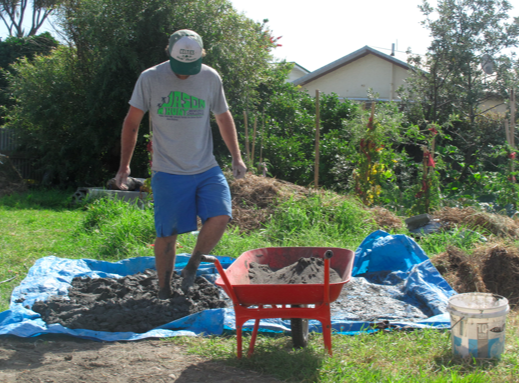
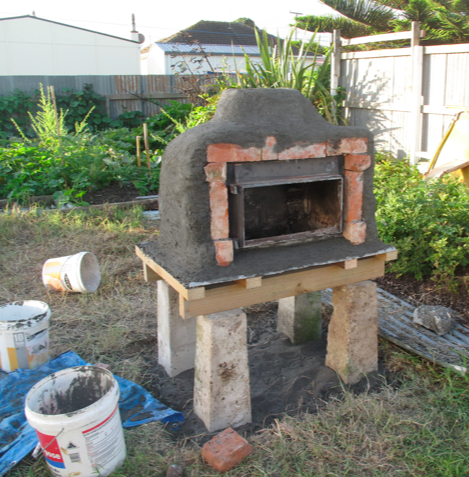
Two layers of mud were placed around the bricks. This layer held everything together and insulated the bricks and firebox. The first layer of mud we decided to use was a mixture of three parts sand to one part clay with a small amount of chopped straw added to form a cob mixture. We mixed the mud with our feet in a tarp, adding water until the mud reached a formable consistency and could still hold its shape.
The first layer of mud was formed into soft cubes about 100mm wide and stacked tightly around the bricks. We tried to apply the mud evenly around the oven, allowing areas to set up a little before continuing to build upward. We surrounded the entire oven with this layer except for the front, to allow the door to function properly.
The second layer of mud was made up of three parts sand to one part clay, with a lot more water added to form a plaster-like consistency. This layer was applied in a 20mm think layer over the first, to even the first layer and provide a smooth, aesthetically pleasing finish.
At this point the oven was smoothed over with a trowel, covered with a tarp, and allowed to dry slowly over the next three days.
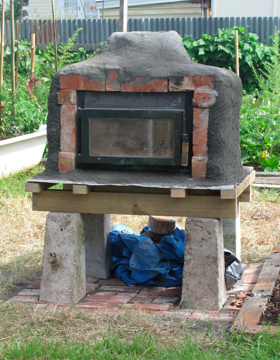
By Saturday, the oven was dry enough to start a small fire in the morning to finish the drying process. After some time, we added more wood to heat the oven up for pizzas in the afternoon. Everything seemed to work fine.
We saved some mud mix from the main part of the build to repair a few cracks as well as build the chimney a little taller and reduce its diameter.

Happy Eating!
-John the Intern

Attention to Detail

Dedicated followers of this blog will recall that we have seven design principles guiding us, six of which we have posted on so far: solar gain, thermal mass, insulation, reduce, reuse, and recycle. In our video, Introduction to Passive Solar Design we mentioned the importance of draft-proofing but we have not blogged about it yet.

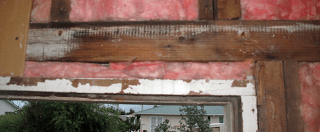
Now that we have passed our pre-line inspection and are ready to put up plaster board, it would appear to be a good time to write on this subject as some of the draft-proofing will disappear behind the Gib. As you can imagine, most drafts come around doors and windows. In order to have a tight, energy-efficient home it is critical to pay attention to these areas.

Insulating the gap between the door frame and lintel.
Because it takes extra time to do a thorough job, some contractors will skimp on this to save themselves time and money. If you have a contractor working for you, insist that they show you all of the insulation and draft-proofing around doors and windows before they cover it up. This is critically important for an warm, dry, energy-efficient home.
Expanding foam concealing “window worm.”
Fortunately, the New Zealand building code is very clear about insulating and sealing around doors and windows which is inspected before the Gib goes up. The code calls for the use of foam tubes (“window worms”) and expanding foam. While these products in and of themselves are neither eco nor thrifty, the use of them will ensure a high-performance dwelling. As we are renovating a 100 year-old villa, we find extra gaps in some unexpected places.
Sealing a gap at the bottom of the wall where the match lining was removed.
Unraveling the worm.
It’s all about attention to detail.
Peace, Estwing

R-E-C-Y-C-L-E: Find out what it means to me!


Earlier in the blog, Nelson introduced the six principles that he chose to employ in the eco-thrifty renovation of his Castlecliff home. One of the principles not yet discussed is Recycling, and due to a recent recycling frenzy at the house, he’s asked me to share the full experience with you all.
First off, let me preface by saying that recycling is the last step in dealing with materials from the renovation. Unlike the common perception that recycling is a really green way to get rid of extra materials, reusing or repurposing them on-site is really the ideal first step. All things have “embodied energy,” or a long story of energy inputs from their growth, manufacture and transport to their present location. For that reason, we’ve been attempting to keep as many materials on-site as possible to minimize waste and maximize efficiency. For example, we’ve been stockpiling boards torn from a dilapidated deck to reuse as lumber for a shed or firewood, and old roofing iron is used to cover wood piles and for all sorts of other projects.

We’ve managed to divert about 95% of the materials from the site by reusing them or selling them to others who can use them. We found an old hot water heater that doesn’t jive with our new solar hot water system, but that didn’t mean we brought it to the dump. First, some resourceful thieves discovered that the inside contained valuable copper, and then we found insulation that could be reused and stuffed into our ceiling.
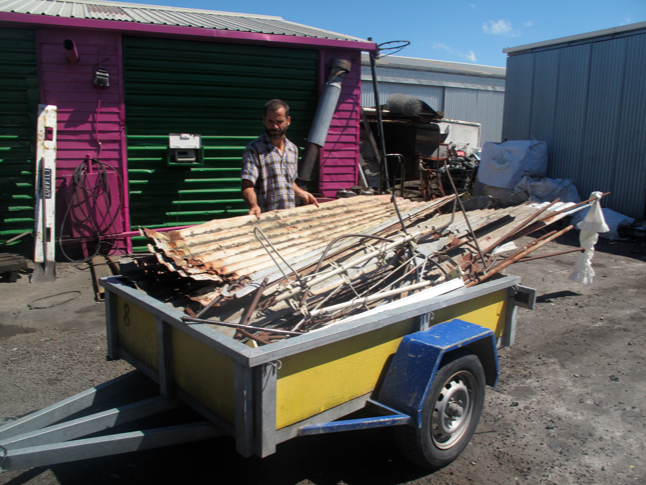
Finally, we were left with the galvanized shell of the heater, a worthy candidate for the recycling center. Other things discovered in every nook and cranny on the property were also prime subjects for the scrap yard. Rusty iron bars and twisty pipes, bicycle parts pulled from the depths of the agapanthus hedge, bits of lead, a car battery, and corroded, scrappy roofing iron were all gathered up and loaded into our little rented trailer for the ride of their life.


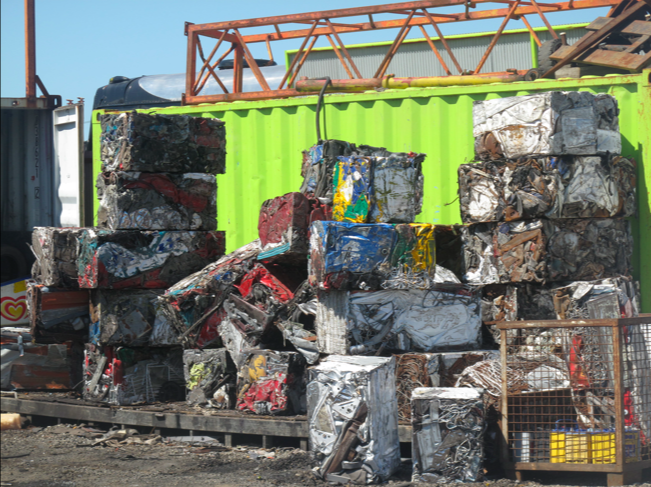
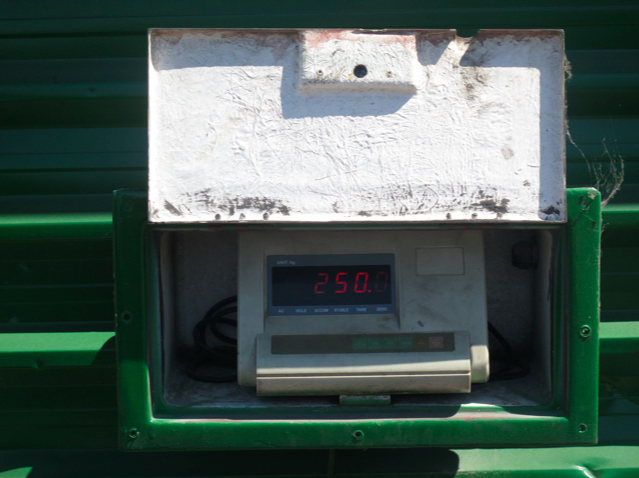
We brought two full loads down to the recycling center, a wondrous place with bales of aluminum cans, mountains of refrigerators, and a bright purple car that sits on top of the office, a beacon to all who pass. Our first load was transferred onto a great scale and rounded out at a healthy 250 kilos. The second round was 165 kilos, making a grand total of 415 kilos of scrap metal gleaned from our yard.

Since most of the material was iron, it was all bulked together for a single price per kilo, with the exception of the valuable battery, a lucky find. We left the recycling center with over $100 in our pockets, a spring in our step, and peace of mind that we’d once again diverted quite a load of material from the landfill.

– A. Lamb Down Under

Being Eco, Thrifty and Conservative

Yes, solar hot water represents a sizable investment. Indeed, it is the second largest cash outlay for this project, just below the cost of a new roof and just above the cost of all of the insulation (walls, ceiling, and under-floor) combined. Beyond that, these three items represent over half the cost of the entire renovation. But I submit that money is well spent in terms of being green, penny-wise and cautious.

Eco (Being green): Sustainability for the long run means having a structure that: 1) won’t fall down; 2) is water-tight; 3) costs little to heat and cool. The new roof addresses the first two of these three by keeping water out of the wooden frame to ensure durability. The insulation and solar hot water satisfy the third criteria.
Thrifty (Being penny-wise): Economic sustainability means investing in systems that will persevere. As a comparison, I offer the boom and bust economic cycles of “bubble” investments that we’ve witnessed over the last few decades. These are patently unsustainable and risky. In contrast, our solar hot water system offers about a 7 year payback period which translates to a 10% annual return (banker’s rule of 7). As energy prices continue to outpace the rate of inflation, that payback period shortens and our virtual “rate of return” increases. The same can be said for insulation, although I don’t know the specific payback period.

Conservative (Being cautious): As energy prices continue to rise, not only the cost of heating and cooling will rise, but also the price of all materials made using energy. This include virtually everything we buy: food, clothes, insulation and iron roofs. Buy purchasing the highest quality roofing material and coating, we are hedging against future price rises. In other words, our roof will last longer than a cheaper one and not need to be replaced as often. This will save on both future materials and labour costs.

This is not a flash reno nor a “Grand Design.” On the contrary, it is patently humble. But by investing in high quality, durable, energy efficient products, we are able to be eco, thrifty and conservative. Come to think of it, this is all about being conservative: conserving energy; conserving resources; conserving money. You’d think we vote National (NZ) or Republican (USA) with our extreme conservatism!

What will it take to get John Key and John Boehner to embrace these types of conservatism too?

Peace, Estwing

Solar H2-oooohhh

Renovations are all about upgrades, whether its a new paint color or a fresh counter top. Here at 10 Arawa Place, we have just gone through a major upgrade – the installation of a new solar hot water system. After Nelson tossed out the old tank, we have been heating our hot water in wine bottles placed in a box with a glass cover. While the temperature of the water in the wine bottles has been reaching 40 degrees Celsius, we only have enough space in the box for just under five liters. All you minimalists out there are cheering right now, but after a hard days work it’s just not enough water to get the grime out. Especially now that there are four of us living in the house.

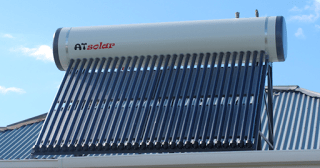
Step in Allan and his AT Solar hot water system. This roof mounted device uses glycol filled evacuated glass tubes to collect and transfer the suns heat energy into the 240 liter tank above. 240 liters delivered at fifty degrees Celsius! whooohooo! Although the system represents a significant investment, it is delivering an ample amount of hot water at a fixed price, relieving worries about energy price fluctuations, lowering the monthly electric bill, and it is a great example of a green technology at work.

Conveniently Dani and Nelson were both in town all day on the day the system arrived and had to be mounted on the roof. Luckily I was around to hold down the fort. After several failed attempts of climbing up onto the roof with the delicate system perched on our shoulders (picture attempting the most difficult rock climbing move you can image, synchronized with a Kiwi bloke on a ladder 2 m away, while carrying a mildy heavy majorly awkward object), Allan decided to call on a buddy. This buddy arrived with a pair of stumpies and a mini-crane. By the time Dani and Nelson arrived home everything was under control.

Putting together an entire solar system? No sweat. Just another day in the life of an intern.

-John the Intern

Partnering for the Planet

The ECO is all about cultivating and nurturing beneficial relationships: in nature and in human society. We are pleased to announce that we have partnered with Sustainable Whanganui to design and deliver professional development training in Education for Sustainability for teachers in Wanganui and the surrounding areas. We are excited about this opportunity to deliver these highly innovative programs right in our own community. If you are interested in us bringing programs to your community, please contact us at theecoschool@gmail.com.

Professional Development – Primary Teachers

This innovative offering provides primary teachers with the skills and confidence to embrace education for sustainability in their classrooms. It takes a multi-disciplinary approach across the learning areas and addresses many of the values, key competencies and principles of the New Zealand Curriculum. And best of all, it is designed to be responsive to teachers’ needs. The program includes two professional development sessions and one classroom session specifically designed for each participant.

Professional Development – Intermediate and Secondary Science Teachers

This innovative offering has two tracks: biology and physics. Each one focuses on the science of sustainability by linking science topics to a local sustainability initiative of The ECO School: The Eco-Thrifty Do-Up. The physics track focuses on the physics of passive solar design and energy efficiency in the home. The biology track focuses on ecological landscape design and the biology behind organic gardening strategies. The program includes one professional development session for each track and a field trip for each participating teacher’s classes to the project site or a PowerPoint slideshow if transportation cannot be arranged.


Peace, Estwing

It’s all Academic

I just pretend to be a builder/farmer/educator. My real identity is as mild-mannered graduate student. My research seeks to explore ways in which permaculture can be integrated into secondary science classes as a way to enhance students’ scientific literacy, ecological literacy, systems-thinking skills and attitudes towards learning science in school. I am lucky enough to be researching through the Centre for Science and Technology Education Research (CSTER) at the University of Waikato.

Not only are my research supervisors fantastic, but my chief supervisor, Dr. Chris Eames, thought it may be a good idea to plant a community garden for the CSTER in the middle of a campus otherwise consisting of concrete towers and asphalt parking lots. We first planted the garden on September 21st, 2009.

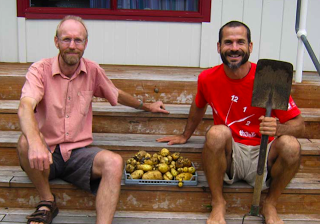
Almost a year and a half later, we have expanded the garden and harvested tomatoes, beans, corn, basil, corgette, aubergine, chilis, lettuce, silverbeet, and…

…SPUDS!

Here’s to the best PhD supervisor ever. Thanks Chris!

Peace, Estwing

Exterior Paint Choice

Two weeks ago there was a major storm forecasted, prompting us to think about the weather-tightness of our house. Buckets were placed in the attic under suspicious looking spots, and moved later when leakier spots appeared. But the roof wasn’t the only spot that needed a little TLC.

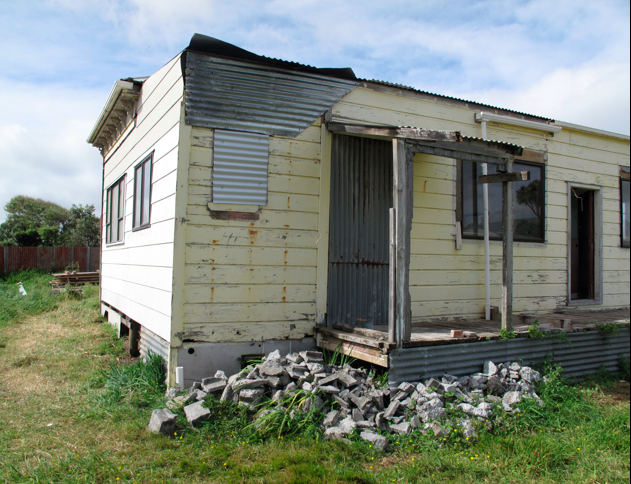
When we first bought our house, the view from the back looked something like this:

We then upgraded the doors and windows and the view became a bit more presentable:

But, the hardieplank remained bare and the sills and facings stayed off the windows as more pressing projects grabbed hold of our attention. Suddenly with a storm approaching, the window facings jumped to the top of the priority list. But, before we could put the facings up, we wanted to paint the hardeiplank underneath and around them. This way we wouldn’t have to go back when the facings were up and try to make a nice neat edge. So what did all this mean? It meant that it was time to buy exterior paint. Wahoooo!!!

We had been thinking about this day for a long time. Debating over the subtle differences between Oneroa, Selwyn, and Blue Knob (I kid you not, that’s a paint color, and we almost bought it). The Placemakers giftcards we received from my Aunt Katy for our wedding, had been set aside for this very purpose, and they were burning a hole in our wallet.

So off we went, and paint was bought. What color scheme did we decide on? Here’s a little mock up, Oneroa for the house, Lake Camp for the gingerbread, and our trim will be pure white:
After we purchased our paint I came home and crunched a few numbers in terms of the environmental and financial impact of our choice, Taubmans Sun Proof Max Latex Exterior Paint. I know, I know, I probably should have looked at these things before we purchased almost $200 in paint, but I got excited, and we had gift vouchers.

So it turns out that we didn’t do too bad on either front.

As always, it is good to shop from local companies who support ethical trading principals and service. A major factor contributing to the sustainability of the paint itself is how long it lasts, so it is important to choose a paint with good weather proofing capabilities. Also, Latex paints, like the one we bought are much better for the environment in manufacturing, cleanup, and off-gassing than oil paints.

The off-gassing of volatile organic compounds, or VOC’s, has been a major conversation for the past few years amongst the paint industry and environmentalists. This is because VOC’s can contaminate soil and groundwater, the vapors of VOC’s react with nitrous oxides to form ozone in the lower atmosphere whihc is harmful to both animals and plants, and VOC’s also prolong the life of methane in the atmosphere – a greenhouse gas contributing to global warming. Oil paints can have up to 400-500g of VOC’s per liter, and traditional latex paints can have 200-300. Paints labeled “Low VOC” must have less than 100g/l and there are even “No VOC” paints available.

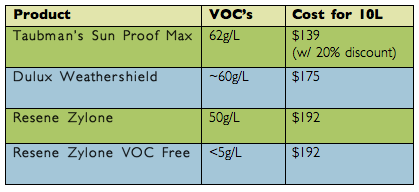
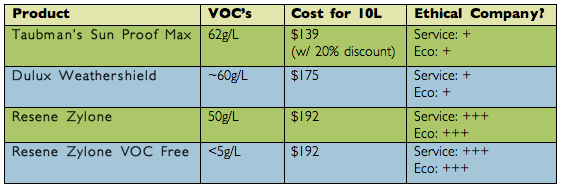
After purchasing our paint I did a comparison of other comparable paints, all latex weather proofing paints of a similar gloss. And here’s how it came out:

So basically, for $53 more, we could have gotten a No VOC paint, that is comparable to the one we chose, from a company with much better eco and social practices. Given that we will need about 3 buckets of paint, this translates into over $150. Is this a thrifty trade-off we should have made for the sake of the environment? I’m not sure. That $150 is a significant amount that could be put towards upgrading to an Energy Star appliance, or another project on our never ending list. And 62g/L is still very low. The jury is out.

But anyway, here I am applying the first brush stroke of paint. It is really starting to feel like we might have a beautiful house when all this is over. Don’t be distracted by my massive shoulders muscles, you’re looking at the paint here people.
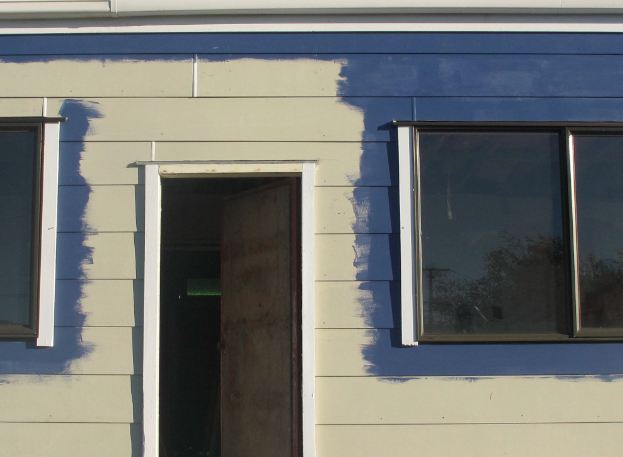
After a few hours we had covered the places where the facings will overlap with two coats. And were left with a patchwork-looking house ready for facings. Just in time too, because we were greeted with three straight days of rain just as John the Intern arrived.
And here is how the patchwork painted house looks now. And what’s John doing up there on the roof? Looks like the subject of an upcoming blog post.

-June Cleverer