Category Archives: sun angles

Momentum: Both Debt and Climate

Today is the winter solstice – “the shortest day of the year.” This weekend marks the time of year when hours of daylight are shortest and hours of darkness are longest.

For a home like ours that is powered mostly by sunlight energy, this is not good news. But every cloud has a silver lining. Here’s what I mean. Screen shot 2014-06-20 at 6.04.34 PM

Although the end of June marks the time when hours of daylight are shortest, it is not necessarily the coldest time of year – that comes later. In other words, as June turns to July and temperatures drop on average, the days actually get longer.

This may sound counterintuitive: more sun but colder. What’s up with that?

It all has to do with lag time, or what may also be called thermal momentum or seasonal inertia. Put simply, there is a delay in the system between energy input (amount of sunlight) and how we experience that energy (air temperature).

Most of the seasonal delay is influenced by large bodies of water: oceans, seas, very big lakes. These large bodies of water are the thermal mass of the planet – they absorb heat slowly and release it slowly. Sunlight energy is loaded into the world’s waters only for it to be released at a later date.

On a very large scale, most climate scientists say that much of the excess heat energy that the Earth is currently absorbing is going into the world’s oceans. They refer to oceans as “heat sinks.” The major concern with this situation is that the ‘sinks’ will become ‘sources’ in the future. In other words, the chickens (massive amounts of heat energy) will come home to roost (wreak havoc on us with extreme weather events).

While this energy is being stored in the oceans everything appears to us to be OK. It is a lot like running up a large debt. I suspect there were few complaints in Wanganui while council was running up our current debt while holding rates artificially low. Only now do we hear complaints.

This is the same strategy that U.S. President Bush (the second) used with the Iraq War. He did not tax Americans to pay for the war, but put it on the national credit card. There were few complaints at the time, but now after a trillion dollars we hear complaints about the “unsustainable levels of federal debt” in America.

Similarly, climate scientists continue to warn of “unsustainable levels of carbon debt,” but I suspect more and more people will echo them in the future, especially because another and perhaps more ominous delay is also built into the climate system.

Once fossil fuels are burned the carbon dioxide remains in the atmosphere for decades causing more and more warming. Many scientists say that even if we stopped burning all coal, oil and gas today that we would continue to experience the effects for the better part of most Chronicle readers lifetimes.

In the same way, even if WDC balanced the city’s budget next year we will all still be paying for debts racked up in the past and the accrued interest for years to come.

OK, now for the silver lining…for our house anyway. Heading into July and through August, as temperatures remain low, the increasing minutes of sunlight every day make our solar home that much warmer. Additionally, we use a ‘delay system’ inside our home to capture the daytime warmth and release it at night.

This delay is, of course, thermal mass and it acts just like the Tasman Sea outside our front door: absorbing heat slowly when it is in abundance and releasing it slowly when it is in deficit.

Understanding complex systems and their associated delays, oscillations, changes and feedback loops helps us to ‘see’ into the future and plan accordingly. This way of seeing the world is called “systems thinking,” and is at the heart of eco-design. It has helped us design and renovate an inefficient old villa into a low-energy eco-home, and it has the potential for humanity to come to grips with global climate change and unsustainable debt.

Human beings are notoriously bad at looking toward the future and planning ahead. Systems thinking is a tool to help us all look toward an increasingly volatile and indebted future, ask if it is the future we want for our children, and then decide whether we have the courage to do anything about it today.


Passive Solar: Let the Sun Shine in

Although I was unaware of it at the time, my first birthday coincided with a significant number one hit by The 5th Dimension on the U.S. Billboard Pop Singles Chart. Here is a music trivia quiz:

• The song is a medley of two songs.

• It was the first medley to top the American charts.

• It remained at number one for six weeks in April and May, 1969.

• It reached number one in Canada and number three in Australia.

• It was replaced at number one in the U.S. by “Get Back” by The Beatles.

• It featured prominently in the musical, “Hair.”

Whanganui’s aging hippies will easily recognize this song as “Aquarius/Let the Sunshine In.”

 Screen shot 2014-05-17 at 8.04.07 AM

One of my earliest childhood memories was going to a high school production of Hair and absolutely loving it. Afterward, my brother and I dug out my parents’ LP and listened to it over and over again. What’s odd about that neither of us had musical talent or any inclination to be on stage.

To this day, we both remain avid music listeners while retaining complete lack of talent. I have given karaoke a go exactly twice: both in the last two years, and both accompanying my wife who has an amazing singing voice.

So what is my point in all of this? Two points: 1) you do not have to be proficient at something to appreciate it deeply; 2) let the sunshine in.

Whether or not this is the Age of Aquarius, I reckon it certainly is the age of designing homes to take advantage of free and abundant sunlight energy. One need not be proficient in eco-design to appreciate this. One need simply pay a power bill and wish it were lower.

The basics of passive solar home design date back hundreds or even thousands of years in some cultures, but the modern era of passive solar dates to around the time when The 5th Dimension was at the peak of their popularity.

As I described last week, passive solar design consists of solar gain, thermal mass and insulation. During our renovation we increased solar gain by adding glazing (windows and French doors) to the northern sides of our villa. At the same time we removed glazing from the southern sides.

Screen shot 2014-05-17 at 7.55.35 AM

North corner before.

Screen shot 2014-05-17 at 7.56.01 AM

North corner during.

Screen shot 2014-05-17 at 7.55.46 AM

North corner after.

If we think of a home as a bank account for energy: in winter, the north facing windows make deposits during the day and withdrawals at night, while the south facing windows make withdrawals day and night (unless we happen to get an unseasonably warm day).

In the end, we had roughly the same amount of total glazing in our home but it was more appropriately placed to take advantage of solar gain and minimize heat loss.

Screen shot 2014-05-17 at 7.56.14 AM

Southern window before.

Screen shot 2014-05-17 at 7.56.22 AM

Southern window during.

Screen shot 2014-05-17 at 7.56.40 AM

Southern corner after, awaiting paint.

Our renovated villa has performed admirably of late. Up until this week we have not had to use any heat source aside from the sun. Operating only on solar energy, our indoor temperature remained over 17 degrees right up until the early morning of Mother’s Day.

From the 28th of April through the 3rd of May when the outdoor high each day was 15 or 16 degrees, our indoor temperature never dropped below 18. Put another way, over these six days our indoor low temperature remained at least two degrees over the outdoor high. This is the power of free and abundant sunlight energy.

If you happen to be a lover of music or free energy but do not consider yourself proficient in the latter, please join me at one of the free upcoming events made possible by our partners and supporters: Tree Life NZ, Sustainable Engineering, Black Pine Architects, Richard Collins – therivermouth.co.nz, Sustainable Wanganui Trust, Progressive Castlecliff, and the Josephite Retreat Centre.

Sidebar: Project HEAT (Home Energy Awareness Training)

Today, 11 am – 1 pm: Drop in eco-design advice. River Traders Market, Taupo Quay

Tomorrow, 3 – 4 pm: DIY Double-Glazing Examples.

Sun Angles: Winter and Summer

Mid-way between the autumnal equinox and winter solstice we find ourselves in the unenviable position of short days and long nights, and looking forward to even shorter days and longer nights for some weeks to come. Despite this, our renovated, passive solar villa has been performing well – the indoor temperature has not dropped below 18 degrees in 2013. (More on this in subsequent columns.)
The scientific explanation for the change in day length is that the Earth’s axis is ‘leaning’ the Southern Hemisphere away from the sun slightly more each day until June 21st. The way we perceive the sun in relationship to ourselves is that it rises a little further northeast and sets a little further northwest each day, as well as hanging lower in the sky at noon. Mind you, this is gradual. It takes 6 months for the ‘tilt’ to change from the sun’s highest point in the sky – and longest day of the year – and its lowest point in the sky.
A good eco-designer takes his of her lessons from nature. And nature takes his or her lessons largely from the sun. Using the transitive property, you can get the rest.
In the space below, I’ll explain two examples of good eco-design that take full advantage of the predictable behaviour of the sun: one biological and one physical.
 WBG, sold out quick-as.
If you were at Whanganui’s Saturday market for its last session before Christmas 2012, you may have been among the lucky few to have purchased The World’s Best Garlic. There is a lot that goes into growing The World’s Best Garlic besides humility. One important ingredient is timing. When I arrived in New Zealand five years ago I was told: “Plant garlic on the shortest day of the year and harvest it on the longest.” Generally speaking, this translates into June 21st to December 21st.
Please be aware, however, that this has nothing to due with full moons, cow poo vortexes, or Grecian Formula 44. It does have to due with soil temperature and gradually increasing sunlight day by day for half a year.
Also be aware that growing The World’s Best Garlic involves the right kind and amount of compost, mulch, and watering regimen, all of which are highly protected trade secrets.
The other example of good eco-design involves two examples of solar hot water that are dramatically different from one another but each serves its own users most appropriately. One system is set on an acute angle and one on an obtuse angle to the sky. In other words, one system is set up for maximum efficiency in the winter and one for maximum efficiency in the summer.
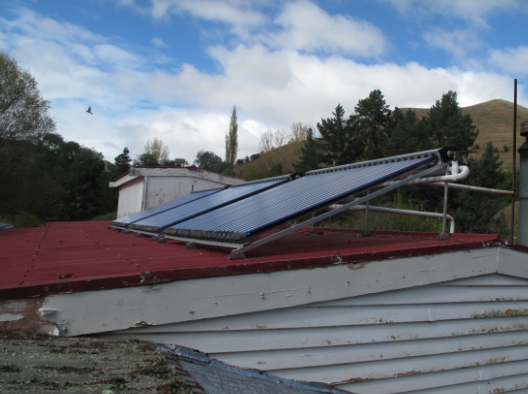
Solar hot water set for a winter sun. 
The solar hot water system on our home is set for a winter sun angle because we know that there are fewer total hours of daylight in winter, and that our insulated tank loses more heat each night in July than in January. There also tends to be more rain and clouds in winter, so we need to take advantage of every clear patch and fine day.
Even set at this high angle, our system can boil over any given day of the summer if we don’t use enough hot water. This ‘boiling’ water shoots down the gully trap as a safety feature to the system.
Solar hot water set for a summer sun. 
So who, you may ask, would set their solar hot water system for a summer angle when there are plenty of long, fine days. Answer: YMCA Central’s Raukawa Falls Adventure Camp. They get heaps of visitors all summer long, many of whom want a warm shower at the end of each day. But for much of the winter, the camp lays more or less dormant, and a back-up wood-fired hot water system can easily fill in when needed.
As spring follows winter, so form follows function…if the design is good.