Category Archives: Uncategorized

Eco-Thrifty Numeracy

I used to wonder how columnists could come up with relevant things to write about week after week after week. Now that I am a columnist, I wonder how to fit all of my ideas into one column!
Two weeks ago I related a number of eco-thrifty stories from the international press, and last week I hailed the election of an eco-thrifty pope. This week I’ll keep it local, using examples from the Chronicle to illustrate my points. No, I am not going to enter into the ongoing global climate change debate on the editorial pages, although I do find it amusing that one local retired farmer claims to know more about atmospheric science than thousands of practicing climate scientists.
Instead, I’ll pull my examples from the front pages of the Chronicle. I’ll apologize up front by saying they have to do with maths. But then again, two stories involving numeracy graced the front page on the 21st of March: one on rates rises and one on children’s maths learning.
Reading the two articles side by side, one question came to mind: I wonder if children are taught ‘the banker’s rule of 7’? Be aware, this question may have come to mind because my mother and brother are both maths teachers. Maths is in my genes.
 It’s all about the maths
The banker’s rule of 7 is that a 7% interest rate will double any figure in 10 years. It has to do with logarithms that are beyond my current maths skills, and the following equation: n = 70/R
The rule indicates that the approximate number of years (n) for an amount to double is 70 divided by the rate (R).
The common example I have been sharing in this column is the rate of electric fee rises, about 7%.
n = 70/7 = 10 years
In other words, at a constant rate of 7%, the price of electricity in New Zealand has doubled in the last ten years, and is likely to double again in the next ten years. Are children taught this in school? It may have bearing on their adult lives.
Using this handy equation, I turn my attention to the article on rates in which a reported rates hike of 6.5% will be applied to properties valued at $152,000.
n = 70/6.5 = 10.8 years.
Stated in plain English, at this level, rates on modest homes will double in under 11 years, while power is forecast to double in less than 10 years. Add to these the insurance hikes we have seen after the Christ Church earthquakes, and the cost of fixing the ‘pong’, and something has got to give.
Be aware, however, that higher rates rises will be imposed on lower value properties and lower rates rises will be applied to higher value properties. Under this formula, the poor and working class will be paying an increased proportion of Whanganui’s budget year after year.
Why the greater rates hike on lower value homes than higher value homes? 
The rates article appeared less than a week after the Chronicle profiled Sarah, in “Managing life on the bread line” (Saturday, 16-03-13). That article described that after paying rent, power and gas, Sarah “has $130 left to provide food and any other essentials.” Given the current rates rises, many struggling families like Sarah’s will find it even more difficult to cope. 
I wonder what Sarah, and other low-income householders think about paying a higher portion of our city’s budget year-on-year, for things like running lights in front of the Central Library during daylight hours. I was pleased to hear recently that by mentioning this apparent waste of power and money in my column a few weeks ago, I have instigated a bit of a debate. Reportedly, some say the lights are on for “security reasons” (during hours of bright sunshine and heavy foot traffic?). Another reported explanation is that the light fixture is art. I admit that I had not thought of that when I first noticed the bulbs illuminated on a bright, sunshiny day two and a half years ago and mentioned it to library staff.
If eight light bulbs burning directly under a glass skylight with sunshine beaming through it is indeed art, I would suggest two potential titles: “Ironic”, or “Money to Burn.”
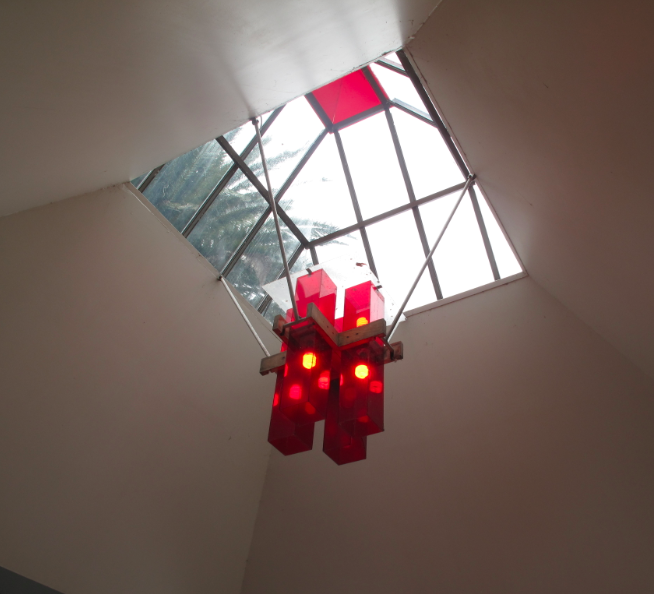
Ironic? Or money to burn? 
For excellent, free advice on how to protect your family against electric rates rises, please see the sidebar.

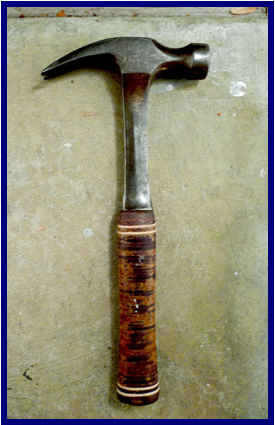
Peace, Estwing
Sidebar:
Project HEAT: Home Energy Awareness Training
Neighbourhood presentations highlight seven excellent, low cost / high performance strategies that anyone can use to make homes warmer, drier and healthier while saving power and money.
30th March, 1-2:30 pm. Wanganui Community Arts Centre, City. (Taupo Quay)
4th April, 7-8:30 pm. All Saints, 70 Moana Street, Wanganui East. 
Autumn Workshops

ECO School Workshops
Autumn, 2013
20th April, 9-5 Thinking Like a Swale: Advanced Permaculture Workshop
27th-28th April. Suburban Permaculture Weekend
5th May, 3-5. International Permaculture Day. Introduction to Permaculture
11th May. Home Energy Savings DIY Workshop
More details below.
Registration essential: theecoschool@gmail.com; 06 344 5013; 022 635 0868
Thinking Like a Swale: Advanced Permaculture Workshop
Water has been a teacher to humanity for millennia. Now that humanity faces unprecedented challenges, water remains our teacher, particularly in the form of the humble yet powerful swale. Beyond its function of slowing the flow of water through a landscape, the swale can be used as the design inspiration for sustainable homes, abundant small-scale food production, community resilience, teaching and learning, and more. This workshop provides examples of ‘thinking like a swale’ and encourages participants to engage this type of thinking in their own lives and communities.
20th April, 9-5. $60, includes lunch.
Suburban Permaculture Weekend, 27th-28thApril
This two-day workshop covers the main aspects of a suburban permaculture installation: an energy-efficient home; low-input / high-productivity vege gardens; food forests; water management; poultry; and, community relationships. The weekend translates theory into practice, using an exemplary suburban permaculture property, the Eco-Thrifty Renovation: www.ecothriftydoup.blogspot.com
Tutor: Nelson Lebo has developed one of the most sustainable rural properties in North America and one of the most sustainable suburban properties in New Zealand. He holds a PhD in permaculture education.
27th April, 10 am – 28th April, 5 pm.
Cost: $160 per person, $260 per couple. Includes meals. Free camping available, or choose other local accommodation.

Eco-Thrifty Popes and Buddhists

Extra! Extra! Read all about it! Vatican goes Eco-Thrifty! Pope shuns chauffeur-driven limo for the bus.
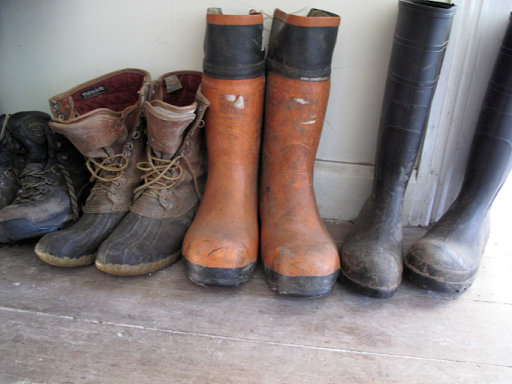
I am humbled by the humility of the newly elected pope: Francis the 1st. I am not a pope-watcher, and usually have no more than a peripheral interested in the comings and goings of the Vatican, but just one sentence changed all that: “The Argentine is known for taking the bus to work and cooking his own meals in his small apartment.” This was in stark contrast to the one thing I knew about his predecessor, Benedict XVI: that he wore designer red shoes.
I confess that I am not a Catholic, but I fully-endorse the teachings of Jesus, especially those in support of the poor and those condemning moneychangers. Over the last decades the wealth gap between these two groups has expanded to a breadth that would make ancient Roman elites blush. This gap prompted the Occupy movement (the 99 percent), countless European protests in the last 4 years, and probably the Arab Spring. Good on the Cardinals for electing a pope who appears to put social justice issues – including the impacts of globalization on the poor – at the forefront of the Catholic Church.
And choosing the name Francis: icing on the cake, but not a decadent cake, more of a pancake with a pat of butter and maybe a tab of real Vermont maple syrup.
While not a practicing Buddhist, I have Buddhist tendencies, although you may not believe it if you have seen me play softball for Whanganui’s Athletics Softball Club. One of my favorite ‘teachings’ from Buddhism is an eco-thrifty ‘lesson’ that goes something like this:
When their robes become too worn to wear, the Buddhist monks use them as blankets on their beds. When they become too worn for blankets, they use them as mats on the floor. When they become too worn to use as mats, they use them a chinking in the walls to keep our draughts.
Along those same lines, we have come up with a use for old towels and off-cut bits of wood for draught-proofing the bottom of the doors in our home. This is a variation on what can be found in everyone’s Gran’s home: the cloth tube filled with beans. I prefer my version for a few reasons. First, a piece of timber wrapped in a towel has a square edge whereas a bean tube – even when squidged up against a door – still has a rounded edge. In most cases – even our wonky home – the junction between a door and a floor is a right angle. Second, my version can be made virtually for free, as almost everyone has some odd bits of timber or can get them from a friend, or even free from a lumber yard. And old towels, everybody has one or two of those. Third, call me crazy but I believe food should be used for eating and not draught-proofing. (Also, what if the mice eat it?)
Another method of draught-proofing doors (and windows) is applying a ‘store-bought’ foam seal. At less than $4 for two rolls at a number of local merchants, this approach is practically free. This is suitable for all timber doors and windows where you can feel draughts, but most aluminium doors and windows are manufactured to be draught-proof.
These strategies for low-cost / high-performance energy savings are included with many others in the Project HEAT presentations that are making their way through Whanganui one suburb at a time. Please see the sidebar for more upcoming events.
Peace, Estwing

Can We Mimic the Success Stories in Energy Savings?

Over the last two months I’ve been collecting articles on energy that relate to many of the topics I write about in this column. At this point I have enough of them to share some recent developments and innovative programmes from around the world.
But first I’ll start with a bit of a no-duh for anyone who has ever visited the United States of America. Forbes magazine reports, “America: The worldwide Leader in Wasting Energy.” Writer, Eric Savitz, suggests “Chronically low energy productivity – the level of output that our economy achieves from the energy we all consume – is costing U.S. businesses and households an estimated $130 billion per year.” I don’t know much about N.Z. business and industry energy-efficiency, but I would suggest that household energy waste here would be comparable per capita to the U.S. That’s the bad news.
The good news is that individual states in the U.S. are implementing innovative programmes, and saving businesses and residents millions of dollars. Savitz reports that one small Massachusetts community helped families save over “$10 million in electric and gas bills by providing personalized information, with neighborhood benchmarks and advice about how they can use less energy.”
In another state, and another magazine (Yes!, probably a lot like NZ’s Good Magazine), Erin McCoy reports that Kentucky in saving power, cutting carbon emissions, and creating jobs by facilitating a win-win-win situation between homeowners, contractors, and the planet. A programme called How$mart provides home energy audits, works with contractors to perform the recommended work, and then checks the work to make sure its been done properly. The average How$mart home has cut energy usage by 20%.
Translating the two articles above to a Wanganui context, this could mean $8.5 million in savings per year (homes only, not business or industry).
NZ average household electricity use: 10,000 kWh/year (Waitakere.govt.nz, 2008)
20% of 10,000 kWh = 2,000 kWh
2,000 kWh X $0.25/kWh = $500
$500 X 17,000 homes in Wanganui = $8.5 million
In my opinion, the coolest thing about taking this perspective is that this money already exists in our community, and we don’t have to ‘attract new dollars’ as Council seems continually trying to do. Instead, we would be retaining dollars now sent to power companies in Auckland, Christchurch or Wellington.
The other cool thing is that investments in energy savings today pay themselves back at faster rates in the future as power prices rise. In other words, the faster rates rise, the faster energy-efficient investments pay for themselves through savings. For example, under ‘normal usage’ a compact fluorescent light (CFL) bulb now pays for itself in about 6 months (200% return on investment!) As electricity becomes dearer, the payback period for CFLs gets shorter.
And what is even cooler, Consumer magazine reports that the Energy Efficiency and Conservation Authority has introduced minimum performance standards for CFLs (05 Feb, 2013). “All general-purpose CFLs must pass requirements for energy performance, light quality, bulb durability, mercury levels and their impact upon the country’s electricity networks.”
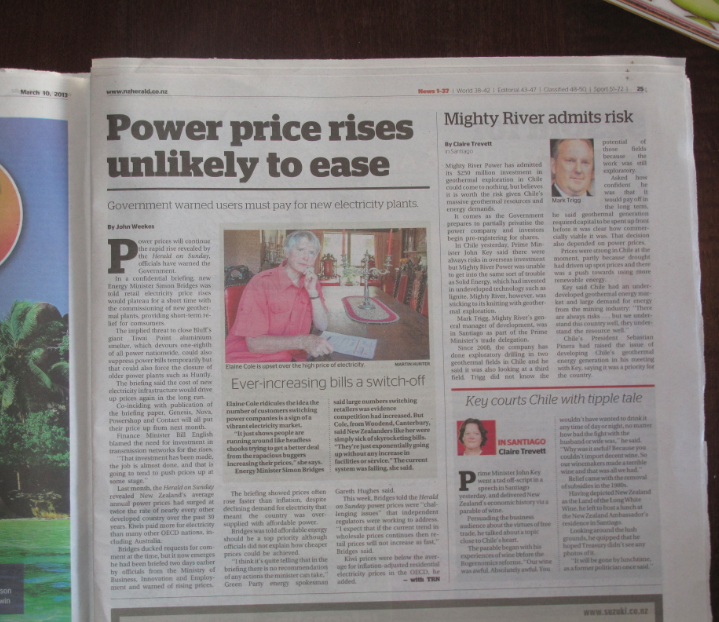
Now the bad news – not so cool – comes from an article I read in the Herald on Sunday, 10thMarch in Nelson’s Café in Stratford. The headline: Power price rises unlikely to ease: Government warned users must pay for new electricity plants.

Given my observations on governments’ ability/inability to embrace sustainability (shared in last week’s column), and my experience with innovative power programmes overseas, I would argue that a simple strategy of eco-thrifty education/incentives/management would render this headline unnecessary because saving power is cheaper than producing power.
Take the 34 million kWh potentially saved in Wanganui per year, and add Feilding, Marton, Bulls, Turakina, etc. and the amount saved is more than the output of a new electricity plant, and at a fraction of the cost. Does that make sense?
The power companies themselves were pushing this type of strategy 25 years ago in Massachusetts, USA, and reaping the financial benefits of not building costly new plants. But here we are 25 years later in ‘clean, green New Zealand’ and the main strategy appears to be building costly new plants. Does that make sense?
At this rate, N.Z. may replace the U.S. in the Forbes headline at the top of this piece: “The worldwide Leader in Wasting Energy.” Unlike our All Blacks, Black Ferns, and the recent Black Sox world championship victory in Auckland, I suggest this is one category we may not want to be number one.
Peace, Estwing

Boxing Day

Those of you in America may wonder what Boxing Day is really all about. Is it a day for pugilism? For recycling cardboard? A day for getting an 8-piece from good old KFC?

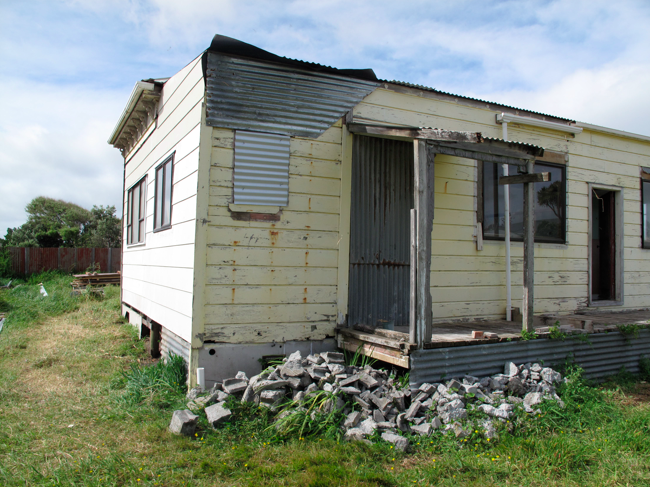
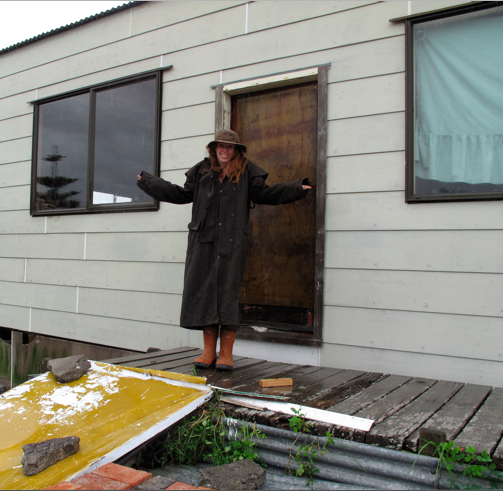
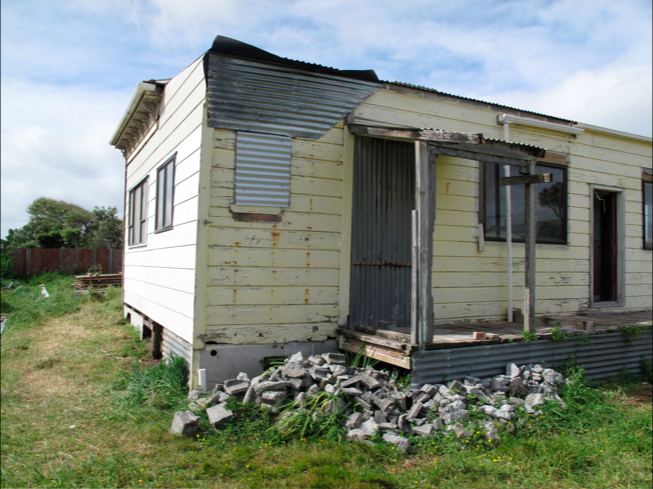
Here on Arawa Place we discovered the true meaning of boxing day. It is the perfect day to weatherproof the box in which you live.

Before.

After.

And not a minute too soon…

The heavens open.

-M.C. Estwing

Foux Da Fa Fa- Les Portes

It is always disconcerting when someone cuts a hole in the side of your house, even if (especially if?) that someone is your husband.

As I mentioned in my last post, clearing the toilet out of the dining room allowed us to move along with the next step of the project, installing new double french doors that open to the back yard.

Before.

During.

After.
Before.

During.

After.

Sweet! We are really starting to get a sense of what the final product will look like. It is amazing how much more light is coming into the house and how much bigger the space feels. These doors are a major component of the passive solar design of the renovation. Maybe now would be a good time to give an overview of the whole plan. Stay tuned for that. Breakfast is calling my name.

By the way, I am disappointed in the lack of cultural pride these French doors are displaying. They have yet to provide us with a beret, baguette, or even soup du jour.

– June Cleverer

Waste Removal

There once was a toilet. She was a nice toilet. She was a functional toilet with one major problem. She lived in our dining room.

Enough of this. Toilets do not belong in dining rooms. Let us set you free.

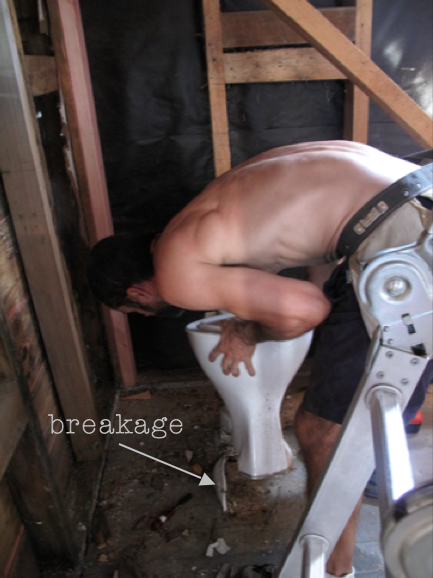
After some brief toilet aerobics.

And some forceful wiggling.

She was set free, if not a little worse for the wear.

And after a short relocation…
She is now free range.

I have to say, I was hesitant to be anywhere near the dining room when Estwing was working his magic with this one, but it was really a mess-free and stink-free demo. Before we disconnected the bowl we wiggled it to get as much of the water possible down through the S-pipe and into the sewage drain. We also poured a few liters of water down to make sure that any water we were dealing with was clean.

Of course, if you are living in a house that actually has running water you could just flush the toilet a few times, but don’t forget to turn off the water before you go disconnecting things.

And, I don’t know if I would recommend our method of pry-bar jimmy-ing. We didn’t want to go through the hassle of hack-sawing a particularly feisty screw, and thought it might just pull out of the wood with a little encouragement. But, it turns out that toilets crack easily. Even though we didn’t want to reuse this toilet, somebody might have, and it would have been nice not to wreck it.

So, overall, getting the throne out of our dining room was pretty easy and disaster-free. Which finally sets us up for the next step. Cutting a giant hole in our house to install some beautiful french doors.

We worship you porcelain goddess.

-June Cleverer

Active Solar

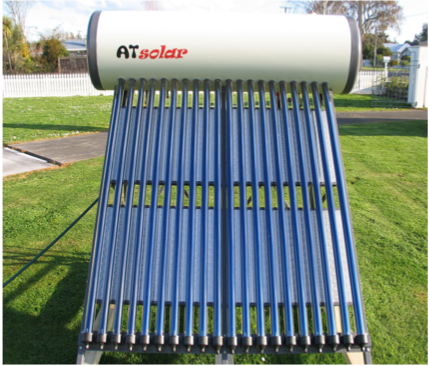
As you may recall, our first 3 design principles all had to do with passive solar design: solar gain (Let the sun shine in), thermal mass (Massticate on This), and insulation (Design Principle #3). Just this week we have decided on the solar hot water system that we will be installing. It is an active system, as opposed to our previous hot water system that was patently passive.

As you may have discovered in the previous posts, a certain level of vocabulary is required to speak accurately about eco-design. Passive and active solar are certainly two concepts central to eco-thrifty designing and building. The difference is quite simple, but if you find yourself talking to an architect, engineer or contractor one day about building a green home, make sure you know the basics so you can ask for what you want.

‘Passive solar’ refers to anything absorbing sunlight energy by simply sitting in the sun: a cat, a parked car, our house.

In new construction, passive solar strategies will pay for themselves in energy savings immediately. In renovation, the payback may take a little longer.

‘Active solar’ refers to a system with some moving elements. In terms of our active solar hot water system, the water is heated by the unit on the roof and flows into the house under pressure. It is actively being moved from outdoors to indoors.

The best data we can find is that the payback period of this system will be around 7 years. That represents a 10% return on investment. Which bank is offering a rate like that?

-Estwing

Lighting up the Silver Screen

The goal of The ECO School is to offer access to high quality, affordable sustainability education. And what better way to do that than by using the internet?… hence the lovely blog that you are reading right this moment. Along those lines we have been planning some other creative ways of using the internet to reach out to you right in your very own living room.

Introducing the very first ECO School movie – Passive Solar Design: An Introduction.
This movie is the first in a series of six that will explain the basics of passive solar design, and how your home, your wallet, and the earth can benefit by taking advantage of that giant free source of energy that hovers about 150 million kilometers above our heads.

Here’s a little teaser for you:
Interest piqued? You can watch the full 2 1/2 minutes by heading over to the movie page on The ECO School website.

Caught in a Moment

There are moments when, amidst all the chaos, above the racket of the hammers and saws, peeking out from behind a broken 4×2, something catches my eye and gives me a glimpse of what the end result of this project might look like.
And I stop, just for a second, and think “Yes, we are creating a beautiful lifestyle”.


Of course then my focus pans back out to the dozens of tin cans of rusty bent nails, the grafitti sprayed siding, and the gaping holes in the floor boards, and I am brought back to the reality of this massive project.

-June Cleverer