Foux Da Fa Fa- Les Portes

It is always disconcerting when someone cuts a hole in the side of your house, even if (especially if?) that someone is your husband.

As I mentioned in my last post, clearing the toilet out of the dining room allowed us to move along with the next step of the project, installing new double french doors that open to the back yard.

Before.

During.

After.
Before.

During.

After.

Sweet! We are really starting to get a sense of what the final product will look like. It is amazing how much more light is coming into the house and how much bigger the space feels. These doors are a major component of the passive solar design of the renovation. Maybe now would be a good time to give an overview of the whole plan. Stay tuned for that. Breakfast is calling my name.

By the way, I am disappointed in the lack of cultural pride these French doors are displaying. They have yet to provide us with a beret, baguette, or even soup du jour.

– June Cleverer

Waste Removal

There once was a toilet. She was a nice toilet. She was a functional toilet with one major problem. She lived in our dining room.

Enough of this. Toilets do not belong in dining rooms. Let us set you free.

After some brief toilet aerobics.

And some forceful wiggling.

She was set free, if not a little worse for the wear.

And after a short relocation…
She is now free range.

I have to say, I was hesitant to be anywhere near the dining room when Estwing was working his magic with this one, but it was really a mess-free and stink-free demo. Before we disconnected the bowl we wiggled it to get as much of the water possible down through the S-pipe and into the sewage drain. We also poured a few liters of water down to make sure that any water we were dealing with was clean.

Of course, if you are living in a house that actually has running water you could just flush the toilet a few times, but don’t forget to turn off the water before you go disconnecting things.

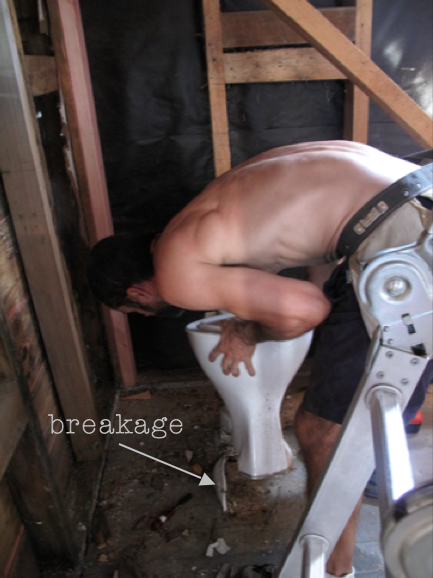
And, I don’t know if I would recommend our method of pry-bar jimmy-ing. We didn’t want to go through the hassle of hack-sawing a particularly feisty screw, and thought it might just pull out of the wood with a little encouragement. But, it turns out that toilets crack easily. Even though we didn’t want to reuse this toilet, somebody might have, and it would have been nice not to wreck it.

So, overall, getting the throne out of our dining room was pretty easy and disaster-free. Which finally sets us up for the next step. Cutting a giant hole in our house to install some beautiful french doors.

We worship you porcelain goddess.

-June Cleverer

Active Solar

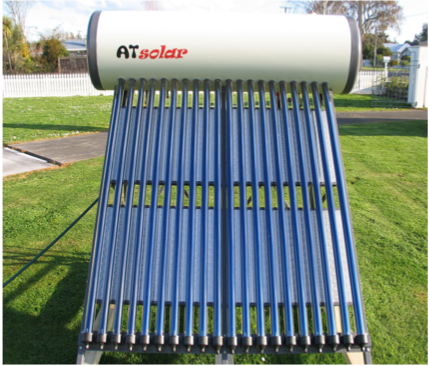
As you may recall, our first 3 design principles all had to do with passive solar design: solar gain (Let the sun shine in), thermal mass (Massticate on This), and insulation (Design Principle #3). Just this week we have decided on the solar hot water system that we will be installing. It is an active system, as opposed to our previous hot water system that was patently passive.

As you may have discovered in the previous posts, a certain level of vocabulary is required to speak accurately about eco-design. Passive and active solar are certainly two concepts central to eco-thrifty designing and building. The difference is quite simple, but if you find yourself talking to an architect, engineer or contractor one day about building a green home, make sure you know the basics so you can ask for what you want.

‘Passive solar’ refers to anything absorbing sunlight energy by simply sitting in the sun: a cat, a parked car, our house.

In new construction, passive solar strategies will pay for themselves in energy savings immediately. In renovation, the payback may take a little longer.

‘Active solar’ refers to a system with some moving elements. In terms of our active solar hot water system, the water is heated by the unit on the roof and flows into the house under pressure. It is actively being moved from outdoors to indoors.

The best data we can find is that the payback period of this system will be around 7 years. That represents a 10% return on investment. Which bank is offering a rate like that?

-Estwing

Design Principle #3: Insulation

Before I got side-tracked by our postal and electrical adventures in Neverland (From off te grid to off te radar), I was working my way through our 7 design principles for this project starting with solar gain and thermal mass. As June and I explain in our short video, Introduction to Passive Solar Design, it is essential that insulation work in conjunction with sun-facing (toward the equator whichever hemisphere you’re in) glazing and adequate mass inside the building envelope.

Not rates envelope, building envelope!

If you are familiar with the greenhouse effect you may see a parallel here. Ultraviolet light comes streaming through our windows in the same way it enters Earth’s atmosphere. When it strikes the ground surface of the planet – or the mass inside our home – some of that UV light is transformed in infrared light, i.e. HEAT. We all know that heat rises, and in the case of the Earth it is the carbon dioxide, water vapor, methane and other greenhouse gases that ‘hold’ the heat in and make the planet habitable. Good on ya, CO2!


But the problem we all face now is that too much CO2 and other greenhouse gases are essentially over-insulating this planet and causing a laundry list of potential less-than-desirable consequences. That’s why the proactive and responsible governments of the world are in Cancun, Mexico sorting it all out for us. Good on ya, politicians!

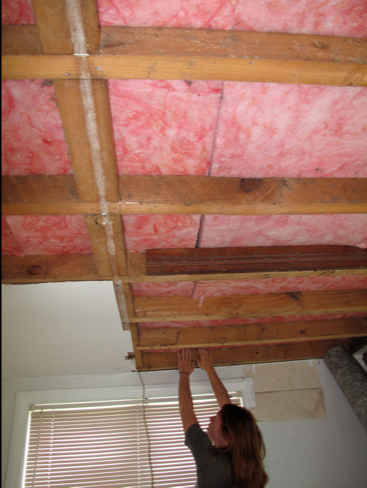
While the results of that meeting are likely to be nothing more than hot air, it is precisely hot air that I am hoping to hold within our home. I wish insulating the attic was as easy as filling it with carbon dioxide. Unfortunately, we have to settle for Pink Batts.


There are pros and cons to each choice of insulation depending on whose advice you seek, and I’ll try to write about that in the future. But today’s lesson is ‘location, location, location.’ Getting the most savings for your insulation investment (being eco-thrifty) is about identifying the low-hanging fruit and picking it first. In the case of insulation, it just so happens that the low-hanging fruit is up high and the high-hanging fruit is down low. In other words, insulate your attic first, your walls second, and your floor last. In this case physics and economics work hand-in-hand.

Relative heat loss through roof, walls and floor of an uninsulated home.

For our do-up down-under, we are insulating the entire attic, all external walls where Gib board has been removed, and under the floor in the northern 2/3 of the house? Why only the northern 2/3? Find out in a future post.

Peace, Estwing

All Thanks to Susan B. Anthony

“Hey babe, can you come here and give me a hand for a minute?”. I step away from the plastic bin I’ve been using as a temporary dish station for the past 45 minutes, hands soapy and greasy. “Can you hold this board up. OK, now can you hand me that hammer?”. “Yes, dear”.

When we first bought this house, before the wedding, before the move, before the work, I had a vision in my head of the two of us working side by side. Day after day we would saw and hammer, plan and design, sweat and problem solve. We would finish our long days exhausted, but filled with a sense of accomplishment at what we had achieved. We would have fun during the process, joking and laughing our way through errors that more experienced builders wouldn’t make. Birds would sing. Music would be playing in the background…the good life.

I can see you shaking your head. Those of you who are long-married or have attempted a renovation project with your partner before are in awe of my naivety.

The truth is that while this is a partnership, a marriage you might say, of two people working together to renovate a house, it hasn’t exactly played out like I imagined. There are a few major contributing factors:

  1. M.C. Estwing is much more handy than me. He has done all this before. I haven’t.
  2. I have a much lower tolerance for mess and dirt than MC, especially in our “living” areas.
  3. MC is actually quite a bit stronger than I am, and can work harder and longer.
  4. I have mad computer and telephoning skills.

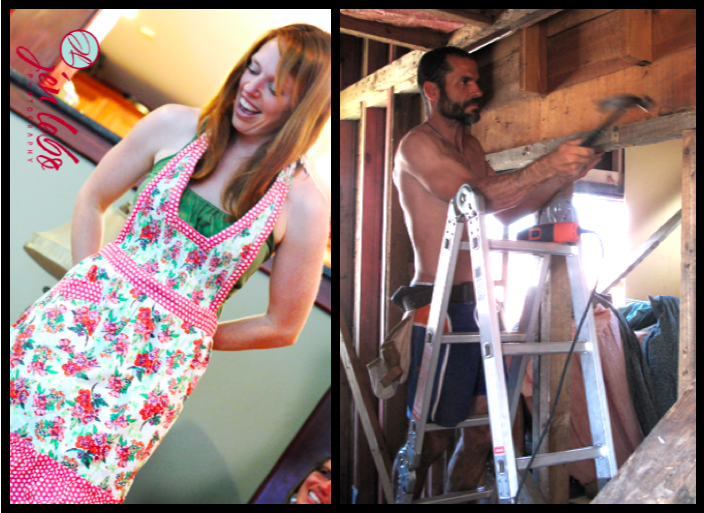
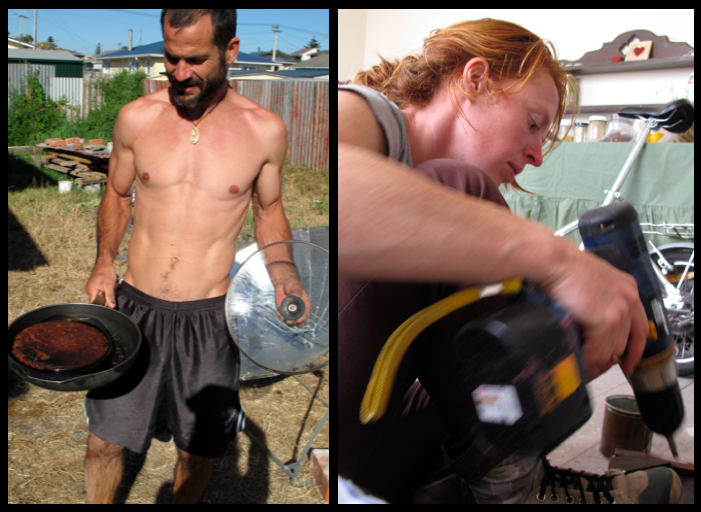
This has led to a division of labor of sorts. On this project team M.C. has landed himself the role of head carpenter and builder.

Which leaves June the roles of cook, housekeeper, secretary, oh yeah, and let’s not forget apprentice. Guess which one of us is more displeased with their roles.

I see you nodding your heads again, all you long-married experienced renovators.
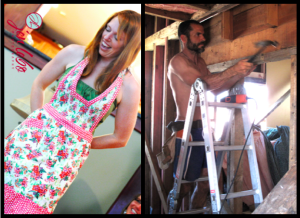
I am being a bit unfair to MC here. He has been fantastic about ensuring that we are both equally involved in the design process. Truly, he is working is butt off, long physical hours, that leave him drained. And, most importantly, he has been receptive to my feedback of the process so far.

He has also tried to engage me as much as possible in daily building tasks. This has been met with mixed success. My learning curve is steep, and his desire to see me succeed is high. This leads him to offer advice. A lot of advice. Often a lot of unsolicited advice. This doesn’t go over well.

Eventually I tire of being out of my comfort zone and efficiency wins over. My role gradually swings to go-for – “Can you pass me this? Can you hand me that? Can you bring this outside?”. I think of all the other things that need doing, and usually opt out and head for some chore that is waiting to be done. It certainly isn’t a scene filled with laughing and joking.

To be honest, the fact is that I do gain pleasure from creating a beautiful home, preparing a nice meal for my husband, and maintaining our social and business networks. I guess the problem is that I know that he would enjoy these things too, if only he had the time. Just as I would enjoy being more involved in the building, if I had the time to work through it at my own pace.

But in the end it really is just the case that he is a better builder, and I am a better homemaker. It is easier, more efficient for us each to take on the roles we are best at, and so that is what we slide back to, again and again. If we had been married at the beginning of the last century we wouldn’t have given a second thought to this division of labor.

So the challenge is this, and I pose this question to any wise person who can offer insight: How do we create a partnership where we encourage each other to break out of our comfort zones? Or is that even necessary? Should we stick to our strengths and each be the master of our own domains? Have I been raised in a post women’s lib era that has me chasing an unattainable working relationship pipe dream whose pursuit will only leave us both grumbling?
-June Cleverer

Did I mention Permaculture?…

Permaculture has lots of definitions. Many are confusing. None are comprehensive. This is mine:

Permaculture is a system of ecological design that seeks to recognize and maximize networks of beneficial relationships, while minimizing or eliminating harmful or wasteful relationships.

To those new to permaculture, such definitions may be more confusing than helpful, but to those familiar with it, heads nod in recognition.

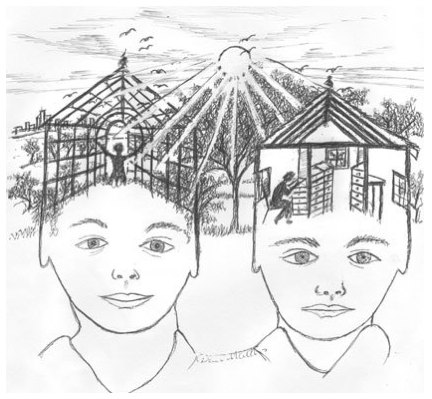
Permaculture is not a set of ethics to quote or a list of principles to memorize, but a way of seeing the world. It is holistic design in four dimensions. Training your brain to see interconnectedness is not easy if you’ve spent 13 to 17 years in Western education. Certain learning “disabilities” make it much easier if the aforementioned decade and a half have not beaten those ways of knowing out of you. I’m lucky enough to have such learning [dis]abilities.

Left: learning disabled mind, Right: learning-abled mind

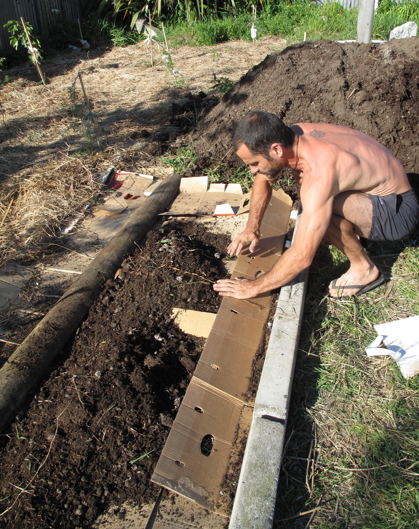
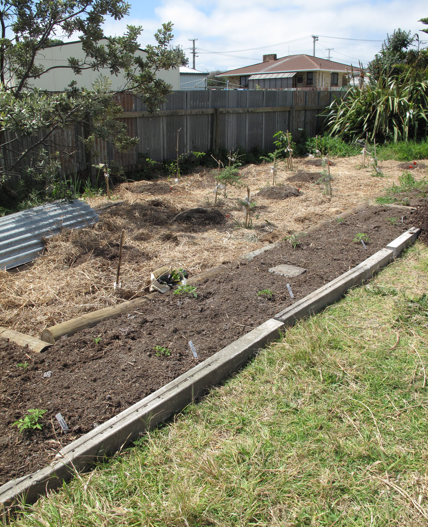
It is about time we pointed out that our eco-thrifty renovation includes the entire 700 square meter section that was more or less full of rubbish and invasive weeds when we arrived. The holistic design includes establishing wind breaks, building soil fertility, planting fruit trees and a large vegetable garden, tractoring chooks, coppicing for fire wood, planting native trees, constructing a large sun trap, retaining water on the property, and integrating the indoor and outdoor environments.

Here is a photo gallery of some of these initiatives so far.

-M.C. Estwing