Access Is More Important Than Ownership

This one goes out to my boy, Rick Estes, in the 603! Along with being the world’s best ZZ Top impersonator…

… Rick has taught me much, like how to mix concrete in a tub and how to jack up a 220 year-old house in order to replace the sills. But perhaps the most important thing that Rick ever taught me was this:
“Access is more important than ownership.” This is how he explained it to me the first time: “I don’t have a washing machine at the moment, but I have dirty laundry and friends that own washing machines. Those same friends invite me over for dinner on occasion. I bring a bottle of wine and a basket of dirty clothes. By the time we are finished with drinks and nibbles, the load is through the wash. By the time we’ve finished dinner the dryer has run.” 
I appreciate Rick’s words of wisdom, and I also appreciated that as my nearest neighbor in rural New Hampshire, he was much better provisioned than I was regarding: hot and cold water; mains power; power tools. (I was able to use his own advice against him!) Which brings me to the most recent application of Rick’s advice. 

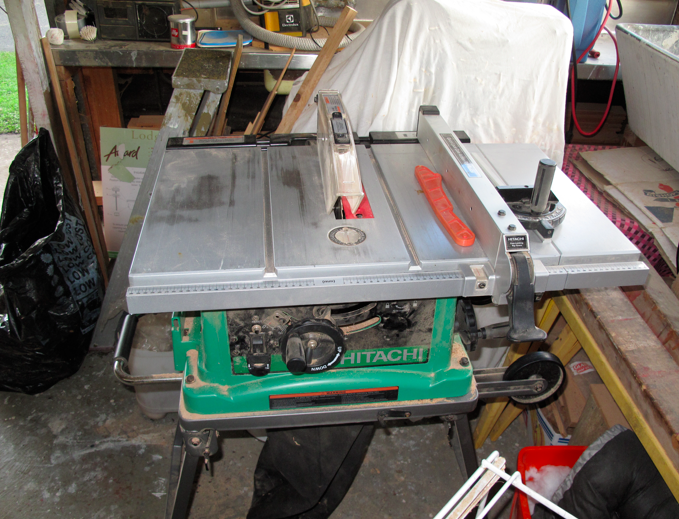
This Hitachi table saw belongs to my friend Peter who lives at the Quaker Settlement on the other side of town.

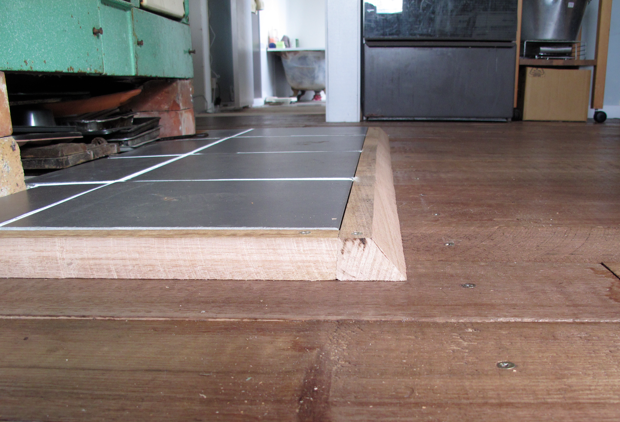
I had to rip some long pieces of oak on a 45 degree angle for our hearth surround…

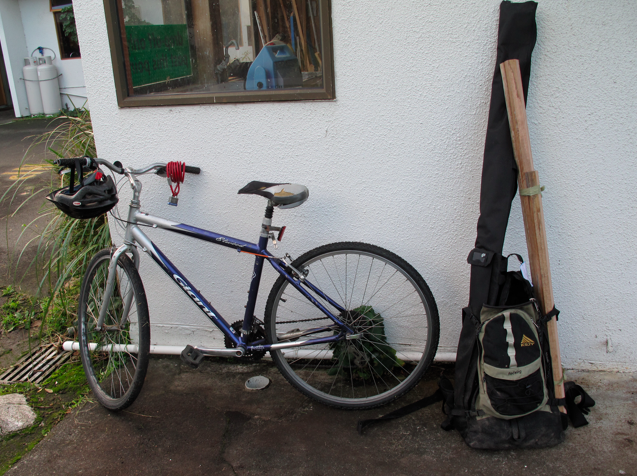
… but could not manage to hold the line with my circular saw. So I mounted up…

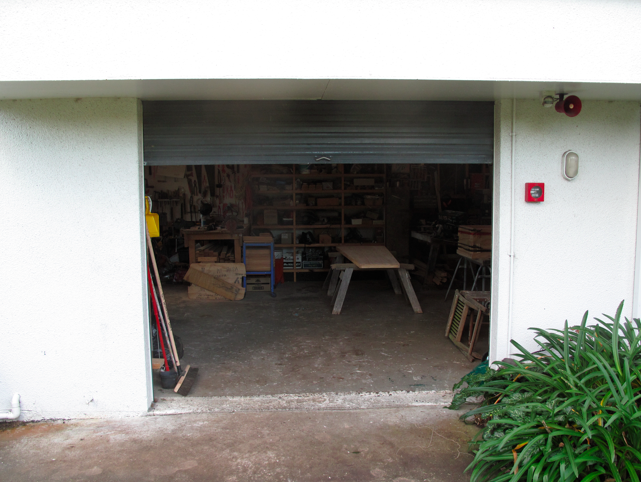
… and headed to the woodworking shop at the Settlement…

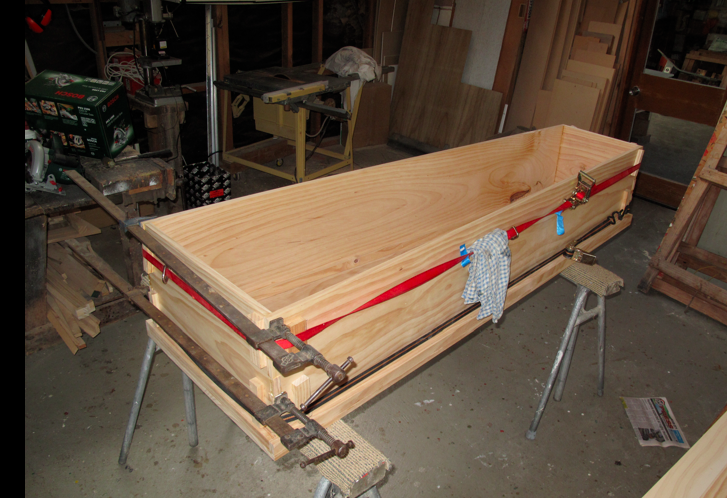
… where woodworking projects include making coffins. Those crazy Quakers!

At any rate, the bicycle ride took me about 30 minutes each way, I chatted with Peter for 20 minutes, I chatted with Mandy for 5 minutes, Enna for 10 minutes and various other greetings. The actual cuts took less than 5 minutes. So after two hours and change, I was back home and ready to finish the hearth. 

In the years since I left my 38 acre farm in New Hampshire, I have often thought about and used Rick’s advice. To those living in a modern Western consumerist culture, Rick’s mantra runs against almost everything we’re told by politicians and the media. But their messages of unregulated consumption often lead to personal debt and planetary debt. The Eco-Thrifty approach to renovation (and life) aims to be lighter on the wallet and lighter on the planet while remaining heavy on purpose, fulfillment, happiness, and surfing.

Chur, Estwing

Retrospective #8: Warm Is Always Beautiful

To date this column has introduced the concept of eco-thrifty renovation and explained the first three of seven design principles that guided us through this process: solar gain, thermal mass and insulation. I’ve emphasized the concepts of payback period and “low-hanging fruit.” Before I move on to our fourth design principle – draft proofing – I’d like to take a moment to review some of the overarching ideas surrounding eco-thrifty renovation that do not necessarily qualify as design principles. Many of these ideas run contrary to contemporary perspectives on home ownership.
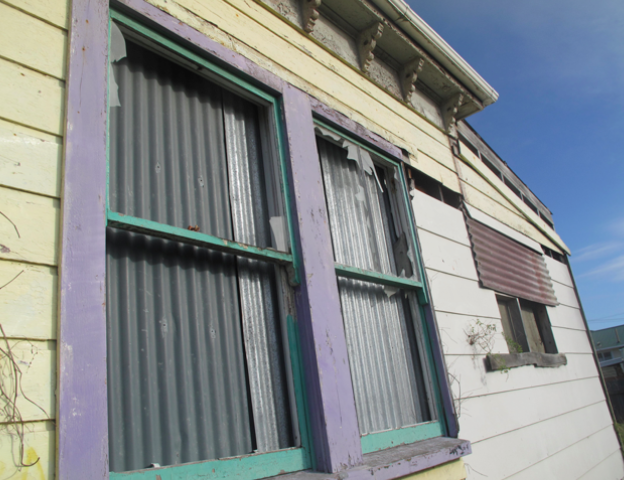
Before
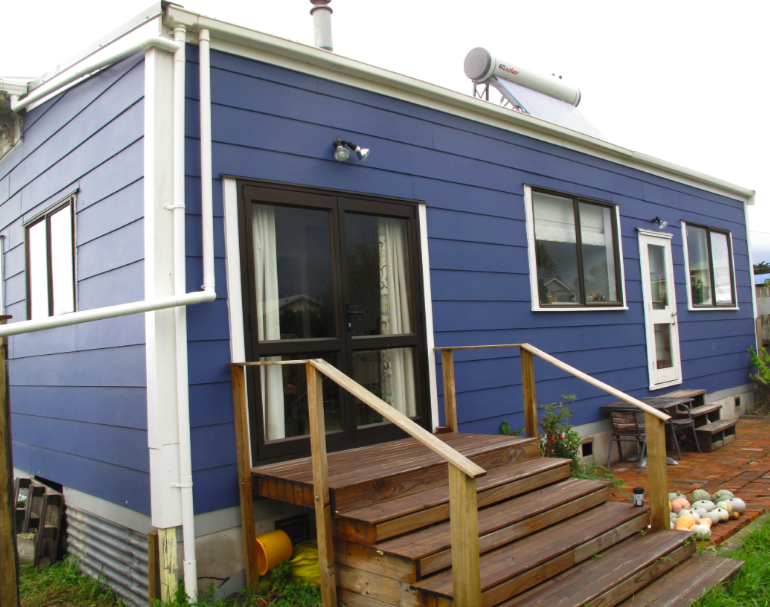
For example, instead of buying the biggest and best house with the biggest and best mortgage, we found one that was within our means with money leftover for the energy improvements I’ve described. In other words, we opted for a $100,000 (purchase plus renovation) insulated, passive solar home than a $250,000 house that might look nicer but have no insulation or substantial solar gain.
After
People say that buying a home is an emotional decision. That appears to be true, but it also appears to get some people into big financial trouble. At worst, the failure to meet mortgage payments results in the loss of the property. At best, meeting mortgage payments over 30 years means they end up paying roughly twice the purchase price. In other words, a $250,000 home ends up costing $500,000.
Before
The focus on payback period means that eco-thrifty renovation is more like operating a business than managing a home. In other words, the process is often more rational than emotional. But this is not to say that it cannot also be beautiful. Beauty the eco-thrifty way comes slowly, often through our last three principles – reduce, reuse, recycle – and through words of wisdom like those from my friend the solar engineer in the Himalayas, “Warm is always beautiful.” Beauty also comes through the freedom offered by not living under a mountain of debt. British economist E.F. Schumacher insisted that “Small is beautiful.”
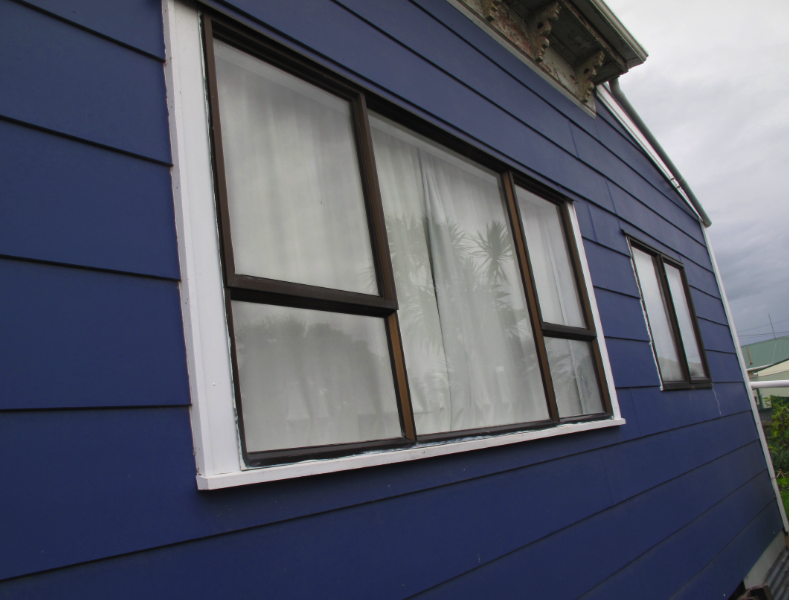
After
Small can mean the size of a cozy, little home, or it can represent the baby steps toward making any home more energy efficient. Those baby steps are what we call “low-hanging fruit.” The low-hanging fruit that I’ve described so far include window battens (insulation), plastic window film (insulation), compact fluorescent light bulbs (electricity savings), and an extra layer of plasterboard (thermal mass). Nearly anyone in Wanganui could put the first three of these to use right away and start reaping savings that represent a greater than 100% return. In other words, the payback period for each of these is less than one year. Please note, however, that an extra layer of plasterboard is appropriate for those homes that overheat in direct sunlight during the months of May – August.
The next idea behind eco-thrifty renovation is having the fiscal discipline to reinvest the savings from low-hanging fruit in medium-hanging fruit, which have payback periods between four and twelve years. Examples of these include solar hot water (electricity savings), pelmets and thermal curtains (insulation), adding north-facing glazing (solar gain), removing south-facing glazing (reducing heat loss), and our Schacklock 501 multi-fuel range (heat source on cloudy days and electricity savings when used for cooking).
We believe that every little bit helps and that the cumulative effects of all these small efforts make for a warm, dry, efficient home that is gentler on the planet and the wallet. This approach to renovation is more about designing for living witha home than designing for living ina home. We interact with the functioning of our home on a daily basis, and as our eco-thrifty renovation winds to an end we are set up for an eco-thrifty lifestyle where we pay about $20 per year in rubbish fees and eat fresh fruits and vegetables we’ve grown ourselves. That is the beauty of freedom. 
Peace, Estwing
Floored

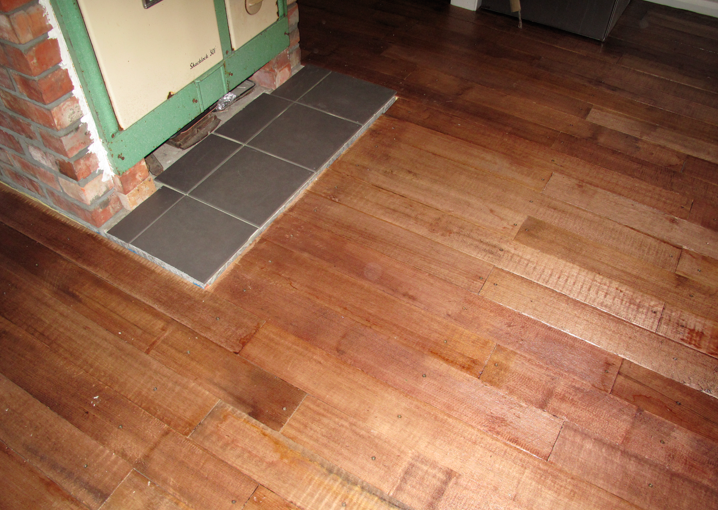
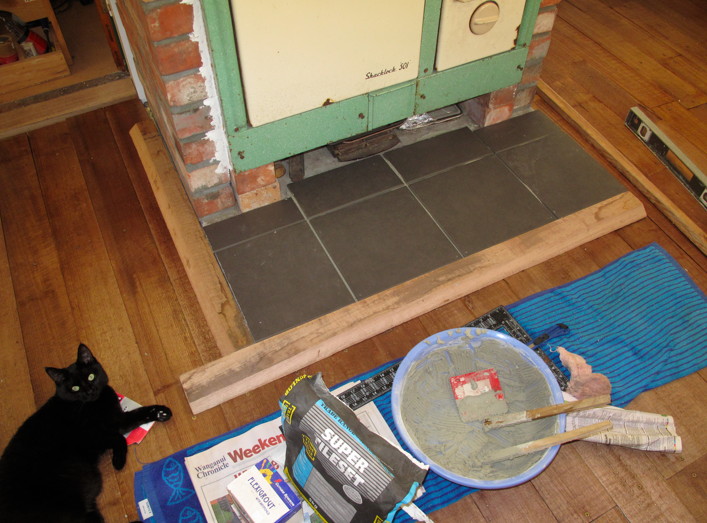
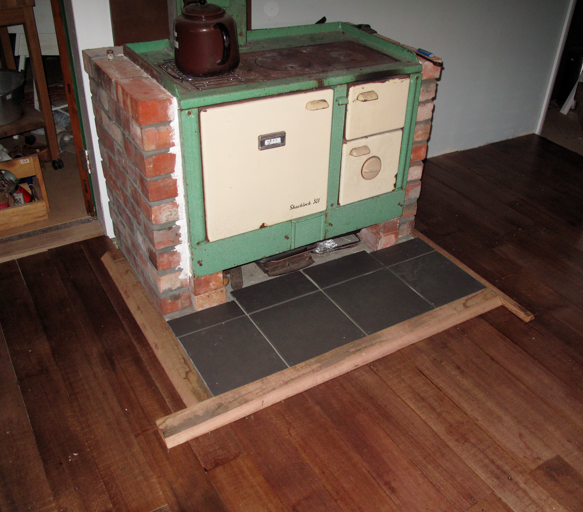
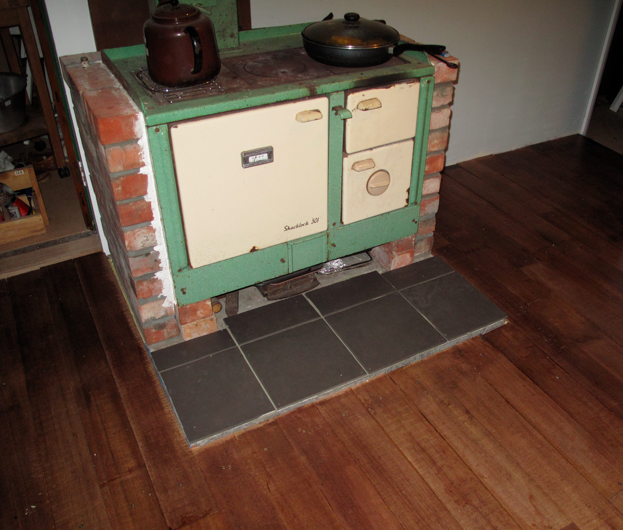
A year and a half after starting our renovation, we nearly have a finished kitchen. Two of the last projects to do were tiling the hearth and putting poly on the floor. I did both of those last week. 
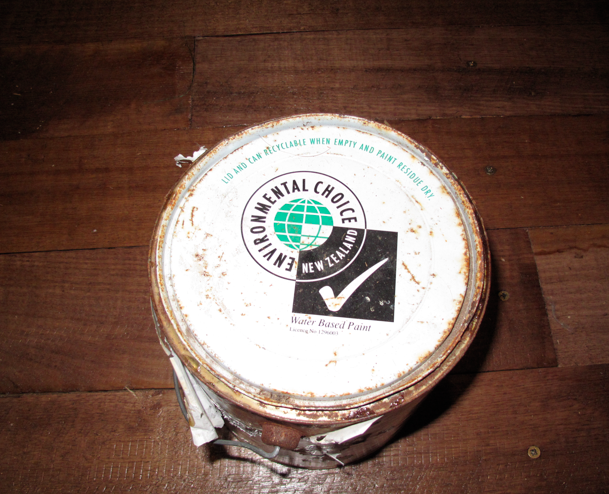
For the floor, I used a water-based polyurethane that is ‘eco-friendly’, ie low VOCs.
Interestingly enough, 4 litres of poly cost more than all of the oak boards (125 mm x 25 mm) we needed to cover about 15 square metres. (We bought the oak as off-cuts from a door factory on the other side of town.) See this post by Jiqiao, our Chinese intern, about laying the floor, which looked like this.  
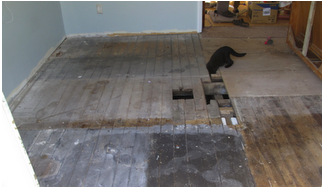
We laid the oak over the old floor, making sure to keep out any drafts, especially along external walls.

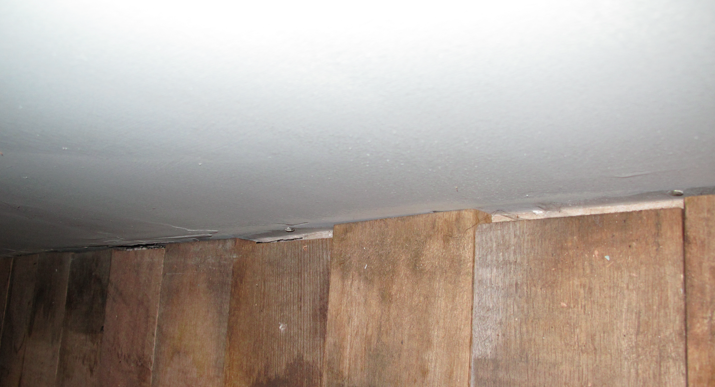
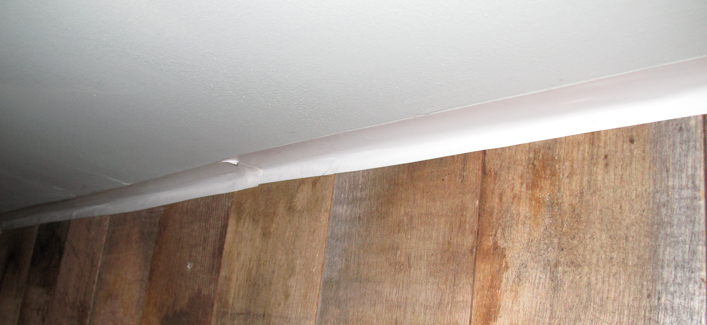
I applied construction tape along the wall/floor intersection…

… and then installed the baseboard. (Behind Billy T.)

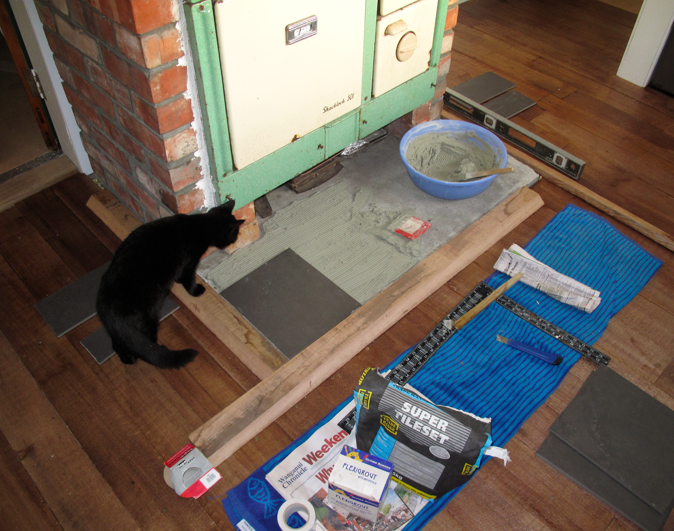
Tiling was something else entirely. We bought the tiles and the adhesive from the shop for about $60 total. 
I have never tiled before, but following the directions on the bag of adhesive seemed to work out fine. 

And I had a supervisor looking on.

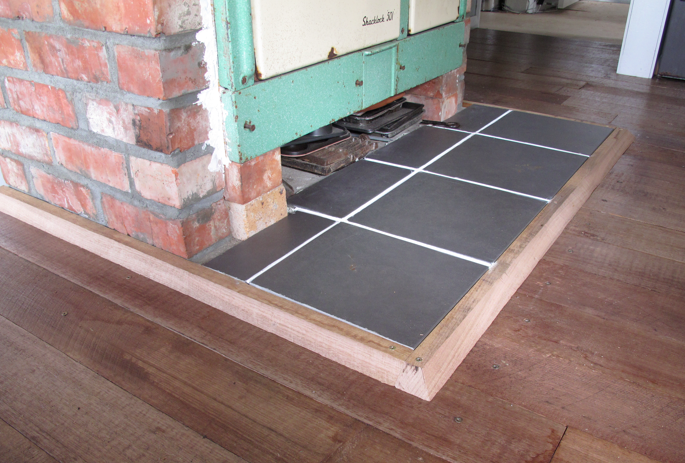
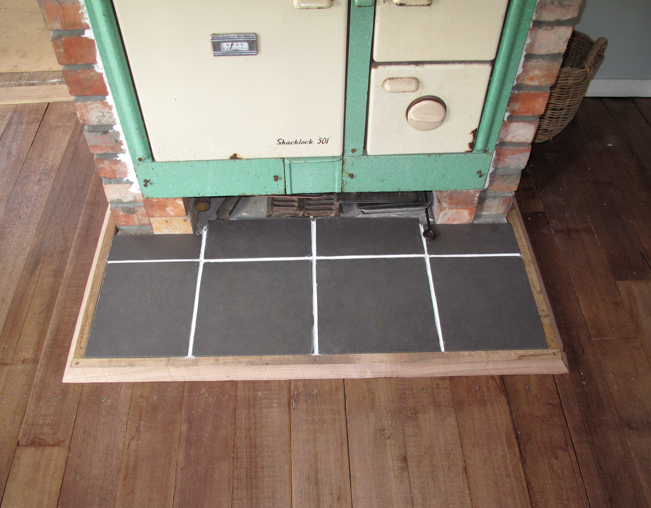
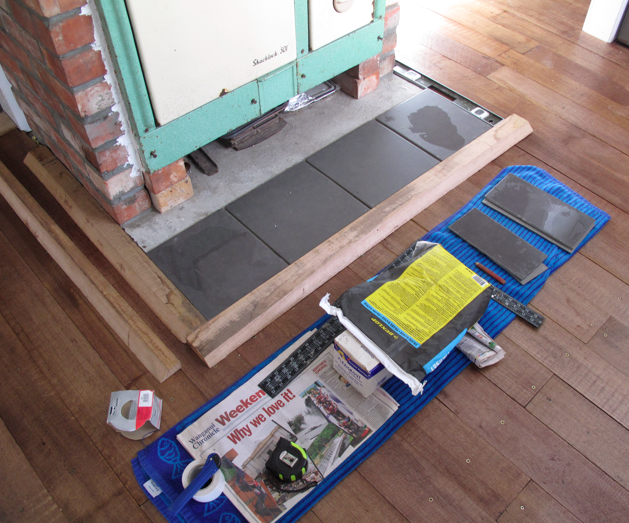
The timber frame is 25mm thick and cut on a 45 degree bevel to match the height of the tiles.

Here, the frame is removed while I finish the cuts.

Total cost: 
Tasmanian oak boards: (25 mm x 125 mm) $80
Screws: $60
Polyurethane: $115
Tiles and adhesive: $60
Finishing the kitchen: Priceless
Peace, Estwing

Retrospective #7: Window Film Insulation

Images courtesy of Space Window Insulation, an excellent source for bulk, inexpensive materials. SWI also accepts our local currency, REBS. Good on you!  www.SpaceWindowInsulation.com
Dead air is not good on the radio, however, it is absolutely fabulous in your home. Specifically, it is great in your building envelope: the walls, windows, floor and ceiling. Another name for dead air is insulation. As my friend the rocket scientist likes to say, “In double glazing the second piece of glass is not the insulation, it is the air in between.” He went on to show me a graph of the R-values for double-glazing when the two panes of glass are set different distances from one another from 1mm through 50mm. Now you may think that only a rocket scientist can get excited about insulation. Not true, I have managed to get four columns in a row out of dead air! (Maybe that’s why I’m in the newspaper and not the radio.) 
You will recall that last week I described how to make an eco-thrifty version of a window quilt that I call a “window batten.” Before that I wrote about the special relationship between curtains and pelmets, and before that it was pink batts. I promise this week will be the last on the topic…for now. 
While not everyone is in a position to insulate their walls, ceiling or floor, or even to install pelmets, I think anyone could make eco-thrifty window battens. (By the way, did anyone make one after last week’s column? If so, please write a letter to the Chronicle and share your experience.) I also think that anyone could install plastic window film insulation that you can pick up in kit form from a number of places around Wanganui. Just as the second piece of glass is not the insulator in double-glazing, the piece of plastic is not the insulator, it is the air gap in between the plastic and the glass. My rocket scientist friend tells me that a 20mm gap is optimum. Anything wider does not improve performance, but anything narrower reduces performance. And by performance I mean R-value: the Resistance to heat flow. 
For instance, the R-value of an insulated wall is about 2, while the R-value of a single-glazed aluminium window is 0.15. That is so low that even a 5mm air gap that you will get by applying the plastic film to the inside of a standard aluminium window may double that window’s insulating ability to about 0.3. That’s still a lot less than an insulated wall, but one of the mottos of eco-thrifty renovation is “Every little bit helps…so long as it has a short payback period.” 
And while it may take a rocket scientist to calculate the exact payback period of plastic window film insulation, it does not take one to compare its cost versus purchasing new double glazed windows for an entire home. We are talking a few hundred dollars versus many thousands of dollars. And as long as the air gap is well sealed, the performance should be equivalent. As a matter of fact, I learned recently that tight fitting thermal curtains can be just as effective as double-glazing. I might add that window battens are just as effective as tight fitting thermal curtains. In our home we are piggy-backing many of these strategies. For example, 1 pane of glass + 1 air gap + 1 sheet of plastic + 1 air gap + 1 window batten + 1 air gap + 1 thermal curtain = 1 very low power bill. This type of horizontal lasagna of window treatments may not appeal to everyone, but I’m confident that saving money does. To quote my friend who is a solar engineer in the Himalaya mountains, “Warm is always beautiful.” 
Peace, Estwing

A Fine Line Between Clever and Stupid

Using secondhand windows in our renovation seemed like a clever idea at the time. They came with the property as part of a house full of rubbish and some building materials. In one sense, we saved about $4,000 and the embodied energy/carbon footprint of new ones by reusing them. In another sense, we are coming up with eco-thrifty alternatives to double-glazing as described in the previous two retrospective posts. But…

… in one case the hinges were stuffed and we did not know it until after the window was installed. The window above does not close fully, thus letting in cold air and sometimes rain blown from precisely the right (wrong) angle. And so it came time to say goodbye to cold and drafty…

… and hello to warm and toasty!

We splashed out for double-glazed and thermally broken because this is a northeastern window that gets the first morning sunlight in winter. Those first rays reach over our breakfast table,

over the coal range,

over Billy T. and the bath tub,

and onto the far wall 11 meters away! At 8 am while all of the other windows are curtained, the sunlight streaming through this window lights and heats our morning. This one strategically-placed high-performance window has made a big difference to the start of our day. It’s worth having one $700 window to serve this special purpose while all the others were free.

Eco-thrfity renovation is not black and white. It is about picking and choosing when, where and how to spend money and carbon. This choice has made a big difference in our quality of life, and it even helps us save a little electricity by shutting off the kitchen lights as soon as the sun rises instead of waiting until it gets warm enough outside. And we made the swap just in time for winter!

Peace, Estwing

Retrospective #6: Window Battens

You will recall from last week that I am a big fan of Neil Diamond and of pelmets. Unfortunately, Neil canceled his Wellington show last year. LAlso unfortunate is that installing pelmets is probably not an option for most renters. (More on that in a moment.) We made our pelmets by reusing old rusticated weatherboards that we removed while re-cladding the exterior. I ripped the re-used weatherboards to 150 mm wide and inverted them so the scallop faced downward. Installed against the drop ceiling in the lean-to section of our home (kitchen, dining and bathroom), the pelmets also serve as an attractive crown molding. Our thermal curtains are hung inside the pelmets – as you would. But because we have retained single glazing, we have added extra-layers of eco-thrifty window insulation in two ways. The first is a modified version of what are commonly called “window quilts” in North America.
Traditionally, a window quilt is an expensive, custom-made quilted cloth that rides up and down in a fitted track installed inside of the window frame. I have never seen one during my four years of living in New Zealand, but, then again, I never saw a pelmet in my 40 years of living in the States. As an international ambassador for all things energy-efficient, I am happy to introduce a special eco-thrifty version of the window quilt to Aotearoa. To avoid confusion, I call this version a “window batten.” A batten is a long, thin piece of wood, in this case about 25 mm by 25 mm. We just used whatever off-cuts we happened to have at hand.
The main idea behind a window batten is that it replaces a window quilt for a small fraction of the cost. For instance, a window batten made for about $5 can replace a window quilt that could cost upwards of $200. Multiply that by every window in your home and you get the picture. Additionally, window battens can be installed without making any holes (screws or nails) in the window frame. That is because a window batten is held up by friction. This is how to make one.
Cut a 25 mm x 25 mm batten 5 mm shorter than the inside width of your window frame. Cut a 25mm x 10 mm batten the same length. Select a wool blanket, duvet inner, or quilted mattress protector (mattress pad) that measures about the same size of the window, but slightly bigger. Next, you’ll need to “sandwich” one end of the blanket between the two battens. Make sure to leave some extra fabric hanging over both ends of the battens. (This will take up the 5 mm shortfall of the battens and wedge the entire unit inside of the window frame.) Pre-drill three to five evenly spaced holes through both battens (and the blanket between them), and then fix a screw in each hole. That is your window batten.
To install the window batten, fold the ends of the blanket over the ends of the paired battens and wedge the lot into the top of the window frame. If it is too loose, fold up a small piece of cardboard and wedge it in. If it is too tight, you may need to cut your battens shorter and try again. That’s one way we’ve insulated our windows against heat loss overnight. I’ll describe another way next week. 
Peace, Estwing
Practicing What We Preach is Win-Win-Win-Win

This is an article I just wrote for the newsletter of our local currency. 
There appears to be a general correlation between REBS subscribers and members of the Sustainable Whanganui Google Group. Now correlation does not mean causation, and I will not submit a chicken or egg theory on this. But what I will do is point out an excellent opportunity for every REBS and/or Sustainable Whanganui member to engage in a win-win-win-win trade. Here is how it works.
Go down to the River Traders Market and stop in at the REBS stall. Purchase your very own bottle of Eco laundry liquid in a refilled plastic bottle. That’s it. How easy. This simple task allows us to practice what we preach, walk the talk, and any other appropriate saying I may have left out. 
First win = Reduce: By purchasing your Eco laundry liquid from REBS you are reducing the number of plastic bottles in the world. REBS buys the laundry liquid in bulk and fills the bottles for the market. And while you’re at it…
Second win = Reuse: …bring that bottle back to REBS when you’re through the laundry liquid and buy a full one. We’ll take that one back and refill it again for the next person. 
Third win = Eco products are generally less polluting than standard products. For instance, the laundry liquid is likely to have less phosphates in it than standard laundry products, which can cause water pollution. 
Fourth win = Supporting a community initiative. REBS is run on a shoestring budget and subs do not come close to covering the costs of administration. Buying Eco laundry liquid, eggs, kumara and potatoes from the REBS stall helps us keep this important community project going. 
Thanks for your support, the REBS committee

Retrospective #5: Curtains and Pelmets

This is the 5th in a series recounting the theory and practice of eco-thrifty renovation running in our newspaper, The Wanganui Chronicle. 
I will admit that in the first four weeks of this column I did not offer very many examples of low-hanging fruit with short payback periods as implied in the first column. I will also admit that I love Neil Diamond and I love pelmets. While I spent the last three columns carefully explaining the components of passive solar design and how they work together, I am finally at a point this week where I can bring two of those components together in an eco-thrifty context and provide some examples of low-hanging fruit that promise short payback periods. Besides that last sentence being extraordinarily long, it implies that an eco-thrifty approach to renovation requires one to both take a big picture view and retain attention to details. I’ll use the example of thermal curtains, pelmets and window quilts to illustrate this point.
As previously described, north-facing windows (here in NZ) are net energy gainers in the winter. While double-glazing is probably best for all windows in a home (and if building new by all means they should be installed), they are expensive to have made to replace existing single-glazed ones. As an alternative to double-glazing we wanted to look at how the performance of single-glazed windows could be maximized with low investment of money and time. What we came up with is a low-budget combination of familiar Kiwi practices and potentially unfamiliar ones from North America. I’ll start with thermal curtains because they are probably the most familiar to everyone. There is not much to say except – wait for it – sometimes even the best thermal curtains won’t hold in very much heat if not installed properly. Let the physics lesson begin!
A free-hanging thermal curtain that does not touch the floor can be almost as useless at heat retention as no curtain at all. (I would repeat that, but I’m writing to a word limit.) Here is how it works: 1) indoor air between the curtain and window cools and sinks to the floor; 2) this creates negative pressure between the curtain and window that ‘vacuums’ warm air from the ceiling and places it against the cold glass; 3) this air cools and sinks drawing more warm air from the ceiling to replace it; 4) and the cycle repeats. What forms is akin to a convection current through the room powered by the cold outside air against the window. The good news is that the cycle can be interrupted in two ways. The bad news (for some) is that one involves a pelmet. Fashion aside, I love pelmets because they are so practical! (Form follows function.) A properly fitted pelmet breaks the convection current by blocking the flow of warm air down from the ceiling. Alternatively – or better yet, additionally – floor-length curtains achieve roughly the same by slowing the free flow of cooled air out across the floor. In other words, heads: you win! / tails: you win! Both: Double win! And for a fraction of the cost of replacing all the windows in your home.
But there is a catch. A human being is required to open and close the curtains according to the level of sunlight and the difference between indoor and outdoor temperatures. I highly recommend purchasing an indoor/outdoor thermometer to help with the energy management of your home. We got ours for $20 at local hardware store and I reckon it has paid itself back within the first year. Oops, out of words and never got to window quilts. Until next week.

Peace, Estwing
Can Zuckerberg Do This?

I heard on NPR that the FB IPO might make it worth 100 B. OMG! 
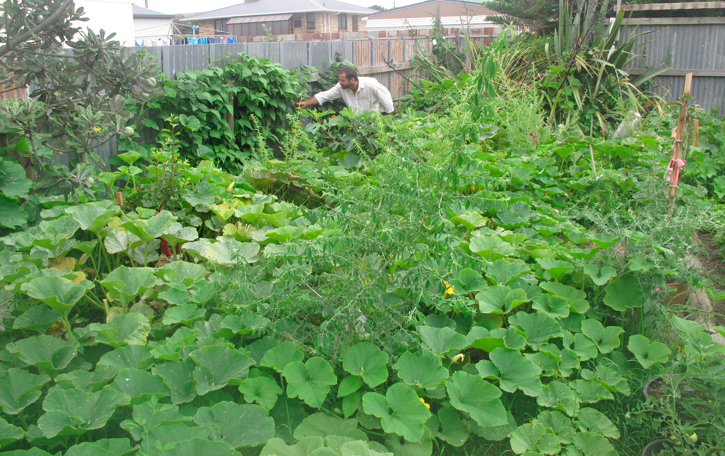
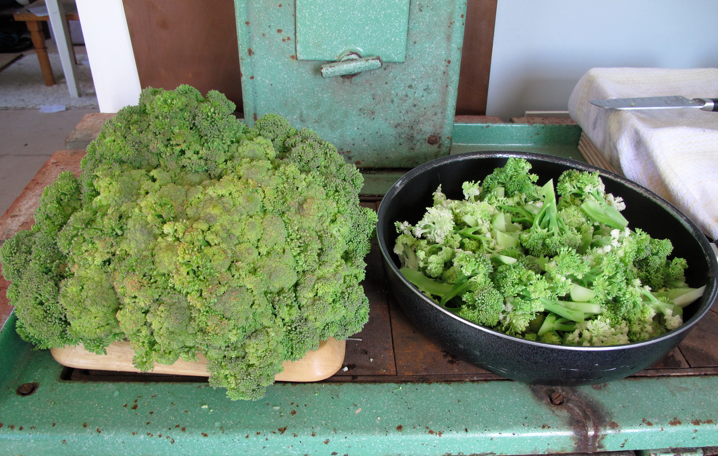
Now, I will admit that I like FB for keeping in touch with old friends, sharing our projects and filling time when I am otherwise unengaged. But is this company really worth 100 billion dollars? Is Zuckerberg really that much of a genius? I can’t begin to answer that question, but I wonder what else he can do. Can he plant a garden? Can he fix a bicycle? Can he knit a sweater? Are any of these questions worth asking about the 0.1%? Will walls of money always protect them from volatility in world food, energy and financial markets? Will the walls of gated communities always protect them from an increasingly rattled 99%? As population grows, soils erode and oceans acidify, will they ever face any sort of scarcity? I can’t answer those questions either, but I do think that for most of the rest of us it is worth learning real skills that can be applied in real settings. While I have been growing organic vegetables for well over a decade now, I continue to learn all the time. Our current location on pure sand and within 200 meters of the Tasman Sea, has offered new opportunities to learn, fail and succeed.  Below are a few images of some of our learning and success this year. (We usually don’t take pictures of our failures, but we do take careful notice of them. I have been meaning to write an entire post about failures. TBD)
The internet can teach you nearly anything! 

Scratch to patch in 5 months. 

Time for a bigger wheelbarrow. 

 That’s all from the same broc.

Broccosaurus 

Caulisaurus 

Cannot beat home grown. 

My, what big hands you have! 

Rock on!

Peace, Estwing
Retrospective #4: Insulation

This is number four in a series of articles documenting the principles and practice of eco-thrifty renovation that I am writing for our paper, the Wanganui Chronicle. 
Last week I described how thermal mass could be used inside of a building envelope to slowly absorb heat energy from low-angle winter sunlight. The ‘invisible’ forms of thermal mass we added during our renovation included an extra layer of plasterboard on walls that receive direct winter sunlight, a cast iron bathtub in our sun-drenched bathroom, and the strategic placement of our re-used coal range to receive direct sunlight all day long through three different windows. Before I proceed to talk about our insulation choices, I should note that these ‘massive’ elements not only help keep our home warmer in winter but also cooler in summer. The summer sun is much higher in the sky and does not penetrate deep enough into our home to strike them directly like it does in winter. Just as thermal mass can buffer against cold in winter, it can buffer against heat in summer. 
While I’m at it, I should also note that insulation helps keep homes cool on hot, sunny days. For example, many homes in Arizona, USA are super-insulated to keep air conditioning costs lower. Closer to home, one of my neighbours out the back on Aotea Street, Castlecliff complained to me about how hot his house is in summer. I noted that he has a low-pitched roof and no ceiling insulation. Can you imagine how hot his attic crawlspace gets? Well, that heat simply radiates through his ceiling and into his living space. Insulation slows the passage of heat, and it works both ways. In other words, by insulating the ceiling he could both slow the transfer of heat downward into his home during the summer and slow the transfer of heat upward out of his home in winter.
If solar gain can be demonstrated by a car parked in the sun, and thermal mass by touching a warm stone after sunset, insulation can be experienced by putting on a jumper. That’s it. The human body is a heat generator and the jumper simply holds that heat close to the body. Where ‘massive’ things are those that sink in water, ‘insulative’ things float. Think polystyrene, pumice, fiberglass batts.
A complete passive solar design must include all three elements: solar gain, thermal mass and insulation. Lose any one and you have an incomplete design and an underperforming building. While I described how we increased solar gain two weeks ago and how we added thermal mass last week, I’ll complete the trilogy this week with a brief description of our approaches to insulation.
For various reasons, we opened up wall cavities during our renovation and dutifully filled each one with fiberglass insulation (inspected) before replacing linings (inspected) in accordance with the building code. We also insulated all ceilings by running the batts (higher R-value than required by code) perpendicular to the joists to prevent thermal bridging through the wood. (Google it.) Although we also bought 100 square metres of under floor insulation in October, 2010 (before the GST rise), we have not yet installed it because I want to treat for borer first, and, well, I just haven’t gotten around to that due to some favorable surfing conditions. And finally, we insulated all of the gaping holes in our well-insulated walls (aka windows) with thermal curtains and their trusty sidekick and unsung hero of New Zealand homes of a certain era, pelmets. While double-glazing is a form of insulation, we chose not to replace all of the windows in our home with new double-glazed ones because this is an eco-thrifty renovation and with Wanganui’s mild climate we felt that the payback on other energy investments would be much greater. As I will describe next week, I believe that the combination of thermal curtaining, pelmets and window quilts represents the type of low-investment / high performance system that suits the eco-thrifty approach to renovation.
Peace, Estwing