Category Archives: Eco Thrifty Life

Regenerative Agriculture: The Popular Face of Permaculture

“Hippy farms always fail.” These were the words of Chuck Barry, a small-scale organic farmer I met in Montrose, Colorado about ten years ago. Chuck made a comfortable living growing high quality vegetables on two acres in a dry and seasonally cold environment that may be compared with Central Otago high country.

His comment was based on observations of some people going into farming with good intentions but little understanding of the amount of work involved and inadequate business sense. There is popular, quaint, romantic notion among many people about growing food organically. But at the end of the day, when faced with actually doing it, most hippies opt out because it turns out to be just too hard.

On the other end of the spectrum – as we have been hearing recently in the news – many conventional farms also fail. Conventional farming wisdom over the last decade goes something like this: 1) borrow lots of money from the bank; 2) convert to dairy; 3) borrow more money; 4) rely on ever-increasing dairy pay outs; 5) borrow more money; 6) rely on ever-increasing land prices; 7) get rich; 8) what could possibly go wrong?

Well, now we know. Dairy pay outs have fallen through the floor and many farmers are pushed to the wall.

On one hand I feel sorry for those famers who have to sell because of their now un-payable debts. But on the other hand, I question why they bought into the paradigm described above in the first place, which appears to me to be very risky.

Alongside financial debt, many conventional farms also run a large soil debt. We see it every day flowing past our city and out into the Tasman Sea.
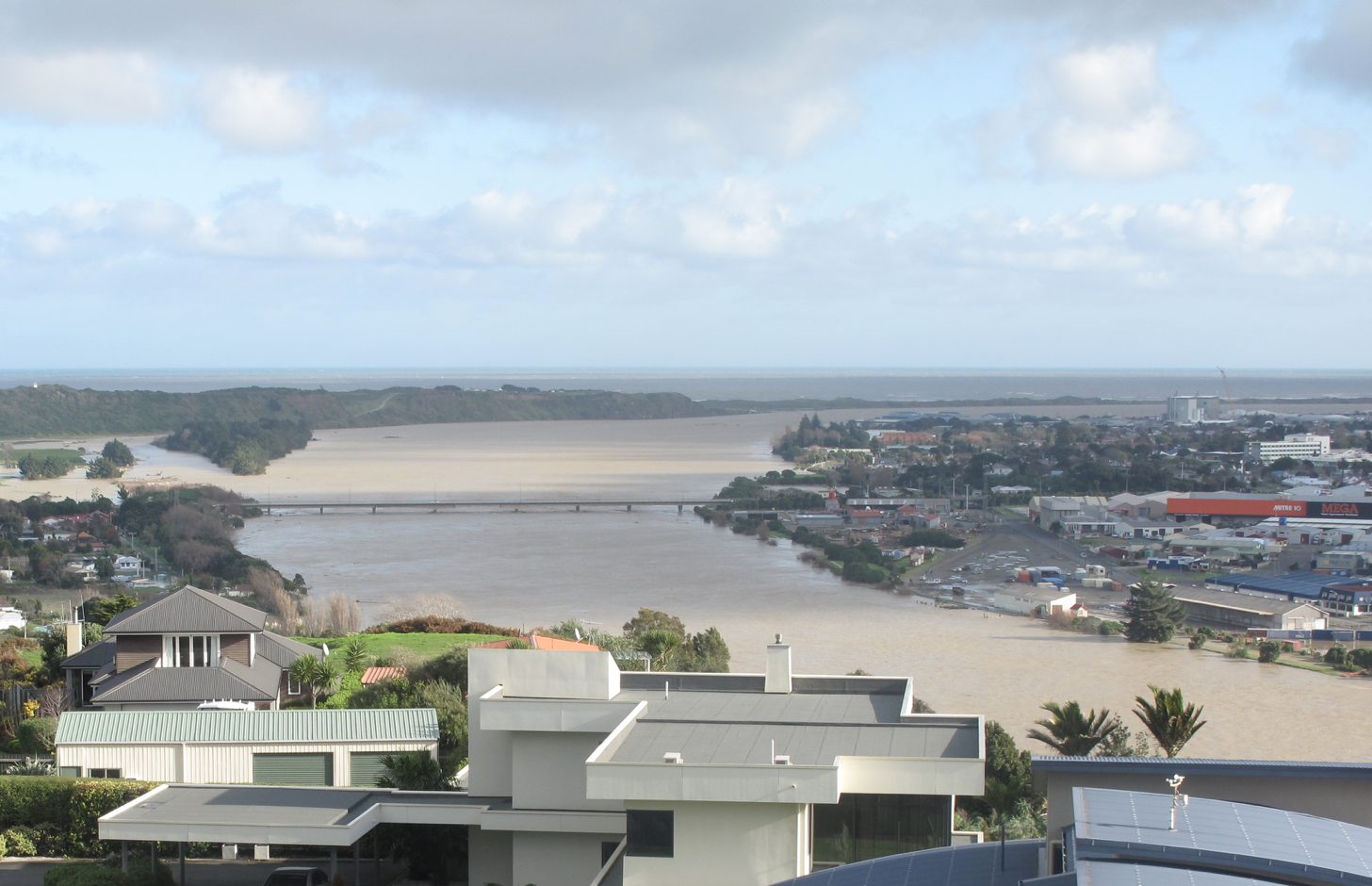
Screen Shot 2015-09-04 at 10.19.55 am

Like financial debt, soil debt is difficult to repay but not impossible. Rebuilding soil fertility while growing food is sometimes called regenerative agriculture. Regenerative agriculture can include organic farming practices, some biodynamic techniques, and holistic range management. All three of these fall within the scope of the eco-design system known as permaculture. I see permaculture as the middle ground between failed hippy farms and failed conventional farms. Screen Shot 2015-09-04 at 10.05.45 am
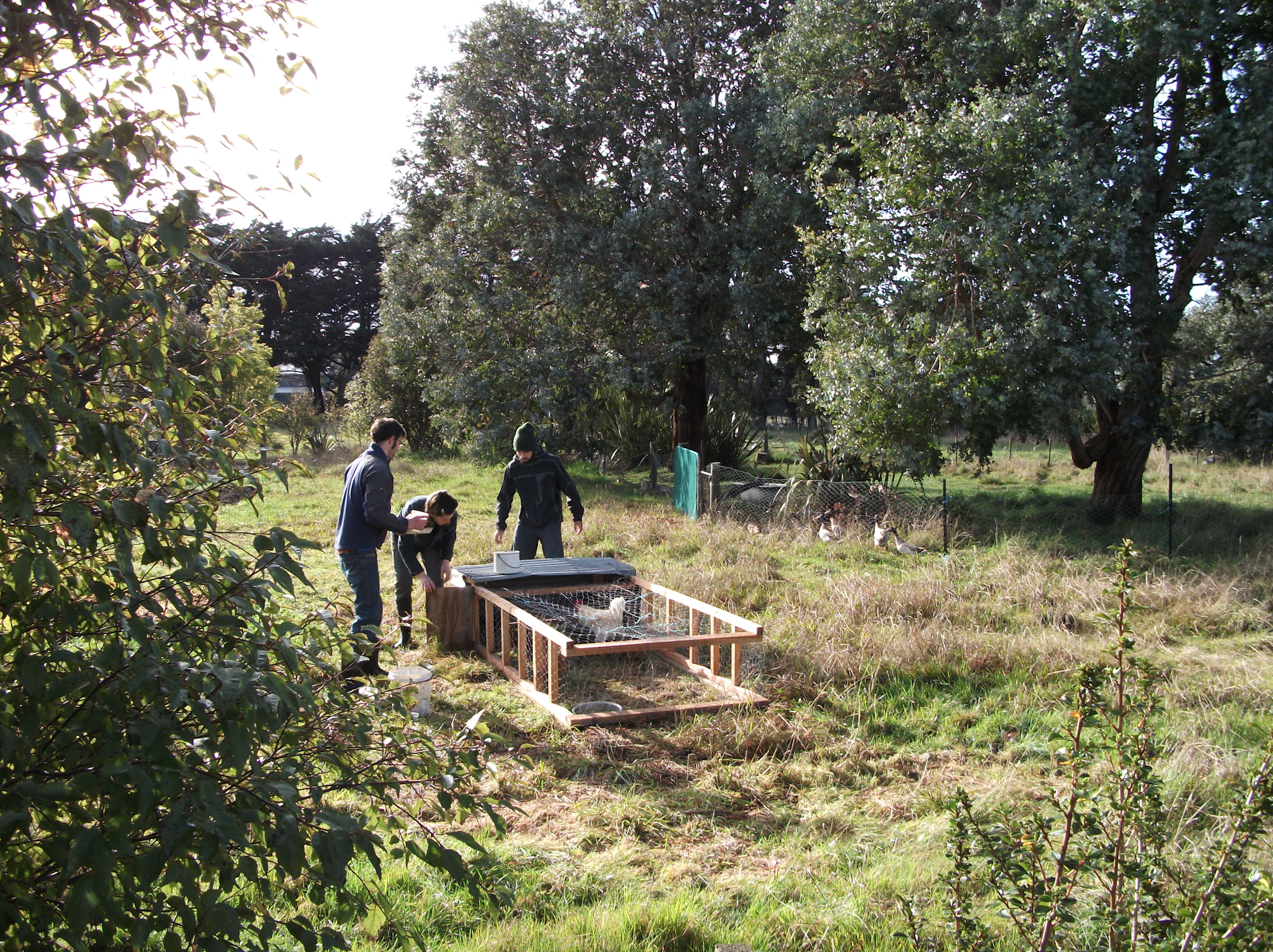
For those who are far right of centre, permaculture may seem like a hippy philosophy, but I would argue that its endurance (40 years and counting) proves it is not. Permaculture farming and land use is practiced around the world in a wide range of climatic conditions from desert to rainforest and in between. It is likely that someone in every country on earth is practicing permaculture in one form or another.

Locally, permaculture is practiced by a small but growing number of people in our community – mostly in the forms of organic and regenerative agriculture. But the scope of permaculture extends far beyond growing food. As a system for eco-design, it is a natural lens through which to view energy-efficient housing, and even the waste management programme for community events that I brought to Whanganui five years ago can be considered an application of permaculture thinking because it takes a holisitic perspective of inputs, outputs, and the human element of waste management. Screen Shot 2015-09-04 at 10.05.36 am
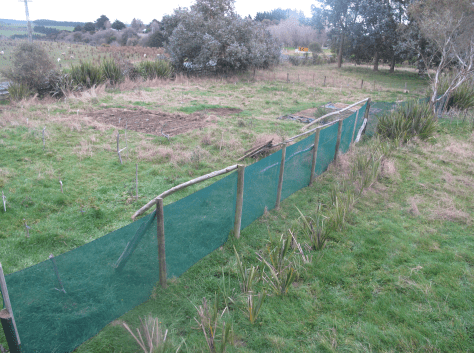
While permaculture is only one of many eco-design philosophies, what sets it apart from the others in that it is based in a set of core ethics: care for the earth; care for people; share surplus resources. It is these ethics that are the driving force behind the third annual Whanganui Permaculture Weekend, as dedicated permaculturists in our community share their knowledge, experience and enthusiasm on a wide range of topics.

Thanks to those who have stepped up with offerings next weekend and thanks to Adult and Community Education Aotearoa for working with us to organise Adult Learners Week, which starts Sunday.
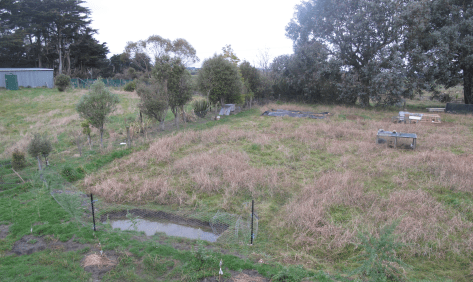
Screen Shot 2015-09-04 at 10.05.26 am

Adult Learners Week – He Tangata Matauranga 2015

6th – 13th September

Whanganui

All events are free thanks in part to support from Adult and Community Education Aotearoa.

Sunday 6th 2-3 PM. Best Heating Options for Your Home, Central Library

Tuesday 8th 5-6 PM. Hot Composting, 223 No.2 Line

Wednesday 9th 4-5 PM. Reducing Heat Loss Through Windows, Gonville Café Library

Friday 11th 4-5 PM. Managing Moisture and Condensation, Gonville Café Library

In conjunction with the Whanganui Permaculture Weekend

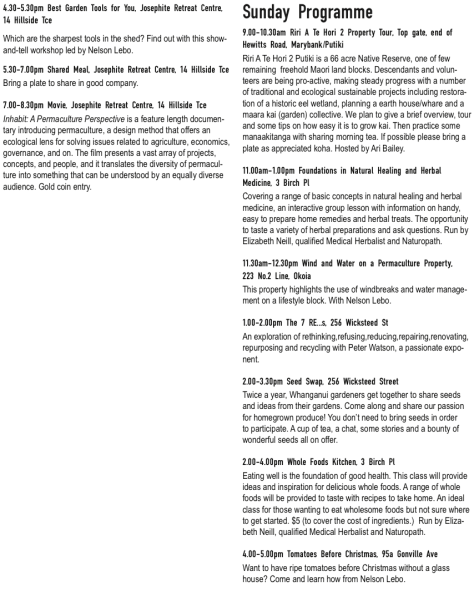
Saturday 12th 4:30-5:30 PM. Best Gardening Tools for You. Josephite Retreat Centre, 14 Hillside Tce.

Sunday 13th 4-5 PM. Tomatoes Before Christmas. Wanganui Garden Centre, 95a Gonville Ave.
Screen Shot 2015-09-04 at 10.24.08 am Screen Shot 2015-09-04 at 10.23.26 am

Screen Shot 2015-09-04 at 10.23.39 am

Guest Post: Patrick on Drainage and Brewing Beer

As I look out into the paddocks bustling with new life, signs of seasonal sway surround us, the stone fruit trees have started to blossom and put forth new leaves in anticipation of the sunshine to follow. Much like back home in Oregon and Washington the plums, followed closely by the peaches and nectarines usher in the new season, and I can’t wait for warmer days and a reprieve from the soggy weather of winter.   Screen Shot 2015-09-02 at 7.51.45 am

We have been working really hard this past week tending to several jobs needed to repair damage caused by the flood, as well as prepping some areas for the planting of food crops. Firstly Kelly and myself went down to the creek and fixed the washed out sections of fence by removing all of the debris that had been collecting over the past few weeks, which by this point had formed a thick mat of dead grass and branches. Then we stood up all of the posts that had been dislodged, one section of fencing even needed to be completely removed from the creek as it had wound itself back into a tangled spool. At one point near the end of clearing the waterway the very soft ground gave way and the creek swallowed me, leaving me hanging from the fence while water rushed into my gum boots and up past my knees. Luckily Kelly was there to laugh at me as I shimmied along the fence and made my way to dry land. It should be noted that these fixes are only temporary so that we can improve the flow of the creek. Also by removing the fencing from the creek we are preventing any further decay that the water will cause to the fencing material. We will be revisiting this project sometime in the next few weeks to perform some more long term fixes, but those will involve cutting the fence in a few places and resetting some of the posts.

Screen Shot 2015-09-02 at 7.52.12 am

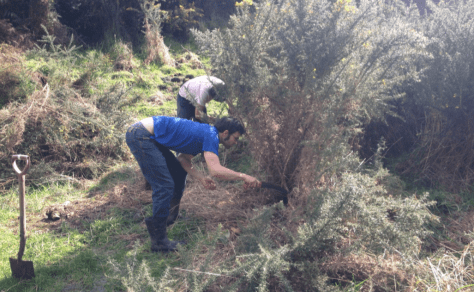
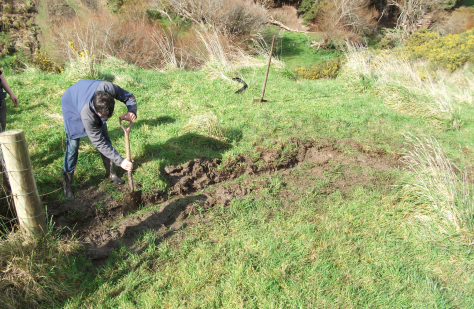
Later in the week we had a new arrival, Matheus from Brasil. The three of us headed out with Nelson where he showed us around some of the less explored areas of his property. Nelson taught us about observing the flow of water over the surface of the land and how to redirect that water by cutting in drains so that the water goes where we want it to go, and not where we don’t want it to go. Near the creek side we cut in a few more drains so that the fence posts wouldn’t be sitting in water, shortening the life of the posts and costing money. We headed back down to the creek side and with the help of Matheus we cleared a large section of gorse to make way for blueberry bushes, a highly valuable food crop that doesn’t mind boggy conditions.

Screen Shot 2015-09-02 at 7.52.24 am

Also we dug out a large section of fence that had been buried with mud and silt from the flood (this will be an ongoing project), and Kelly rained havoc on the thistle population. We also took stock of the battens required to repair sections of fence where sheep from the neighboring property could squeeze through, this was part of another valuable lesson Nelson taught us about projecting our thoughts into the future in order to create a priority list that is proactive rather than reactive.

Screen Shot 2015-09-02 at 7.52.38 am

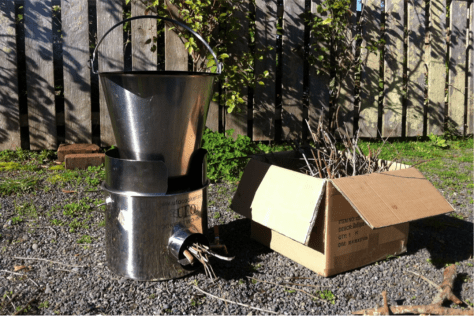
This past week at the Eco School we brewed an all Kiwi IPA, made with New Zealand hops, malted barley, filtered rain water, and some last minute ingenuity. This brew was completely unique to anything I had done in my 7 plus years of home brewing. We started by heating the 13.14 L of mash water to a temperature of 75 C using the rocket stove and a high quality stainless steel bucket. We went ahead and heated 24 L of water in total, 12 in the bucket and 12 in the water jacket of the rocket stove, as this was the full capacity of both vessels. We wanted to get the most out of the energy used, and we would be needing an additional 16.125 L of water for the sparging process. Once our water hit the correct temperature we added a little more than half of the total volume to our mashtun. In this case our mashtun was a 30 L fermenting bucket lined with a bag made from sanitized wind netting, hand stitched the previous night, all nestled in a large box lined with heavy blankets for insulation. While the mash was doing its thing, which takes about an hour, we added approximately 5.5 L of water to the rocket stove and kept stoking the fire until the water reached 77.2 C. After sparging, we had collected a total of 28.4 L of wort, we then split the liquid into two containers and started the one hour boil. We had 5 separate hop additions comprised of Rakau, Motueka, and Riwaka hops all added at different times throughout the boil. After primary fermentation, we will be utilizing a sixth dry hop addition of Riwaka hops, dry hopping during secondary fermentation will add a wonderfully fruity nose to the finished beer. Finally we moved onto the last few steps which are chilling the wort, aerating the wort and pitching the yeast. This is the only stage of brewing in which we want to introduce oxygen into our beer, all steps after this we will be doing our very best to avoid oxidizing our beer. In about two weeks we will be bottling our beer in some bottles generously donated to us by the nice folks at Yeastie Boys Brewing via Beervana. After secondary fermentation completes we will be bottling our brew, the following week will be filled with prayers to Ninkasi (the goddess of fermentation) in hopes that our hard work is rewarded with a tasty, refreshing beverage.

Until next time, Patrick

Permaculture Update: Sharing with Interns

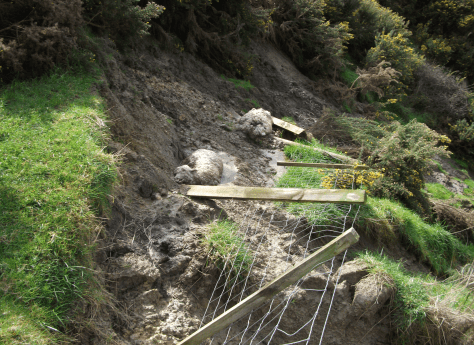
We have been very busy lately on the farm and have three interns helping us recover from the June floods and preparing for a resilient future. Here is a picture of the largest slips on our property.

Screen Shot 2015-08-30 at 7.48.36 am

I have counted 13 dead sheep on the neighbouring farm, including these two.

Screen Shot 2015-08-30 at 7.48.17 am

The above slip was caused in part by water pooling up behind it. With a simple, shallow drain we are able to divert most of that water away from this vulnerable hillside.

Screen Shot 2015-08-30 at 7.49.13 am

The drain is less than 10 metres long and only about 10 cm deep.

Screen Shot 2015-08-30 at 7.49.34 am

The drain is just below this odd piece of geography on our farm. The fence goes up the hillside and then right back down.

Screen Shot 2015-08-30 at 7.47.41 am

We will fence off this hillside and plant it to manuka.

Screen Shot 2015-08-30 at 7.56.01 am

Elsewhere on the farm, we can see the second stage of ecological succession as ponga are growing underneath gorse, which stabilises the slopes and adds nitrogen to the soil. It will be taken over by native bush over time.

Screen Shot 2015-08-30 at 7.50.01 am

Here is a view down the valley.

Screen Shot 2015-08-30 at 7.55.35 am

Up the hill in zones 1-2-3, we have been busy propagating black currants…

Screen Shot 2015-08-30 at 7.54.24 am

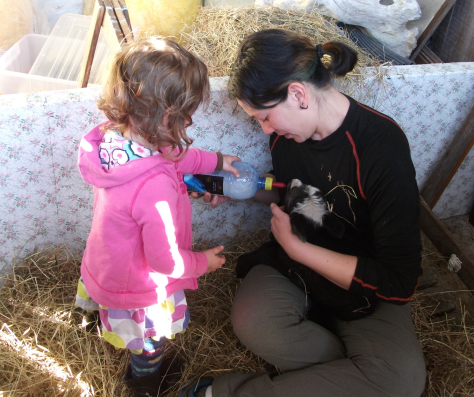
… feeding lambs…

Screen Shot 2015-08-30 at 7.53.00 am

… brewing beer…

Screen Shot 2015-08-30 at 7.54.00 am

…sniffing plum blossoms.

Screen Shot 2015-08-30 at 7.46.35 am

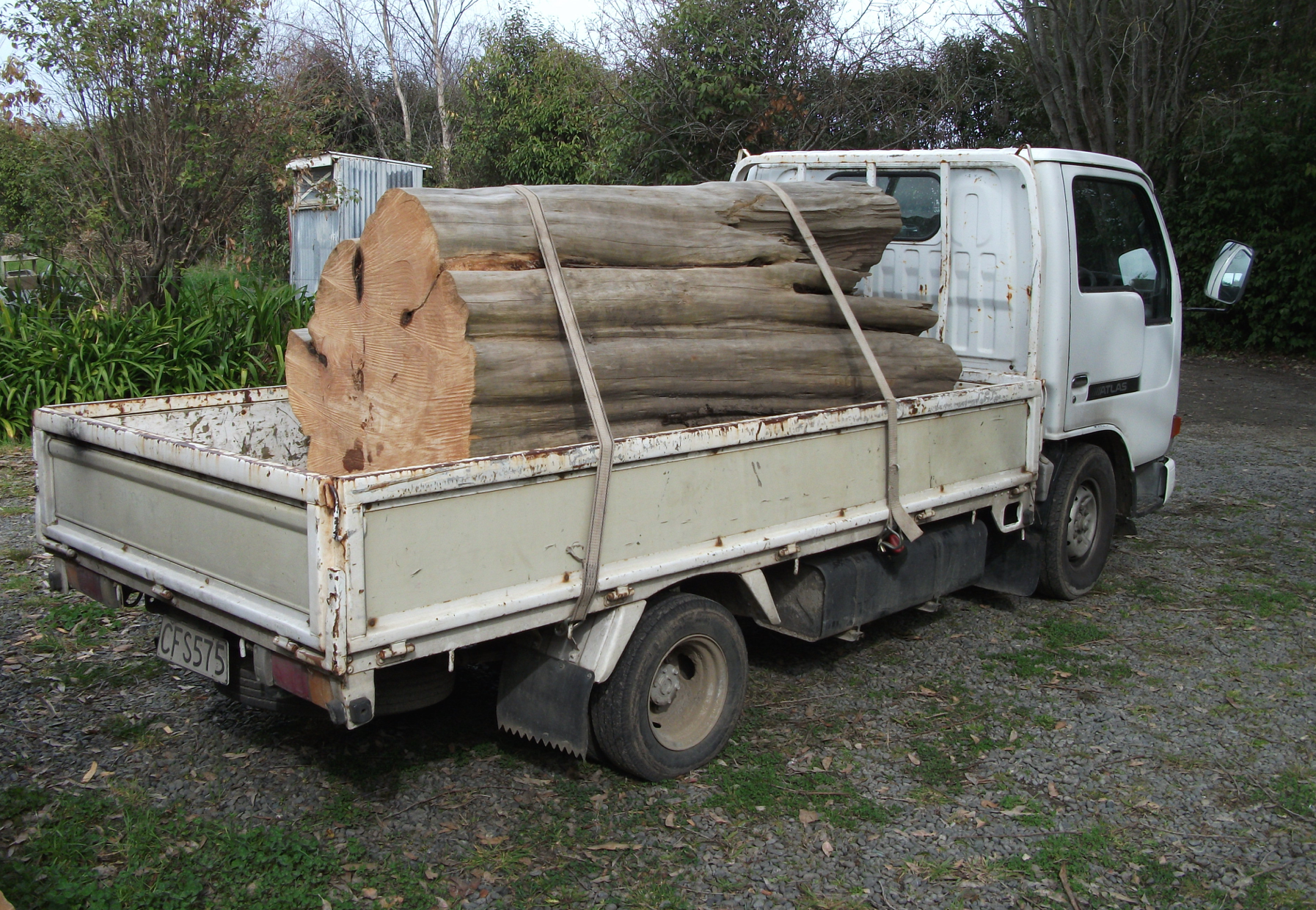
Our mate, Simon, has brought this macrocarpa log over to mill into slabs.   Screen Shot 2015-08-30 at 7.54.44 am

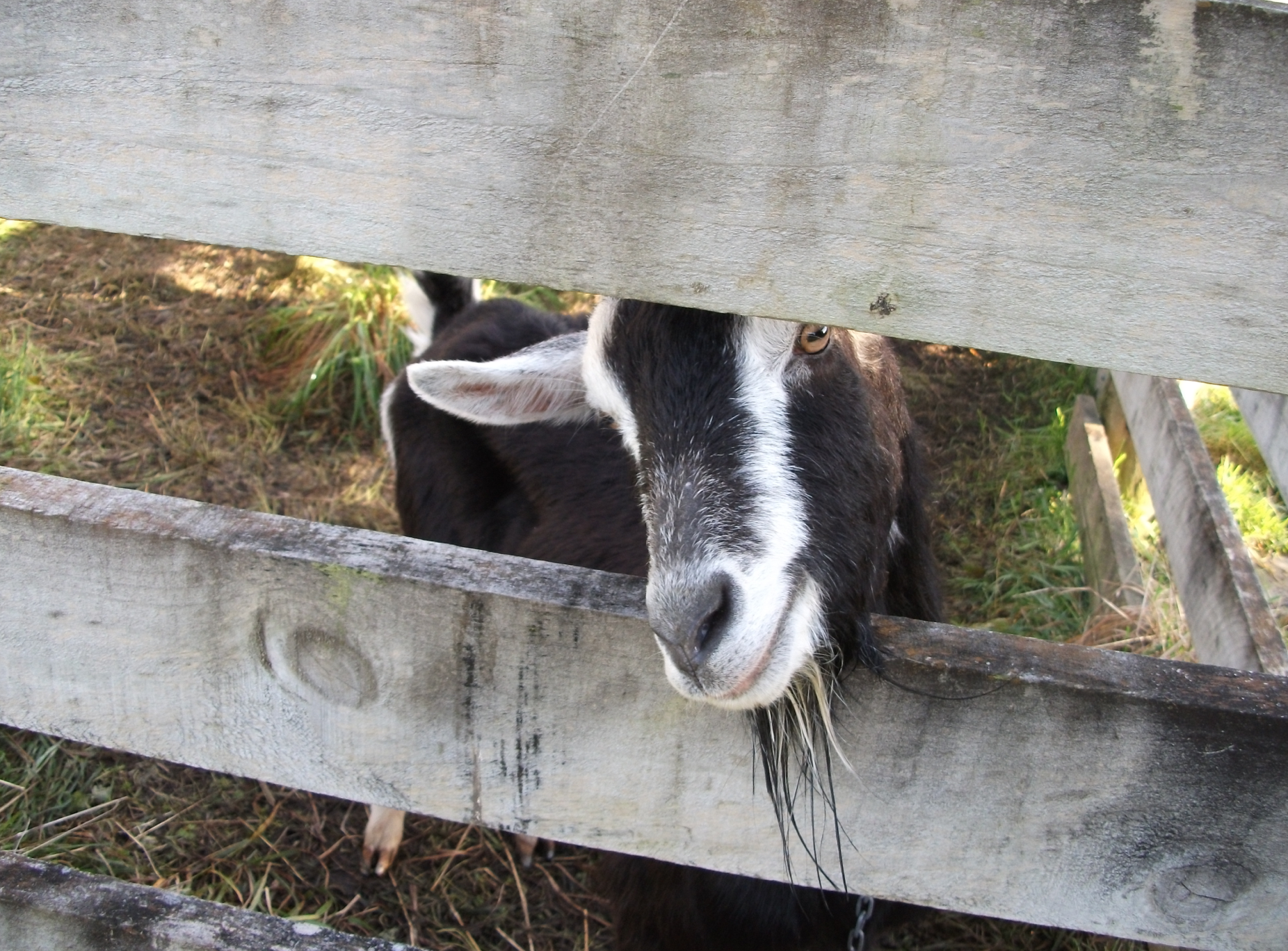
We were given this goat, Buster, on Friday.

Screen Shot 2015-08-30 at 7.53.37 am

Kelly the intern has drawn a zone 1-2-3 map.

Screen Shot 2015-08-30 at 7.52.30 am

Kaitiaki Farm.

Screen Shot 2015-08-30 at 7.51.54 am


Peace, Estwing

Plagiarism, Praise, and Poplar Poles

Have you noticed that those who demand to be credited are often the last to give credit to others? It’s one of those odd paradoxes of life. However, with an increase in “intellectual property” lawyers and the corporations that hire them, it appears that the trend is going the other way. I heard recently that a fish n’ chips shop in the South Island called “The Cod Father” is being sued by a Hollywood studio.

Some may consider this an over-the-top reaction, but we may see more and more cases like this, with potentially significant impacts on New Zealand because of the Trans Pacific Partnership (TPP) deal and a failure to take plagiarism seriously by some sectors of our society.

A prime example is the highly publicised 2009 case of plagiarism against Witi Ihimaera in a book entitled The Trowenna Sea. What was far more intriguing than the plagiarism itself was the response from Auckland University, expressing publicly that it was a small offence. Beyond that, vice-chancellor Stuart McCutcheon claimed in an email to staff and students that public comment on the matter of Professor Ihimaera’s indiscretion was ill-informed. Nonetheless, Ihimaera recalled all copies of the book.

At the time this story was in the news I was marking papers at another university and found plagiarism rampant among students. After spending hours tracking down and documenting each original source that went un-cited, the course convener advised me not to pursue any cases of academic dishonesty.

What surprised me at the time was that these two New Zealand universities took academic honesty less seriously than the high school where I used to teach in the States. In both university cases, administrators made the choice not to take plagiarism seriously.

Interestingly, I got the same response after I pointed out that a Wanganui District Council officer plagiarized significant sections of an opinion piece published in the Chronicle written under a WDC byline. Granted, WDC is not an academic institution but surely this is not a good look for council and would not inspire confidence among ratepayers.

In my opinion, there is nothing wrong with citing sources and it actually makes one’s argument more robust. At the same time giving credit where credit is due and acknowledging other’s great ideas and good work enhance one’s own work.

For example, during the renovation of our Castlecliff home I was generous with praise for our local building inspectors and the fundamental elements of the building code. Everyone we dealt with in Building Services was helpful and professional, and by renovating our home through the proper channels we were able to prove that a warm, dry, low-energy home does not have to be made of sticks and straw, and built in the wop wops without consent.

Another example is all the wonderful businesses and organisations that partnered with us to provide free and independent advice on healthy homes to our community. Shouting their praise gave Project H.E.A.T. (Home Energy Awareness Training) more credibility, not less.

Another organisation that deserves huge credit is Horizons Regional Council, and particularly the staff at the Wanganui office. It is difficult to heap enough praise on them and the vision of HRC on holistic watershed management. The professional advice I have received on a number of occasions has been invaluable and the three metre poplar poles delivered to my door are already protecting vulnerable slopes on our land and will ultimately reduce peak flood levels – albeit just a tiny bit – for our friends in Anzac Parade. Screen Shot 2015-08-28 at 10.53.10 am

Finally, it is my pleasure to acknowledge Adult and Community Education Aotearoa for supporting Adult Learners Week – He Tangata Matauranga for the third year. Together we have been able to provide over 20 free workshops on topics ranging from growing fresh vege to understanding your power bill.

THANK YOU to all of these groups that make our community healthier and more resilient!

Sidebar:

Adult Learners Week – He Tangata Matauranga

Sunday 6th 2-3 PM. Best Heating Options for Your Home, Central Library

Tuesday 8th 5-6 PM. Hot Composting, 223 No.2 Line

Wednesday 9th 4-5 PM. Reducing Heat Loss Through Windows, Gonville Café Library

Friday 11th 4-5 PM. Managing Moisture and Condensation, Gonville Café Library

Friday 11th 6:30 PM. Solar Energy, CANCELED

Saturday 12th 4:30-5:30 PM. Best Gardening Tools for You. Josephite Retreat Centre, 14 Hillside Tce.

Sunday 13th 4-5 PM. Tomatoes Before Christmas. Wanganui Garden Centre, 95a Gonville Ave.
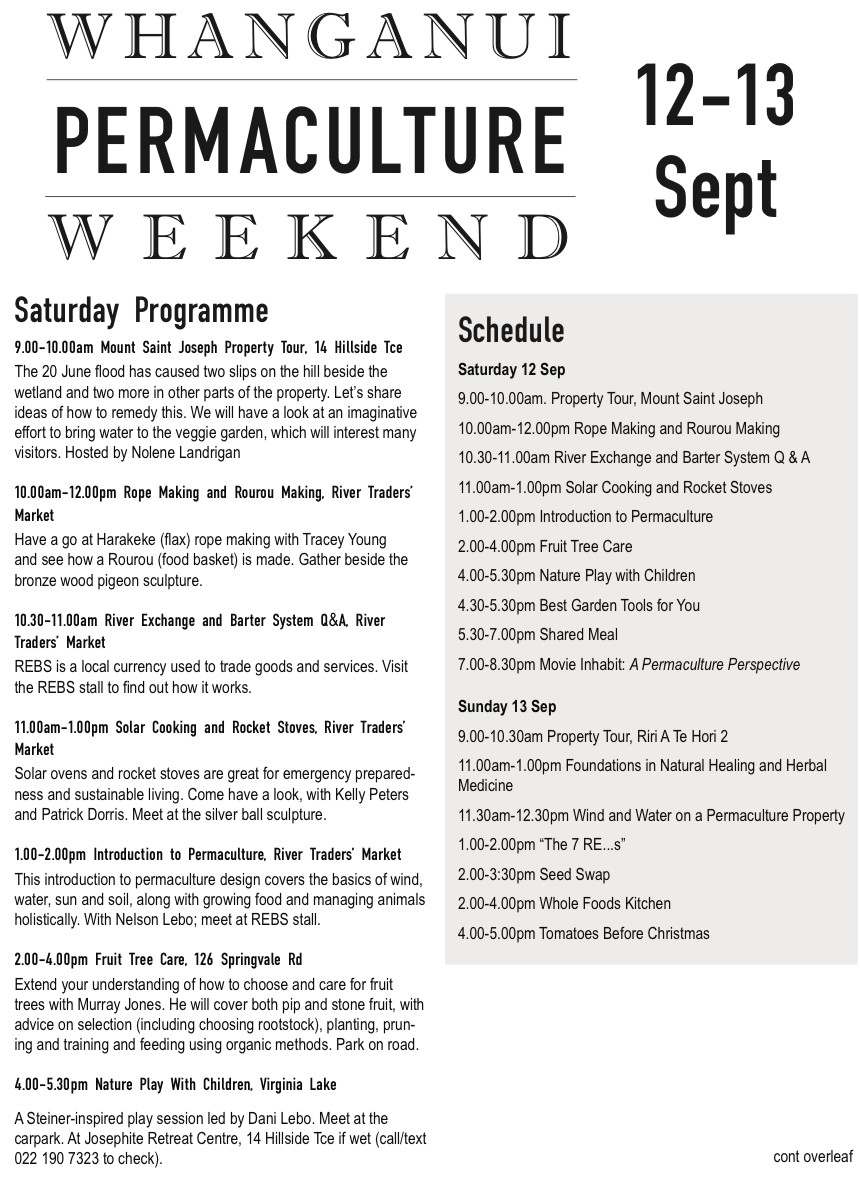
Juan Anton: Permaculturist Supremo!

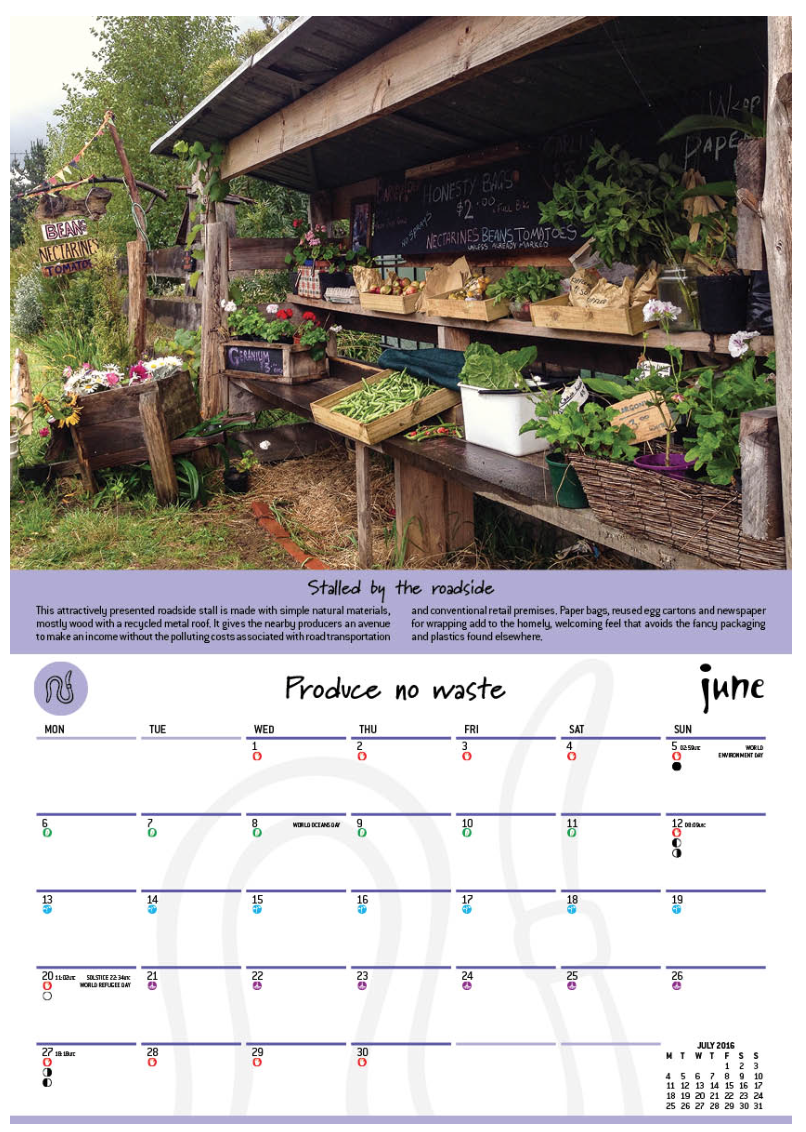
The 2016 Permaculture Principles Calendar features Juan Anton on the cover. Here is a little more about him.


78 year old Juan Anton Mora runs 40 minutes several times a week. What is his secret? A healthy lifestyle and a wish to change the world must have played their part. Because the purpose of each of his actions is to “change the world”, or to be more precise, to fight hunger in the world. No less.

Continued: http://permacultureprinciples.com/post/juan-anton-edible-forest/


In New Zealand, calendars are available from The ECO School. Email  theecoschool at gmail dot com

Guest Post: Kelly on Planting Trees to Stabilise Slopes

Greetings everyone, this is our first blog post as interns at the Eco School. We hail from Portland, Oregon USA and just started our 1 year New Zealand working/learning/traveling experience. The main goal of our trip is to learn more about permaculture, sustainable living and to learn about, and give back to the local communities we visit.

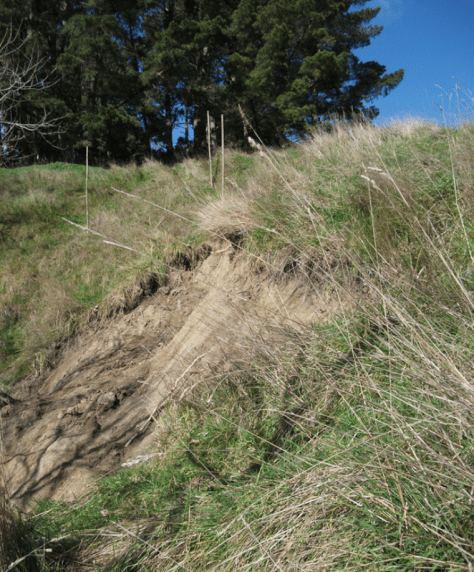
Before arriving in Wanganui we heard there had recently been some flooding. We had no idea of the severity of this flood. When we arrived, about 6 weeks after the major flood, it looked like the river was still way above normal level. There were still traces of silt on the streets and in the grass of the parks. We walked into the i-Site, or tourist info center, and saw a red line on the pillar above our waist height marking that this was the highest flood level ever recorded in Wanganui history. As we drove up the hill to our new home for the next six weeks, it looked like a hungry giant had taken multiple bites out of them. There were slips and erosion occurring everywhere we looked.  Screen Shot 2015-08-20 at 6.12.07 am

Slips far and wide. 

There is no doubt that climate change and many other factors have led to this disaster. The hills are wasting away and sometimes taking a couple of sheep with them. Some homes that were built too close to the edge looked like the Titanic going down. You can see the vast difference in the soil quality before and after the slip. Needless to say, there’s lots of work to do!

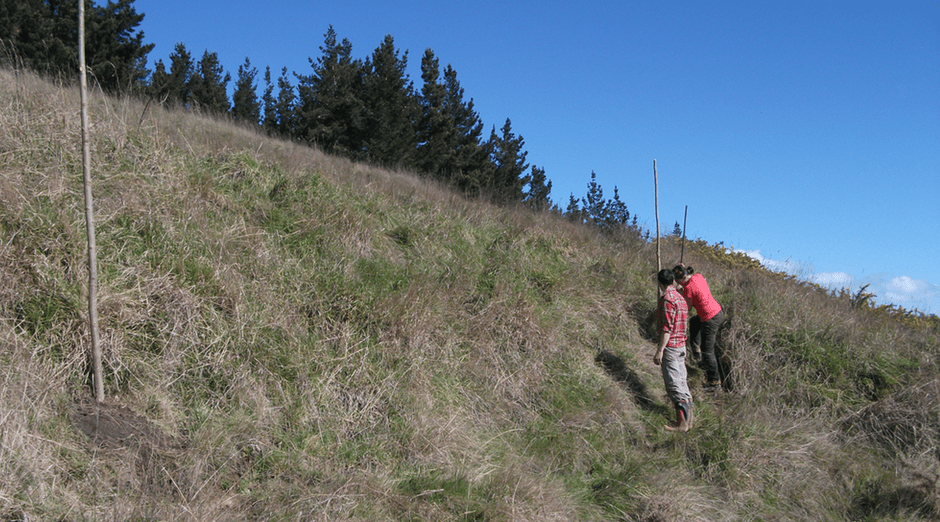
One of our tasks has been planting poplar trees. We planted 20 trees in various spots along the hillside near slip areas to help with erosion control. They also serve as wind breaks, moisture and flood control, and they can be used for animal fodder in drought season. Permaculture design rule: everything must serve at least three purposes, check.

Screen Shot 2015-08-20 at 6.11.33 am

Poles above a slip. 

They were a cheap, easy to plant, low maintenance variety that was recommended by the council. At only $7 each, you get a 3 meter high tree. To plant them we dug out as small of a hole as possible that was about 60 cm deep. This sounds easier than it was, with the clay and moisture in the soil, we had to get down on hands and knees and stick our arms in up to our elbows to pull out the dirt. It would stick to the shovel so you’d have to kick it off with your boot. By the time we were done our boots were 5 kilos heavier! We stuck the tree in on one side of the rectangular hole so that the soil only had to be tamped on one side.

Screen Shot 2015-08-20 at 6.12.20 am

Patrick tamping away. 

We then used top soil that was collected from the some of the slips to fill the holes. Most of the soil we dug out was clay, so the top soil will give the tree more organic material and a better chance at taking root. Then we tamped, stamped, tamped and packed some more. Got to make sure these guys don’t move until they’re roots are established.

Screen Shot 2015-08-20 at 6.11.08 am

Poles in the ground.

One and a half days later, they’re in and ready to start growing, soaking up the extra moisture, rooting down the hillsides and protecting the beautiful land and animals at the farm. It feels good to be putting something back into nature.

Until next time, thanks for reading.

-Kelly

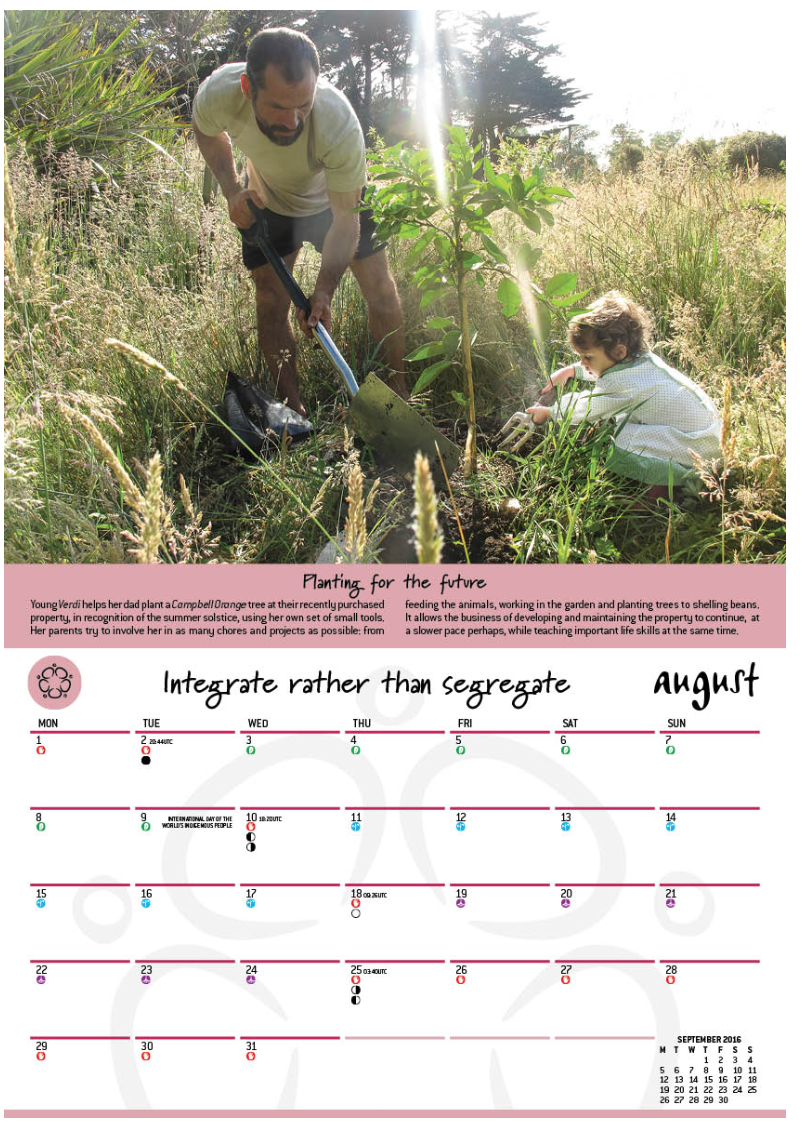
2016 Permaculture Principles Calendar and Moon Planting Guide

“Internationally relevant and filled with inspirational and thought provoking images that support and reinforce your values every day of the year. Learn each of the 12 design principles over the course of a month and be reminded of suitable garden activities with daily icons and phase times according to our moon planting guide. Now with a rainfall / temperature chart.”

Screen Shot 2015-08-16 at 7.45.34 am

Available in New Zealand only from The ECO School.

RRP: $18 post paid anywhere in NZ. Two for $32 post paid.

Bulk Discounts Available.

Available in Whanganui and Palmerston North at discounted rates for pick-up orders. Enquire.

To order, contact theecoschool at gmail.com

Screen Shot 2015-08-16 at 7.46.13 am Screen Shot 2015-08-16 at 7.46.00 am Screen Shot 2015-08-16 at 7.45.46 am

“Organise your garden, your life and share your schedule with this deceptively simple but thought-provoking permaculture calendar – for your home or workplace. Illustrating one of the twelve permaculture design principles for each month, gives you the time to absorb them. Each example includes and image and story of locally appropriate sustainable living and design.

Including a planting guide that can help yield more productive crops and healthier plants by planning your garden activities according to the moon phases. Exact phase time changes along with daily icons enhance the traditional gardening rhythms that have been handed down over the centuries.”

Screen Shot 2015-08-16 at 7.46.28 am

“The permaculture calendar is made from 100% post consumer recycled pulp on certified carbon neutral paper that is manufactured and printed in Australia using 100% renewable energy.

The calendar’s size and weight take advantage of standardised postage and reduced freight costs. Printing plates and paper waste are all recycled. Inks are vegetable based so don’t release unnecessary VOC’s into the atmosphere or require harmful solvents for clean up. Once the calendar has reached the end of its life you can recycle or compost it, hang the pictures, or keep it intact as a reminder of the principles and important events over the year.

While the production effort does a lot in limiting its impact on the earth and the people in the process, we’re also demonstrating the ethic of Fair Share by donating 10% of the net return from sales of the calendar to Permafund, supporting permaculture projects internationally.”

Peace, Estwing

Late Winter Permaculture Update

Although we have had a few more frosts this week, there are also signs of spring. There are buds on the plum trees.

Screen Shot 2015-08-12 at 8.47.39 am

The garlic is taking off.

Screen Shot 2015-08-12 at 8.49.19 am

New growth has appeared on the Chilean guava.

Screen Shot 2015-08-12 at 8.46.15 am

The winter veggie garden is picking up speed.

Screen Shot 2015-08-12 at 8.47.24 am

We have been busy planting vulnerable hillsides with trees.

Screen Shot 2015-08-12 at 8.45.46 am

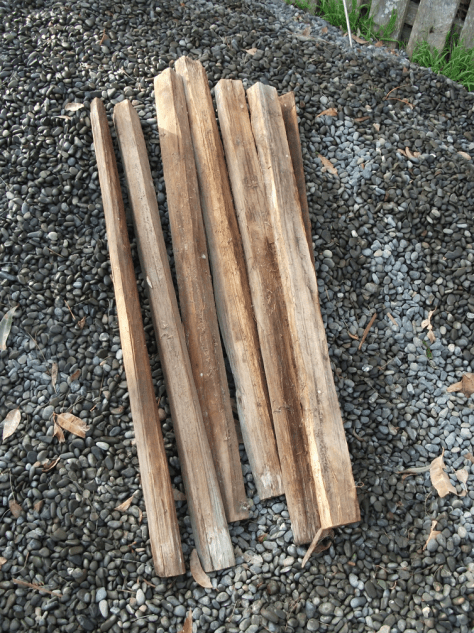
In order to keep the sheep out of the trees we have had to add battens to the eight wire fences. I found totara battens to use instead of treated pine.

Screen Shot 2015-08-12 at 8.49.09 am

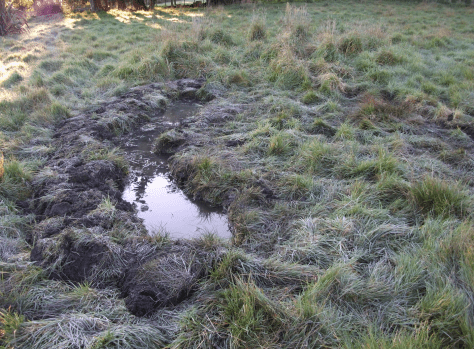
We have also begun digging a new pond.

Screen Shot 2015-08-12 at 8.45.28 am

We’ve also had some cool things arrive in the post that we will be selling locally at discounted prices. This rocket stove crossed with a thermette is pretty cool.

Screen Shot 2015-08-12 at 8.48.47 am

Iconic permaculture book for sale below retail price.

Screen Shot 2015-08-12 at 8.48.14 am

Get ready for summer with a solar cooker.

Screen Shot 2015-08-12 at 8.47.50 am

It’s here! The 2016 Permaculture Principles Calendar.

Screen Shot 2015-08-12 at 9.11.05 am

For the third year in a row, Verti has made the calendar.

Screen Shot 2015-08-12 at 8.45.07 am

If you are interested in any of these products, please contact us.

Peace, Estwing

TPPA: How Predictable!

Editor’s note: This is another weekly column in the Wanganui Chronicle.


Thanks for the great feedback on last week’s column. Despite the vindictive image of Wanganui that was encapsulated in the initial response to Duncan Garner’s visit to our beautiful city, there are indeed many thoughtful, reflective and open-minded residents.

I admit that my conservative views do not suit all readers and I apologize for forcing them upon you week after week. I’m the guy who spent four months working on drainage around his house just before we were hit by a once-in-85-year rain event.

Above all else I believe an ounce of prevention is worth a pound of cure. If you have been brought up on the metric system instead of imperial measurements, here is a translation: 28.3 grams of prevention is worth 453.6 grams of cure. Doesn’t exactly have the same ring to it, eh?

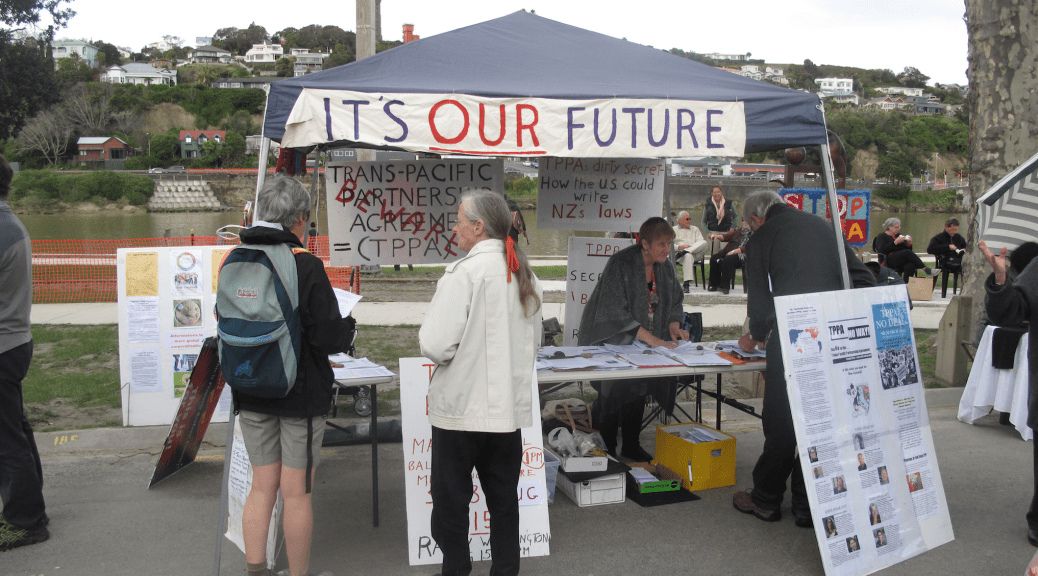
‘Prevention’ has the same type of prefix as ‘proactive’. Even ‘prefix’ has that same…prefix. Any way you slice it, it’s about addressing an issue before it becomes a problem. One great example has been our community’s long and sustained effort to raise awareness about the likely problems that will result if the government signs onto the Trans Pacific Partnership Agreement (TPPA).

In late 2013 I contacted Chronicle editor, Mark Dawson about writing a piece on the TPPA. He gave the green light and as far as I know it was the first appearance of the secretly negotiated treaty in our local press. Here is what I wrote:


“Fortunately for democracy, some material from the TPPA has been leaked, including a 95-page excerpt published by WikiLeaks in Mid-November. Following that leak, the Herald (14 November, 2013, NZ WikiLeaks Scoop) reported that information in the excerpt includes disputes between New Zealand and US negotiators on issues of internet freedom, industrial innovation, ownership of endemic plants and animals, and, near and dear to my heart, access to affordable medicines.

“From the Herald, ‘A large section reveals the battle between the US pharmaceutical lobby and countries such as New Zealand that want to continue to buy cheaper generic medicines.’

“In order to dissect this sentence we need to know a couple of facts: 1) the utmost duty of a corporation is to return profits to its shareholders; 2) the US – where corporations have used lobbyists to sculpt health care policy – has the most expensive health care system in the world while ranking close to 40th in performance by the World Health Organization; 3) New Zealand health care remains reasonably priced in part due to the ability to bulk buy generic medicines.

“Using the numbers above in a mathematical equation: 1 – 3 = 2. In other words, if pharmaceutical corporations have their way through the TPPA, NZ health care will more closely resemble that of the US.

What this means for Whanganui is that our already strapped health services would become even more so. For example, the funds now available to pay a doctor may have to be shuffled to cover the increased costs of medicines. Along with the dollars vacuumed away, we would lose a valuable human being who lives in our city, owns a home, pays rates, and buys local products. Every dollar associated with that doctor’s salary would be wisked away to New York, San Francisco, or Hartford. We lose, they win.

I reckon it is our democratic duty to do our best to resist corporate influence globally and locally, but we need to do so proactively. Once the deal has been done, it won’t easily be undone.”


Last week the Prime Minister admitted that under the TPPA some medicines would cost the country more. If only he’d read my column two years ago he would have been way ahead of the game!

Without the assistance of a crystal ball I was able to ‘see the future’ because I am a strong believer in research, data, patterns, and evidence-based decision-making. Despite what radicals might think about secret trade deals, climate change, income inequality, and boosting regional economies, I’ll stick to my Ounce-of-Prevention ideology metric system be damned!


Sidebar: March and Rally Today!

1:00 PM. Gather at Silver Ball sculpture at the riverside.

1:15 PM. Rally at Majestic Square.

Holistic Land Management: Permaculture Design in Motion

One year after arriving on this piece of land we are well on our way to developing a premier permaculture property. Like our model suburban permaculture project – the Eco-Thrifty Renovation – we intend to use this as a model for resilience education in our community and worldwide.

Screen Shot 2015-08-02 at 9.00.42 am

We call this property Kaitiaki Farm. In Te Reo Maori, kaitiaki means guardian. It is the weightiest word I have ever come across in my life, and I do not take using it to name the farm lightly. If our first child had been a boy, Kaitiaki would have been his middle name.

Screen Shot 2015-08-02 at 8.59.23 am

This extraordinary piece of land has all the makings of a textbook permaculture property and an excellent way to teach best practice in low-input / high productivity land management. It is also a great opportunity for those who want to learn by seeing a ‘work in progress’, I reckon there may be no better place in the world.

Screen Shot 2015-08-02 at 8.59.05 am

From big concept ideas to specific details, Kaitiaki Farm is a living, breathing permaculture textbook. Most of us learn by doing, so why not consider coming along to the Whanganui Permaculture Weekend 12th-13th September (more details to follow) or coming to a full-day workshop on Sunday, 27th September.

Screen Shot 2015-08-02 at 8.58.53 am

We believe in offering the highest quality resilience education and that money should not be a barrier to attendance. The Permaculture Weekend is free to attend, and all of our workshops run at half what others charge. When it comes to excellence in community resilience education, there should be no compromise.

Screen Shot 2015-08-02 at 8.58.12 am

The workshop will cover many aspects of permaculture, including: designing for wind and water; tractoring birds; improving soil structure; composting; swales and drains; nurse trees; slope stabilisation; trees as fodder; pollarding firewood; alley cropping; drought-proofing; market gardening; developing and managing a food forest; scything; and more.

Screen Shot 2015-08-02 at 8.58.34 am

Peace, Estwing