Category Archives: Eco Thrifty Life

Is there an H in Hypocrite? Climate Change Denial

Editor’s note: This ran as an opinion piece in the Wanganui Chronicle on Friday, 27th December.
Beware those bearing H’s.
No, this has nothing to do with the spelling of W(h)anganui, although I suspect there is ample crossover with those who have come to embrace the word hypocrite when attacking individuals who speak out on climate change. In other words, it’s likely that the same people who do not want an H in Whanganui are more than happy to draw the mighty H from their quiver and quill as a first-line offensive against climate change activists and ordinary citizens who have the courage to bring up the issue in the press.
In our feel-good, consumer, deflect-blame Western culture, I reckon the worst thing you can call someone is a hypocrite. We all know that we do not live 100% by our values 100% of the time, but the last thing we want to hear is someone else telling us. I suspect it is part of a psychological defense mechanism.
Knowing this human tendency, the worldwide, corporate-funded climate change denial network has come to advise its “trolls” to use the term at every possible opportunity. Calling someone a hypocrite has become a common technique of climate change deniers when asking climate scientists or activists how did they travel to a certain conference, protest, or other event. It is meant to shut down the conversation before it begins by calling their credibility into question because they may have traveled by automobile or airplane.
In Whanganui, our Chronicle Letters Page climate change denial trolls – two of whom do not live anywhere near the River City – have learned this technique, presumably from an on-line tutorial from the right-wing Heritage Foundation or other such corporate-funded denial organization.
About six weeks ago, a local writer to the Chronicle – who appears to lack enough courage to use their first name when signing her or his letters – suggested I was a hypocrite for expressing my opinion that a predicted increased incidence of severe weather events would likely make clearing sand from the Castlecliff Beach car park more costly in the future. A prudent approach, I suggested, that would both save money (rates) and reduce pollution (carbon dioxide) would be to downsize the massive, underused car park in a managed retreat.
Of course the obvious response to this reasoned, win-win, eco-design solution is to call the messenger a hypocrite. Duh.
I have been called many things in my long and lonely life, but never a hypocrite. My street ‘cred’ is ‘legit’, yo.
I suspect that anyone who knows me would agree I am many things good and bad, but not a hypocrite. Regardless of political affiliation, it would be difficult to find a former colleague of mine willing to say I am nothing if not genuine in my words and deeds. Although I would not hold a candle to Buddha or the Dalai Lama, a colleague did once call me Bodhisatva. Go ahead and laugh, but this may be closer to the truth than you think. After all, I did teach Walter Becker’s son when he was in year 9, but do not remember if he took me by the hand during our parent-teacher conference*.
Although I share a car with my wife, I ride a bicycle and take the bus the vast majority of the time. I have traveled between Whanganui and Hamilton over a dozen times on board Intercity. When purchased a week in advance, the return fare costs less than half the price of petrol alone. Public transport reduces carbon emissions, and I have time to read, write and sleep on the bus.
I suppose this means those who wish to call me a hypocrite will simply say I’m self-righteous. With some people you cannot win, but that does not stop them writing letters to the paper, nor should it. Keep ‘em coming peeps, but please follow these simple instructions: do your homework first; only use quotation marks for direct quotes; include sources and references for anything that is not considered common knowledge; have someone proofread your work; Use your full name; and, above all else, don’t write anything that will end up embarrassing you in front of the entire city.
It takes courage to write something for public consumption, and I admire courage.
* In case you missed it, Walter Becker is ½ of Steely Dan.
Peace, Estwing
Swales and Rain Gardens for Water Management

It is encouraging to see the number of people engaging in meaningful dialogue about important local issues through the Letters page of the Chronicle. Sadly, too often these letters include references to failed attempts to work with Wanganui District Council on strategies that work with nature instead of against it.
For some reason, our Council appears stuck in the past on many issues of infrastructure and economic development. From most accounts, the 1950s were a great time to be alive, but in many cases ‘50s thinking no longer applies.
All of this makes it particularly significant that WDC Chief Water Engineer, Kritzo Venter, has been active and vocal about promoting progressive water management strategies that ‘mimic’ those that nature itself has developed over millions of years. (That is some investment in R&D, ain’t it?!?)
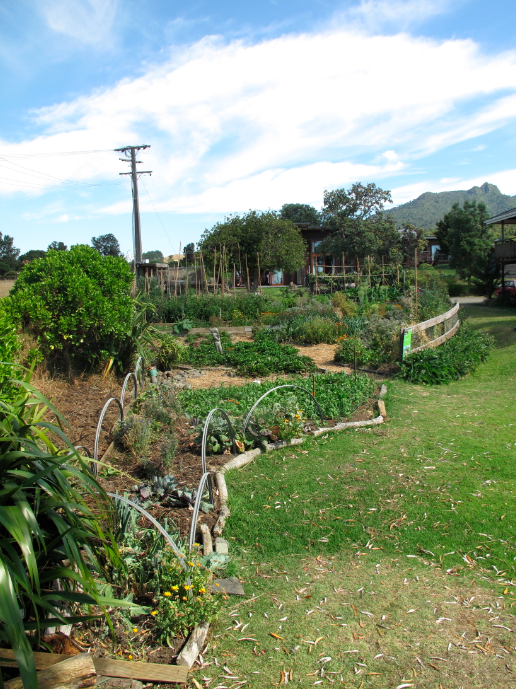
Small swale and rain garden. 
One of those water management strategies – swales – has been in use for decades in some places around the world. A swale is a long, narrow earthwork that runs perpendicular to slope. They slow the flow of surface runoff and facilitate infiltration into the ground. They are perfectly level, unlike ditches, which are sloped to drain water away like a river. Water in a swale soaks into the ground instead of running over it. A carefully constructed swale includes a level-sill spillway that gently allows it to be overtopped in a controlled manner in the event of extreme rain.
The use of swales is the type of win-win-win situation I write about in this column because it: 1) reduces stream and river levels during flood events; 2) increases groundwater reserves that can be called upon during periods of drought; and, 3) significantly reduces the overall cost of infrastructure. Eco-thrifty at its best.
For example, two years ago I was asked to consult on a proposed residential development in Kaiwhaiki that had significant drainage problems. I was told the 10-year-old quote to ‘solve’ the problem the ‘old way’ using pipes and culverts was for half a million dollars. After picking my jaw up off the floor, I told them that good eco-design, which would include cluster housing and the use of swales, would significantly slash that price. WDC Chief Planner, Jonathan Barrett, appeared supportive of those ideas during one meeting held at Council.
The other strategy promoted by Kritzo – and praised by Chronicle assistant editor, Anna Wallis – is the use of rain gardens. A common use of rain gardens is to absorb and filter runoff from new parking lots or other such impermeable surfaces. In this way, rain gardens function like wetlands: sponging up excess water and cleaning it through natural processes.
A series of mini-swales and vege gardens make up this garden.
I first learned about rain gardens in 2005 while taking a certificate programme in the States on Organic Land Care. Shortly thereafter I advised a school to install rain gardens in a number of locations where they had persistent drainage problems. This was particularly meaningful in the context of the school because it became a relevant learning experience for students.
In 2009, while living in Raglan, I built a small management system to control an excess of runoff coming from the roof of a newly built outdoor kitchen at a campground. The system consisted of a swale, a level-sill spillway, and a rain garden. We planted the swale with feijoa trees and the rain garden with plants that tolerate periods of wet and dry.
Swales and vege gardens soak up water and keep it from flooding this lawn.
While in Raglan, I also used swales as a metaphor for eco-design during a Pecha Kucha night, where artists and designers share their work through 20 slides with narration of 20 seconds per slide. That presentation, “Thinking Like a Swale,” became the inspiration for a programme I offered at the Josephite Retreat Centre earlier this year to acknowledge the UN year of water. Hopefully, when River Week 2014 comes around next year, I’ll get a chance to present it again to compliment and support the education efforts Kritzo has already made in the community.
Us ‘swale-thinkers’ gotta stick together. It’s a watershed out there.

Conservative Like Me

Editor’s note: This piece ran today as an opinion in the Wanganui Chronicle. It is in response to some complaints by the (radical) right that there are too many ‘libral’ columnists. This should give you a laugh.

Saturday was the summer solstice, the longest day of the year: a time for celebration and the harvesting of garlic; a time for BBQs and surfing (although, always is also a good time to catch waves); a time to bask in light before the long and slow slide back into the darkness of winter.
Exactly three months ago – 21st September – I wrote the first of five opinion pieces that have appeared in the Chronicle. It may have been beginners luck, but I consider that piece, which linked research on income inequality to social problems, and then to the WDC rates structure, as the best of the lot. On the day it ran, I got a text from a surfing buddy that went something like this: “Awesome article in da paper, bro. Chur. Chur.” Another friend told me, “The Chronicle shouldn’t have labeled it as an opinion. That’s the type of investigative journalism they should be doing.”
Working with the editors of the Chronicle, I had planned specifically for the piece to run on the vernal (spring) equinox as a way to reflect on balance and imbalance in our world and in our city. If you believe the international research that shows a correlation between income inequality and social problems (The Spirit Level, Wilkinson & Pickett, 2009), and can perform basic addition, multiplication and division, you will easily recognize that the WDC rates structure serves to increase the wealth gap in our city, and the annual Council rates rises widen the gap each year. (More on this, hopefully, in 2014.)
The reasons I think it was my best effort include: it is based on respected research and clear local data; it is relevant to everyone who lives in Whanganui; it was written as objectively as possible; and, the equinox was a fine metaphorical launching pad for a critical discussion on this important local issue, although from what I can tell that discussion has not really been happening…yet.
But equinoxes are easy to write about, and peer-reviewed research and replicable data is so boring. Objectivity – Shmogjectivity! The solstice is a time to be bold, opinionated, controversial!
And in that spirit, I would like to point out what has become glaringly obvious in the pages of the Chronicle: So many radicals writing so many opinions. The Chron is clearly out of balance and needs more conservative voices like mine!
Who, besides me, will stand up for conserving natural resources, other than Nicola Young and the throng of writers in Monday’s “Conservation Comment”?
Who, besides me, will advocate for a conservative position on climate change, other than Nicola Young and the gaggle of writers in Monday’s “Conservation Comment”?
Who, besides me, thinks that selling high performing government assets to foreign private investors is risky, other than Nicola Young and the pride of writers in Monday’s “Conservation Comment”?
Who, besides me, embraces the precautionary principle when considering the potential impacts of hydraulic fracturing, offshore drilling, iron sands mining, and genetic engineering, other than Nicola Young and the flock of writers in Monday’s “Conservation Comment”?
I mean, give me a break! Am I the only one, along with all of these other conservatives, who thinks wasting energy, wasting money, and wasting resources while taking radical positions on the economy, society, and environment must be addressed in a public forum?
We need more conservative voices in the Chronicle to address the radical policies of extremists that put our economy and social structure at risk.
Please join me, fellow conservatives, to stand up for risk aversion, fiscal responsibility, and the precautionary principle. Together, our combined voices and the power for the press may be able to move this new Council toward truly conservative positions. Let the radicals take the Letters page, if we can dominate the Opinions! 

Value in all things Vintage

After looking at last week’s column, I must hand it to the Chronicle editors for their mastery of the pun when writing captions for photographs. I thought I was good at word play, but I can’t handle a candle (you see there, that’s alliteration) when compared to the punsters in their new offices at the corner of Guyton and St. Hill streets. I doff my cap-tion to you, sirs and madams of our local press.
But in the world of puns, allusions, and similes, in the words of David St. Hubbins and Nigel Tufnel (This Is Spinal Tap, 1984); “It’s a fine line between stupid and, uh…”
“Clever.”
While this week’s column addresses many things vintage, it seeks to do so only with respect.
Among the many values we hold dear to eco-thrifty renovating and living is seeing potential value in building materials no matter their age or surface appearance. We have found time and again, that below the rough surface of many a piece of 100 year-old native timber beats a heart of rock-solid, tight-grained integrity.
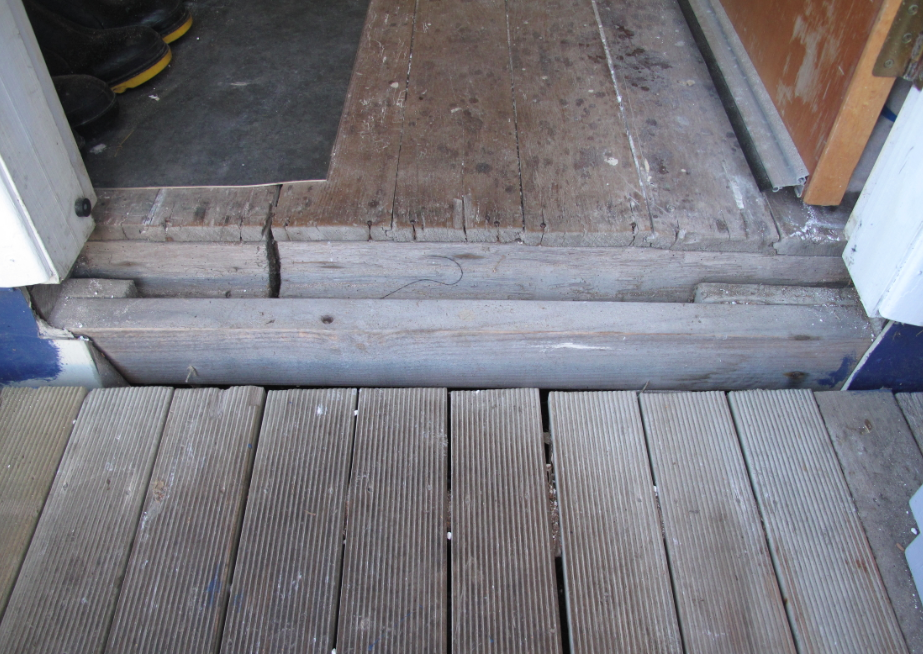
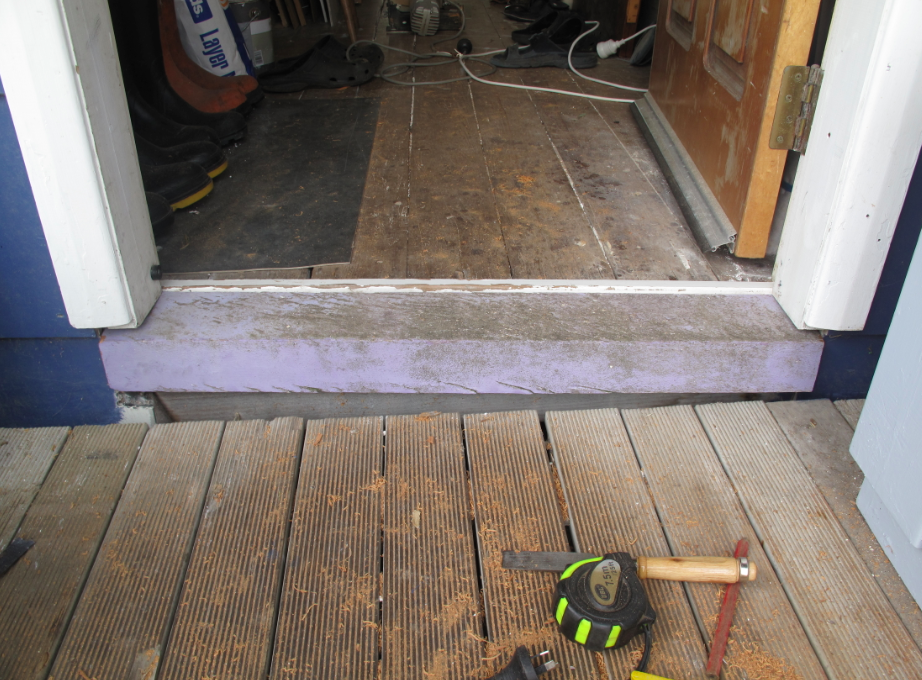
We have re-used beautiful, durable native timbers in many ways throughout our renovation. One of the latest examples – and last touches to our nearly finished home – is the threshold at the front door. Regular readers will recall I recently made reference to the fact that on day one (also on day 1,000) we had a gaping hole beneath our front door where one would expect to see a sloped sill, or some such piece of timber.
No Joke: No Hearth
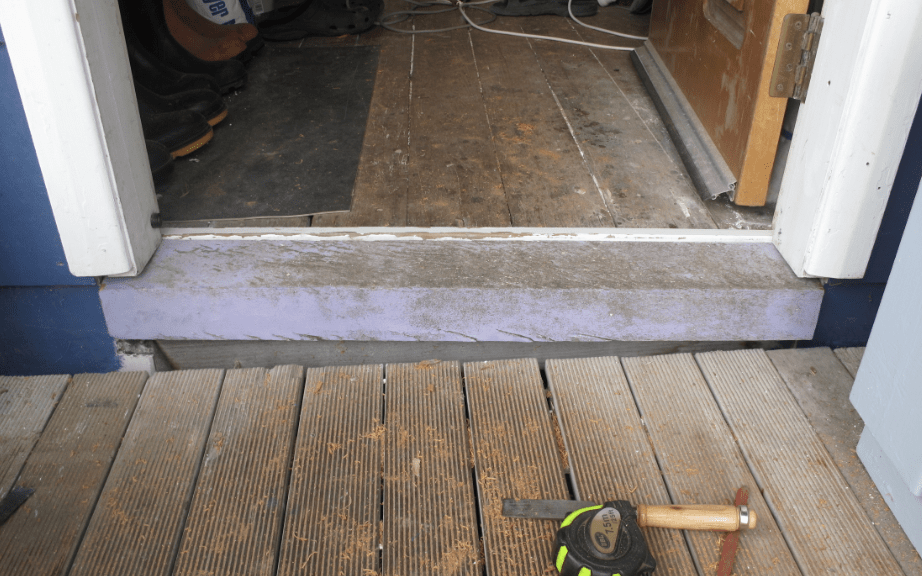
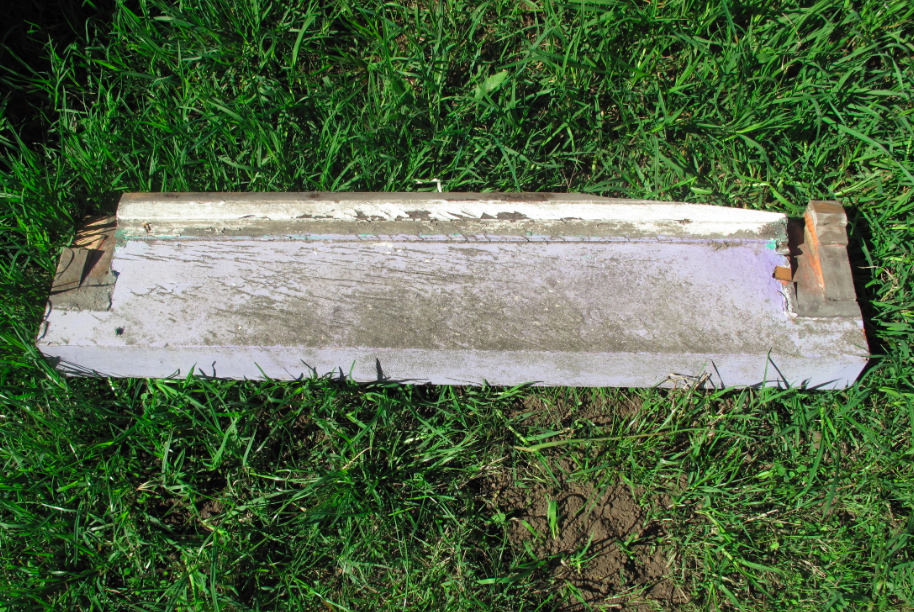
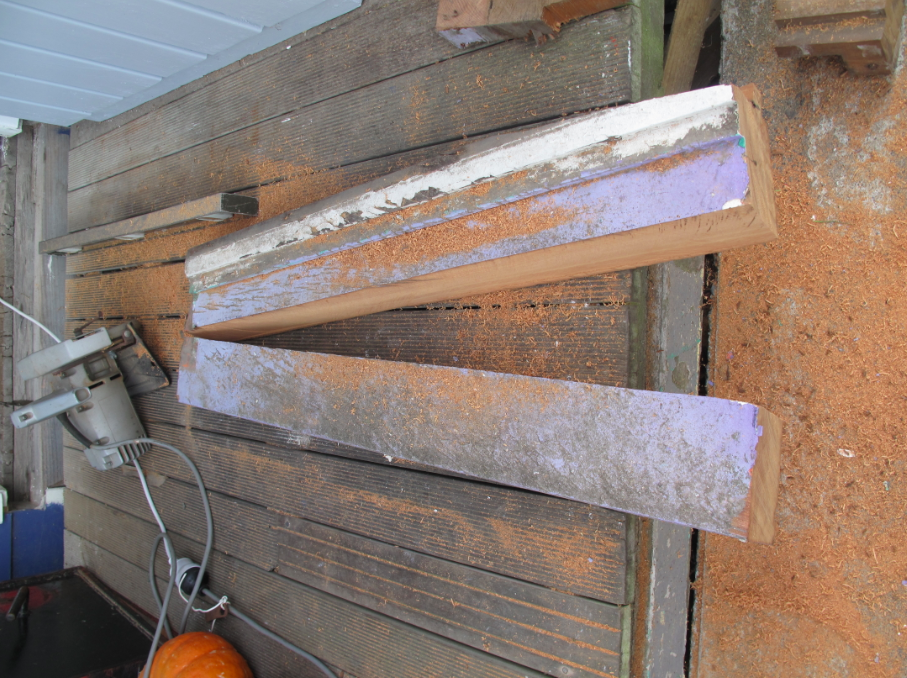
But no – just a hole that remained until I got to item number 1,478 on my list of things that needed to be done to the villa. In April of this year, I tracked down one of the original windowsills that we had removed and tucked safely away in October, 2010. As plainly seen in the first photograph, its surface was worn and weathered from 100 years of Whanganui storms, showers and sun.
Old window sill
But beauty is only skin deep, and integrity comes from the heart, whether it is heart rimu, or another dense, native hardwood. After 100 years exposed to the elements, the sill had not a single borer hole of speck of rot. I cut it to length, and ripped it to width, nearly burning out the motor of my saw.
Hard-as timber
In houses and in human beings, there are those that look nice on the surface and those with integrity underneath. Some may have both, some may have neither, and some may have one or the other. Personally, I’d rather surround myself with walls and with people of integrity no matter how they look.
About two hours later
As a culture, we often disregard what is old, dated or worn. Often times our seniors feel the brunt of this ‘youth bias’ and may feel neglected, unwanted or of little value except when holidays come around and they find themselves surrounded by family for a brief period of time.
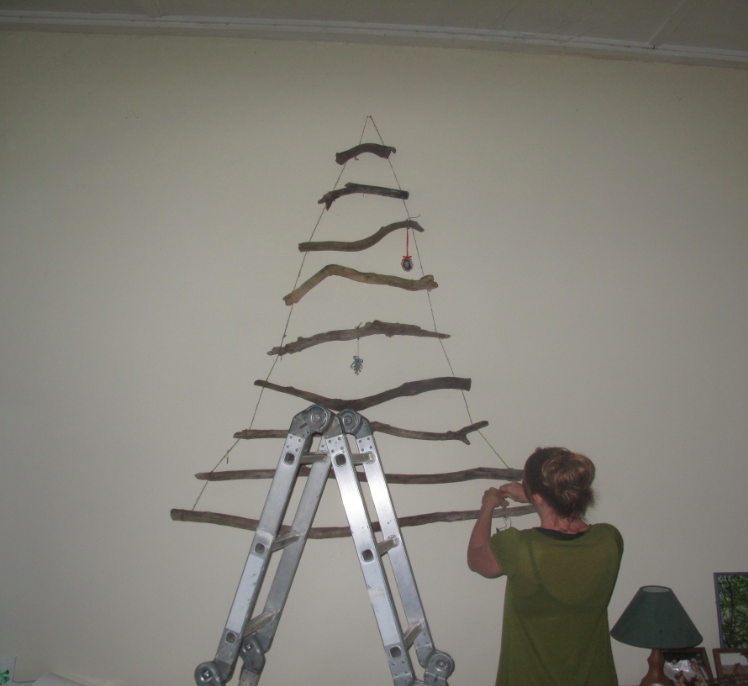
Eco-thrifty Christmas tree
But for those seniors who may not have family nearby or even in the country, the holidays may be especially lonely or depressing. With this in mind, we would like to invite any seniors who may find themselves alone this Christmas Day to an afternoon tea at 10 Arawa Place, Castlecliff, from 2 pm to 4 pm.
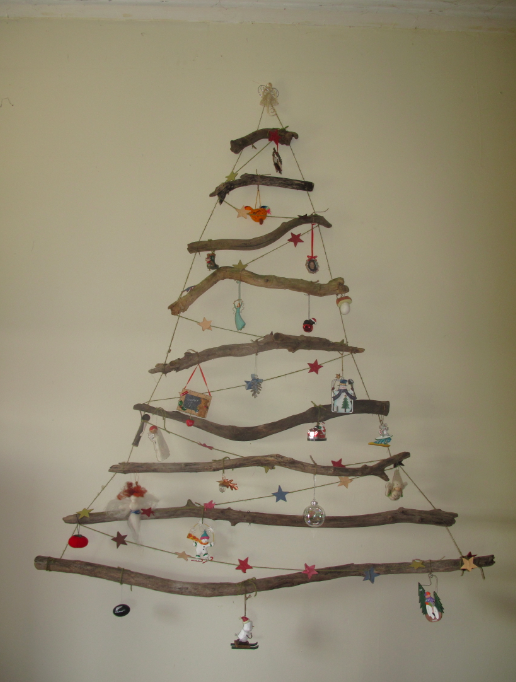
Fully decorated
We will have a platter of biscuits and a bubba that enjoys cuddles. We’ll have a grand, old time – no pun intended.

Peace, Estwing

Making Small-Scale Vegetable Production Pay

Any small-scale organic farmer or market gardener knows it’s very hard to make anything more than a minimum wage unless one has unprecedented access to a population that is willing to pay fair prices for high quality food. Paradoxically, the land values near these population centres are extraordinarily high, basically preventing small-scale farming or market gardening.

For the rest of us, it is a hard slog for the moment. I have three pieces of advice for the aspiring market gardener who wishes to make a fair wage for their skills and time: 1) find a niche product; 2) be first to market with a common product; 3) grow the best of the best of anything.

Finding a niche product, however, can be hard so I’ll focus on the other two for the moment.

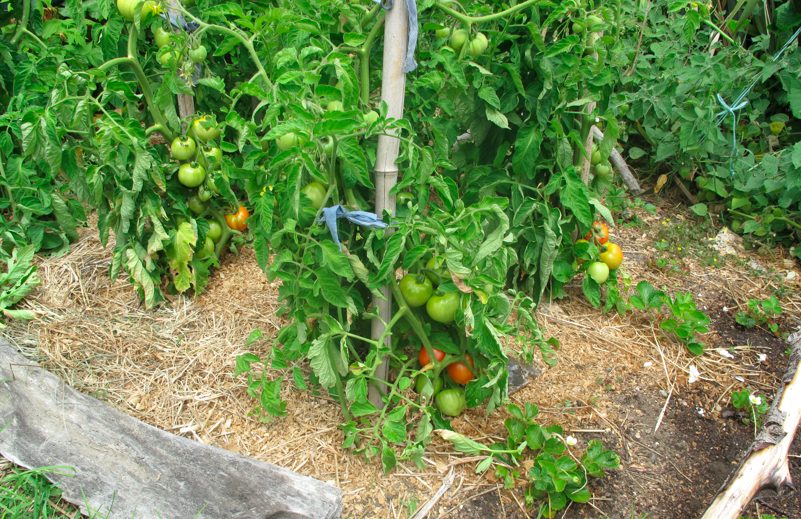
Last year I beat everyone to our local market with fresh, local, organic tomatoes by over three weeks. As such, I could charge a premium for being the first, and then drop out of the competition when everyone joined me and prices fell.

Being first to market means planting early varieties and getting them in the ground early.

It also means planting these early varieties in the hottest spots.

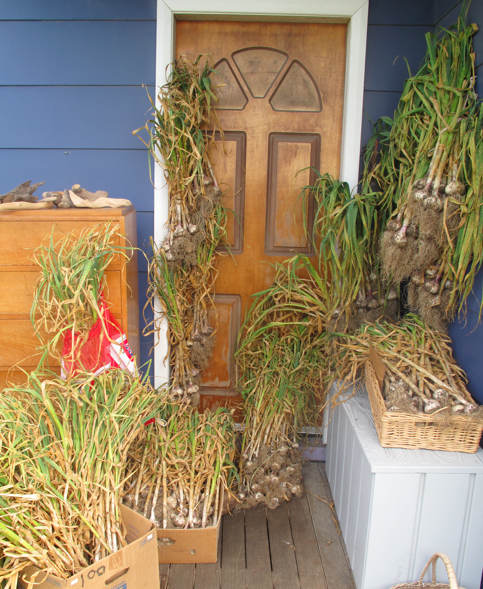
I would not call garlic a niche crop, but I will say that discriminating cooks will pay for the best garlic.

We will sell and give away about half, save a quarter to replant, and eat a quarter ourselves.

Peace, Estwing

TPPA Bad for Health of New Zealand

Editor’s note: This piece ran in the Wanganui Chronicle as an opinion piece last week.
As a general rule, I’m not fond of the word expert. I feel it’s used too often, especially among self-proclaimed experts. At very least the designation should only be bestowed by a third party. In modern, Western culture, universities have taken on that role: A Masters Degree implies one has achieved a certain level of “mastery” of a subject, while a PhD implies the highest level of mastery, ie expertise.
When I was in the initial stages of my doctoral research, my supervisor said something to the extent: “When you’re finished you will be the world expert on your topic.” At the time I was more intimidated than inspired. Now I’m more-or-less indifferent. What good is being an expert in a field in which few people appear interested?
Recently I have ventured from my field of study and into a realm in which I am most assuredly not an expert. That realm is democracy, and if you have read previous opinion pieces, you’ll know I have tried to carefully construct logical, sequential arguments based on observable phenomenon, simple data, and the work of real experts on any given topic. That I am allowed back on the Opinion page appears to indicate that at least a few readers appreciate this approach to promoting democracy in Whanganui.
This time, however, we leave the River City to discuss topics more central to discussions happening in Wellington, Washington D.C., and the netherworld of corporate secret negotiations. The topic of this column is the ethereal Trans-Pacific Partnership Agreement (TPPA), but first a word on the timely topic of asset sales. (Remember to vote!)
While not an expert on asset sales, I do rank myself highly on the common sense scale. Considering this, I subscribe to the following simple argument I have heard in a number of places: If an asset performs well (returning an acceptable or better rate), it would appear too valuable to sell. On the other hand, if an asset is underperforming, the selling price would be so low that the state would hardly make anything from the sale.
Put another way, if private money considers public assets so potentially profitable as to purchase them, wouldn’t that expert financial insight be a signal to government that any given asset is too valuable to sell? Right-leaning politicians are always on about “trusting the wisdom of markets.” So why not trust that wisdom and hold on to those profitable assets for the people?
Globally, asset sales have been used as a technique to transfer public wealth into private hands. From what little the public has been able to glimpse of the TPPA, it appears to do the same but in different ways.
From what I have been able to gather, the TPPA is a trade agreement between nations in the general vicinity of the Pacific Ocean that is being negotiated in secret. As such, who could possibly be an expert on the topic except those insiders already sworn to secrecy?
Fortunately for democracy, some material from the TPPA has been leaked, including a 95-page excerpt published by WikiLeaks in Mid-November. Following that leak, the Herald (14 November, NZ WikiLeaks Scoop) reported that information in the excerpt includes disputes between New Zealand and US negotiators on issues of internet freedom, industrial innovation, ownership of endemic plants and animals, and, near and dear to my heart, access to affordable medicines.
(Before I go on, I would love to see a Maori perspective on “ownership of plants and animals” as related to the TPPA on this Opinion page.)
From the Herald, “A large section reveals the battle between the US pharmaceutical lobby and countries such as New Zealand that want to continue to buy cheaper generic medicines.”
In order to dissect this sentence we need to know a couple of facts: 1) the utmost duty of a corporation is to return profits to its shareholders; 2) the US – where corporations have used lobbyists to sculpt health care policy – has the most expensive health care system in the world while ranking close to 40th in performance by the World Health Organization; 3) New Zealand health care remains reasonably priced in part due to the ability to bulk buy generic medicines.
Using the numbers above in a mathematical equation: 1 – 3 = 2. In other words, if pharmaceutical corporations have their way through the TPPA, NZ health care will more closely resemble that of the US.
What this means for Whanganui is that our already strapped health services would become even more so. For example, the funds now available to pay a doctor may have to be shuffled to cover the increased costs of medicines. Along with the dollars vacuumed away, we would lose a valuable human being who lives in our city, owns a home, pays rates, and buys local products. Every dollar associated with that doctor’s salary would be wisked away to New York, San Francisco, or Hartford. We lose, they win.
I reckon it is our democratic duty to do our best to resist corporate influence globally and locally, but we need to do so proactively. Once the deal has been done, it won’t easily be undone.
Nelson Lebo, is a consultant, educator, and advocate for affordable health care.

She’s Crafty: Driftwood Frame Playgym

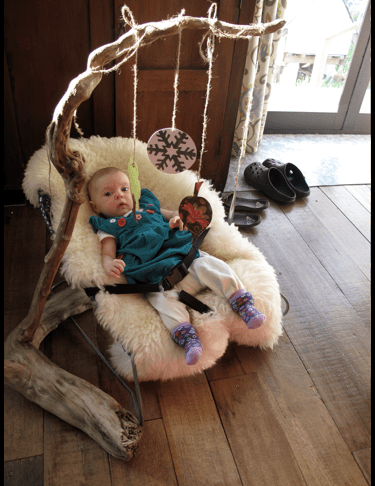
This is one of the first projects we made for EcoThrifty Baby. We wanted a play gym for her, but were (and still are) trying to avoid plastic as much as possible. Ironic, since tupperware is her ultimate favorite toy at the moment.

Screen shot 2013-06-22 at 9.39.08 PM

ETB chillaxin on her sheep skin under her handcrafted playgym – lifestyles of the rich and famous.

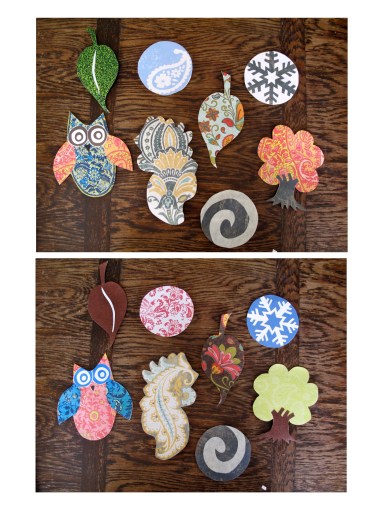
I made the hanging pieces for this playgym from scrapbook paper glued onto cardboard. I tried to pick natural themes and shapes, but also wanted her to have high contrast and bright colors for her little developing eyes.

playgymThe pieces of ETB’s play gym were scrap book paper glued onto thin cardboard.
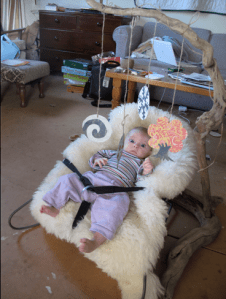

ETH scoured the beach near our house for a few days before he found the perfect pieces of driftwood to form the base and hanging frame. He then drilled a hole into the base just slightly smaller than the diameter of the piece that he wanted to use for the frame, and sanded it down to make a perfect fit. The base is heavy enough that ETB can’t pull it over if she tugs on the shapes.

Screen shot 2013-06-22 at 9.38.48 PM

Driftwood frame with no glue, no nails.

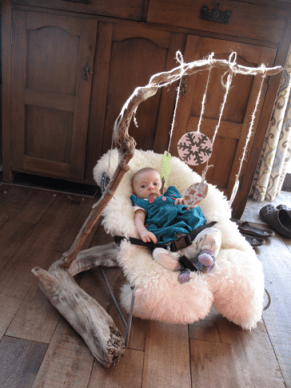
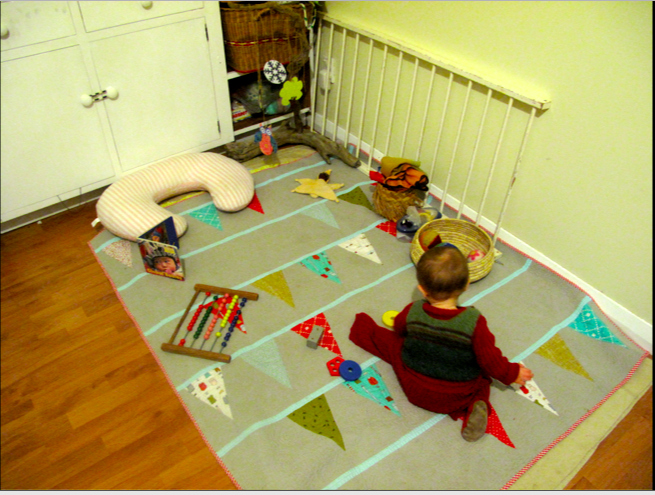
When ETB was a tiny infant we hung the shapes over her carseat and bassinet. When she transitioned into her bouncy chair, they were her favorite entertainment. Now that she is a crawler, this still sits in the corner of her play area. Every once in a while she still bats around the shapes, but I think her days of really enjoying the play gym might be over (sniff, sniff).

Screen shot 2013-06-22 at 9.37.49 PM

ETB as a tiny bub with her play gym pieces hanging above her.

Screen shot 2013-06-22 at 9.45.16 PMETB is a big girl now and her play gym still sits in the corner of her play space.

Upcoming Workshops

Two Workshops, One Day. June 1st, 2013
1:30-3:30 pm. Window Blanket DIY Workshop
4:00-5:30 pm. Growing Great Garlic, Plentiful Pumpkins, and Tomatoes Before Christmas

Window Blanket DIY Workshop.
1st June, 2013. 1:30-3:30 pm. Quaker Meeting House. 256 Wicksteed St.
As effective as double-glazing but at a small fraction of the cost, window blankets are one of the best things a householder can do to make their home warmer, dryer and healthier. In this workshop, you will learn how to make your own custom fit window blanket to take home and install. You’ll also gain the knowledge and skills to make more of them at home.
All tools will be supplied. Either bring your own materials or buy them at the workshop for a small fee.
Space is limited.
Registration essential. theecoschool@gmail.com – 344 5013
Workshop fee: $20 ($15 unwaged)
Materials fee: $8 – $16
Growing Great Garlic, Plentiful Pumpkins, and Tomatoes Before Christmas

This workshop shares  some lesser-known tips and techniques to enhance the growing of common garden vegetables organically. On our small section in Castlecliff, we grow 400 beautiful garlic and over 100 kilograms of pumpkins with very little effort. Last year we had our first ripe tomatoes on 15th December without a glass house.
1st June, 2013. 4:00-5:30 pm. Quaker Meeting House. 256 Wicksteed St.
Space is limited.
Registration essential. theecoschool@gmail.com – 344 5013
Workshop fee: $15 ($10 unwaged)

Sun Angles: Winter and Summer

Mid-way between the autumnal equinox and winter solstice we find ourselves in the unenviable position of short days and long nights, and looking forward to even shorter days and longer nights for some weeks to come. Despite this, our renovated, passive solar villa has been performing well – the indoor temperature has not dropped below 18 degrees in 2013. (More on this in subsequent columns.)
The scientific explanation for the change in day length is that the Earth’s axis is ‘leaning’ the Southern Hemisphere away from the sun slightly more each day until June 21st. The way we perceive the sun in relationship to ourselves is that it rises a little further northeast and sets a little further northwest each day, as well as hanging lower in the sky at noon. Mind you, this is gradual. It takes 6 months for the ‘tilt’ to change from the sun’s highest point in the sky – and longest day of the year – and its lowest point in the sky.
A good eco-designer takes his of her lessons from nature. And nature takes his or her lessons largely from the sun. Using the transitive property, you can get the rest.
In the space below, I’ll explain two examples of good eco-design that take full advantage of the predictable behaviour of the sun: one biological and one physical.
 WBG, sold out quick-as.
If you were at Whanganui’s Saturday market for its last session before Christmas 2012, you may have been among the lucky few to have purchased The World’s Best Garlic. There is a lot that goes into growing The World’s Best Garlic besides humility. One important ingredient is timing. When I arrived in New Zealand five years ago I was told: “Plant garlic on the shortest day of the year and harvest it on the longest.” Generally speaking, this translates into June 21st to December 21st.
Please be aware, however, that this has nothing to due with full moons, cow poo vortexes, or Grecian Formula 44. It does have to due with soil temperature and gradually increasing sunlight day by day for half a year.
Also be aware that growing The World’s Best Garlic involves the right kind and amount of compost, mulch, and watering regimen, all of which are highly protected trade secrets.
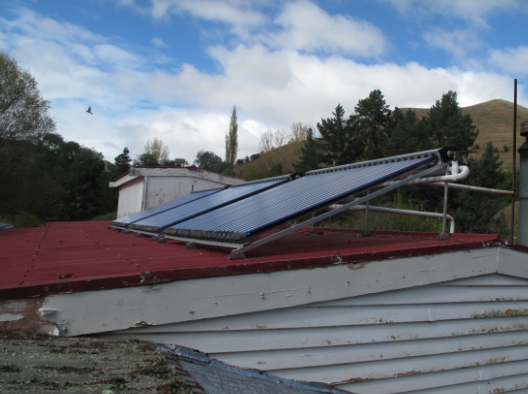
The other example of good eco-design involves two examples of solar hot water that are dramatically different from one another but each serves its own users most appropriately. One system is set on an acute angle and one on an obtuse angle to the sky. In other words, one system is set up for maximum efficiency in the winter and one for maximum efficiency in the summer.
Solar hot water set for a winter sun. 
The solar hot water system on our home is set for a winter sun angle because we know that there are fewer total hours of daylight in winter, and that our insulated tank loses more heat each night in July than in January. There also tends to be more rain and clouds in winter, so we need to take advantage of every clear patch and fine day.
Even set at this high angle, our system can boil over any given day of the summer if we don’t use enough hot water. This ‘boiling’ water shoots down the gully trap as a safety feature to the system.
Solar hot water set for a summer sun. 
So who, you may ask, would set their solar hot water system for a summer angle when there are plenty of long, fine days. Answer: YMCA Central’s Raukawa Falls Adventure Camp. They get heaps of visitors all summer long, many of whom want a warm shower at the end of each day. But for much of the winter, the camp lays more or less dormant, and a back-up wood-fired hot water system can easily fill in when needed.
As spring follows winter, so form follows function…if the design is good. 

A Market Stall for the Community

 Editors note: We are members of our local currency, I am a committee member, and I work on our bi-monthly newsletter. Here is an article I’ve written for the weekly free papers in Whanganui to increase awareness and interest in REBS, and our market stall. 
A Market Stall for the Community
You may have noticed the River Exchange and Barter System (REBS) stall at the Saturday market and said to yourself, “What’s that all about?” Answering what REBS is about is a big task, so I’ll just say that it is form of a ‘local currency’ that allows members to sell and buy goods and services independent of the New Zealand dollar. The aim of local currencies is to maintain wealth within the community, because the ‘money’ earned and spent is only accepted by other members within the network. Whanganui’s REBS programme has been in existence for over two decades.

The REBS market stall provides the opportunity for members to sell items on Saturdays without having to buy their own tent, pay full market fees, and commit five or six hours to the endeavour. Currently, about six REBS members are splitting the stall fees and sharing the workload. The tents have been paid for, and our stall is a well-known fixture – having been at the market every Saturday for years on end! All we need is you!
Actually, we need your: fresh, local fruit and vege; quality art work; pot plants; hand crafts; high quality second-hand goods; and, if you have a valid food handling license, your prepared food items. All items on the stall can be sold part REBS currency and part NZ dollars (NZD). For example: 50% NZD and 50% REBS; 80% NZD and 20% REBS; or 100% REBS.
In order to make the stall economically sustainable, we need everyone who brings items onto the stall to commit one weekend each month and 10% of their takings. Additionally, contributors to the stall must join REBS, which has an annual subscription fee of $15. The top sellers on the REBS stall take in over $50 every weekend, and sometimes have topped $100 in a single Saturday.
For more information, please stop by the REBS stall on a Saturday to inquire. (We are located between the trolley tracks and the river.) Or contact Michael O’Shea on 344 5032. Please don’t just show up at the stall with goods in hand expecting to sell. We need a minimum of two days advance notice.
Peace, Estwing