Category Archives: Eco Thrifty Life

New Year – New Ducks

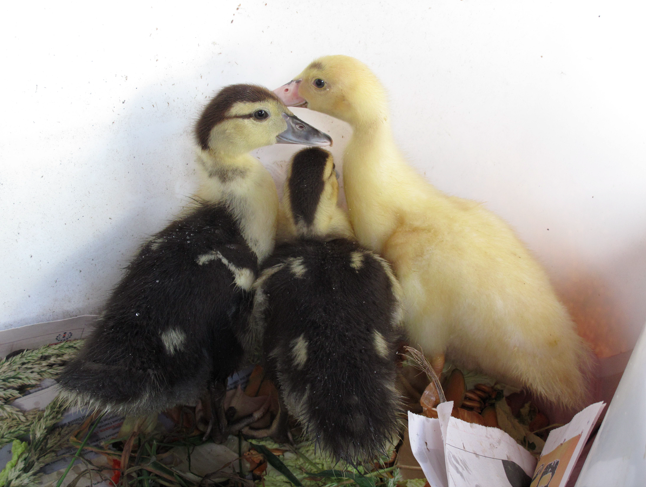
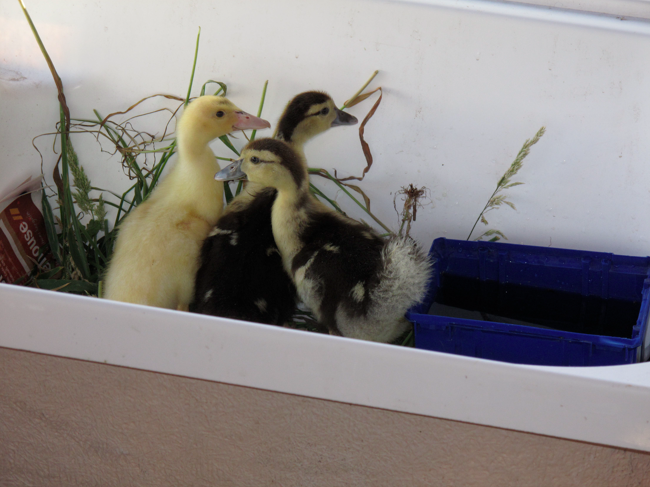
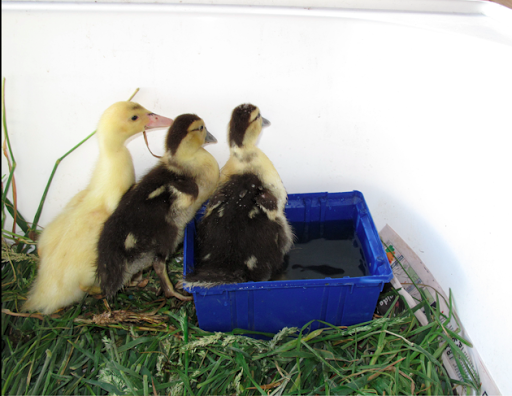
We have ducklings! Estwing took me on a surprise trip yesterday to the outskirts of town to pick up an early birthday present. We came home with a box full of chirping little pooh-filled dumplings of cuteness. I’ll stop talking and get right to the pictures, since I know that’s what you’re after.


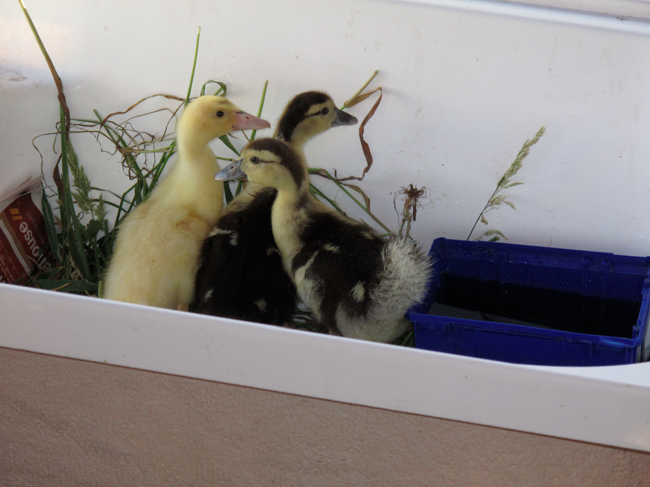
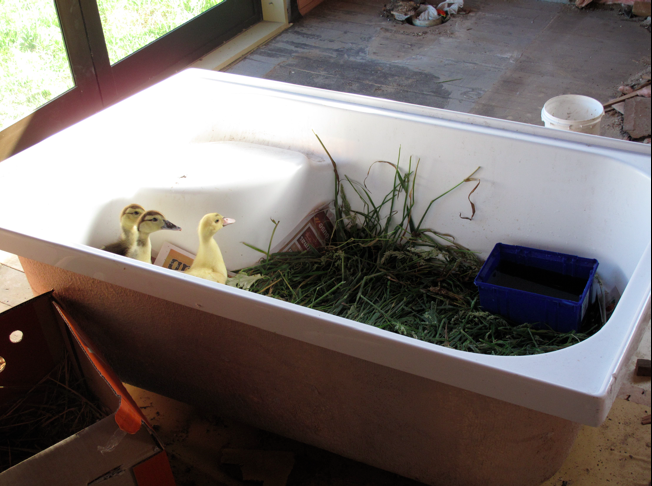
For now they’re living in a bathtub in our future dining room.


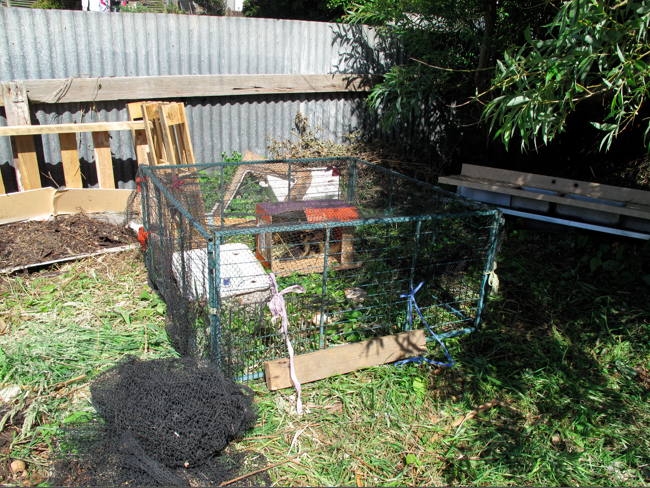
We built them a pen outside, but they escaped. Cunning little buggers. We found them nuzzled up under the willow tree while a hungry cat lurked nearby. We’ll have to modify it today to be a bit more duck proof.


Our ducks are Muscovy Ducks, which will grow up to be not too cute at all. But for the time being, they are ridiculous. For now they seem to just poop and eat and chirp at inconvenient times. But eventually they will help control pests in our garden, give us fertilizer, and provide us with edible eggs. Here’s hoping we picked three females!

We have some names picked out already, but are open to suggestions. Any thoughts?

-June Cleverer

Peas and Carrots: Our Eco-Thrifty Wedding

Way way back, at the beginning of this whole process, over nine months ago, I wrote about how our goal was to have an amazing wedding that celebrated us. By celebrating us, I mean celebrating who we are, what we stand for, how we live. Our lifestyle. A lifestyle of living simply and lightly on the planet.

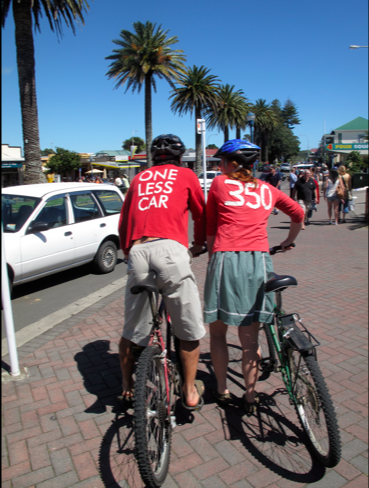
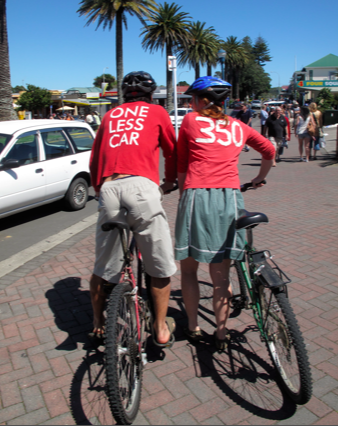
The Veggies on 350 day last year (personal photo).

I’d like to pretend that this was easy, but the pull of the wedding industry is strong. Actually, maybe that’s unfair, because it’s not just the wedding industry. I am a girl who grew up in a state known for its highways and malls, in the highest consuming nation on the planet, during an economic boom. I was given Barbie dolls, and movies starring Disney princesses, and cassette tapes of Debbie Gibson and told by society, that like them, I too could have it all, especially on the biggest day of my life, my wedding day.

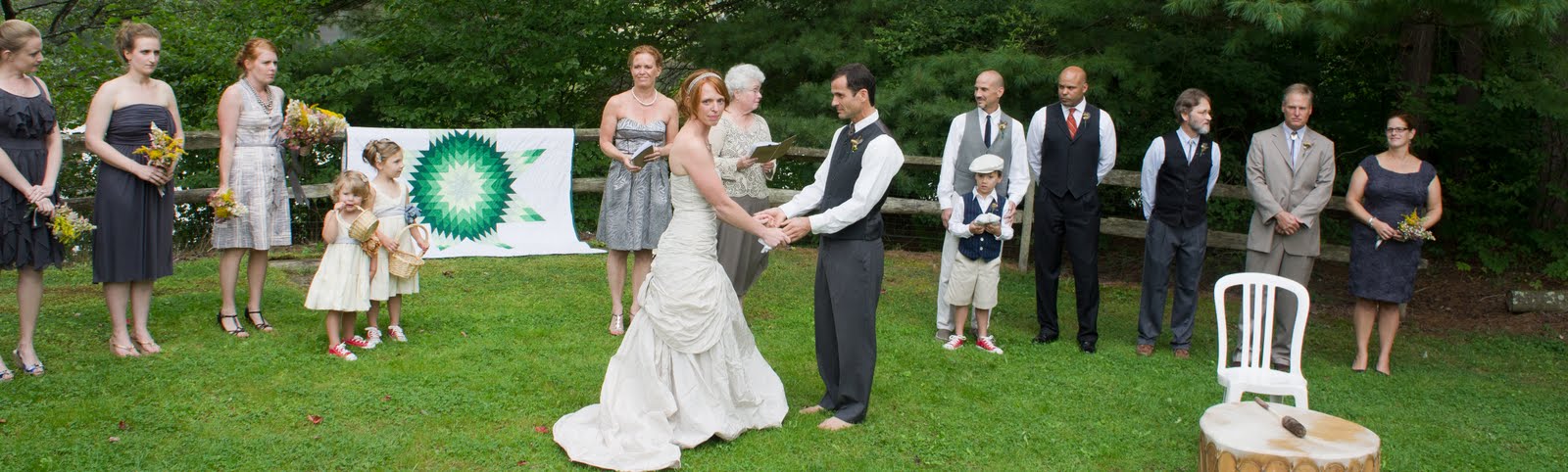
A princess bride? (Oh Darling Photography)

So, yes, even though my heart and my head knew the boundaries that I wanted to play within when planning our wedding. And even though I created those boundaries, not anyone else. Even though deep deep down I wanted simple, and thrifty, and eco. Somewhere even deeper, laid a girl ready and waiting to buy into all of the hoopla.

Beautiful hoopla. (Personal Photo)

So, if my recaps seem a bit schizophrenic… If you wonder why we were so staunch about non-paper invitations, and then printed out eight page programs… If you wonder why my dress is re-used but my flowergirls are wearing new Chucks, all I can say is it was a struggle. It was a struggle between us and what we thought our families wanted, between us as a couple, and between myself and my inner diva.

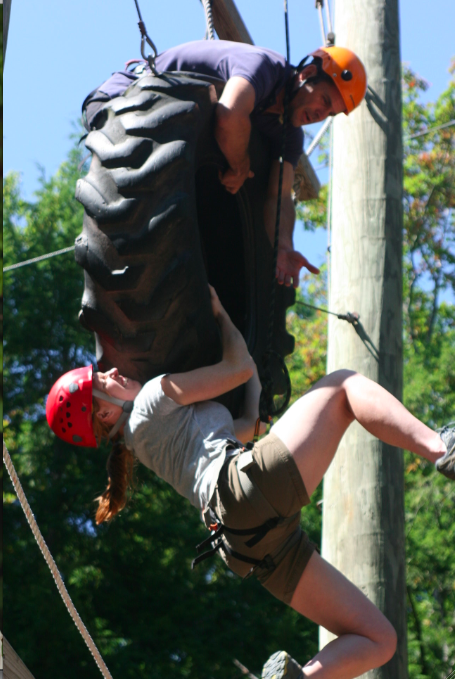
The Veggies de-stress the day before the wedding. That’s some good teamwork. (Photo by Mamma Veggie)

And as I sit here in my gumboots, wiping the baby duck pooh off my workpants, sorting through wedding pictures to put with this post, I am happy with the balance we struck. In the end, I think we came out on top. We didn’t end up with the thriftiest or eco-iest of weddings ever on the whole planet, but we sure gave it a go. And we did end up with a very eco-thrifty wedding, one that was also very us, and made us very happy.

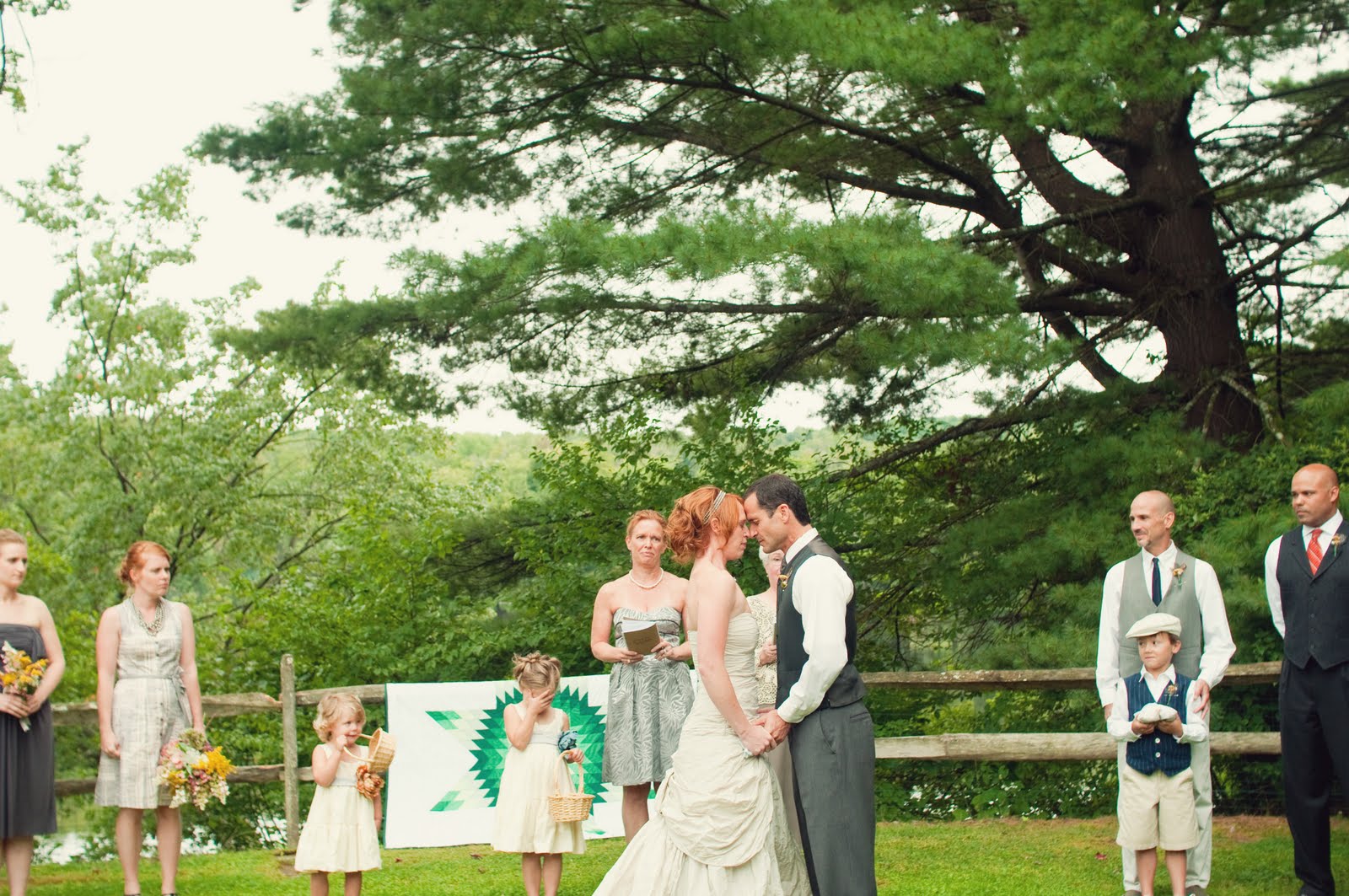
Happy Veggies. (Oh Darling Photography)

I will try to give out any eco and thrifty tips that we picked up along the way as I go through my recaps, and I will definitely give you both and environmental and financial tally of the event at the end.

P.S.- Wanna see a picture of our new baby ducklings?

I thought you might! (Personal Photo)

Did you have battles with yourself or your SO while wedding planning? What were some of the things you got pulled into that you wish you hadn’t? What are some things you were happily able to resist?

Wow, Willow Tree!

Remember how our Christmas tree was a branch of willow that we had coppiced and were attempting to pega-pega in a bucket of sand? Of course you do.

Well, that minor trim got me in the mood for a major haircut. For the willow, not for me.

When we bought our house our willow was in a bad state. She had been neglected for years and was covered in a thick layer of vines that had killed one major branch and were choking out all of the upper foliage.

Sad neglected willow.

So I gave her a good healthy dose of TLC. I painstakingly removed all of the vines and dead branches to let the healthy ones flourish. Well shoop, baby shoop. My efforts, combined with the nice sunny weather we’ve been having, mixed with a good bout of rain allowed her to grow, grow, grow.

I was a proud parent, for a while. Then I noticed that our willow was turning into a bit of a glutton, taking over our yard, and a bit of a bully, shading out everything in its path. I had created a monster.

Ferocious willow.

Another problem was that while our willow tree has three primary branches, most of the growth was the occurring on one major branch on the southeastern side. The tree was unbalanced from the weight of this one branch, which was also drawing most of the nutrients from the roots.

There are two reasons behind this. Firstly, our dominant winds come from the northwest, so the tree is constantly being blown toward the interior of our yard, helping that branch to flourish. Also, the primary branch on the northern side of the tree had been trimmed heavily sometime in the past, and the primary branch on the western side was choked out by convolvulous. If left unchecked I was worried that the tree would eventually topple.

Ferocious June.

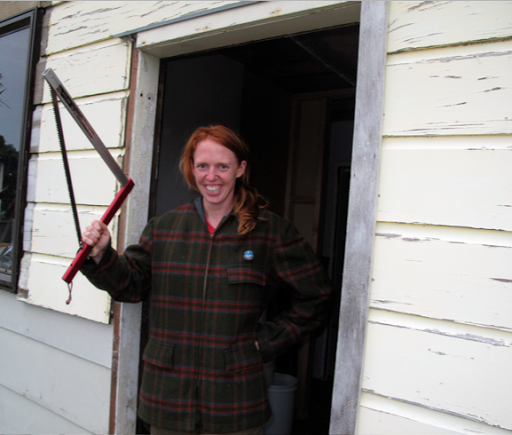
After a day of bonding with a handsaw, our willow was tamed, slightly. We took off the lower branches from the southeast side which will hopefully serve five functions:
1) give us some of our yard space back
2) help re-balance the tree towards the fence (you can see that it is still leaning into the yard quite a lot)
3) allow the native trees on the eastern side more light and space
4) makes it tougher for convolvulous to climb into the tree
5) provide us with firewood for the winter

Trimmed willow.
I’m not sure if we used proper coppicing techniques, or if what we did will serve the tree in the long run. Looking at the tree and the property, we did what seemed to make sense. It was hard to know just how much to take off, wanting to reap the most benefit, but not damage the tree. I have a feeling we could have pruned even more heavily, but we will watch to see how the tree reacts, and wait and see how quickly the branches regrow before pruning again. I think the tree is healthier now, at least she looks more balanced and the convolvulous will have a tougher time taking over.

We will watch these branches for resprouts.

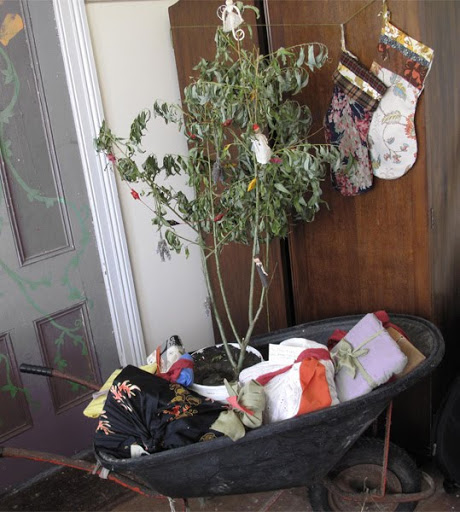
Our Christmas tree is still sitting in a bucket of wet sand in a wheelbarrow in our living room. She seems to be holding up fairly well. Once we get around to it we will transplant her along the fence next to the big willow. Eventually we are hoping this will become a living fence, from which we will be able to coppice for firewood, and will replace or at least camouflage the existing iron.

Side-benefit of coppicing: fuel.

-June Cleverer

Peas and Carrots: The Veggies Get Hitched

Hi…
My name is Veggie…
And I am a recap slacker.
It has been 85 days since my last post. It has been 129 days since my wedding.

129 days!!! What?!? Come on Veggie. Get crackin’. What are you waiting for, anyway?

Well it’s not like I’ve been slacking. The Veggies have been on the move. Since the end of our stay-cation-moon we have: flown back to New Zealand, moved out of our housetruck, and moved into a 100-year old villa shack work-in-progress about 6 hours down the coast. Oh yeah, and we’ve launched a new project for our non-profit, rebuilt our website, and ran six workshops. Phew.

But hive, I’ve been missing you.

And so, as one of many New Year’s resolutions, I’ve decided to get going on my recaps. I wonder if there might be a few other bees thinking along these lines too.

I leave you today with a little peek and a promise to be writing on a regular basis in the weeks to come. So get ready for some summer campin’, barn dancin’, softball playin’, compost makin’ good times.

Happy Solstice, Happy Holidays, and a very Happy New Year!

Photo: Liz Gallo. (Momma Veggie)

Oh Willow Tree

Did you know that willows can be coppiced? Did you also know that when placed in water or damp soil, a willow will resprout roots? We like to use the spanish term for this “pega-pega” (“stick-stick”), mostly because its fun to say.

Anyhow, my desire for a christmas tree this year led me to do a bit of experimenting with coppicing and pega-pega on the willow tree growing in the back corner of our yard. Of course you can’t cut down a tree without a lumber-jacket on (I think I just invented a new word), even if it is 20 degrees Celsius.
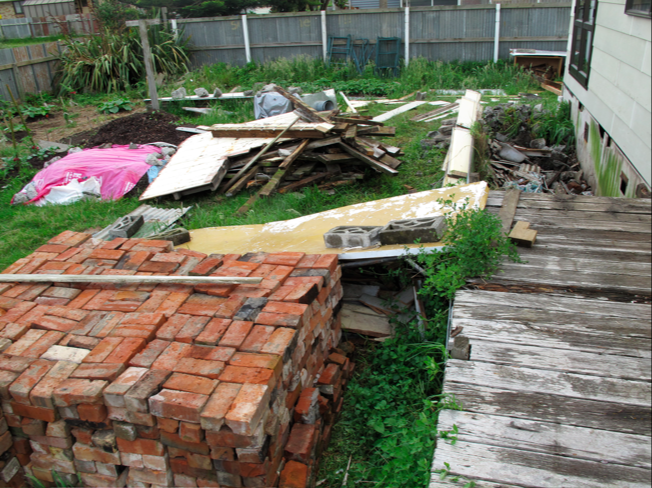
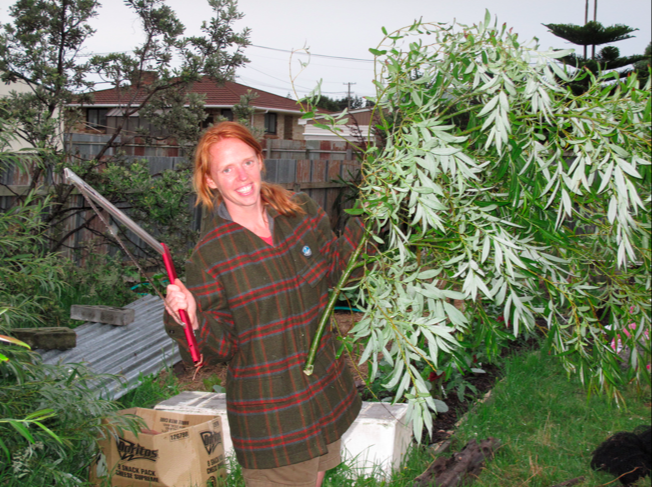
I headed out bravely into what more closely resembles a junk yard than a wilderness. And after quick rendevous with a particularly overgrown willow branch…

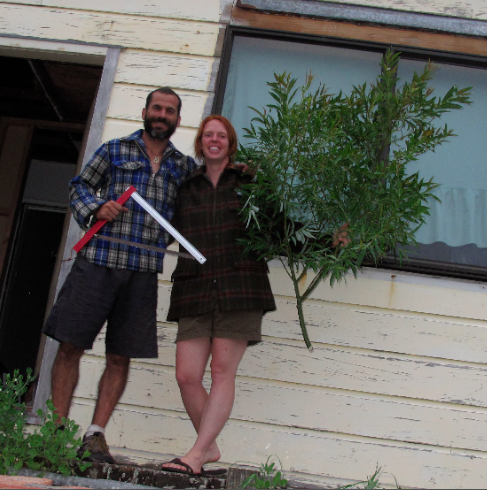
I emerged triumphant. I allowed my trophy husband to pose with me and our harvested tree, because I think he’s cute. I was feeling all merry, and humming christmas carols. Its a bit hard to get into the Christmas spirit when its hot and muggy out, but we were trying our best.

Earlier that day I had made some bundles of lavender harvested from the bush outside our front door.

I added these to a garland and angel I bought at Trade Aid and the bride and groom cake toppers my sister made us for our wedding.

Then we set the willow branch in a bucket of sand, and lacking placement options in our home-in-progress, decided to set it in a wheel barrow, for easy transport. Then, while belting out that song from “Love Actually” and listening to that rock and roll Christmas CD we used to listen to growing up. (You know, the one with Sting and Cyndi Lauper singing Christmas Carols). We decorated that bad boy.
And look! It’s already filling up with presents.
As the kids at my day camp say… “Only 2 sleeps ’till Santa”.

-June Cleverer

The 3 R’s

In the midst of the holiday shopping rush – often called ‘Silly Season’ here in NZ – we have taken a non-traditional approach to…just about everything.

While others fill their yard with festive light displays, we…

While others buy artificial Christmas trees at the Warehouse, we…

While others carefully wraps presents in gift wrap, we…

It seems that in the week leading up to the biggest consumer orgy of the year that I introduce our next three design principles: Reduce, Reuse, Recycle. As you may be aware, the order of this trio is as important as the meaning of each one.

With regards to waste management, we want to first reduce the size of the waste stream, then reuse as much of that waste as possible, and finally recycle whatever is left over that we absolutely cannot use on site. We have already diverted over 90% of the waste stream of this project in this way.

My next posts will cover specific strategies for reduction and examples of creative reuse.

Peace, Estwing

All Thanks to Susan B. Anthony

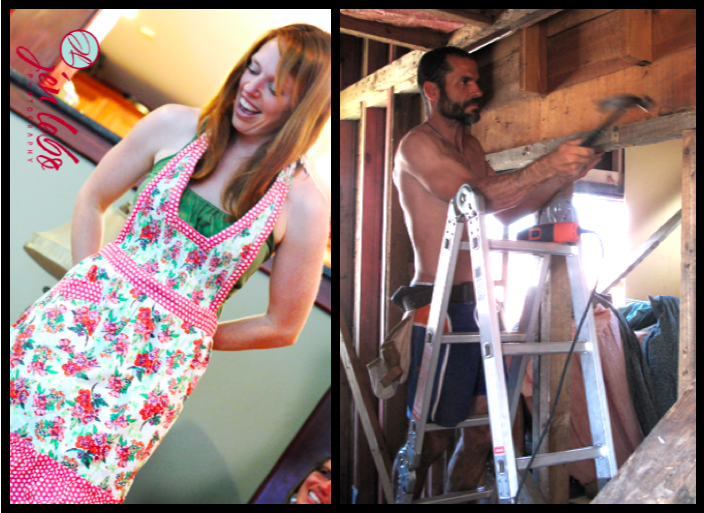
“Hey babe, can you come here and give me a hand for a minute?”. I step away from the plastic bin I’ve been using as a temporary dish station for the past 45 minutes, hands soapy and greasy. “Can you hold this board up. OK, now can you hand me that hammer?”. “Yes, dear”.

When we first bought this house, before the wedding, before the move, before the work, I had a vision in my head of the two of us working side by side. Day after day we would saw and hammer, plan and design, sweat and problem solve. We would finish our long days exhausted, but filled with a sense of accomplishment at what we had achieved. We would have fun during the process, joking and laughing our way through errors that more experienced builders wouldn’t make. Birds would sing. Music would be playing in the background…the good life.

I can see you shaking your head. Those of you who are long-married or have attempted a renovation project with your partner before are in awe of my naivety.

The truth is that while this is a partnership, a marriage you might say, of two people working together to renovate a house, it hasn’t exactly played out like I imagined. There are a few major contributing factors:

  1. M.C. Estwing is much more handy than me. He has done all this before. I haven’t.
  2. I have a much lower tolerance for mess and dirt than MC, especially in our “living” areas.
  3. MC is actually quite a bit stronger than I am, and can work harder and longer.
  4. I have mad computer and telephoning skills.

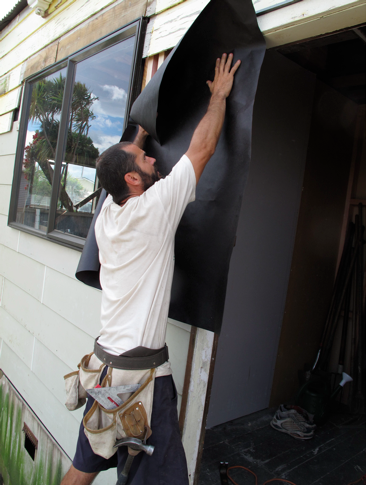
This has led to a division of labor of sorts. On this project team M.C. has landed himself the role of head carpenter and builder.

Which leaves June the roles of cook, housekeeper, secretary, oh yeah, and let’s not forget apprentice. Guess which one of us is more displeased with their roles.

I see you nodding your heads again, all you long-married experienced renovators.
I am being a bit unfair to MC here. He has been fantastic about ensuring that we are both equally involved in the design process. Truly, he is working is butt off, long physical hours, that leave him drained. And, most importantly, he has been receptive to my feedback of the process so far.

He has also tried to engage me as much as possible in daily building tasks. This has been met with mixed success. My learning curve is steep, and his desire to see me succeed is high. This leads him to offer advice. A lot of advice. Often a lot of unsolicited advice. This doesn’t go over well.

Eventually I tire of being out of my comfort zone and efficiency wins over. My role gradually swings to go-for – “Can you pass me this? Can you hand me that? Can you bring this outside?”. I think of all the other things that need doing, and usually opt out and head for some chore that is waiting to be done. It certainly isn’t a scene filled with laughing and joking.

To be honest, the fact is that I do gain pleasure from creating a beautiful home, preparing a nice meal for my husband, and maintaining our social and business networks. I guess the problem is that I know that he would enjoy these things too, if only he had the time. Just as I would enjoy being more involved in the building, if I had the time to work through it at my own pace.

But in the end it really is just the case that he is a better builder, and I am a better homemaker. It is easier, more efficient for us each to take on the roles we are best at, and so that is what we slide back to, again and again. If we had been married at the beginning of the last century we wouldn’t have given a second thought to this division of labor.

So the challenge is this, and I pose this question to any wise person who can offer insight: How do we create a partnership where we encourage each other to break out of our comfort zones? Or is that even necessary? Should we stick to our strengths and each be the master of our own domains? Have I been raised in a post women’s lib era that has me chasing an unattainable working relationship pipe dream whose pursuit will only leave us both grumbling?

-June Cleverer

Did I mention Permaculture?…

Permaculture has lots of definitions. Many are confusing. None are comprehensive. This is mine:

Permaculture is a system of ecological design that seeks to recognize and maximize networks of beneficial relationships, while minimizing or eliminating harmful or wasteful relationships.

To those new to permaculture, such definitions may be more confusing than helpful, but to those familiar with it, heads nod in recognition.

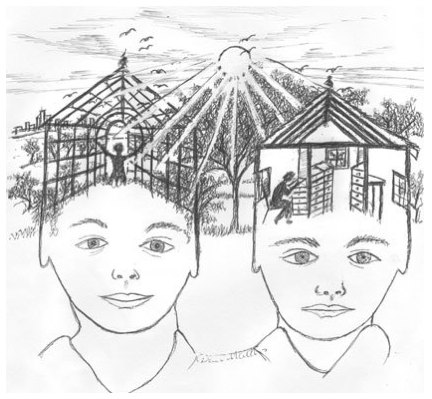
Permaculture is not a set of ethics to quote or a list of principles to memorize, but a way of seeing the world. It is holistic design in four dimensions. Training your brain to see interconnectedness is not easy if you’ve spent 13 to 17 years in Western education. Certain learning “disabilities” make it much easier if the aforementioned decade and a half have not beaten those ways of knowing out of you. I’m lucky enough to have such learning [dis]abilities.

Left: learning disabled mind, Right: learning-abled mind

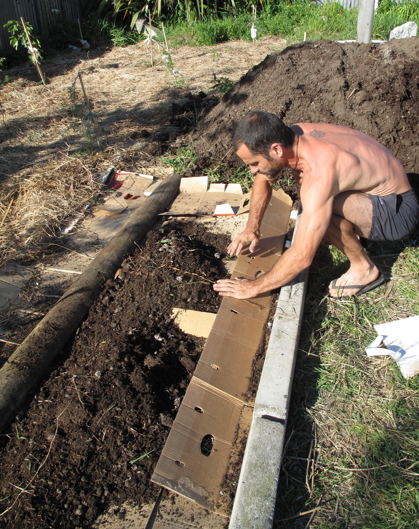
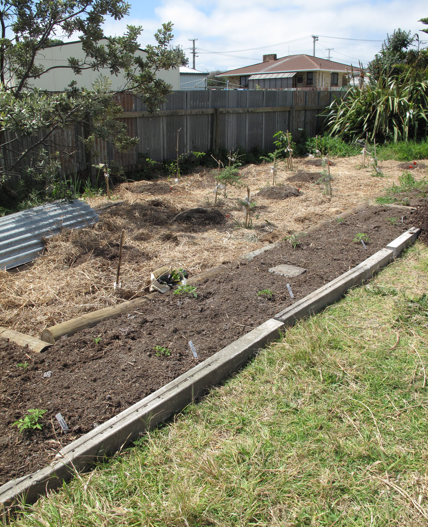
It is about time we pointed out that our eco-thrifty renovation includes the entire 700 square meter section that was more or less full of rubbish and invasive weeds when we arrived. The holistic design includes establishing wind breaks, building soil fertility, planting fruit trees and a large vegetable garden, tractoring chooks, coppicing for fire wood, planting native trees, constructing a large sun trap, retaining water on the property, and integrating the indoor and outdoor environments.
Here is a photo gallery of some of these initiatives so far.

-M.C. Estwing

Answer: Bike On A Bike

Question: How does one return a borrowed bike when their own bike is their only other mode of transportation?
Here’s a product for all of your carbon-neutral bike transportation needs.

Fine print: Must have calves of steel and a sturdy backpack for successful performance. Do not attempt with folding bike on bottom. Dutiful husband not included.

You saw it here first people. Now, don’t go running out trying to market this brain child. We are trademarking this revolutionary technology as we speak. Also in the works: furniture on a bike, seedlings on a bike, and wife on a bike.

Editors note: After substantial research, it turns out that the market for these products is extremely limited. Turns out there are significantly easier ways to transport large items.

In all seriousness, living car free presents some very real challenges for us. We rely heavily on our fleet of bikes: the little folder; the hand-made green bike; the silver road bike; and our B.O.B. trailer. And I cannot express just how very thankful we are that we now live in a flat coastal town. Finding motivation to ride this 6k into town is much easier than it was to find the motivation in Raglan where the 6k involved riding up the side of a mountain. But, as easy as the trip is, riding after dark, in the rain, or with a huge load can be dangerous and inefficient.

We also love that we live two blocks from the bust stop, and that the bus runs about a dozen times a day. We’ve done our laundry, grocery shopping, and even transported timber back from town on the bus. I’ve made a little group of commuting friends who seem to ride the same routes as I do regularly, mostly older or mentally handicapped folks, or both. My favorite is an older Maori gent named Tui, who shouts a big “There she is!” every time I board, and then proceeds to tell the rest of the passengers “She’s American, you know?”. Not sure whether that’s meant as a warning or a kudos. Either way, I like to think of him as my bus boyfriend. Don’t tell the hubs. But, as nice as the bus is, the last bus is at 5:10pm and there are no buses on Sundays. What is up with that Wanganui District Council?

So really, if we want to do anything in the evenings, or transport large items. We are at the mercy of the generosity of friends. And they have been extremely generous. If we even mention that we might want to pick something up in town, we have several offers of people who are willing to help us. Heck, even our new neighbor over the back fence offered us her car after watching us carry a load of lumber back from the bus. This offer would have been more useful just a few minutes earlier, but its nice that she put it out there. But, its not sustainable environmentally or socially to rely on people shuttling us back and forth to town.

So we are left with some options. One option is to set up a barter system with one of our friends or neighbors who has a car. If we set up some kind of car share system, then with some planning we could eliminate the extra trips involved in shuttling back and forth and would feel like we are contributing to a mutually beneficial relationship (instead of a parasitical one?).

Another option of course is to cave in and join the ranks of car ownership. And there are endless details involved in that decision. Do we buy a really flash new eco car or go down the used-car route? Would we buy a small fuel efficient model or a bigger car that we could use to haul loads? We would we really have the self-discipline to limit ourselves to mandatory trips only or would our lifestyle significantly change?


What do you think? What would you do? What do you do? How do we contribute to the creation of a sustainable transportation culture without sacrificing our individual needs? Or is that even possible?

-June Cleverer