Category Archives: Eco Thrifty Renovation

Another Autumn Update

We’ve had an amazingly mild and sunny autumn so far. Here is the third and final autumn update on our 2 and 1/2 year-old permaculture property.

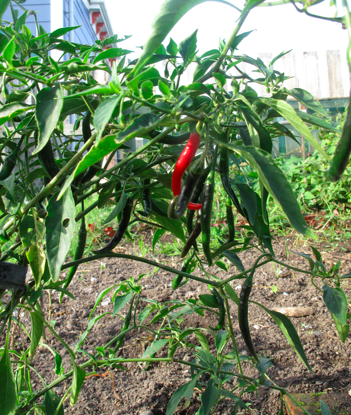
Chilis ready for harvest and drying.  

Kale self-seeded ‘volunteers’ ready to be divided and planted out.

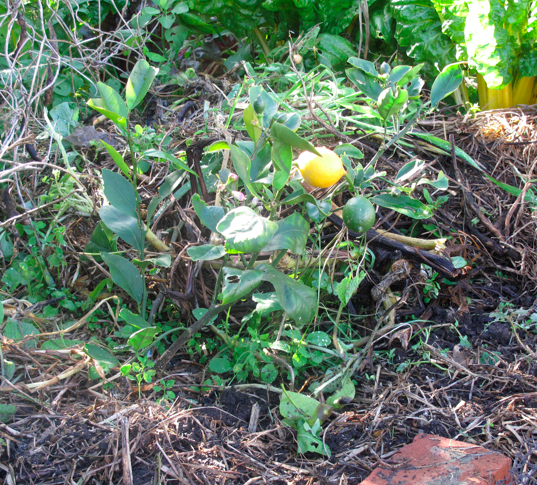
First lemon of the season.

Interplanting strawberries and kale. 

Broccoli heading up.

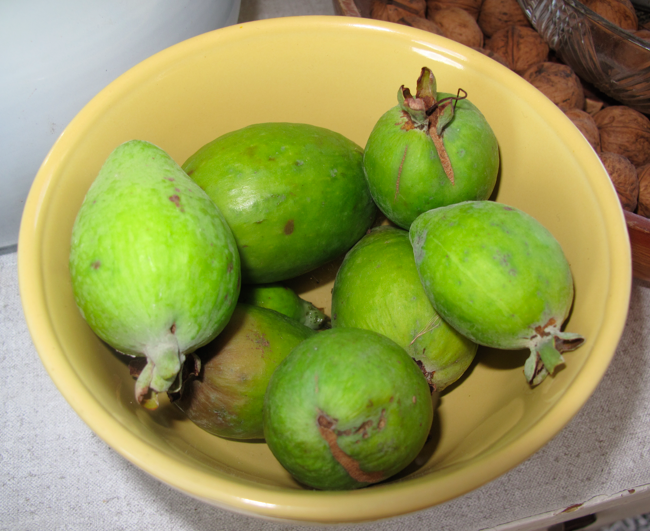
Some very marginal feijoas

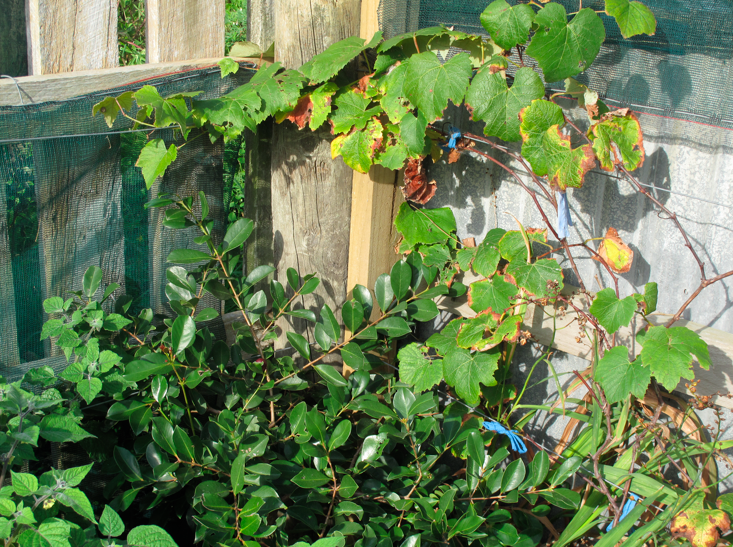
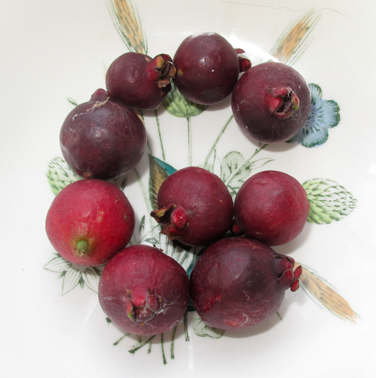
This corner is a real sun trap, with a grape trellised above and around a guava. 

Peace, Estwing

Window Blankets: The Ultimate in Eco-Thrifty

Double-glazing is great. Secondary glazing is awesome. Thermal curtains are sweet-as, if they are fitted properly. And pelmets are da bomb!
We have incorporated all of them into a diverse strategy for improving the thermal comfort of our home in Castlecliff while keeping costs low by using eco-design thinking. The eco-design process takes in a multitude of factors and plans for efficiency, effectiveness, and redundancy. When applied to the built environment, good eco-design includes what some call the ‘Green Rule of Energy,’ which goes something like this: Saving energy is cheaper than producing energy.
My New Hampshire (USA) farmhouse inspire me to think about keeping warm on a budget.  
For example, a compact fluorescent light bulb (CFL) uses just one quarter as much electricity as a standard incandescent light bulb while producing the same amount of light. If a 25-watt CFL were run next to a 100-watt incandescent for 10 hours per day, the difference in running costs for one month would be about $5. The difference in running costs for a year would be – you guessed it – $60.
The dramatic difference shows the power of the Green Rule. Imagine the savings by changing two light bulbs, or five, or every light in your home or business. And, as an added bonus, CFLs last about 10 times longer than incandescents, so there are additional savings from buying one bulb instead of 10 over a period of time.
Another example of the Green Rule of Energy is insulation. Please be aware, however, that insulation comes in colours other than pink! In other words, there may be a specific product we associate with the word ‘insulation’ – batts – but insulation itself is simply trapped air, such as that in between two pieces of glass in double-glazing. The second piece of glass is not the insulator, it is the trapped air in between the two. So, in a sense, insulation is invisible because it is air! Abracadabra!
The original window blanket in my 1782 farmhouse.  
Now that I have blown your mind, I’ll describe what is quite potentially the lowest cost / highest performance way to insulate a villa, bungalo, beach bach, houseboat, or even a sheering shed. This incredible breakthrough in air technology has previously been unknown to New Zealanders because…well, frankly I made it up, and I only arrived a couple of years ago.
Of course, there is another possible explanation for such an extraordinary technological breakthrough being kept secret. And that is, of course, that the greedy New Zealand health care industry wants Kiwis to live in cold, damp homes so it can reap grotesque profits from treating preventable illnesses. Oh, what’s that you say? Nevermind.
I call it a ‘window blanket’, and it is an excellent example of Yankee thrift meets Kiwi ingenuity. When I first started building them a decade ago for my 220 year-old farmhouse in New Hampshire, I used two pieces of wood, a few screws, and a second-hand mattress protector (quilted mattress pad) with the elastic cut off. Now that I build them for our villa in Castlecliff, I use two pieces of wood, a few screws, and a second-hand wool blanket.
The ‘modern’ version of a window blanket in our Castlecliff home.  
Because we have a lot of wood hanging around from our renovation, and there are ample op shops in Whanganui, the average cost per window blanket has been about $7. If properly fitted, they perform as well as double-glazing. This is significant because up to 30% of heat loss from a home is through glass doors and windows – about as much as the heat lost through the ceiling.
This is not to say that you should not invest in double-glazing if you have the means. What it is to say, is that with window blankets everyone has the means to make their homes cosier.
Want to learn more? A DIY workshop on window blankets will be help the 1st of June from 1:30-3:30. Registration essential.

Upcoming Workshops

Two Workshops, One Day. June 1st, 2013
1:30-3:30 pm. Window Blanket DIY Workshop
4:00-5:30 pm. Growing Great Garlic, Plentiful Pumpkins, and Tomatoes Before Christmas

Window Blanket DIY Workshop.
1st June, 2013. 1:30-3:30 pm. Quaker Meeting House. 256 Wicksteed St.
As effective as double-glazing but at a small fraction of the cost, window blankets are one of the best things a householder can do to make their home warmer, dryer and healthier. In this workshop, you will learn how to make your own custom fit window blanket to take home and install. You’ll also gain the knowledge and skills to make more of them at home.
All tools will be supplied. Either bring your own materials or buy them at the workshop for a small fee.
Space is limited.
Registration essential. theecoschool@gmail.com – 344 5013
Workshop fee: $20 ($15 unwaged)
Materials fee: $8 – $16
Growing Great Garlic, Plentiful Pumpkins, and Tomatoes Before Christmas

This workshop shares  some lesser-known tips and techniques to enhance the growing of common garden vegetables organically. On our small section in Castlecliff, we grow 400 beautiful garlic and over 100 kilograms of pumpkins with very little effort. Last year we had our first ripe tomatoes on 15th December without a glass house.
1st June, 2013. 4:00-5:30 pm. Quaker Meeting House. 256 Wicksteed St.
Space is limited.
Registration essential. theecoschool@gmail.com – 344 5013
Workshop fee: $15 ($10 unwaged)

Sun Angles: Winter and Summer

Mid-way between the autumnal equinox and winter solstice we find ourselves in the unenviable position of short days and long nights, and looking forward to even shorter days and longer nights for some weeks to come. Despite this, our renovated, passive solar villa has been performing well – the indoor temperature has not dropped below 18 degrees in 2013. (More on this in subsequent columns.)
The scientific explanation for the change in day length is that the Earth’s axis is ‘leaning’ the Southern Hemisphere away from the sun slightly more each day until June 21st. The way we perceive the sun in relationship to ourselves is that it rises a little further northeast and sets a little further northwest each day, as well as hanging lower in the sky at noon. Mind you, this is gradual. It takes 6 months for the ‘tilt’ to change from the sun’s highest point in the sky – and longest day of the year – and its lowest point in the sky.
A good eco-designer takes his of her lessons from nature. And nature takes his or her lessons largely from the sun. Using the transitive property, you can get the rest.
In the space below, I’ll explain two examples of good eco-design that take full advantage of the predictable behaviour of the sun: one biological and one physical.
 WBG, sold out quick-as.
If you were at Whanganui’s Saturday market for its last session before Christmas 2012, you may have been among the lucky few to have purchased The World’s Best Garlic. There is a lot that goes into growing The World’s Best Garlic besides humility. One important ingredient is timing. When I arrived in New Zealand five years ago I was told: “Plant garlic on the shortest day of the year and harvest it on the longest.” Generally speaking, this translates into June 21st to December 21st.
Please be aware, however, that this has nothing to due with full moons, cow poo vortexes, or Grecian Formula 44. It does have to due with soil temperature and gradually increasing sunlight day by day for half a year.
Also be aware that growing The World’s Best Garlic involves the right kind and amount of compost, mulch, and watering regimen, all of which are highly protected trade secrets.
The other example of good eco-design involves two examples of solar hot water that are dramatically different from one another but each serves its own users most appropriately. One system is set on an acute angle and one on an obtuse angle to the sky. In other words, one system is set up for maximum efficiency in the winter and one for maximum efficiency in the summer.
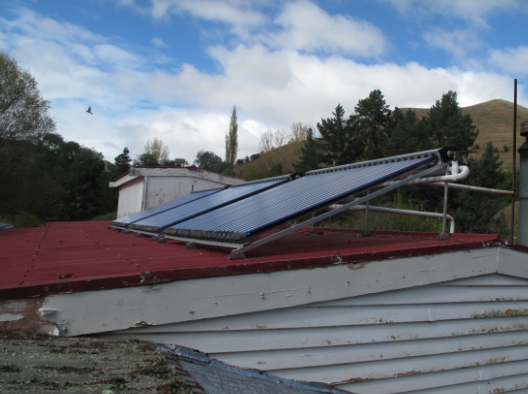
Solar hot water set for a winter sun. 
The solar hot water system on our home is set for a winter sun angle because we know that there are fewer total hours of daylight in winter, and that our insulated tank loses more heat each night in July than in January. There also tends to be more rain and clouds in winter, so we need to take advantage of every clear patch and fine day.
Even set at this high angle, our system can boil over any given day of the summer if we don’t use enough hot water. This ‘boiling’ water shoots down the gully trap as a safety feature to the system.
Solar hot water set for a summer sun. 
So who, you may ask, would set their solar hot water system for a summer angle when there are plenty of long, fine days. Answer: YMCA Central’s Raukawa Falls Adventure Camp. They get heaps of visitors all summer long, many of whom want a warm shower at the end of each day. But for much of the winter, the camp lays more or less dormant, and a back-up wood-fired hot water system can easily fill in when needed.
As spring follows winter, so form follows function…if the design is good. 

Late Autumn Update

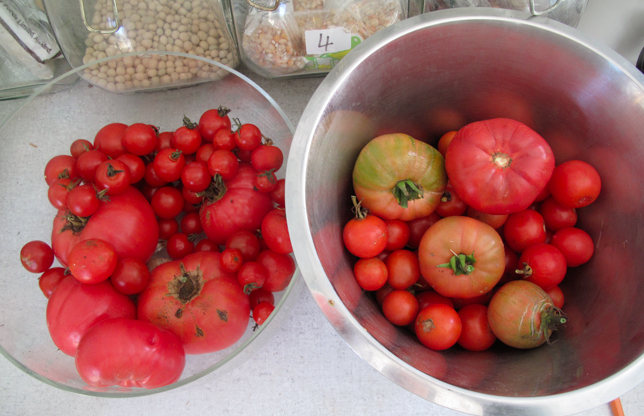
As we slide from summer into winter, we are saying goodbye to the last of our tomatoes and hello to the first of our guavas. 

We are almost ready for our first ever ripe tamarillo. Thanks Andy Dolling!

But no sign of our first banana. Thanks anyway, Hadi Gurton.

We do have some feijoas coming in…

… and finally chilies ready to harvest and dry.

Somehow I managed to grow the smallest Monty’s Surprise apple ever. 
I found some plants on sale last week, including grapes vines…

… passion fruit…

… and blueberries.

These NZ native trees I started from seed in the spring. 

The olives (15 of them) are all putting out new growth.

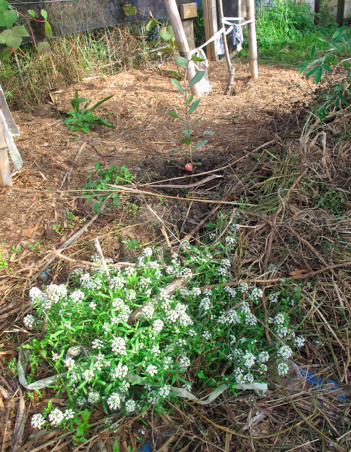
And volunteer alyssum makes good ground cover in a food forest.

After two and a half years, our section is more or less planted out with over 100 edible perennials and 30 -40 native trees and shrubs.

Peace, Estwing

Bad Design Wastes Money and Lives

Nothing gets my goat more than a waste of money than a waste of life, but more on that later. For the moment I’ll address a couple of examples of wasted ratepayers money easily observable in our community.
First, according to my conservative calculations, the daytime running of lights under a glass skylight at the main entrance to Central Library has cost ratepayers $600 since I first raised the issue with library staff two and a half years ago. Some may argue that this is a small pittance when compared to other issues facing our city, but I suggest it is a troubling indicator of an apparent disconnect between the people who set and spend our rates and the service that ratepayers get in return.

From a holistic perspective, these are the economic and environmental realities facing our city: increasing unemployment; increasing power bills; increasing rates hikes; increasing insurance costs; and, increasing extreme weather events. I’d like to add a bit of humour to this list to break the grim mood – maybe a clever Neil Diamond reference – but I can’t think of anything.
The bottom line for all of us – especially those on low or fixed incomes – is that we will have fewer dollars in our pockets at the end of each week to spend on anything other than power, rates, insurance, and dealing with the added expenses incurred by extreme weather events. Add to this the massive debt already held by our city, and I ask the simple question: Can we afford to spend another $600 running outdoor lights during the daytime over the next two and a half years?
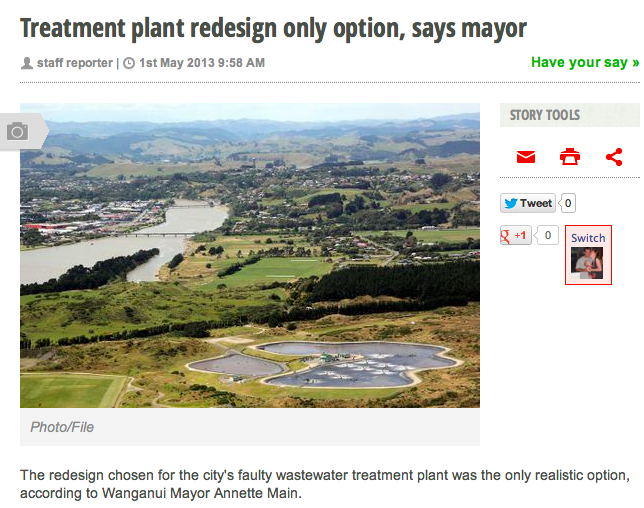
Now, add to the above the largely unspoken yet likely reality that we will all soon get dinged for the huge additional expense of ‘fixing’ the sewage treatment plant that was never properly designed in the first place. After wasting money and wasting life (still to come), my next goat-getting peeve is bad design. This characteristic I share with Kevin McCloud, the outspoken host of Grand Designs.
Bad design almost always costs more in the long run than good design. This relates to an important tenant of eco-thrifty renovation: sometimes being cheap is expensive. From all available evidence, this appears to be the case with our dysfunctional treatment plant. The evidence also suggests that a number of councilors and council staff are at the heart of the poor decision-making process that has saddled us all with a bad design.
On the other hand, eco-thrifty decision-making takes a long view by considering the upfront and running costs of everything from light bulbs to solar hot water to roofing iron to wind protection in the garden. Which brings me to poor design and the loss of life.
It was with a heavy heart that I visited a community garden last week to find a large proportion of the fruit trees either dead or dying from wind damage. I was especially saddened because I told a number of people involved in the garden six months ago that the garden needed wind protection. Nothing was done. Wind protection is an essential part of good horticulture design, and without it the careless planting of trees can result in an unfortunate waste of money and life. 

Along with Kevin McCloud, I cannot emphasize enough the importance of good design. Given the economic and environmental trends I mentioned above, I suggest the most appropriate design strategy for everything from outdoor lighting to treatment plants to community gardens is eco-thrifty design. What’s wrong with saving money while saving the planet? 
Peace, Estwing

Second Post by Xander, ECO School Intern

Kia ora koutou. Xander’s first blog post was very popular on our blog. See it here: http://www.ecothriftydoup.blogspot.co.nz/2013/03/guest-post-xander-our-new-intern.html
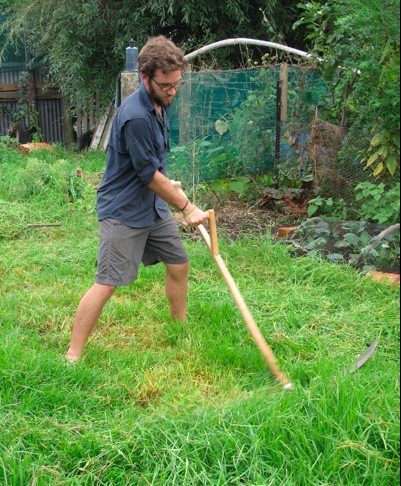
There is truth in the saying, “one man’s trash is another man’s treasure”.  To some extent, this is what the Eco School is all about. I have often found myself repurposing a lot of what I had once considered “trash,” turning it into what Nelson indirectly calls “treasure”. For instance, after scything the lawn, the heaps of cut grass can easily be turned into compost or mulch.
To me, this is what sustainability is all about, that is, to reuse or repurpose what you’ve got (or what someone else has got). That being said, it also adds the individualistic, personal component of rethinking. For example, I would have never thought that a crate could be used as mobile chicken coop. Granted, the chickens didn’t use it, but it did have that personal ingenuity. It had the potential and the capacity to be something great. The mobile chicken coop is no different than this old house (although the house is way more functional).
Although it is overly obvious that sustainability has become a buzzword in today’s society, it is still a very significant concept to consider. Not only does it apply to everyday, practical work, it also applies to more abstract ways of thinking. It is arguably a form of environmental justice, which encompasses social and economic spheres and all the inherent spheres within each of those. To me, sustainability also means to use wisely what we got.
And it is at this point where we can see how sustainability acts upon the concepts, institutions, or systems that already exist today. It is be no means revolutionary, insofar as it does not overthrow any of the systems in place today to start a fresh system. On the contrary, I believe that sustainability utilizes the systems in place today to work towards a healthier, environmentally friendly tomorrow.
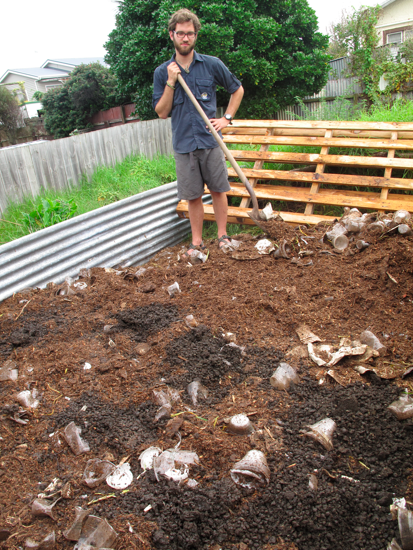
All of this is why I think that the Eco School is the epitome of sustainability, especially on the practical level. Take, for example, the mountain of compost that lies in the side yard. Since its conception as a pile of biodegradable rubbish following the Masters’ Games, I’ve watched it (mostly) turn into a meaningful goliath of compost. However, in the beginning, all that it took was an eye to see the potential of the biodegradable rubbish. Even before then, all that it took was a rethinking of the Masters’ Games and the Whanganui community (i.e. sustainability in action). The Maters’ Games and Whanganui have always had that potential, it was just a matter of tapping into it.
         Coming from America, the mental cogs of sustainability are not turning. One reason, to me, is that sustainability is at odds with get-rich-quick, race-to-the-top mentality. But who’s to say really, America is a funny place. On the environmental front, America is behind the times. Take for instance the fact that it’s hard to find a public recycling bin on the street. Sure, they collect recycling from private residences, but no public recycling?
         Sustainability uses what’s available in a mindful way. The system back in the States is quite the opposite; however, it will not go away anytime soon, although it seems to be waning. One of Nelson’s sayings is, “the problem is the solution”, which directly coincides with my impression of sustainability. In my first blog, I shared my transformation story. From all that I’ve learned at the Eco School, I have the skills and framework for building a better tomorrow. Some believe that the world has gone to crap. To some it is nothing more than a pile of rubbish from some global, economic tournament. Maybe the same is true within America. But, like I said, one man’s trash is another man’s treasure.
-Xander

Cluster Housing Saves Resources, Money, and Reduces Impacts on the Land

Two living spaces share one wall to conserve resources and energy. 
I was flattered to have been identified recently in the Chronicle (20-04-13) as an “exponent.” I was only left to wonder, am I ‘squared’ or ‘cubed’? My suspicion is the latter, as a Roman numeral 3 – III – sometimes follows my name of official documents. Although it would be rather cool to change it from Lebo III to Lebo3.
The article in question – Plan considers papakainga settlements on Maori land – reported on a Maori Land Court meeting from March 18, and quoted extensively WDC Principal Planner Jonathan Barrett. I remember meeting Jonathan about a year ago, and being impressed by his open-mindedness and willingness to work with groups to rethink some aspects of planning that would serve people and the planet better than a grid-type suburban landscape.
I had been invited to the meeting in question at the last minute, and was not completely sure about the agenda or even who would attend. I was also unprepared to be the centre of attention, not that I minded because the topic was one easily adapted to a discussion on eco-design. And once you get me going on that…
To provide some background, I had been invited to take a look at a piece of land at Kaiwhaiki Pa that had a decades-old development plan but some serious seasonal drainage issues. The existing plan indicated a grid-type layout of homes across the property, including the low areas. From what I recall, there was also a decade-old quote for a drainage project that would cost around half a million dollars.
From my perspective, this was a case of trying to fit a square peg into a round hole. Sure, it could be done, but at what cost? Engineers will tell you, “We can do anything with enough money.”
But a suburban-style development on that piece of land would be unnecessarily expensive, unnecessarily destructive to the environment, and, from my scant knowledge of traditional Maori settlements, culturally inappropriate. The ‘burbs are a Pakeha invention. Maori lived in villages.
From my perspective, the existing plan represented a lose-lose-lose situation. This is the opposite of the way I think and design, so naturally I had some ideas to put on the table based on my philosophy of eco-design, which is holistic, cooperative and adaptive.
From a holistic perspective, the drainage problem could be dealt to in a number of ways. First by looking up the watershed and determining in what ways biology (trees and shrubs) could be used to decrease runoff. Next, a number of ‘gentle’ erosion control methods could be used on the property to slow the flow of water by dissipating its energy. Finally, if part of the land wants to flood seasonally, Let It!
Rough sketch of Kaiwhaiki land. 
By clustering the homes into a village setting on the highest part of the section, hundreds of thousands of dollars could be saved on massive drainage works. At the same time, cluster housing reduces the costs of roading, water and sewage pipes, power lines, and even building materials. When two homes share one wall, each family need only pay for three and a half walls instead of four. At the same time, their heating costs will be reduced because each home would have three external walls instead of four. In other words, the two homes warm each other with an awhi, hug.

Two accommodations at Solscape Eco-Retreat share one wall. 
The design strategy is cooperative at every level. Not only does it involve the pa trust working with WDC, but also it involves humanity working with nature instead of against it. This is the heart of eco-design.
And finally, the design strategy is adaptive, because each group mentioned in the article – Kaiwhaiki, Marangai, and Putiki – will have different wants and needs, and each piece of land will have its unique character that must be honoured. Additionally, such developments in our District could become the new Best Practice for papakainga throughout Aotearoa, and iwi from across the land would visit to learn how they could adapt such an approach for themselves. Now that is exponential!

Peace, Estwing
Anniversary for Eco-Thrfity Renovation Column in Wanganui Chronicle

This weekend marks the one year anniversary of this column – 52 weeks of design principles, advice, maths (payback period), Neil Diamond tributes, and the tiniest bit of humour. I enjoy writing, and when Ross Pringle asked me to consider this column I saw it as a great distraction from my doctoral thesis, and a chance to contribute something to the health and sustainability of our community.
A lot has happened for me over the last year: I became a dad, a doctor, and got the certificate of compliance for our major eco-renovation. Now I am over-educated, under-employed changer-of-nappies.
To mark this anniversary, I’ve decided to bring back the column that started it all. Mind you, this is not the first ETR column, but a column I wrote for the Conservation Comment – which appears on Mondays in the Chronicle – in December, 2011. The wise, and dearly departed (to the South Island) Mr. Pringle recognized something in this piece, and rang with an offer I could not refuse. The rest, as they say, is history, albeit very recent history.
Before 

After
Twenty-Twenty Hindsight: A Year of Living Lightly on the Planet
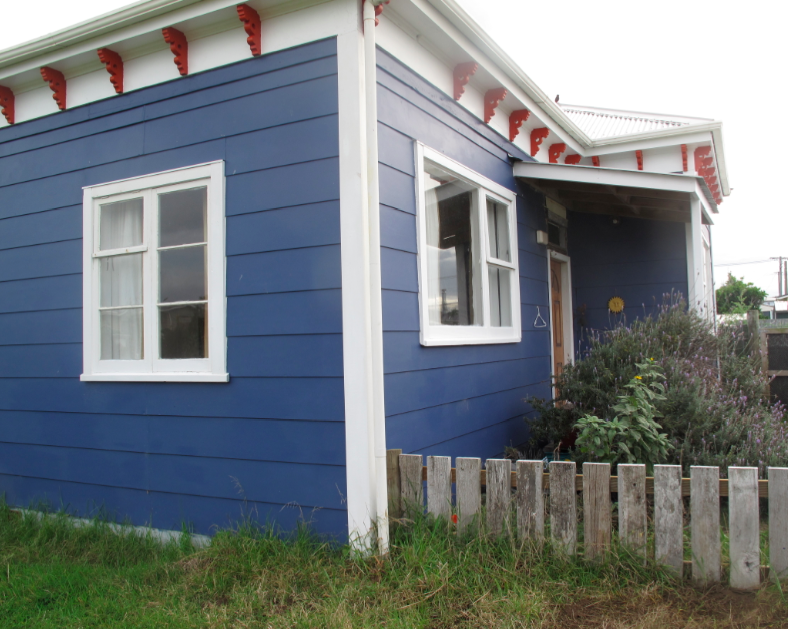
We are now over the 12-month mark of renovating an abandoned villa in Castlecliff into a warm, dry energy-efficient home. When we set out on this low budget / high performance retrofit we had no specific numbers in mind for energy savings and waste reduction. We simply wanted to push the envelope and do the best we could. As it turns out, our power bill has averaged $20 per month (this includes the daily line charge) and we have spent a total of $20 in rubbish fees for the entire year. I’ve come to call this our “20-20 hindsight” but there is no reason it could not also be a 20-20 vision for others to work toward by the year 2020. Of course electric rates will increase by then, but that is all the more reason to invest in efficiency now. (At current rates of annual change, electric rates will double in under ten years.)
The first Conservation Comment I wrote in July explained the design principles we employed for our passive solar renovation that have helped us achieve low energy bills. There is nothing new or unusual about those principles: solar gain, thermal mass, insulation and draft proofing. Similarly, there is nothing new or unusual about the design principles for our approach to resource conservation: reduce, reuse and recycle. The 3 R’s have helped us reduce the cost and impact of the renovation project as well as the cost and impact of our day-to-day lives. Here are a few examples.
While we have followed the New Zealand Building Code and used treated pine, Braceline Gib, building paper, and heaps of insulation, there are also areas where we were able to reduce costs and impacts by reusing materials. Prime examples include the bathtub, vanity, washtub and toilet in the bathroom, and the bench, sink, mixer, drawers, and shelves in the kitchen. Perhaps the most visible example is the vintage Shacklock 501 multi-fuel range that I bought my wife two years ago as a wedding present and we worked with Building Control to find a way to install safely. But my personal favorites are the pelmets that I made from old weatherboards that we removed while re-cladding sections of the exterior. And, like any builder would, we saved off-cuts to use as dwangs or for other small jobs.
Regarding our household waste stream, we compost all of the food scraps and even our fish and chips papers. We save paper to burn in our Shacklock or our outdoor pizza oven (made from an old wood burner) or to mulch our gardens and fruit trees. We reuse plastic bread bags and other small non-recyclable plastic containers. Again, there is nothing special about any of this, other than the fact that we take it seriously and put out one bag of rubbish for every two months. Perhaps the most unusual thing we do at all is emphasize the costs savings rather than simply the environmental benefits. At the end of the day, eco-thrifty living makes dollars and sense.

Early Autumn Update

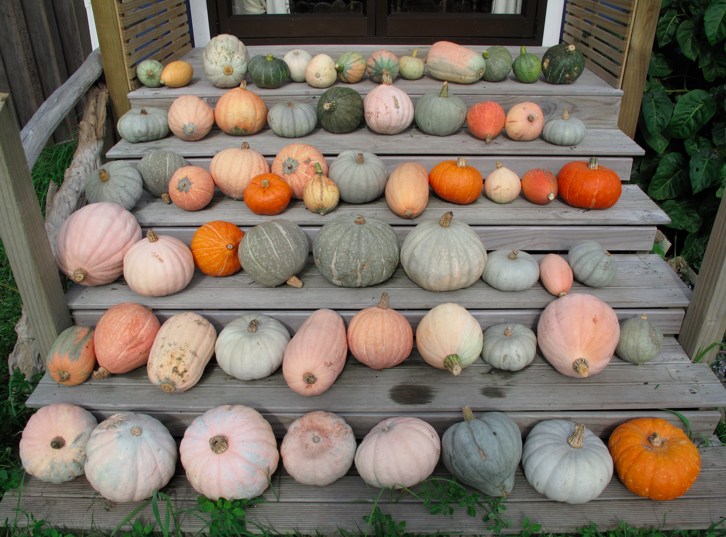
Here is a bit of a photo tour of the property almost 2 and 1/2 years into our project… Oops, there appears to be a problem uploading some of the pictures. So, this may be an abbreviated tour, starting with the first wave of our pumpkin harvest. Here they are curing in the sun for about three weeks before putting them into cool storage in the back bedroom.

One of our Monty’s Surprise apple trees is producing nice size fruit in our duck enclosure.

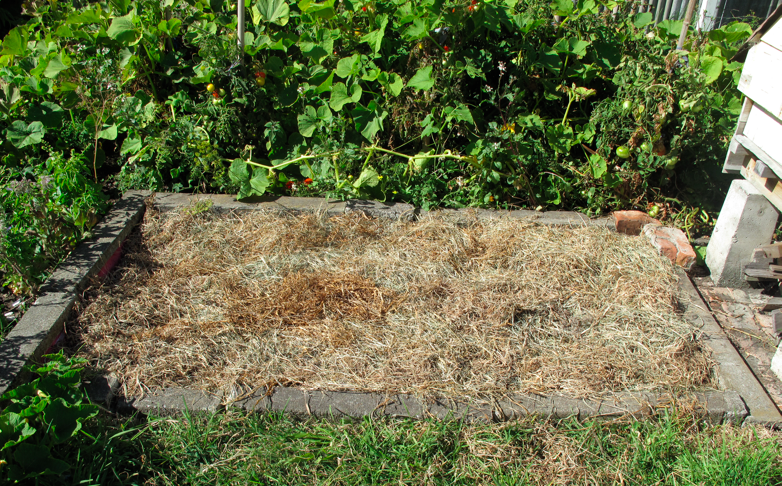
Perhaps our last garden bed being prepared with a piece of plastic killing the grass, and covered with grass scythed by Xander last week.

Our front yard.

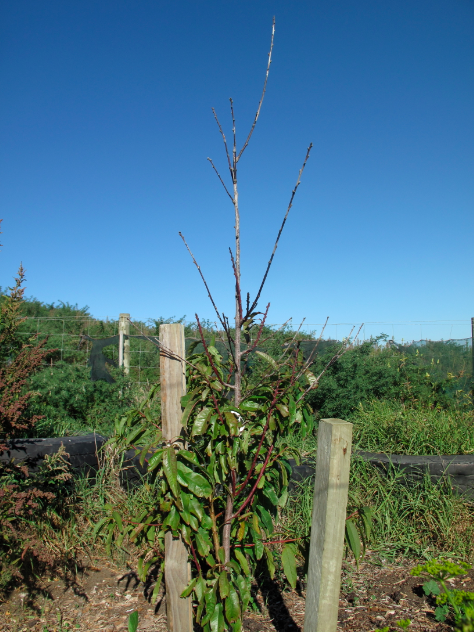
Wow, peaches in the dunes within 100 metres of the Tasman Sea. Free food!

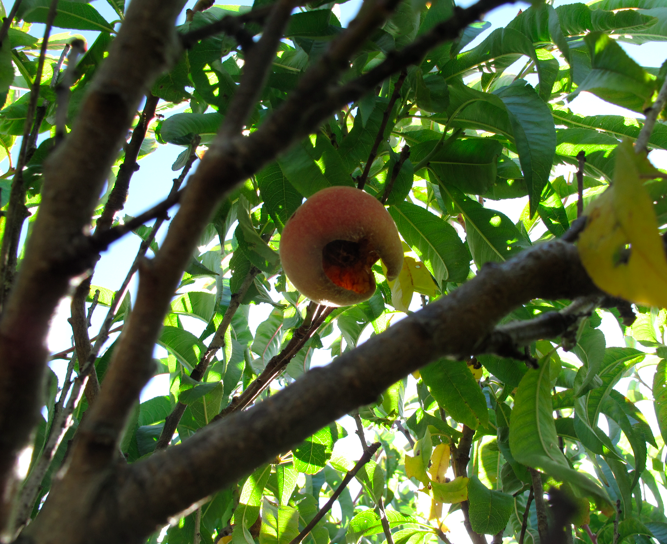
The wasps have found the free food too.

Here is that amazing peach tree.

A nice harvest in our kitchen.
 
Blackboy peaches, Yum!

Sorry the other pics would not load, Estwing