Category Archives: Uncategorized

AN ODE TO BABE. By Kelly Peters

AN ODE TO BABE

From where you came, to us you shall be

You were full of curiosity and a hunger

A wondrous, funny little being to me

Accompaniment for all our working

An energetic walk and funny little hop

The run and race of the day, so eager to play

The black sheep of my herd

But with white lightning beaming atop

Up and down the hills your call could be heard

A yearning to be alongside us

To help and to nap in a warm quiet slumber

Of the garlic beds freshly mulched hay

Memories of one taken too soon

Whose energy shall be passed on

To the trees and the moon

In the springtime you shall bloom

With a blossom so bright to outshine and illuminate

You’re now among the clouds and stars

The Tui shall chirp and the Kereru quietly feast

A sweet little lamb, never to be forgotten

To be in your company, you were no beast

The tree shall bear a delicious fruit

To be enjoyed by all in your memory

For we all shared a great time

Screen Shot 2015-09-14 at 5.17.46 pm

Detroit, Greece, Whanganui…

Two of the great thrills of growing up on the outskirts of Detroit were going to see a baseball game at Tiger Stadium and going out for dinner in Greektown. Balls, strikes, homeruns, souvlaki and baklava are etched in my memory.

I recall riding bicycles with my friends to a Greek restaurant for lunch when we were 12 or 13 years old. The owner, Olga, came out to talk to us, and I mentioned that “Olga’s” was my favourite eatery. She immediately gave us a meal ‘on the house’. Who says there’s no such thing as a free lunch?

Times change. Now when I think of Detroit and Greece I think of bankruptcy. In both cases, running up public debt over decades was perceived as a ‘free lunch’. However, it does not appear that all the blame can be laid on Greeks and Detroiters for “living beyond their means” and that lenders should be held accountable for making bad loans. That said, it also appears that successive governments in both locations made bad decisions on how to spend taxes and to run up debts backed by taxpayers.

Screen Shot 2015-07-10 at 5.48.46 pm

As we have seen at the local level in Wanganui, many decisions made by government are not based on sound research, robust data, or even expert advice. We hear debates about “core business” and “nice-to-haves” and subsidies for certain sectors, programmes, events and businesses.

Everyone likes to be on the receiving end of a subsidy but almost no one enjoys being on the giving end. There are many preconceived notions of how much we should pay in tax and where the monies should go. These notions are often aligned with political ideology.

We often encounter highly-opinionated but under-researched points of view in the Letters page of the Chronicle. A recent letter accused me of asking that my “business” of “adding insulation” be subsidized by our local council. Let’s start with the easy stuff: 1) I don’t have a business; 2) recommending adequate insulation is a small part of what I do; 3) the article referred to in the letter never mentions Wanganui District Council. But to be fair, the letter writer is not known for accuracy.

The responsibility of promoting strong and resilient communities, healthy citizens, public wellbeing, and local financial security does not solely fall to local government. For example, in Wellington the Sustainability Trust administers an excellent programme for healthy home assessments. In Palmerston North, the Red Cross runs a curtain bank. In the Hawkes Bay an incredible consortium of community groups has rallied around the concept of healthy homes. Likewise, in Christchurch, various organisations fulfill various roles along these lines.

But government on many levels can and does get involved. Almost everyone knows that central government has subsidized insulation through EECA for many years. It should be noted that government also subsidizes things like doctor’s visits, dental treatment, research and development, and yacht racing. Our own Horizon’s Regional Council subsidizes public transport as well as the education of farmers on better land care.

In Wellington, the City Council worked cooperatively with Victoria University and the Sustainability Trust to provide 67 free whole-house assessments to “help improve living standards for students.” Of the trial project, Mayor Celia Wade Brown said, “Energy savings, lower carbon emissions and students who are warmer and healthier through the winter months are all positive outcomes from this project.” In a nutshell, Wellington Council chooses to subsidize the health, wellbeing and financial security of community members because it recognizes the wide-ranging benefits.

In our River City subsidies take a different form, focusing on a glass-half-empty vision despite advice from one of New Zealand’s top economists. The current debate around subsidies includes the contentious issues of stop banks, uninsured homes, and art galleries. It’s not worth including the wastewater plant here, but I hope we can agree a million dollar odour fence was an unwise use of rates.

The bottom line is that a vibrant community is only realized through the efforts of the entire community. ‘It takes a village.’ We invite all to come and lend a hand. Those that turn up are those that turn up, but if recent history is any indicator, we are not likely to get a ‘free lunch’ from central government as it appears to have turned its back on the regions.

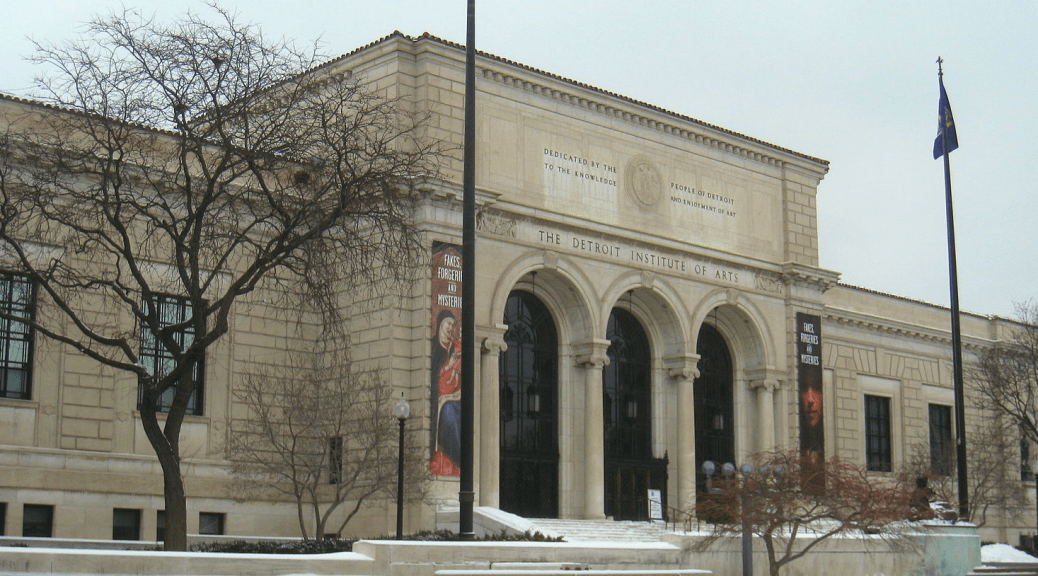
Additionally, it’s worth noting that Detroit has one of the finest art museums in the world. I’ve heard Athens has some good art too.


Sidebar:

Damp homes are set to have a major impact on our community for at least the next three months. Pick up free copies of the following information sheets at the Chronicle offices in Guyton Street.

Managing Moisture and Condensation

Ground Vapour Barrier Installation Guide

Marketing vs. Physics

Hundreds of shoppers in our community will misspend thousands of dollars at major local retailers buying inefficient heating products partly due to deceptive advertising and unsubstantiated claims.

I offer this as an observation based on physics and language, as well as what appears to be woefully poor legislation on what might be called “false advertising.”

The following list of dubious claims was collected in about 20 minutes: 10 minutes walking around the heating department of a large store, and 10 minutes leafing through circulars that appeared in my letterbox last Saturday morning. All of these claims apply to what is basically the same product: a plug-in electric heater.

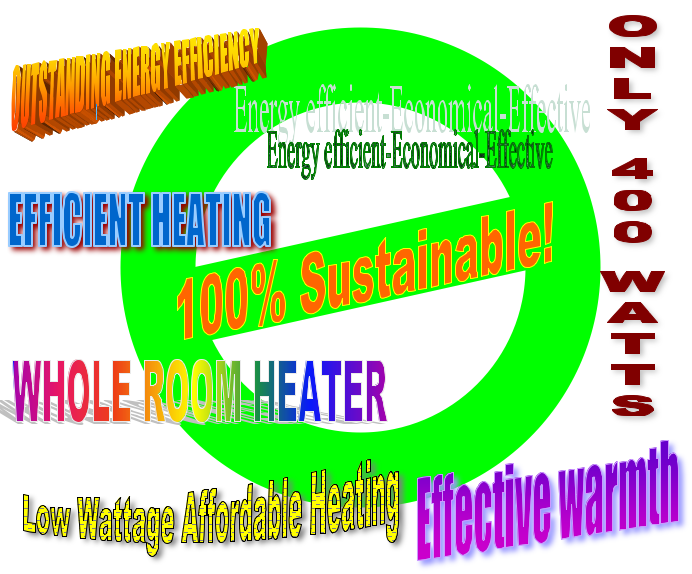
ECO; EFFICIENT HEATING; “Real warmth, real savings”; “High Efficiency Heating”; “LOW WATTAGE Affordable heating”; “Effective warmth”; “Energy efficient – Economical – Effective”; “Save up to 50% or more on your heating costs”; “ONLY 400 WATTS”; “WHOLE ROOM HEATER”; “OUTSTANDING ENERGY EFFICIENCY”. Screen shot 2015-05-25 at 8.07.56 AM

Before we dissect the language of these claims let’s take a look at the physics. Any plug-in electric heater – oil fin heater, fan heater, resistance heater, “eco” heater, etc – has an efficiency ratio of 1:1. This means that one unit of power (1 kilowatt hour) produces one unit of heat (1 kilowatt). (Remember that there are 1,000 watts in a kilowatt.)

Let’s take a standard 2-kilowatt (2,000 watt) heater as our baseline for this discussion. Over the course of one hour this heater will use 2 ‘units’ of power (costing 50-60 cents) to produce to ‘units’ of heat.

Got the physics? Now, on to the language.

Efficiency is recognized as the ability to reduce waste, save effort or energy, or generally to accomplish more by using less. For example, an energy efficient light bulb produces the same amount of light while using less power. Similarly, a fuel-efficient vehicle travels 100 km on fewer litres of petrol than an inefficient vehicle.

In most cases, efficiency is a matter of relativity. In other words, one thing is seen as efficient relative to something else that is inefficient. Here is the kicker for today’s discussion: all plug-in electric heaters are considered inefficient when compared with heat pumps, wood burners, and flued mains gas heaters. By comparison, heat pumps have an efficiency of 1:3 or 1:4. This means that for one unit of power they produce three or four units of heat.

From this perspective, the claims above appear completely out of line. Let’s start with the last one: “OUTSTANDING ENERGY EFFICIENCY.” Shocking claim. I suggest this squarely falls into the category of false advertising. Sadly, it probably works brilliantly and has resulted in many sales to well meaning and unsuspecting pensioners and parents of young children.

Next up: “ONLY 400 WATTS.” This gets to the heart of the e/eco/econo/ecocalifragilisticexpialidocious claims on certain plug-in electric heaters. They are small and give off little heat. When compared to a 2,000 watt plug-in heater, a 400 watt heater uses 1/5 the power and generates 1/5 the heat. In both cases the efficiency ratio is 1:1.

Imagine you pull into a petrol station and the offer of the day is 1/5 tank of petrol for only 1/5 the price of a full tank. Is that a bargain worth spelling out IN ALL CAPS?

Which brings us to another claim: “Save up to 50% or more on your heating costs.” According to my calculations, if you replace every 2,000-watt heater in your home with a 400-watt heater you will save exactly 80% on your heating costs because you will live in a very cold home. No wonder the package of one product claims: “LOW WATTAGE Affordable heating.” True, but certainly misleading.

I could go on all day but it appears I’ve run out of words, so I’ll leave you with this: “WHOLE ROOM HEATER.” Absolutely true for a VERY SMALL ROOM or a VERY WARM DAY.

Once again the lesson is to be very cautious of all claims on how to make your home warmer and drier. Seek independent expert advice from the EECA Energywise website (www.energywise.govt.nz) or the Eco Design Advisors website (www.ecodesignadvisor.org.nz).

Peace, Estwing

Resilience is not Prepping

Editor’s Note: Here is a short response to a large amount of mis-reading of misunderstanding of the last post (which I wrote for The Automatic Earth), which was reposted on over a dozen websites including Naked Capitalism and Zero Hedge.


The article I wrote for TAE last week – Resilience is the New Black – appears to have caused a stir in certain sectors of the internet. It’s great that the piece struck a chord with so many but came as a surprise to me. We have been publishing our blog – www.ecothriftylife.wordpress.com – for over four years but only get 50 to 100 views per day.

The other two things that surprised me were the misreading of the piece and a huge amount of confusion and uncertainty about what ‘resilience’ even means. I’ll address both in this article.

Ilargi first alerted me that Ives Smith had posted the article on Naked Capitalism with some comments of her own. I had a look and was a bit shocked at what she had written. Her comments appear to misrepresent the article and perhaps served to bias readers before they got into the piece itself.

It appears that the two main points of her critique miss the mark: 1) that I have abandoned the notion of sustainability; and, 2) that I have turned my back on the world and focus only on “me, mine, my family.

Here is what I submitted to the comments section, admittedly after reading a number of bizarre musings from courageously anonymous posters:


Thanks for posting this article. Raul tipped me off. It’s great to see it has sparked healthy debate. Two important points that I think you missed in your preamble.

First, it was not my intention to indicate an “abandonment of the notion of sustainability.” What I wrote is that I do not bang the drum for sustainability anymore. I practice it on a daily basis. I have meant to make a couple of points in the article: 1) My observations of the global debate on many issues has shifted to resilience over the last 7 years; and 2) Most people in my direct experience relate much stronger to the notion of resilience than sustainability. I work with patterns and both of these are strong patterns I have observed since 2008. As a community educator, it is my duty to take the most effective approach to support my fellow citizens. The resilience approach has been hugely successful across the socio-economic spectrum.

Second, the word community is used three times in my article along with a reference to sharing our project locally. I’d say that scores 4 mentions of us supporting our neighbours and our city. Characterizing the piece as focusing on “me, mine, my family” is simply inaccurate. I know of few people in the sustainability movement worldwide who are more community-focused than us or who are more generous with their time. Ask anyone who has ever met us or worked with us, including Ilargi and Nicole at the Automatic Earth.

I see no problem challenging someone on their own “home turf.” I think it is important to do. But it is necessary to make sure you are accurate in your critique.


My thesis was that resilience has surpassed sustainability at the forefront of many people’s minds in recent years. But to embrace resilience does not mean to deny sustainability completely. If resilience is ‘the new black’ it doesn’t mean you don’t wear sustainability once in a while. Personally, I wear it everyday, but I bang the drum for resilience because more people listen.

On the second point above, Ives is totally off the mark. I am heavily involved with the permaculture movement and sustainability networks, and know of few people globally who can match our community projects here. How did she overlook the major emphasis on community in the piece? Reading further down the comments section gave me some possible clues.

One person suggested resilience was simply “prepping” and another thought it might be some new hipster term for…I don’t remember. My point is that there appears to be a huge amount of misunderstanding of resilience. I suspect that Miss Smith labeled me a “prepper” and then stereotyped all of the common attributes of preppers.

I am used to the term sustainability being interpreted in hundreds of different ways, including being co-opted by corporations. It seems the concept of sustainability is surrounded by grey area, but I was not expecting the same for the concept of resilience. It appears the Internet can make anything grey, so I’ll try to put things in black and white.

Resilience is not “prepping.” I repeat, resilience is not “prepping”.

A three second search of the Internet found these definitions:

1) the ability of a substance or object to spring back into shape; elasticity

2) the capacity to recover quickly from difficulties; toughness.

While both definitions focus on after-the-fact aspects of resilience, the most important aspects in the context of climate change, income inequality and volatile energy prices involve building resilient capacity. In other words, the ability of bounce back requires lots of up front groundwork. In these contexts, the groundwork that needs to be done is moderating extremes.

The human body is a great example of moderating extremes. When we are too hot we sweat and when we are too cold we shiver. Like the Buddha, our bodies seek a middle way. But unhealthy living conditions weaken the immune system and decrease the body’s resilience. I have been a crusader for warm, dry, healthy homes in my community (and world wide through the web) for over four years. I even developed a maths/science curriculum on passive solar design using our Eco-Thrifty Renovation as an example. The Little House That Could can be found on Facebook.   https://www.facebook.com/pages/The-Little-House-That-Could/205750306163061?ref=hl

In the context of climate change, resilience means moderating climate extremes, especially those involving water and the lack thereof. In both cases eco-design is the best approach to take: imitating the way nature moderates for climatic variability. We are currently using eco-design to drought-proof our farm while also managing for periods of excessive rainfall. I have written an article for fix.com on how to drought-proof a suburban property but it is yet to be published. If you’re interested keep an eye out for it.

In the context of income inequality, we also need to buffer society from extremes. Researchers have told us that there is a correlation between wealth inequality and social problems. If we want a resilient society – and I sure do – we need to work to moderate those extremes. That’s why I have put so much volunteer work into raising awareness of the TPP in my community.

In the context of volatile energy prices, I believe it is important to design for resilience for ourselves and our communities. Our Eco-Thrifty Renovation project represents this approach, and would be considered one of the best such initiatives anywhere in the ‘developed world’. For a summary of the project, see this page I posted as part of my diploma work in permaculture: https://ecothriftylife.wordpress.com/2015/03/30/eco-thrifty-renovation-by-the-numbers/

We have lots of mottos and catch phrases, but one of the best is Act Locally – Share Globally. Our work represents thousands of volunteer hours that are both locally and globally focused. As an individual, I answer every email I get requesting information about our projects. Who else can say that?

The bottom line is that extremes and their consequences are almost always expensive. Avoiding and moderating them is both conservative and practical. I believe our world and my family will both be better off if I promote resilience to extremes on all levels. Nothing grey about that, is there?


Peace, Estwing
 

Caveat Emptor

Have you ever been rung by a company promising you a product that will improve the health of your home? Have you ever been told over the phone that you qualify for an insulation subsidy? Have you ever been promised a “free estimate”?

Yes, it’s true, when something seems too good to be true it usually is.

I have been amused recently by an advertisement on local radio claiming that solar energy is a great way to “save” power. Um, excuse me but solar photovoltaic panels do not save electricity. They generate electricity. This is about as fundamental a flaw in understanding of electrical power as our local authority’s demonstrated understanding of wastewater treatment. And we all fear what that will cost.

The same ad claims that solar panels “essentially” pay for themselves over their lifespan. First of all, what does “essentially” mean? It does not seem like a guarantee of performance to me. And even if it did, the last time I checked, the lifespan of most photovoltaic panels was 30 years. A payback period of 30 years represents a very marginal return on investment that does not compare to dozens of better investments one can make in power savings for the home.

On one level this type of marketing is amusing but on another level it is concerning because it deceives most of those who hear it.

Please understand, I do not mean to pick on one particular company. I am simply using this as an example to demonstrate my point. Businesses are in business to do business. This means selling you products or services that you may or may not need.

This is not to say that all businesses use questionable sales pitches. Many do not. What it does mean is that enough do that it should make all consumers very cautious. We often hear about “cowboys” in the building and home improvement trades.

Perhaps “bandits” would be more accurate. Sadly, there are enough of them out there to colour the whole industry.

Here is a short list of things to be aware of to protect yourself from getting less-than-your-money’s-worth:

Cold Calls – If you are contacted out of the blue with a “special offer”, ask yourself why have I not heard about this in other ways?

High Pressure Sales Techniques – The more pressure salespersons apply to you (ringing repeatedly, urging you to sign an agreement without having time to reflect), the more skeptical you should be!

Unsubstantiated Claims – Ask to see data that proves the claim. Ask for a guarantee of performance in writing.

“No money down” and Payment Plans – When you buy something on credit you always end up paying more.

Unneeded Products and Unneeded Services – Remember, a salesperson is just that. If you speak to one on the telephone or one comes to your home, they have one thing in mind: to get you to open your wallet.

Sadly, we know that pensioners are targeted in many of these ways. Over the last two years I have visited many homes in Wanganui occupied by seniors who have not been given value for money on everything from curtains to heating systems to ventilation systems. It’s frustrating to come in after the fact and witness the impacts of slick salesmanship or simply bad advice, particularly when it effects those on fixed incomes.

Yes, in this world, good advice comes at a price, but bad advice is almost always more expensive. Fortunately, when it comes to the housing sector there are a number of sources of free, independent, expert advice. Here are a few:

The Energy Efficiency and Conservation Authority (EECA): www.eeca.govt.nz

Beacon Pathway: www.beaconpathway.co.nz

Eco Design Advisors: www.ecodesignadvisor.org.nz

These are considered among the most accurate and trustworthy sources of advice in New Zealand on everything involving heating and cooling, insulation, controlling moisture, and appropriate ventilation.

Closer to home, you can contact the Whanganui Regional Health Network for advice and to see if you really qualify for a government (EECA) insulation subsidy. Additionally, you can submit your questions to the Chronicle and I will answer them over the next three months. Please submit your inquiries to Anna Wallis, Wanganui Chronicle, PO Box 433 Wanganui or anna.wallis@wanganuichronicle.co.nz

 Screen shot 2015-05-01 at 11.02.24 AM

Byline: Dr. Nelson Lebo diagnoses unhealthy homes and prescribes cost-effective remedies for any budget.

Get on the Bus!

The Electric Kool-Aid Acid Test (Tom Wolfe, 1968) is recognized as one of the great non-fiction literary works of the Beat Generation. The New York Times called it an “essential book” among the great reads of the time.

Using a literary style called ‘New Journalism’, Wolfe conveys the story of poet Ken Keysey and his Band of Merry Pranksters as they make their way on a second-hand school bus across the United States from West Coast to East Coast. Along the journey they have a number of wild adventures and meet the likes of Jerry Garcia of the Greatful Dead, Allen Ginsberg, and the Hells Angels.

Screen shot 2015-03-30 at 12.53.13 PM

As one might expect, ‘Pranksters’ came and went throughout the long and winding trip. As the driver, Keysey used a simple phrase over and over before closing the door, starting the engine, and pulling back onto the highway: “You’re either on the bus or off the bus.” The bus was appropriately named “Further.”

Fast-forward 2015: Any talk of cultural icons and named buses leads only to Winston Peters and his “Force for the North.” Ironically, while Winny was physically on the bus, it was Prime Minister John Key who metaphorically urged Northland voters to stay on the National Party bus. At present, riding that bus means supporting the secretive Trans Pacific Partnership Agreement (TPPA).

Peters, however, has said he won’t stamp that ticket. “We’ll stop them passing this law. It’s about foreign corporates suing you as a taxpayer. That’s a challenge to this country’s democracy, which has been going for 167 years. It’s about our sovereignty and right to make our own laws.”

Screen shot 2015-03-30 at 12.51.47 PM

Peters appears to have won a decisive victory in the National Party stronghold by sticking to his message: This government has neglected the regions, and particularly Northland, for too long.

I have never been to Northland but one thing I hear about the region is its dreadful housing stock. On this issue, the Whaganui region cannot be far behind. If you live in a home built before 2008 it almost certainly cannot be characterised as warm, dry and easy to heat. Even many homes built since 2008 would be considered low-performers when using an international yardstick.

It is well known that many Kiwis live in cold, damp homes far below World Health Organisation standards. Research shows that these conditions cost the nation dearly in medical expenses, missed days at work, illness related absenteeism in school, and high power bills for those who do turn up the heat. This creates what appears to be a lose-lose-lose situation, especially when applied to our Wanganui community.

Not having grown up in New Zealand I don’t fully understand the cultural tolerance for grotty housing and why it is so hard to rally people to ‘get on the bus’ for healthy homes. I would have thought that a wide range of organisations in the River City would get right behind the idea of healthy homes/healthy people/healthy economy. But the concept doesn’t seem to gain traction here.

Over the last two winters I have had the pleasure to work with a very small group of concerned individuals and businesses to provide free independent advice on the most affordable and best performing ways of keeping any home warm and dry. The feedback from participants has been excellent.

Ironically, during one of our free presentations at the Josephite Retreat Centre last September on “How to use your heat pump effectively,” Winston Peters was in the city campaigning. Since Peter’s voter base was the exact target audience of the presentation, you will not be surprised by our low turnout on the night. Maybe I should have asked to be his warm-up act!

But seriously, do you have any ideas on how we can rally our community to ‘get on the bus’ for low-energy/high-performance homes? Or am I just spinning my wheels?

To Quote Ken Keysey, “There are going to be times when we can’t wait for somebody. Now, you’re either on the bus or off the bus. If you’re on the bus, and you get left behind, then you’ll find it again. If you’re off the bus in the first place — then it won’t make a damn.”

Peace, Estwing

The 3 R’s Plus Some More

Editor’s Note: This is my regular column in the Wanganui Chronicle.


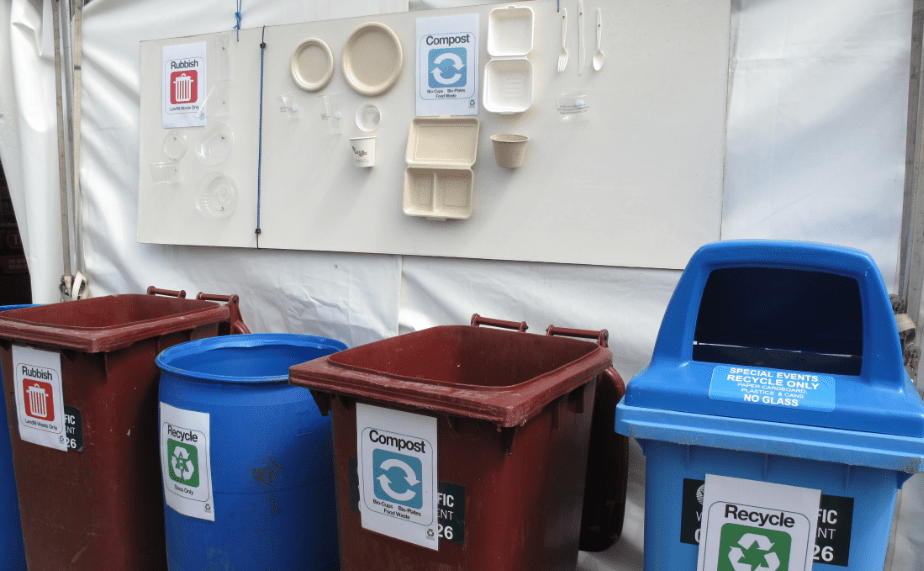
In the last two weeks we have seen a number of pieces in the Chronicle on waste management, kerbside recycling, composting and the 3 R’s: Reduce-Reuse-Recycle. In eco-thrifty renovation we engage in a lot of reuse – often referred to as repurposing – as well as retrofitting and redesign.

One major aim of eco-thrifty renovation is to reduce power bills, indoor moisture, draughts, and respiratory illness caused by living in cold, damp homes. To be honest, eco-renovation hardly involves recycling, and since I have been actively recycling my entire life thanks to positive role modeling by my parents, I don’t ever really think about it. It’s just automatic.

On the occasion that I do think about recycling I am actually thinking about designing programmes that promote and enhance it. One example of this is the events recycling model that I developed in 2011 that later came to be known as Zero Waste Events. This service – with success levels that would make a German blush – was built on over 20 years of experience designing and managing award-winning school and municipal waste management programmes in the US.

Our school’s programme was so well recognized that I received a regular stream of phone calls from other schools wanting advice, and even the University of New Hampshire and ‘Ivy League’ Dartmouth College sought advice to improve their programmes. So you can imagine my surprise when I came to live here over four years ago and tried for the first time to engage positively with council only to experience another R: Rejection.

Here is some background. My wife and I had such a positive experience working with the excellent WDC building officers during our renovation, and the young man working reception at front-of-house was so friendly that I assumed all of my dealings with council would be along the same lines. The eager receptionist engaged me in conversation during my many visits sifting my way through the NZ Building Code with assistance from helpful on-call building officers.

During a number of our chats the receptionist suggested I contact certain council officers involved in areas where I had experience. I left a number of hand-written notes saying basically, “Hi, I’m new in town and have experience in XYZ and would like to contribute to the city.” This is where the rejection came in, although a fairer description may be declined-to-reply. I’d understand if it were a one-off, but it was the first of many occasions.

The purpose of this story is not to rehash my introduction to WDC’s communication style, but to provide context for an ‘outsider’s critique’ of the Chronicle article on low uptake by residents of fee-based kerbside recycling. At risk of becoming the Shamubeel Eauqub of waste management, here goes.

With all due respect to those quoted in John Maslin’s well-written article, I found many statements confusing and contradictory of statements previously published. To begin with, the low uptake of fee-based kerbside recyling should have surprised no one. Did the headline “Locals reluctant to recycle at a cost” come as a revelation to any readers? I’d love to see the projected participation rate and on what research and data it was determined.

Twenty years ago I attended a recycling conference and learned a few fundamental things about the role of government and basic human behaviour: Recycling is seen as good for society and the environment, and therefore government’s role is to remove barriers to citizen participation. Cost is a primary barrier. Surprised?

We hear WDC is reluctant to subsidize recycling because of the money, but council regularly chooses to subsidize many economic, social and artistic programmes instead. Previous articles on the Resource Recovery Centre included the emphatic statement: No rates were used to develop the facility. Yet Councillor Rob Vinsen reports in Maslin’s article that council’s contribution had been $150,000. This contradicts earlier statements made by officers and elected officials. Why the discrepancy and what’s the truth?

The truth is we live in a participatory democracy and it is our right (some would say duty) to engage with the government and to question poor design. Take a look around our diverse city and think about what is local government’s “core business” and what are the “nice-to-haves.”

Ring, text, email, write or talk to your elected representatives. Write a letter to our vibrant local newspaper. Go ahead and have a good winge if you feel something about our community is not good enough. Let councilors know you are paying attention and remind them that they are halfway to re-election.


Peace, Estwing

Ethical Eating, Kiwi Style with No Pretention

A huge thanks to Nicola Young for putting us onto The Katering Show in her last column. The episode titled “Ethical Eating” is great on many levels. The commentary on pretentious shoppers at a Farmers Market is priceless. For anyone who thinks about the social and environmental impacts of the food they eat, “The Kates” offer a warning not to take ourselves too seriously.

Along the same lines, the phrase “ethical eating” is pretty loaded. I would never use the term as it appears to imply that all other eating is unethical. Yow! Does that include the ‘Reduced for Quick Sale’ apple crumb cakes I buy en masse from Countdown?

In my experience with Farmers Markets and pretentious shoppers, I have always taken a proactive approach but admittedly with mixed results. About ten years ago I brought my produce to a brand new market in a wealthy village a few miles from the not-so-wealthy hamlet where I had my farm. This was during the era when “Artisinal Bread” was coming on the market and gaining a 30% mark-up because of the use of the word artisinal. I was like, “Yo! Sign me up.”

Turns out the extraordinarily pretentious lady who organised the market did not appreciate my “Artisinal Salad Greens” or my “Zesty Zero-Emissions Mesclun Mix.” Rather unceremoniously my stall space was given to a lady who knitted tea cozies, and the so-called “Farmers Market” lost one of its two actual farmers. (Everyone else was a “crafter.”) Screen shot 2015-03-06 at 7.00.38 AM

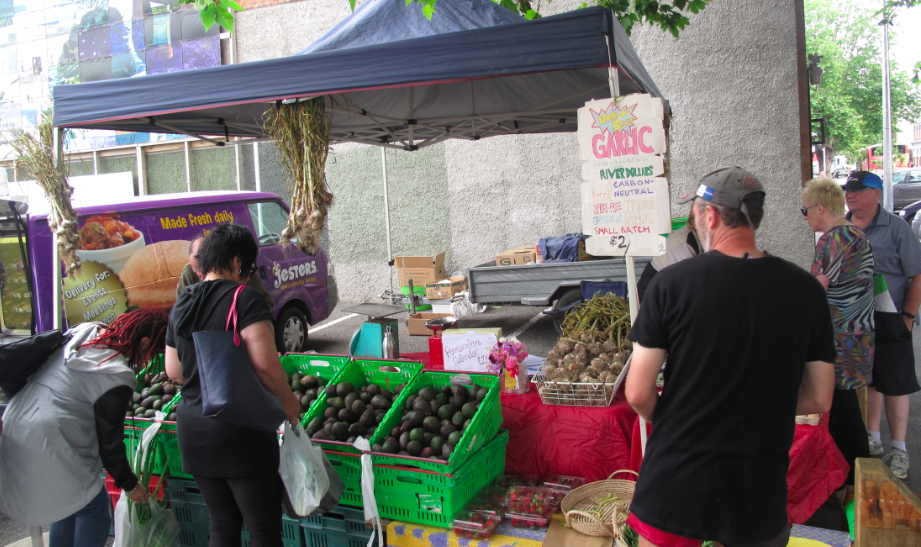
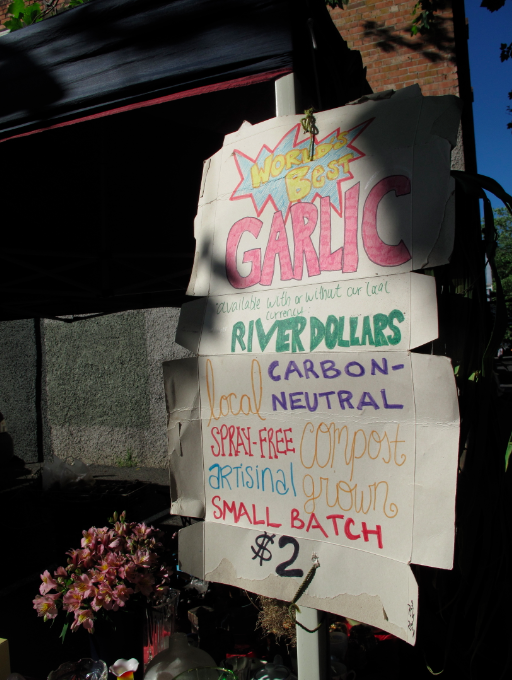
Fortunately I have encountered no such snobbery at our own River Traders Market…well not much anyway. In all good humour, we market our World’s Best Garlic as, “local, carbon-neutral, spray-free, compost grown, small batch, and artisinal.” It is available with or without the use of Whanganui’s local currency, “REBS.” We were warned not to label it “organic” because we have not paid to join that club, and the labeling Nazis may persecute us.

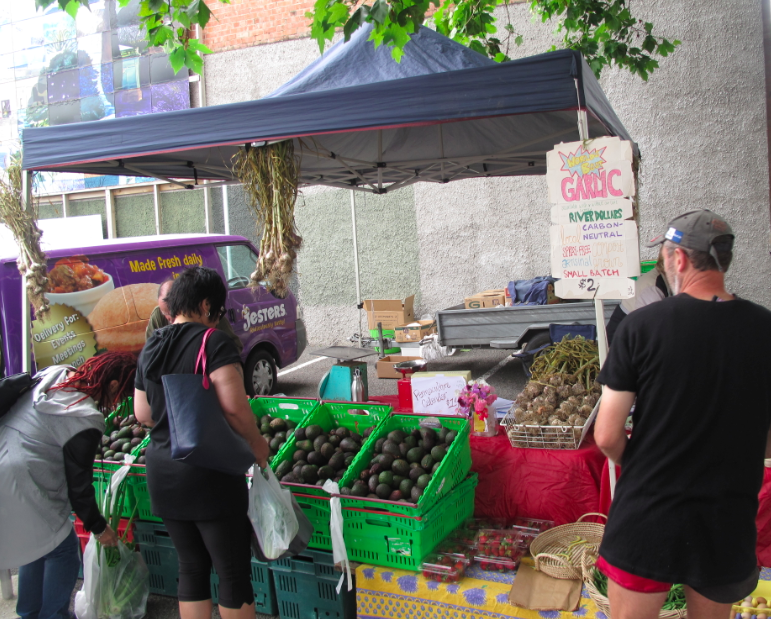
When it comes to unpretentious shopping for local and/or organically-grown fruit, vege and eggs there is no better place than the REBS stall on Saturday morning. My colleagues do an amazing job of keeping this community-based, cooperative stall stocked with fresh, in-season produce every weekend of the year. From my understanding, the REBS stall is one of maybe only two that have never missed a market day in over six years.

Screen shot 2015-03-06 at 7.00.53 AM

It seems every discussion of local, organically-grow food always comes around to price. Here I would like to steer the discussion away from  clever marketing and affordability to quality. There is no better tasting garlic available than that which I grow. I will admit to first equal – that’s awesome, mate – but none greater.

In olive oil there is extra virgin first cold press. In coffee there is 100% Arabica beans. In garlic there is fresh, local and grown using exceptionally high quality compost. (I’m not a wine snob so I wouldn’t know the next permeatation.) High quality food costs more than low quality food. Same with cars, houses, mobile phones, computers, beer and “escort services.” You get wacha pay for. Screen shot 2015-03-06 at 7.00.24 AM

It seems every discussion of ‘ethical eating’ also comes around to meat. There is no debate that the vast majority of methods for raising meat animals have large environmental impacts. It is also no secret that cutting back on one’s carnivourous behaiviour or choosing to be vegetarian tick the most ‘ethical’ boxes on the list.

Screen shot 2015-03-06 at 7.01.07 AM

However, in New Zealand we have the unique opportunity where eating more meat is best for the environment! Too good to be true? Not at all. Step right up for a generous helping of local, organic, free-range, natural, small batch, goat humanely “demised” and lovingly processed by a skilled craftsman-of-a-Kiwi-bloke and slow-cooked to perfection over an entire day by the gentle caressing rays of the Earth’s local star. Screen shot 2015-03-06 at 7.01.17 AM

But how am I going to fit that on a sign?


Peace, Estwing