All posts by Estwing

Addicted to P

We have an addiction to P in our home. (Note: In no way do I mean to diminish the real problem of P addiction in NZ – indeed, in our neighborhood – or in the USA known as “meth.”) The P addiction in our home is all about permaculture. Please be aware that permaculture is not the only ecological design system that exists on this glorious planet, but some say that it is the most comprehensive. To that, I add the most documented. Permaculture has over 30 years of books, magazines, and even a few peer-reviewed papers, as its chronicle. This is particularly useful for those (ie, me) writing doctoral theses on ecological design in science education.

The P addiction in our home results from an approach to permaculture not as a set of principles to memorize and apply in a formulaic manner, but rather as a way of seeing the world. In other words, permaculture as systemic, not systematic. This perspective, for me, results from decades-long involvement in ecological design and a learning disability that was misdiagnosed (ignored) in my youth. In other words it is a combination of nature and nurture. I was born with a brain that is better at seeing at the space in between things than the things themselves. While this may have contributed to my success as an All-American lacrosse attackman (ie finding my way between large defensemen), it also inspired my second grade teacher to alert my parents that I would never read. Luckily, they were both teachers themselves, and sent me to a tutor instead of to the meat works (to work, that is, not to contribute my flesh).
Ethical note: NOT my second grade class. This looks like 4th grade. Wait, maybe 6th grade.

Regarding nuture, I’m not referring to the 17 years of private school or to the amazing support given to me and my brother by our parents. If anything, the rigid, traditional schooling I experienced for much of my life suppressed my potential for systems thinking. The main lesson I learned from school is that it was all a game, and the playing field was tilted in favor of certain brains and away from others. My brain was an other, and I struggled mightily not to drown (below C-level) through primary school, middle school and into high school. Around the time I hit my stride in lacrosse, I also figured out how to play school. Interestingly, some psychologists suggest that certain people outgrow their ADD after going through puberty. I don’t know if that was the case for me because I’m definitely still ADD. Instead, I think that I figured out how to succeed in a reductionist paradigm by taking a systems approach. Although I considered earning good grades a game, I never took it as seriously as lacrosse because I did not respect it. It was more of a joke, where sport is serious business.

It was not until I had graduated from university (Magna Cum Laude, now that is a joke) until I came to the unfortunate realization that I hadn’t learned how to do anything in all those years at school. I could not grow a garden. I could not prune a tree. I could not build a house. Seventeen years of private education and all I got is this lousy scroll! No, the nurturing of a more holistic perspective did not occur until I began learning how to grow food, prune trees and build – ok, renovate – houses. A garden, a tree and a house are not things. They are systems, and we can never hope to understand them from a reductionist perspective. And for me, luckily, the seed I was born with was not terminated by a “Round-Up Ready” education. I’ve heard that certain seeds can remain viable for decades and even centuries. By those standards, 17 years appears fair to middling.

But I reckon that was good enough because it germinated in the humus of a pumpkin patch and the dust beneath a crosscut saw. And during the ensuing 17 years (and then some) I’ve nurtured a holistic perspective by actively practicing systems thinking. It was not easy at first, but with practice strides came. As I took up running marathons I made the easy connection between exercising my body and exercising my mind. At the same time, as a professional science teacher (go figure) I began to develop systemic pedagogies. In other words, teaching ecology in ecological ways. The release of creativity inspired me as a teacher and inspired many of my students. (Some still preferred reductionist approaches to teaching and learning. Most likely because they were familiar to them, and that they had found numerical and alphabetic success under them.)

And around that time I found a Masters program developed and delivered by the amazing Coleen O’Connell and Cloe Chun. Mind you, I had no intention of ever going back to school as a student. But they were willing to embrace a different paradigm for education that resonated with me. I can vividly recall Coleen selling the Masters in Ecological Teaching and Learning to me at the Society for the Protection of New Hampshire Forests building in Concord. I listened politely and told her, “I do all those things already.” She replied, “And you should get credit for them.” I was sold, especially because my employer paid for the degree.

I really must thank Coleen and Cloe for helping advance my education practice, which has lead me here to this computer in this foreign land and an email address that ends in ac.nz. And I must thank the New Zealand government for offering affordable tuition to international doctoral students and very reasonable health coverage. And most of all I must thank my supervisors Chris, Kathrin and Richard. But especially Chris for being an awesome colleague and friend.

Centre for Science and Technology Education Research community garden great potato harvest of 2011.

To his credit (and maybe his regret) he encouraged me to do my research “in a permaculture way.” This half-sentence of advice has made the process of PhD research more dynamic, more enjoyable, and hopefully more robust. For example, the methodology chapter in most theses is direct, dry and formulaic. In other words, dull to read and boring to write. Thanks in part to Chris’ advice, a holistic permaculture perspective, and drugs (not P), I have had a lot of fun writing this chapter.
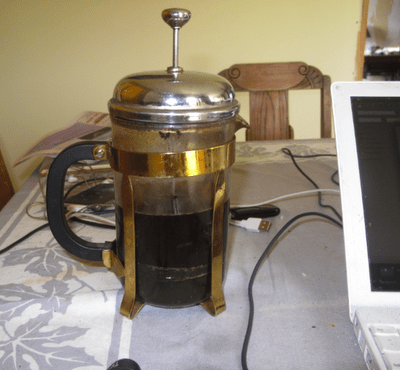
Three a day keeps distraction away.

I have engaged with the material and, in my opinion, created something entirely original. Many synergies exist between permaculture and education research. It is just a matter of creating a guild.
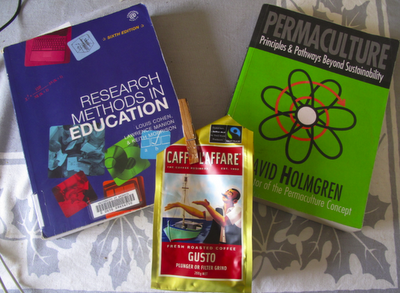
The whole is greater than the sum of its parts.

Oh, that was exhausting. For you too? This post takes a different approach than previous posts. If this is your first read, take some time to explore others. There should be something here for everyone. Maybe not Rick Perry.

For a snippet of the methodology chapter, see below. Please note it is an unedited first draft that I wrote this morning on 3 pots of organic fair trade coffee. I’d appreciate any insights or feedback. I may even acknowledge you in my thesis.

Peace, Estwing

The P of METHedology

4.7 Validity and Reliability

Many tables have four legs, but stability requires just three. A guild of three complimentary plants – such as the Hopi “Three Sisters”: corn, beans and squash – provides a stable cultivated ecology for growing food. A ship lost at sea can find its way using three beacons by a process called triangulation. In research, triangulation allows for stable (robust) findings and locates conclusions out of an ocean of data. Stable research is said to be reliable (Cohen et al., 2007).

But triangulation in every case described above is not a linear progression. In other words, two plus one does not represent the same incremental increase as one plus one. For example, a table with one leg benefits little from adding one more leg, but hugely from adding a third. Corn and squash planted together do not thrive like they do when beans are added to fix nitrogen in the soil to feed them. And a lost ship is still lost with only two points for reference. In all of these cases, there is a tipping point of integrity reached by triads when symbiosis turns to synergy. The whole becomes greater than the sum of the parts, and the system punches above its weight. Three, it appears, really is a magic number (Johnson, Year?)

In the world of research, triangulation is defined as the use of two or more data collection methods (Cohen et al., 2007). Campbell and Fiske (1959) contend that triangulation is a mighty way to demonstrate concurrent validity, and the process is deemed more or less essential for those doing qualitative research. Mixed method, or multi-method, approaches in social science research provide a number of advantages. For instance, blah blah…more here…

While major advances in validity and reliability occur between one and two, and two and three forms of data, subsequent improvements tail off quickly thereafter. A more-the-merrier attitude turns to four’s-a-crowd. That said, redundancy is bad neither in research nor permaculture. If one plant in a guild succumbs to an insect pest or disease, or if one method is found to lack validity, then an extra component in the system suddenly proves helpful. In fact, ecological validity in education research requires the consideration of as many characteristics and factors involved in the subject of study (Cohen et al., 2007). Brock-Utne (1996) promotes ecological validity when studying the adoption of new educational policies in actual classrooms. I submit that, when politics and scale are removed, that is essentially what I did in this case. In other words, I developed a new approach to teaching science, provided it to a teacher, and then attempted to chart what actually happened in his classroom. However, ecological validity can run up against boundaries determined by ethical considerations such as anonymity and non-traceability (Cohen, et al. 2007). These considerations were paramount for this study, which took place in a small school in a small town in a small country.

To be continued…

and continued…

and continued…

Draft Dodger

Editor’s note: Sorry about the misspelling of hongi on the last post. I have never seen the word spelled out, and to my untrained ear it sounds exactly like hangi. Dani knew the difference, but she is too busy to proofread my blogs, plus it would not have been much of a surprise for her had she edited for me, eh? If you are not familiar with te reo, google hangi and you will get a good laugh!
Anyway, the topic of this post is dodging drafts in an eco and thrifty manner.
From what I have heard, anyone who has ever lived in a NZ villa has commented on how cold and drafty they are. We have been working to change that, but unfortunately were a little late for the coldest week in recorded NZ weather history. Although we did not get the flue for our multi-fuel stove installed by a plumber in time, the week provided an excellent opportunity to collect data on our passive solar design. We reached indoor afternoon temperatures of 20 – 24.2 degrees Celsius all week long, although morning readings dropped to around 10 as overnight lows were in the 1 – 3 degree range. I reckon there are four main reasons for this: we have not yet insulated under the floor; the new concrete hearth is uninsulated; all of the pelmets are not up yet; and draft-proofing is not complete. One particular culprit in the case of the latter is the back door(s).
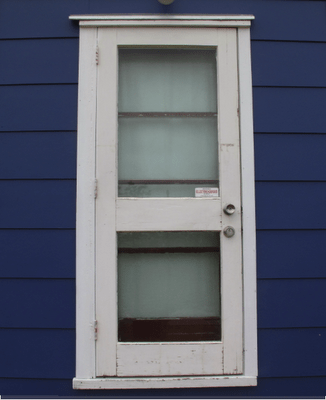
Could not track down a good old American aluminum storm door. Bought this wooden door on trade me for $40, including 2 locks and 6 keys.
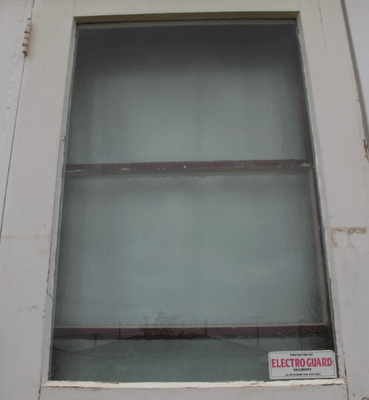
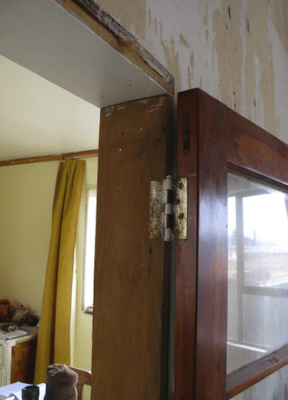
Although the back door(s) is “double glazed” so to speak…
Replaced the original traditional rimu four-panel glass door (inner door) that had been smashed by vandals with an identical one from the Renovators Centre for $100.
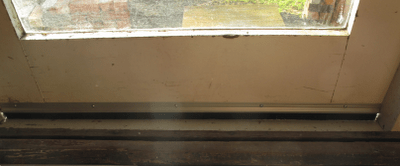
… as of last week there remained significant gaps around the perimeter.
The hardware store had a sale on door seals, so I picked up a couple. I decided to test the cheapest one along with a mid-range one. The cheapest model was on sale for $10. I reckon that is a good price, but the durability and longevity may be low as it is intended to be applied only with an adhesive strip.
That seems like a recipe for planned obsolescence. Some times being cheap is expensive. So I decided to beef up this model by pre-drilling 5 holes along its length. I used the adhesive to set it in place…
… and then tapped into my supply of stainless steel screws, which will not react with the aluminuim strip.
The entire installation took about 10 minutes and cost maybe $11 including the screws.
For the outer door, I went with the slightly more expensive model which included its own screws and was pre-drilled in the factory. I think this one was $15. But the feature that appealed to me most was the brush seal instead of the foam seal. Our new aluminium French doors has brush seals, so I figured that was a sign that they will take more wear and tear over time. Someone correct me if I’m wrong on this.
This installation took only 5 minutes.
15 minutes for both doors. Why had I not done this sooner? Oh yeah, PhD thesis, new bathroom, new kitchen, new roof, etc. And, the other measures I had already taken on these doors were functioning ok. For example, foam strips along the door frame.
Remember to follow instructions to get all sides of the frame.
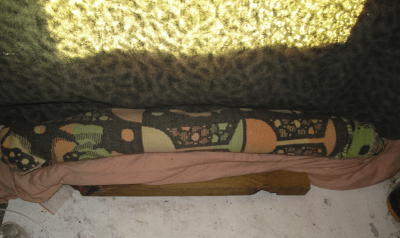
Additionally, I had already put up a pelmet above the inside door and hung a thermal curtain so that it nearly touched the floor. Then I took a pair of second hand blankets from the auction and “draft-not-quite-proofed” the bottom.
When we bought this house a year ago this door was smashed and poorly covered by a sheet of some pulp-like wood product and some roofing iron. Rain driven by northwestern winds (prevailing for us) pushed water inside.
Now, for a total of under $200 in materials, we have two draft-proofed, weather-sealed glass doors to let in sun but keep out rain and cold. And, some might say its more attractive than an aluminum storm door.
Peace, Estwing

For the Love of Good

On a more serious note – as hard as that is for me – we watched our wedding videos last night to mark our one year anniversary (Southern Hemisphere Edition). First of all, it is difficult to believe that it has been a year. So much has happened between then and now. And secondly, it is such a special memory to have had all of our friends and relatives there on that day last year.

But we don’t need to look at the videos to be reminded of those special friendships. We simply look at the wall in the lounge to recall special memories.
This star quilt came as a complete surprise to me from our friends Steve and Stephanie Lamb. Dani knew about it in advance, but she did not tell me. Receiving a star quilt in the Lakota tradition is like earning a haka or moko in Maori tradition.
Hangi is a traditional Maori greeting. This one made especially memorable for Brady’s (centre of star quilt) reaction.

I was fairly cavalier about the whole wedding ceremony deal until I saw the star quilt hanging on the fence. That’s when I lost my @#$%. Luckily the photographer trailing me knew when not to snap any shots.


Steph wrapped us in the quilt…


… while Steve sang us a pair of Lakota songs. It was one of a number of traditional Native American parts of the wedding ceremony. And, if I do have to admit, it was the best wedding ceremony I’ve ever been too, and it was 100% designed and planned by Dani. She did an amazing job along with help from her sisters, the moms, and to a lesser extent the dads.


Team Gallo


Team Lebo


Team Lejnieks


There a few things in the world with the potential to be less eco and less thrifty than a wedding and a house renovation. But in the last year we have managed to pull off both. And because of both, I am filled with happiness and love. Along with my wife, here are some of the things I love.
90 degree Celsius solar hot water after the coldest week in recorded NZ history.


From an abandoned wreck, we have created a warm, dry, cozy home. Because of the passive solar redesign we’ve used, the house is warmer at the end of the coldest week in recorded NZ history than it was at the beginning of the week. This represents a huge success for me because I am neither a professional engineer nor builder. At the end of the day, we have a permaculture paradise for under $90,000 (NZ) or $45,000 – $75,000 (US depending on exchange rate).
I love our garlic.


I love our ducks. And I love that they eat the leaves and flowers of our tagasaste trees as proper permaculture ducks should do.


And I love that they eat puha, a native NZ green that grows prolifically on our section.


I love these lilies blooming in the middle of winter.


Beautiful, even against a roofing iron fence.


And I love the painting that Amy Lamb (Steve’s niece) created for us from an old, broken villa window and a reused piece of Gib (drywall). I’m so glad that Amy and John Wright could spend time with us as our first interns. They were amazing! John went on to work on an organic farm in New England, and I hear that Amy has just started her own blog.


A. Lamb down under.


And finally (not a complete list, but this post needs to end sometime), I love my computer because my creative and skillful wife made the picture on the desktop.


Because it holds my 150,000 word (sorry, Chris) and growing thesis. And because it allows me to share our incredible eco-thrifty successes on this project with people worldwide. It’s all good.
And that’s the point. It is all good. And I love it all.
Love, Estwing


Paper Pushing

Being eco and thrifty can make gift-giving difficult at times. Some people may not recognize and appreciate the careful consideration that goes into the process. But anniversaries – especially the upper ones – require gold and diamonds, neither of which are particularly eco or thrifty. Luckily, we are only celebrating our first (paper) anniversary. Let’s consider the options.
The local, free weekly paper? Not exactly a gift if someone else sends it to us.


Or how about another form of paper? Eco, thrifty, practical.

But maybe not appreciated. And then I heard on the radio about Wanganui’s big event yesterday…


… and their paper-based giveaways.


Thrifty, but maybe not so eco. Hmm. Still thinking. Aha! Fish and chips come wrapped in old newspapers. Brilliant!
Happy Anniversary Honey!
Peace, Estwing

Recirculating Materials and Wealth in the Community

Before the big cold front descended upon us this week I post a tribute to “our suppliers.” But it was not until yesterday – while writing an article for the monthly REBS (River Exchange and Barter System) newsletter – that I thought about how these businesses help to retain wealth within our community by “recycling” dollars through Wanganui residents. Here is the article.
Peace, Estwing

Supporting Second-Hand Superstars

We recently celebrated our “local suppliers” in a blog post (13th August – http://www.ecothriftydoup.blogspot.com). Those “suppliers” include the Renovators Centre, Hayward’s Auctions, and various opp-shops around town. While the post was meant to be half serious and half tongue-in-cheek, it occurs to me that all of these businesses provide valuable services in terms of keeping dollars in the local community and reusing materials within the local community.

In the same way that a local currency such as REBS recycles wealth close to home, these businesses are contributing to a more sustainable Wanganui economy and a more stable global ecology. I would add Trade Me to that list when we purchase items and services from other River CIty residents.

If you have been observing the world news from Europe and America, you’ll recognize significant social unrest resulting from decades of unsustainable financial and economic management. Cuts to social programmes and education – so-called “austerity measures” – are a global trend and will come one day to Wanganui, which, from my understanding, is already heavily indebted. Has anyone seen the cover of the NZ Listener this week?

Everything we do to retain wealth within our community today – including supporting second-hand shops and auctions – will help ensure a more financially stable tomorrow.

Quote: “The next item up for bid is a box of bloomin’ good stuff.” – Brian Hayward, Hayward’s Auctions

Alternate quote: “Use it up, wear it out, make it do, or do without.” Olde Time New England Proverb

The Power of Sun

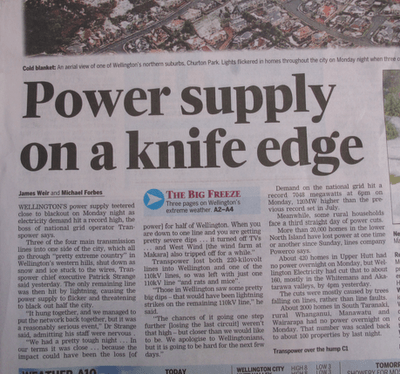
I reported yesterday on the cold weather gripping New Zealand. Here are some headlines:


And it turns out that the country used a record amount of electricity.

“Its those damn heat pumps in Auckland!” – Anonymous friend.
What most of the news does not say is that while the weather was cold with a few snow showers, it was mostly sunny. These are perfect conditions to put passive solar design to the test. So what did I do? Cooked a nice vegetarian curry.
And I even burned it while not paying attention. So I put on the rice…and burned that too. Ugh!
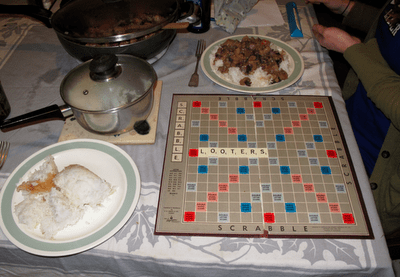
So to distract my wife from the burned supper, I suggested we play Scrabble.
Oh, what’s that in the background?
What’s it read?
That’s inside and outside temperature.
Must be my lucky day. Warm house. Hot supper. Beautiful wife. All for under 1 kilowatt of electricity. While the country as a whole was breaking records for electricity use, our passive solar renovations have come shining through with massive savings for us. Thanks sun.
And, on top of all that…
… a 50 point bonus on my opening turn! Happy! Happy! Well, not everyone.
Peace, Estwing

You Might Be a Redneck…

New Zealand is gripped by a near 100 year Antarctic weather system. It snowed in Auckland yesterday for the first time in 72 years, and much of the Central North Island is paralyzed at the moment by closed roads. Even school closings! Many generations of Kiwis have never experienced a “snow day.”
Here on Arawa Place we have had morning frosts and yesterday’s high was around 8 Celsius. At the moment it is 6 C. Brrr. But the sun came out yesterday afternoon to heat our home and our water. The wife had a long, hot shower this morning as ice covered the chooks’ water dish outside.

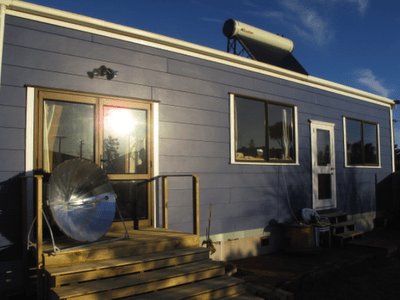
And again this morning the sun is streaming through our northeast windows.
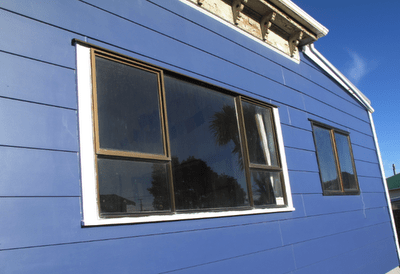
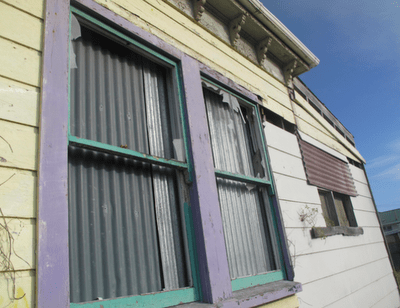
By the way, this is what the northeast wall looked like 9 months ago.
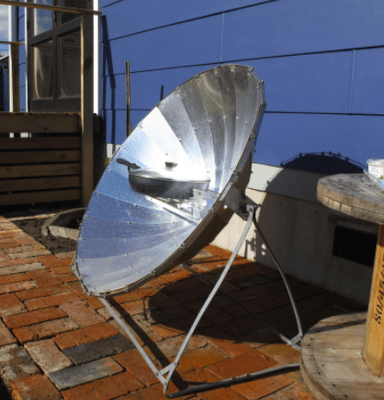
So despite the unusually cold conditions, we’re managing to stay warm in our recycled villa. And we’re even taking advantage of strong sun and light winds for a little cookout. Ummm, that smells like…
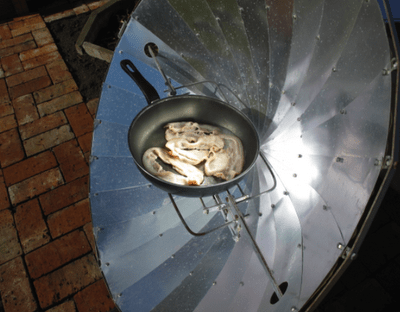
… bacon!
You might be a redneck…


Nothing says eco-thrifty like reduced price, free-range “natural” bacon on a solar cooker.


Peace, Estwing

Celebrating Our Suppliers

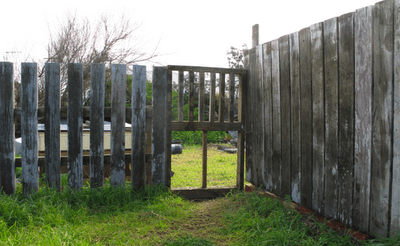
Permaculture is more than a set of design principles. It is a way of seeing. It involves seeing energy and how it flows through a system. And it involves seeing the potential in materials that others may ignore. What many consider useless, permaculturists can repurpose into functional and beautiful elements. For example, we turned a dangerous collapsing deck into an attractive fence and gate to keep dogs away from our fowl, which also serves as a windbreak for our banana plant.
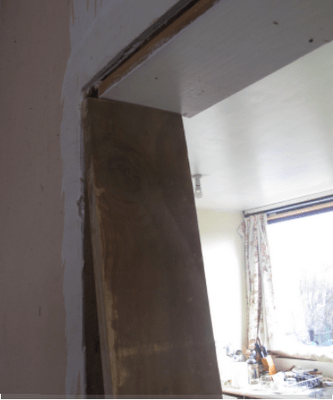
We have made wide reuse of materials left on this property when we purchased it, such as these bits of timber to frame a doorway.
But I was one board short of framing the doorway, so I went down to the Reno Centre…
… and found one for just $5.
And while I was at the Reno Centre I was lucky enough to find some galvanized flue pipe at a fraction of the price of buying it new.


Along with the Reno Centre, Wanganui is blessed with many Opportunity Shops (“Opp-Shops”) where we like to find many things, especially bric ‘a’ brac!
And speaking of bric ‘a’ brac, there is no better place than…
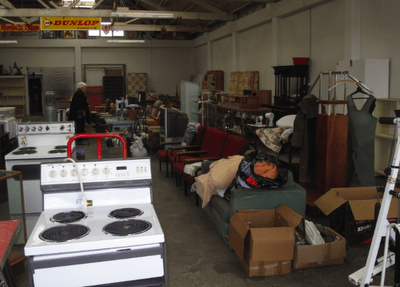
Hayward’s Auctions!
From a permaculture perspective, Hayward’s is the ideal venue to fulfill multiple purposes: great stuff at great prices and high quality entertainment. We go every Thursday night. It is our date night.
And, of course, there is metals bin at the local transfer station.

Together, all of these awesome local suppliers have helped us turn this…
Before
… into this!
After
Thanks to all our suppliers for providing a valuable service to the community.
Peace, Estwing

Celebrating Spirit!

Exuding enthusiasm.

We celebrate our dear friend Melinda Hatherly on the occasion of her birthday. We feel so blessed to know Lindy and her husband, Murray Jones. Caring, generous, community-minded, the list goes on.

This Whonderful Whoman from Whanganui played a key role in our Whedding and Whare Wharming in February.

Whedding theme was “Opp-Shop Melbourne Cup.”

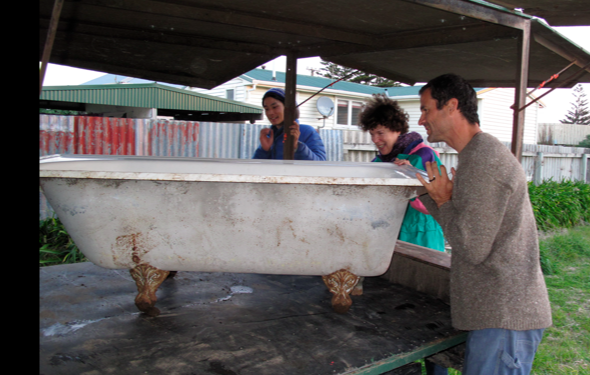
She was also there last October to help deliver our second-hand bath…


… and our first dinner party (before we had power or water).


And, along with Murray (back left in photo above), provided the best house warming gifts ever: fruit trees and bags full of organic compost!


As she helped us celebrate our special day, we want to celebrate hers.

Peace, Estwing

Nick of Time

I do not know much about wedding protocol (just ask my wife) but from what little I understand, there is a one year window for gift giving. By some small miracle, I have just squeaked in before the deadline. Hope you like it, Dearheart.


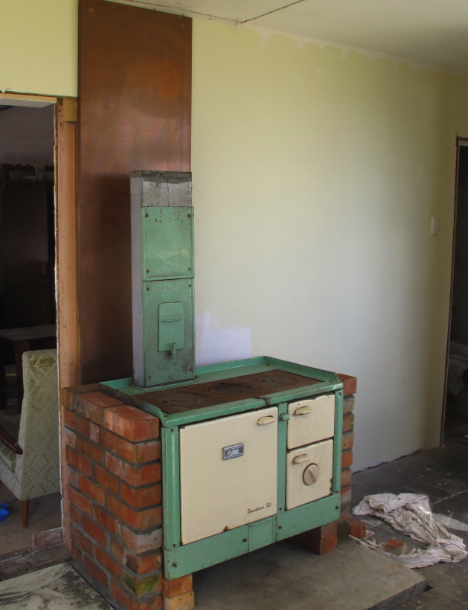
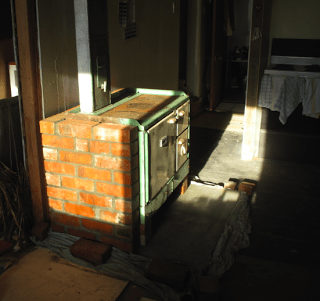
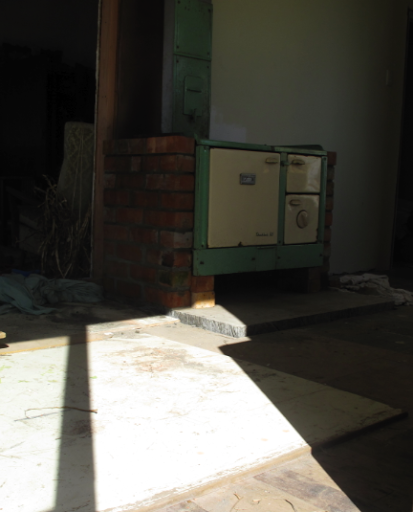
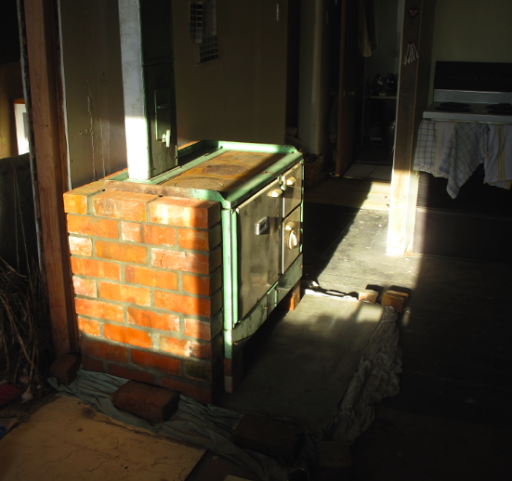
Now that that’s sorted, I wanted to explain how our coal range acts as thermal mass. Its placement is such that it receives winter morning sun through a northeast window.

It then receives winter mid-day sun through the French doors. Since we are nearly 2 months past the solstice, the sun is barely reaching the hearth. On June 21st it will reach of the first 3 courses of bricks.
And afternoon sun through a northwest window.


Even when not burning wood, our trusty Shacklock still has an energy role to play in our home. It slowly absorbs heat from the sun during the day and reradiates it at night. And the wife thinks its cute.
Peace, Estwing