All posts by Estwing

Beached As

In the post yesterday, I introduced Jonah and the whale. Today I am happy to report that the whale is beached. Or, as we say in NZ, “Beached as, broo.”
J is the MAN.


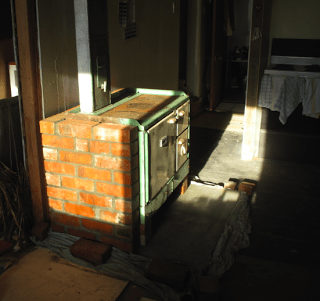
Jonah is an amazing bicycle mechanic and community-minded individual. We adore him, and were pleased to find out – quite by surprise – that he can lay bricks.
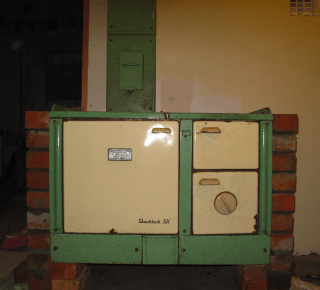
Classic Kiwiana
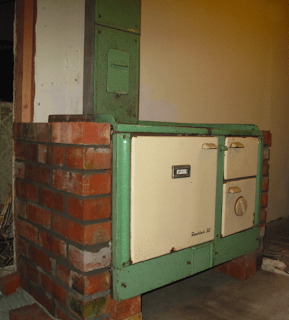
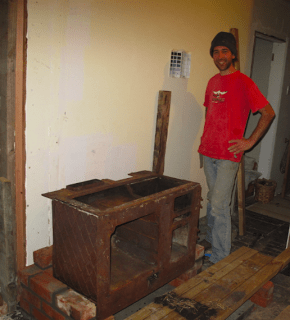
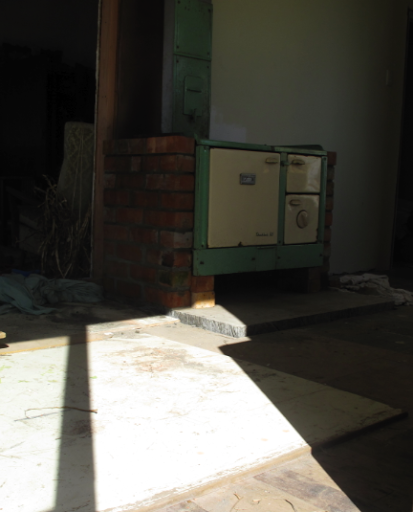
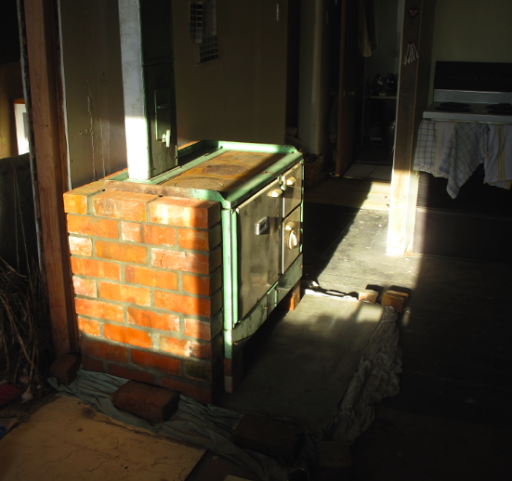
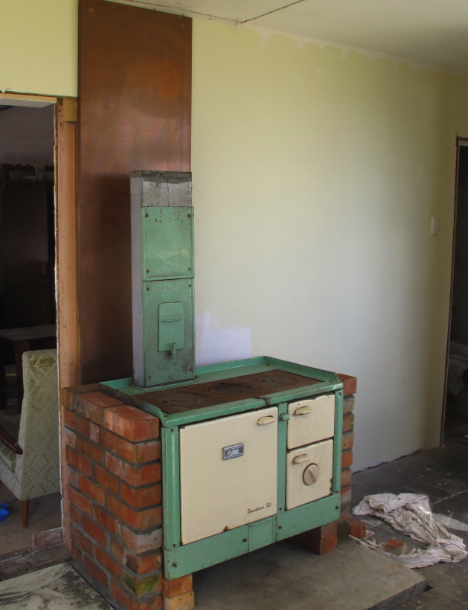
Not only will this beautiful reused coal range heat our home and cook our meals, but it is the quintessential Kiwi-green color that completes our evolving palette.
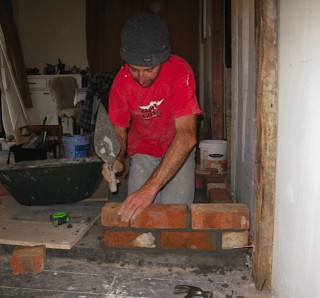
Admiring Jonah’s sweet as brick work.


Thanks Jonah. Rock on, bro.
Peace, Estwing

Jonah and the Whale

Although we have made it most of the way through this winter relying on passive solar heating, there have been a few cloudy days that have tested our reserve and forced us to get out the electric heater. None the less, our power bill remains under $30. But for a long time we have planned to install our second hand Schacklock 501 coal range (“multi-fuel stove”) in the kitchen. In true permaculture fashion, it will serve multiple purposes. We plan to use it for cooking and space heating. (I bought it on Trade Me even before we bought the house.)
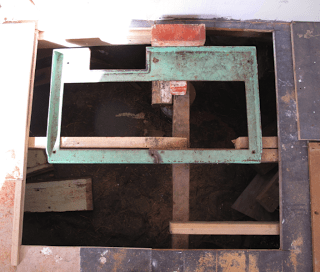
Working closely with Building Control, we embarked on the process of building a full foundation and hearth slab. This first entailed cutting a hole in the floor…

… and determining where to build the foundation using the enamel stove top as a template.

To make a long story somewhat shorter, I spent a lot of time under the house digging, building boxing (form work), placing steel, pouring concrete and setting concrete blocks.

Then my little helper packed all of the cavities with pumice from the beach to support and insulate the bottom of the hearth slab.

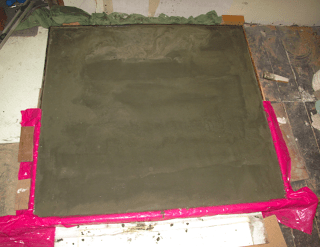
After the building inspector checked our handy work, I poured the slab.

Enter Jonah, man of many talents.


He can move heavy objects.


He can pray.


But most importantly, he can lay bricks.

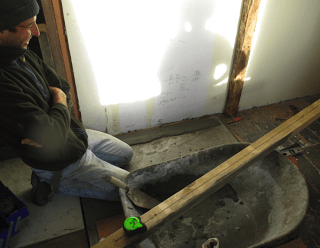
We used the stove top as a template again to get the first course laid.


And by tea time we had the whale in place.


But we ran out of mortar before Jonah could finish the brick work up the sides and back. So we had a nice curry and went to bed.


To be continued…
Peace, Estwing

Chooks by the Book

Dedicated to Mr. Carver.
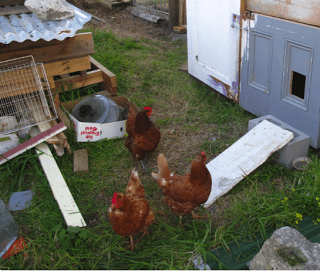
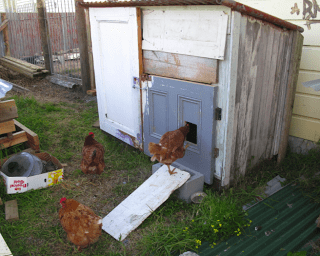
Although we have been farmers for a decade, we are new to poultry of all types. We have been feeding 3 ducks and 5 chooks for months with nary an egg in sight. We have written about our cute-as ducklings and tractoring our pekins and muscoveys. We have lost 2 ducks and 3 chooks to the elements and local dogs, but just received 4 large red shavers from a friend. Supposedly they lay.
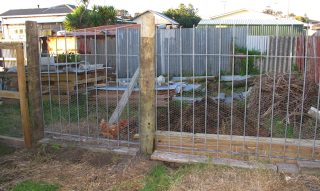
They are fairly large for tractoring, so we decided to build a chook yard for them using various second-hand materials.
And reinforced against dogs!
In true permaculture fashion, we will use our new chooks for their multiple talents: eggs, fertilizer, meat and cultivation.
Ultimately, we will remove the valuable resources currently in the yard and replace them with other valuable resources such as fruit trees.
Keeping fowl in and around fruit trees helps control insect pests, keeps grasses down and automatically cleans up all fallen fruits. And we look forward one day to…
Is it?
Could it be?
The $80 egg!

Peace, Estwing

PowerPoint to the People!

With 9 months of blood, sweat, tears, blisters and photos accumulated, we’ve put together our first PowerPoint slideshow for the general public. It launches tomorrow with the Wanganui PROBUS club, and then will be presented at the monthly permaculture gathering on the 17th of this month. In September it goes to Hamilton and Raglan. Here is an article I just wrote for the Wanganui Chronicle updating the community on our progress.

The Eco-Eco Home

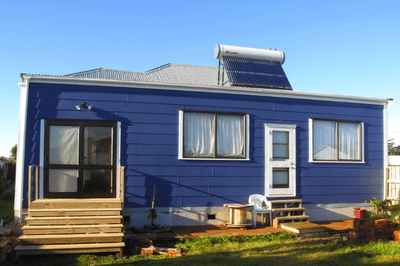
The words economy and ecology are both derived from the Greek word oikos, which means home. Our home in Castlecliff is living up to this double billing by saving energy and money as a result of a substantial renovation of a 100 year-old villa we embarked upon in November of last year. The economical and ecological success of this project results from a series of design principles that have guided us – along with the New Zealand Building Code – through the process. The principles can be divided into two categories: energy and matter. I’ll use this article to explain our approach to energy conservation and a future article to explain our approach to resource conservation.

We’ve saved energy and money by incorporating passive solar design into the renovation and installing energy efficient products. Passive solar design relies on three components: solar gain, thermal mass and insulation. We increased the amount of sunlight entering our home in winter by adding windows to the north side and removing them from the south. What a difference it has made! We are reaching indoor temperatures well above 20 degrees on sunny July days. But one danger of passive solar design is the potential for overheating on the sunniest days. This is addressed by adding thermal mass inside the building to slowly absorb excess heat during the day and reradiate it at night. This can be tricky in a renovation, particularly with a home built on piles. We’ve added mass by putting an extra layer of Gib on north-facing walls that receive direct sunlight, installing a cast iron bathtub in our sunny bathroom, and building a brick surround for our multi-fuel stove, which gets all-day sun in winter. As far as insulation goes, we’ve filled all exposed wall cavities as well as installed under-floor and attic insulation. We also make use of thermal curtains and pelmets. These elements are working beautifully together, but represent a fairly low-tech approach to energy conservation.

The other ways we save energy and money are slightly higher tech, including the use of energy efficient light bulbs and appliances as well as solar hot water. In total, our compact fluorescent light bulbs, under-the-bench refrigerator, Energy-Star washer and solar hot water helped us achieve a power bill of just $17 for the month of June. Yes, June as mild, but that $17 included a line charge of 38 cents per day. In case you missed the recent headlines, inflation is at a 21-year high, with electricity up 8%. That concerns my wife and I, and I imagine it concerns other Wanganui residents. That’s why we have been using this project as an educational tool to share the successful strategies and techniques for an eco-thrifty renovation. Our educational efforts so far have included workshops, school programming (in partnership with the Sustainable Whanganui Trust with funding from the Wanganui District Council), presentations to seniors groups and our blog www.ecothriftydoup.blogspot.com.

There will be a short presentation of this project at the monthly Wanganui Permaculture Gathering on August 17th at 6:30 pm at the Whanganui Environment Base on Wicksteed Street.

For more information contact: theecoschool@gmail.com.

-Nelson Lebo


Times for Permaculture

There is a fantastic article on permaculture in the New York Times that is well worth reading.
I especially love the Lexus ad at the top of the page.

Of particular interest to me as an educator are the many references to transformative learning experiences that tend to accompany peoples’ discovery of permaculture. Permaculture is a holistic, regenerative design system that can be applied to rehabilitating degraded land…
Transformed from a weed-infested yard full of rubbish.

…a falling down house…
Transformed from the verge of collapse to a warm, cozy home.
…or a dysfunctional, unsustainable culture.
The belief in perpetual growth without consequences must be overcome.
For learners of all ages, permaculture can be both the journey and the destination. And the truth is, we never really arrive. It is all about embracing certain levels of sustainability, peace of mind, and joy. Here are a few gems I picked out of the article that just might make their way into my dissertation. (See link above for source.)

“It’s an ecological theory of everything,” Mr. Cody said.

The ethic of permaculture is the movement’s Nicene Creed, or golden rule: care of the earth; care of people; and a return of surplus time, energy and money, to the cause of bettering the earth and its people.

In its effort to be universal, permaculture espouses no religion or spiritual element. Still, joining the movement seems to strike many of its practitioners as a kind of conversion experience.

As a system, permaculture impressed him as panoptic and transformational. “It shook my world,” Mr. Pittman said.

“I don’t know that anyone has ever done a double-blind study of permaculture,” said Mr. Pittman of the national Permaculture Institute. “Most people in permaculture are not that interested in doing those kinds of studies. They’re more interested in demonstrating it. You can see the difference in species diversity and yield just by looking at the system.”

As Mr. Weiseman observed, permaculture may be a “leap of faith.” But not leaping might have its own consequences.

“We know what’s right,” Mr. Weiseman said. “We know what’s best. We feel this thing in our bones and in our heart. And then we don’t do anything about it. Or we do. And I did. And it’s bearing fruit.”

And I thought all the NYT was good for was mulching the garden…
Peace, Estwing

More on Pelmets

I mentioned in the last post on pelmets that we are using a different approach in the kitchen, dining room and bathroom than in the lounge. The lounge has a high ceiling so the pelmet was placed directly above the window. But the other rooms have low ceilings, so we are having the pelmets serve a second purpose as crown molding as seen here in the bathroom.

Note: Pelmet not yet painted.

After removing rotten studs, reframing the walls and putting up new plaster board, I nailed a 2 x 2 into the top of the studs at the ceiling. In this case, I also had to pack it off a little to make sure the curtain has enough clearance to open and close easily.

Above dining room window.

I have mentioned before that we are reusing weatherboard from the exterior for our pelmets. I’ve ripped it down to 150 mm but left on the rustication as seen in the next two images.

The nice curved bevel will make an attractive crown molding above the windows and the French doors. For continuity, I have run the pelmet/crown molding along the the wall-ceiling juncture on all exterior walls in the dining room/kitchen and in the bathroom. This ties it all together. Now if the wife would decide on a paint colour…
And finally, in the mud room/air lock, I used two weather boards to come down about 350 mm from the ceiling to cover the curtain rod that was mounted just above the door. This allows us to use a standard length curtain rather than having an extra long one custom made.


Please note in the image above that we are supporting local artists by hanging their original pieces in our home. Word up to MAE4!
Peace, Estwing

Hedge Against Inflation

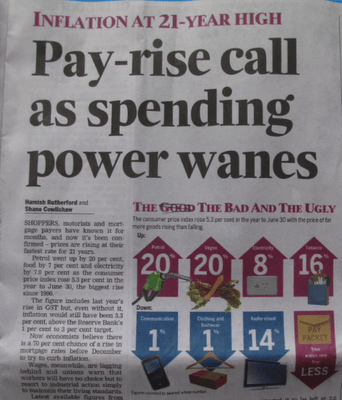
I have often written about investing in energy efficiency and food production capacity as ways to hedge against inflation. And none too soon!
Dominion Post, 19-07-11
This article from Wellington’s Dominion Post points out that inflation is at a 21 year high, and that petrol is up 20% year on year, vegetables are up 20%, electricity is up 8% and…we’ll skip the cigarettes. While no one may be happy to see these numbers, those who consciously design their lives with the expectation of such increases can at least know that all of their wise planning and efforts are paying off. (Not to mention a certain level of vindication from those friends and relations who like to criticize such plans and efforts.) Additionally, after over 20 years as an environmental educator, I have observed that there is no better way than high prices to convince many people to take so-called green steps such as conserving energy, recycling, driving less and planting a garden. That’s one reason that we emphasize equally the economic and ecological benefits of this project.
For us, the prospects of climate change and peak oil (both of which are already here) motivated an intentional design strategy for the location, orientation and development of our property on Arawa Place. Taking a look at the Dominion article, I’ll address the three areas of inflation that pertain to us.
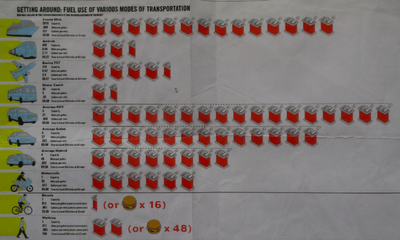
Petrol: Simply put, we want to use a little petrol as possible. This influenced the choice of location of our house. We are three blocks from a bus stop and it is a six kilometer easy bike ride on a flat road to the city centre. Below is an excellent graphic from Good magazine showing the relative fuel efficiencies of different forms of travel. Note that bicycling is the most efficient form of travel on the planet!
Good Magazine
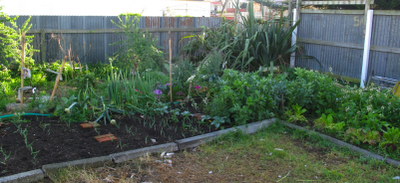
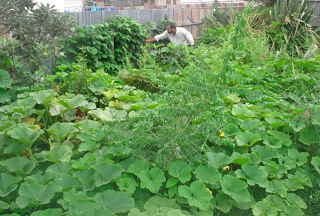
Vegetables: Over the last 8 months we have planted over 20 fruit trees and built close to 40 square meters of garden beds. We continue to build beds and plan to plant a dozen berry bushes in the spring. For a great set of photos showing the progression of our weed/rubbish filled yard into a food forest/garden go here.
Electricity: We have made major investments in solar hot water, a super efficient washing machine and insulation, and minor investments in light bulbs and a second hand under-the-bench fridge. All in, we are using less than 10% of the electricity as compared to the average Kiwi home, and our return on investment looks to beat even that high rate of inflation of 8%.
Our Eco-Eco approach is paying huge dividends for the planet and for our bank balance. And we want to share this success. I am just finishing up a PowerPoint presentation on the Eco-Thrifty Renovation “so far.” Please contact us if you’d like to book a presentation in your community.
Peace, Estwing
Hooked on Pelmets

I have been interested in energy efficiency for decades, but I had never heard of a pelmet until I came to New Zealand 3 years ago. Now I’m hooked on them. This is what Wikipedia says.

A pelmet (also called a “cornice board”) is a framework placed above a window, used to conceal curtain fixtures. These can be used decoratively (to hide the curtain rod) and also help insulate the window by preventing convection currents[1]. It is similar in appearance to a valance, which performs the same function but is made of fabric. A pelmet can be made of plywood[2], and may be painted, or fabric covered.

The convection currents mentioned are illustrated below with red arrows representing warm air and blue arrows representing cold air. The thick black lines are the wall and floor, the Yellow wavy line is the curtain, and the short, thin black line above the curtain is the curtain hanger.

Without a pelmet, what happens is this: Heat is radiated through the window as shown by the short, red arrows. This results in cold, heavy air falling to the floor, which creates negative pressure. Warm air is then drawn down from the ceiling to take its place. This warm air is cooled and the cycle continues. The entire room becomes a convection current fueled by the heat loss through the window. Not good for energy efficiency.

A pelmet (shown in green) breaks the convection cycle by creating a physical barrier to the air flow. The cold air next to the window does not sink and pull warm air from the ceiling. Genius! Thank you Mr. Pelmet.

Here is the pelmet we installed in the lounge. It is made from a beautiful old piece of exterior weather board mounted into the lintel.


We are using a different approach to pelmets in the kitchen, dining room and bathroom. I’ll write about those in another post.

Peace, Estwing

Update on School Programmes

For those of you interested in the ways we are using the ETR as an educational tool in schools, here is an update on three innovative projects we’ve completed and a sneak peak at one that is in development. What follows is a first draft for an upcoming article in our local paper.
Peace, Estwing

Conservation Education

From year 1 students at Aranui School to year 13 students at Wanganui High School, high quality, innovative sustainability education is reaching learners throughout the city. With financial support from the District Council, the Sustainable Whanganui Trust and the ECO School have been working together since January of this year to develop an adaptive approach to sustainability education that is responsive to the needs of both teachers and students. A principle aim of this effort is to respond to teachers’ needs and to design educational projects that compliment – rather than compete with – The New Zealand Curriculum. Three projects have been implemented so far and another is currently in development.

Aranui School opened its doors to a week long project for the years 1 and 2 classrooms, which used a cross-curricular approach to teach about solar energy, recycling, composting and growing vegetables. Each lesson explored these issues through science, maths, social science, English, health and physical education, technology and the arts. The lessons engaged students’ minds, hands, and even their feet – in the form of relay races, dance and educational games.

Wanganui Intermediate School’s needs, however, were quite different. “We expressed our need to have sustainability issues linked to science curriculum requirements in the run-up to the Science Fair,” said Keith Beautrais, Head of Science and environment Keith Beautrais. The approach that was designed in response was a 40 minute interactive presentation called “The Science of Sustainability” based on the types of science – primarily biology and physics – involved in a demonstration eco-renovation project in Castlecliff called the Eco-Thrifty Renovation. The presentation, said Beautrais, “made the link in a clever way – linking ideas with a narrative style. Many staff spoke to me about how useful the session was.”

And finally, the approach at Wanganui High School was different yet again. Sustainability teacher Matt Carroll was interested in exposing his senior students to local sustainability initiatives. Two appropriate projects were identified: the Sustainable Schools Programme and the Eco-Thrifty Renovation. Lessons were designed to link these initiatives directly to the students previous learning and their understanding of the aspects of sustainability. Two classroom presentations were followed by a field trip to the Eco-Thrifty Renovation where the passive solar design was performing perfectly on a sunny, June afternoon.

Feedback from both teachers and students has been excellent for all three programmes, which has provided impetus for the development of another one called “Eco-Maths.” The project has been developed in the form of a professional development session for teachers. Dates and locations will be announced soon. For more information contact The ECO School at: theecoschool@gmail.com.

-Nelson Lebo

Domestic Bliss

He mixes mortar while she makes pumpkin soup. Just a typical day here in Wanganui.

There are a few minor inconveniences when you are living amid a project like this. I’m sure many of you home renovators can relate to the dusty, constantly changing, always innovative living conditions.

We came home late one night last week and I was the first one in the door. MC grabbed my arm and said “Don’t go in the kitchen unless you turn a light on!”. When I entered I discovered what I am affectionately naming our “lion trap”. A massive hole with sinister looking rebar spikes emerging from what used to be our kitchen floor.

Hmmm. O.K. then.

MC worked hard all week to turn the lion trap into the foundation for our multi-fuel cookstove, which he will install when he returns from Australia. I, unfortunately was not much help, due to a bruised vertabrae in my back. No lifting, twisting, or activity for 10 weeks. Yikes! So I compensated by baking, cooking, and cleaning.

Domestic bliss.

-June Cleverer