Category Archives: Eco Thrifty Renovation

Practicing What We Preach is Win-Win-Win-Win

This is an article I just wrote for the newsletter of our local currency. 
There appears to be a general correlation between REBS subscribers and members of the Sustainable Whanganui Google Group. Now correlation does not mean causation, and I will not submit a chicken or egg theory on this. But what I will do is point out an excellent opportunity for every REBS and/or Sustainable Whanganui member to engage in a win-win-win-win trade. Here is how it works.
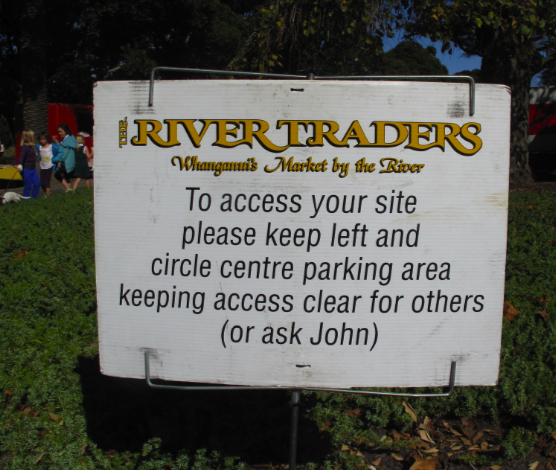
Go down to the River Traders Market and stop in at the REBS stall. Purchase your very own bottle of Eco laundry liquid in a refilled plastic bottle. That’s it. How easy. This simple task allows us to practice what we preach, walk the talk, and any other appropriate saying I may have left out. 
First win = Reduce: By purchasing your Eco laundry liquid from REBS you are reducing the number of plastic bottles in the world. REBS buys the laundry liquid in bulk and fills the bottles for the market. And while you’re at it…
Second win = Reuse: …bring that bottle back to REBS when you’re through the laundry liquid and buy a full one. We’ll take that one back and refill it again for the next person. 
Third win = Eco products are generally less polluting than standard products. For instance, the laundry liquid is likely to have less phosphates in it than standard laundry products, which can cause water pollution. 
Fourth win = Supporting a community initiative. REBS is run on a shoestring budget and subs do not come close to covering the costs of administration. Buying Eco laundry liquid, eggs, kumara and potatoes from the REBS stall helps us keep this important community project going. 
Thanks for your support, the REBS committee

Retrospective #5: Curtains and Pelmets

This is the 5th in a series recounting the theory and practice of eco-thrifty renovation running in our newspaper, The Wanganui Chronicle. 
I will admit that in the first four weeks of this column I did not offer very many examples of low-hanging fruit with short payback periods as implied in the first column. I will also admit that I love Neil Diamond and I love pelmets. While I spent the last three columns carefully explaining the components of passive solar design and how they work together, I am finally at a point this week where I can bring two of those components together in an eco-thrifty context and provide some examples of low-hanging fruit that promise short payback periods. Besides that last sentence being extraordinarily long, it implies that an eco-thrifty approach to renovation requires one to both take a big picture view and retain attention to details. I’ll use the example of thermal curtains, pelmets and window quilts to illustrate this point.
As previously described, north-facing windows (here in NZ) are net energy gainers in the winter. While double-glazing is probably best for all windows in a home (and if building new by all means they should be installed), they are expensive to have made to replace existing single-glazed ones. As an alternative to double-glazing we wanted to look at how the performance of single-glazed windows could be maximized with low investment of money and time. What we came up with is a low-budget combination of familiar Kiwi practices and potentially unfamiliar ones from North America. I’ll start with thermal curtains because they are probably the most familiar to everyone. There is not much to say except – wait for it – sometimes even the best thermal curtains won’t hold in very much heat if not installed properly. Let the physics lesson begin!
A free-hanging thermal curtain that does not touch the floor can be almost as useless at heat retention as no curtain at all. (I would repeat that, but I’m writing to a word limit.) Here is how it works: 1) indoor air between the curtain and window cools and sinks to the floor; 2) this creates negative pressure between the curtain and window that ‘vacuums’ warm air from the ceiling and places it against the cold glass; 3) this air cools and sinks drawing more warm air from the ceiling to replace it; 4) and the cycle repeats. What forms is akin to a convection current through the room powered by the cold outside air against the window. The good news is that the cycle can be interrupted in two ways. The bad news (for some) is that one involves a pelmet. Fashion aside, I love pelmets because they are so practical! (Form follows function.) A properly fitted pelmet breaks the convection current by blocking the flow of warm air down from the ceiling. Alternatively – or better yet, additionally – floor-length curtains achieve roughly the same by slowing the free flow of cooled air out across the floor. In other words, heads: you win! / tails: you win! Both: Double win! And for a fraction of the cost of replacing all the windows in your home.
But there is a catch. A human being is required to open and close the curtains according to the level of sunlight and the difference between indoor and outdoor temperatures. I highly recommend purchasing an indoor/outdoor thermometer to help with the energy management of your home. We got ours for $20 at local hardware store and I reckon it has paid itself back within the first year. Oops, out of words and never got to window quilts. Until next week.

Peace, Estwing

Can Zuckerberg Do This?

I heard on NPR that the FB IPO might make it worth 100 B. OMG! 
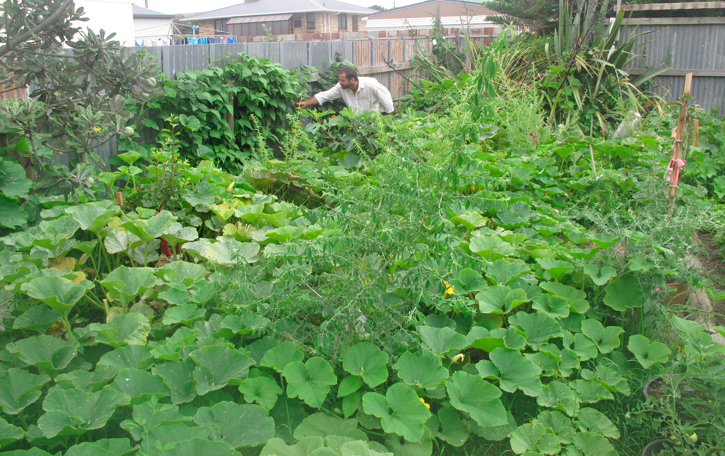
Now, I will admit that I like FB for keeping in touch with old friends, sharing our projects and filling time when I am otherwise unengaged. But is this company really worth 100 billion dollars? Is Zuckerberg really that much of a genius? I can’t begin to answer that question, but I wonder what else he can do. Can he plant a garden? Can he fix a bicycle? Can he knit a sweater? Are any of these questions worth asking about the 0.1%? Will walls of money always protect them from volatility in world food, energy and financial markets? Will the walls of gated communities always protect them from an increasingly rattled 99%? As population grows, soils erode and oceans acidify, will they ever face any sort of scarcity? I can’t answer those questions either, but I do think that for most of the rest of us it is worth learning real skills that can be applied in real settings. While I have been growing organic vegetables for well over a decade now, I continue to learn all the time. Our current location on pure sand and within 200 meters of the Tasman Sea, has offered new opportunities to learn, fail and succeed.  Below are a few images of some of our learning and success this year. (We usually don’t take pictures of our failures, but we do take careful notice of them. I have been meaning to write an entire post about failures. TBD)
The internet can teach you nearly anything! 

Scratch to patch in 5 months. 

Time for a bigger wheelbarrow. 

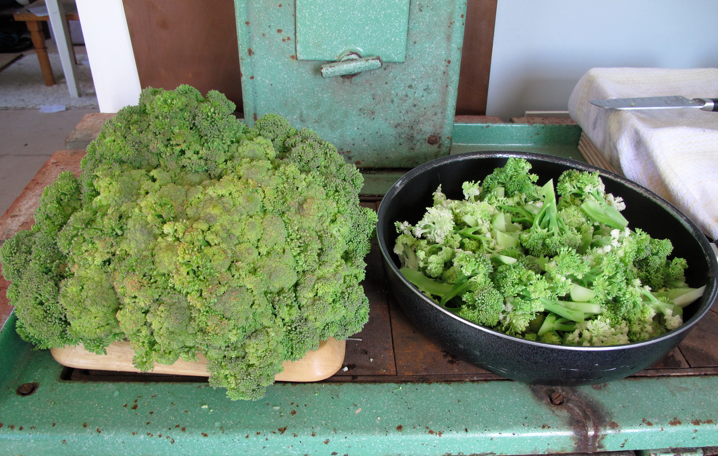
 That’s all from the same broc.

Broccosaurus 

Caulisaurus 

Cannot beat home grown. 

My, what big hands you have! 

Rock on!

Peace, Estwing

Retrospective #4: Insulation

This is number four in a series of articles documenting the principles and practice of eco-thrifty renovation that I am writing for our paper, the Wanganui Chronicle. 
Last week I described how thermal mass could be used inside of a building envelope to slowly absorb heat energy from low-angle winter sunlight. The ‘invisible’ forms of thermal mass we added during our renovation included an extra layer of plasterboard on walls that receive direct winter sunlight, a cast iron bathtub in our sun-drenched bathroom, and the strategic placement of our re-used coal range to receive direct sunlight all day long through three different windows. Before I proceed to talk about our insulation choices, I should note that these ‘massive’ elements not only help keep our home warmer in winter but also cooler in summer. The summer sun is much higher in the sky and does not penetrate deep enough into our home to strike them directly like it does in winter. Just as thermal mass can buffer against cold in winter, it can buffer against heat in summer. 
While I’m at it, I should also note that insulation helps keep homes cool on hot, sunny days. For example, many homes in Arizona, USA are super-insulated to keep air conditioning costs lower. Closer to home, one of my neighbours out the back on Aotea Street, Castlecliff complained to me about how hot his house is in summer. I noted that he has a low-pitched roof and no ceiling insulation. Can you imagine how hot his attic crawlspace gets? Well, that heat simply radiates through his ceiling and into his living space. Insulation slows the passage of heat, and it works both ways. In other words, by insulating the ceiling he could both slow the transfer of heat downward into his home during the summer and slow the transfer of heat upward out of his home in winter.
If solar gain can be demonstrated by a car parked in the sun, and thermal mass by touching a warm stone after sunset, insulation can be experienced by putting on a jumper. That’s it. The human body is a heat generator and the jumper simply holds that heat close to the body. Where ‘massive’ things are those that sink in water, ‘insulative’ things float. Think polystyrene, pumice, fiberglass batts.
A complete passive solar design must include all three elements: solar gain, thermal mass and insulation. Lose any one and you have an incomplete design and an underperforming building. While I described how we increased solar gain two weeks ago and how we added thermal mass last week, I’ll complete the trilogy this week with a brief description of our approaches to insulation.
For various reasons, we opened up wall cavities during our renovation and dutifully filled each one with fiberglass insulation (inspected) before replacing linings (inspected) in accordance with the building code. We also insulated all ceilings by running the batts (higher R-value than required by code) perpendicular to the joists to prevent thermal bridging through the wood. (Google it.) Although we also bought 100 square metres of under floor insulation in October, 2010 (before the GST rise), we have not yet installed it because I want to treat for borer first, and, well, I just haven’t gotten around to that due to some favorable surfing conditions. And finally, we insulated all of the gaping holes in our well-insulated walls (aka windows) with thermal curtains and their trusty sidekick and unsung hero of New Zealand homes of a certain era, pelmets. While double-glazing is a form of insulation, we chose not to replace all of the windows in our home with new double-glazed ones because this is an eco-thrifty renovation and with Wanganui’s mild climate we felt that the payback on other energy investments would be much greater. As I will describe next week, I believe that the combination of thermal curtaining, pelmets and window quilts represents the type of low-investment / high performance system that suits the eco-thrifty approach to renovation.
Peace, Estwing

Man About Town

Perhaps the only thing harder than creating a sustainable life for oneself is promoting sustainability out in the community. I have been averaging 10 to 20 hours of volunteer work per week for the last couple of months. The work itself is not so hard, but maintaining motivation sometimes is. We hear advice from the likes of Nicole Foss, Richard Heinberg, J.H. Kunstler, Rob Hopkins, etc. about the importance of building community. They are dead right about that, but do not underestimate how much effort it takes. But sometimes the work can seem more like play. For instance…

With the wife away at a conference in Auckland for the weekend, I set out to multitask my way through a Saturday morning (after dropping her at the airport at 6:20 AM and then spending three hours on my thesis).

Thankfully, most of the multitasking took place at our Saturday market.

I was happy to see that the welcoming committee was there to greet me, my bicycle and trailer.

 First stop was at the stall of our local currency, the River Exchange and Barter System (REBS).

As the newsletter editor and newly appointed grants writer, I had two jobs to check in about with other committee members. The newsletter looked suitable for publication on Monday, but a grant application due in the post Tuesday needed heaps of official forms, seals and certificates I had no access to. (To be continued…)

After I did all I could at the REBS stall, I headed over to buy some native plants.

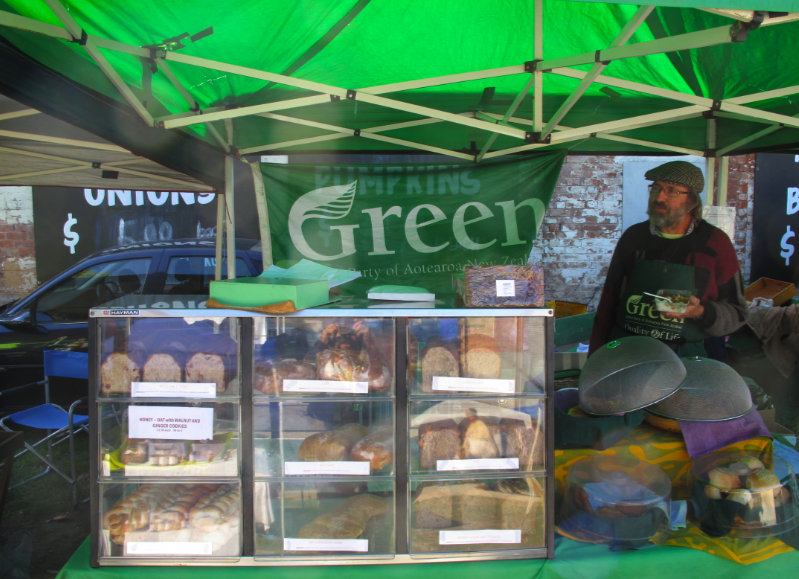
 And then it was over to the Greens’ stall for fresh bread…

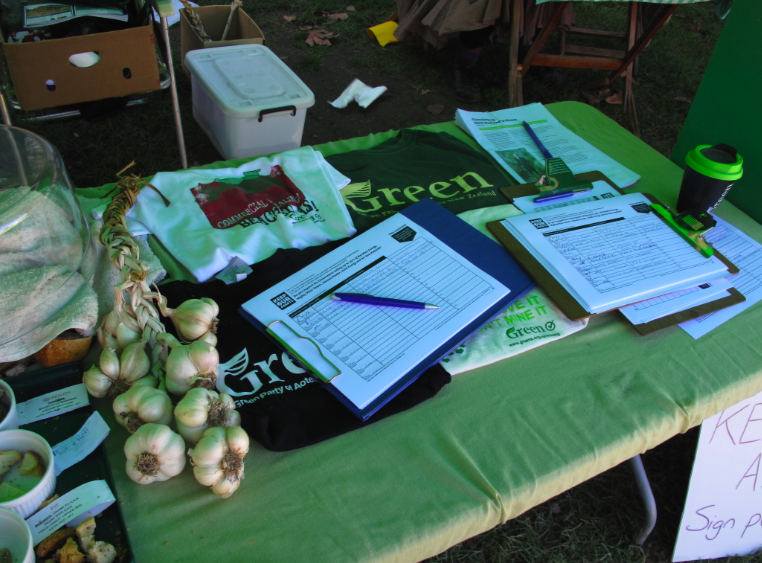
… and petition signing. My friend John said he has never had such success getting signatures as he has had with this issue of asset sales. (In other words, the selling of publicly owned state assets to private individuals and corporations. Think Greece). I salute Hone Harawira and the Mana Party for taking this issue to the streets and to the Capitol!

With my plants and bread, I loaded up my trailer and was nearly on the road when…

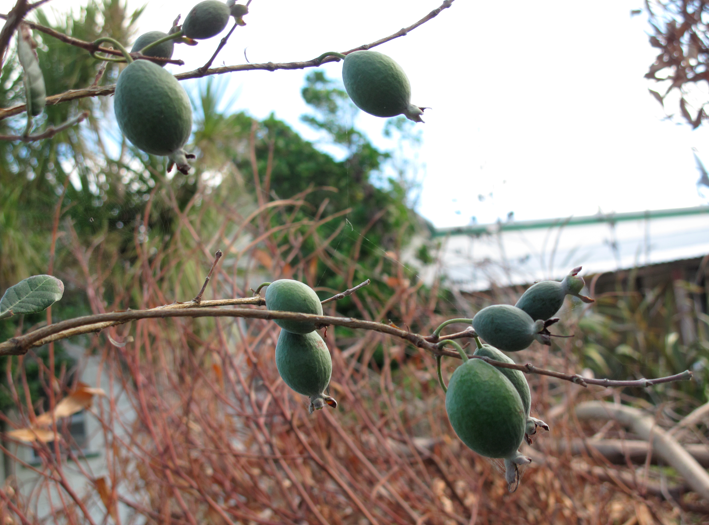
… Lola and Calexico (and thier feijoas) could not be resisted.

All in all it was a fun an productive morning, so much so that it called for an afternoon surf. All work and no play…

Peace, Estwing

Retrospective #3: Thermal Mass

This is the third in an ongoing series documenting the principles and practice of eco-thrifty renovation for our community being published every Saturday in the Wanganui Chronicle. 
Last week I wrapped up my column with words of wisdom that did not quite make the list of trending terms on Twitter. For those of you who missed the re-Tweets, those words were, “A window is simply a hole in the side of your home with a piece of glass (two if you’re lucky) in it. Windows can gain heat energy or lose it. Because winter is the time of year that we’re mostly concerned about this, I’ll put it as straightforward as possible. In winter, northerly facing windows are net energy gainers and southerly facing windows are net energy losers. Summer is a different story, and there is such a thing as too much incoming solar heating even in winter, just ask the hippies from the 1970’s who had good intensions but incomplete design ideas.”
Did anyone ask an aging hippy? If so, they probably said those early passive solar structures were too damn hot on sunny winter days and that they had to open the windows to keep it comfortable. That’s because they probably had heaps of sun-facing glazing but not enough thermal mass. Thermal what? This is probably the least understood aspect of passive solar design, which it probably why it was overlooked by many early solar builders (who may or may not have also been under the influence of Jimi Hendrix.)
Just as solar gain is easy to understand by thinking about a car parked in the sun, thermal mass can be experienced by placing one’s hand (or bum) on a sun-baked stone or concrete stoop or curb 30 minutes after sundown. Massive things (ie, they contain lots of mass) gain heat slowly and lose it slowly. Wanganui owes its moderate climate in large part to the thermal mass of the Tasman Sea. Water and anything that sinks in water can be classified as ‘massive’ while anything that floats in water is more ‘insulative’. (Insulation will be discussed next week.) Just as the Tasman moderates Wanganui’s climate, certain massive elements inside of the building envelope can moderate a structure’s climate. In new dwellings this usually takes the form of an insulated concrete slab. But our 100 year-old villa is on piles. How did we add mass without buckling our aging rimu floor joists? (Truth be told, I did sister up some of the joists before we took the measures described below, but that was purely precautionary. I am VERY conservative.)
We added thermal mass in three ways, and did so only on the north side of our home and only in places where the low-angle sun strikes it directly during winter months. For the most part, our thermal mass is invisible. In other words, if you walked through our home it would not be immediately apparent. For example, on those walls that receive direct sunlight in winter we added an extra layer of plasterboard (aka Gib). The mass of plasterboard can be ascertained by selecting a sheet measuring 1.2 X 2.4 metres and lifting it over one’s head. Another ‘invisible’ way we added mass was to install an antique, cast iron, claw-foot bathtub in our sun-drenched bathroom. (Ascertain mass as described above.) 
And finally, we added mass inside of our building envelope by the careful locating of our code-approved antique Shacklock 501 coal range (300 kg), with brick surround (300 kg) and steel-reinforced, fully inspected concrete hearth (100 kg). This 700 kg behemoth receives direct sunlight in winter from three different windows at three different times of day. 
This heat energy is stored in the mass, which prevents our home from overheating, and then releases it slowly at night as our home cools (despite our best efforts to hold in the heat with insulation: the topic of next week’s column).
Peace, Estwing

Our Growing Family

The Springvale Garden Centre has a huge sale on now on perennials. Yesterday I bought 4 blueberry plants, 4 grape vines and a Tahitian lime.

This brings our total fruit-bearing perennial plantings to nearly 50 on our 700 square meters. (See below for an unofficial accounting.) In true permaculture style, we are layering our plantings. For example, in this frame there are 4 grape vines growing along the fence, 3 apple trees in front of them, four blueberry bushes in front of them, and…

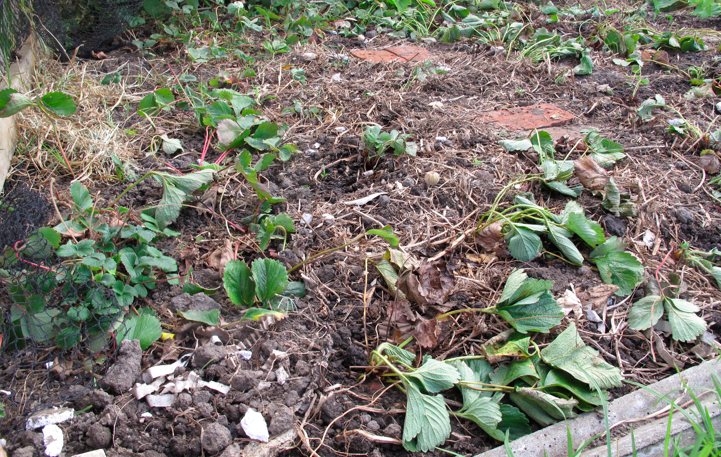
… a strawberry patch in front of that. But that is not all.

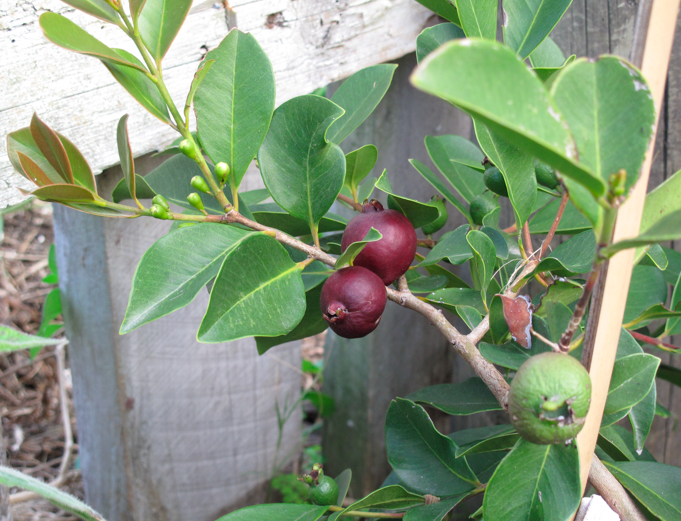
In the left-hand corner are a cape gooseberry and a guava that is fruiting right now. Yum!

We also have feijoas ripening.

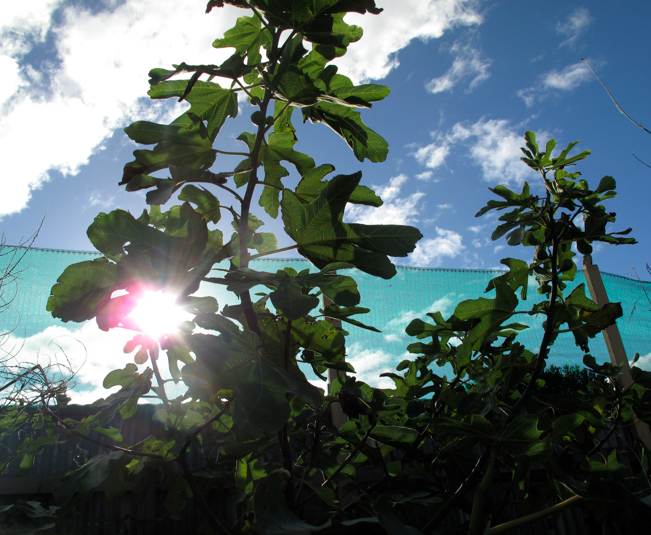
And it seems like we always have figs.

Billy T. followed me around all afternoon as I was planting the new members of our family and taking pictures of older ones.

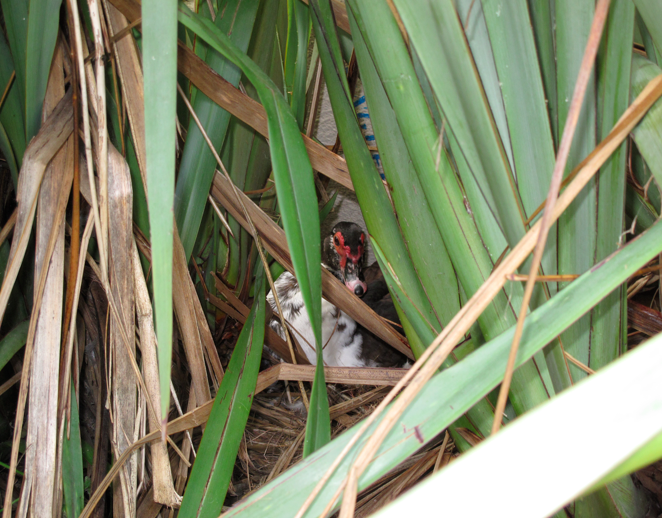
We paid a visit to Amelia on her nest in the harakeke.

And we checked on the broccoli bed.

Billy T. told me that she thought staggering the planting by 3 weeks was good idea. Those in the foreground will give a second winter/early spring harvest.

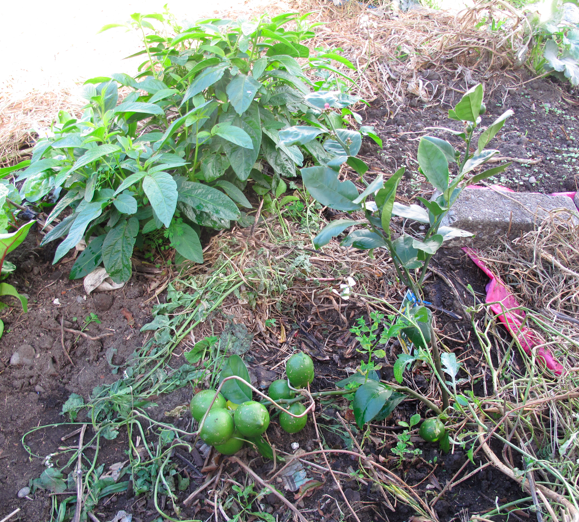
And we could not help but be impressed by the growth of the pepino we planted about 6 weeks ago (background). We are also looking forward to our first lemons this winter (foreground).

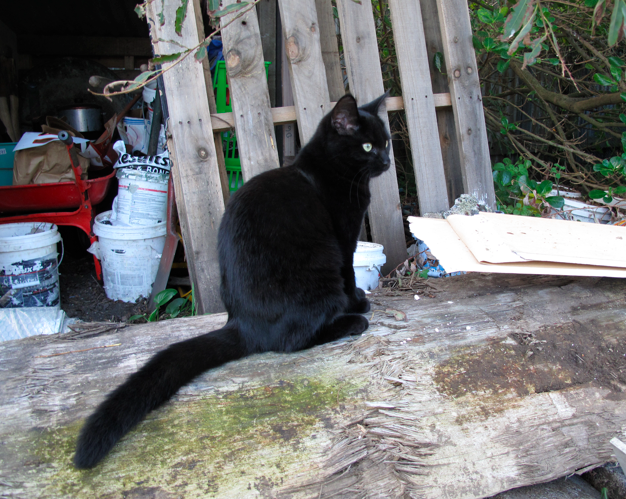
What’s that, Billy T.?

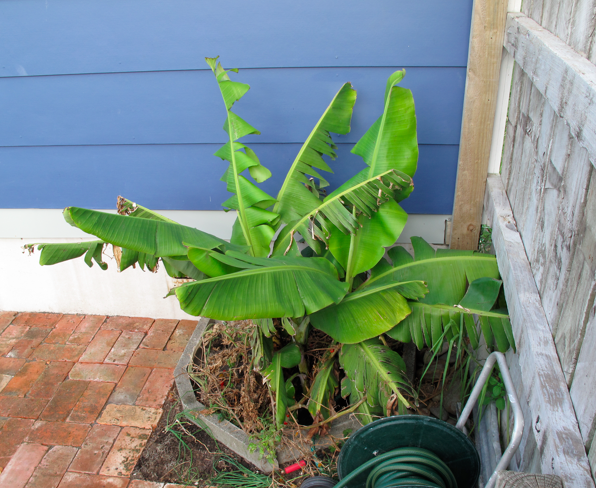
Of course. You’re right, the banana is doing well too.

You are a very observant cat. Thanks. Oh, by the way, that was a good idea to tractor Eunice and Rosemary across the yard for the winter. They’ll eat grass and fertilize.

Thanks Billy T. And thanks Springvale Garden Centre.

Unofficial Tally:
11 apple trees
10 feijoa trees
7 peach trees
4 blueberry bushes
4 grape vines
2 fig trees
2 lemon trees
1 plum tree
1 pepino
1 lime tree
1 cranberry bush
1 red currant
1 tamarillo
1 cape gooseberry
1 guava bush
1 banana

As yet, no pear tree or partridge.

Peace, Estwing

Retrospective #2

This is the second edition of our new series running in our paper: The Wanganui Chronicle.

Last week I wrote about ‘payback period’ and ‘low hanging fruit.’ To review, payback period is the amount of time it takes to recoup an investment in energy-efficiency with savings on your power bill. Low hanging fruit are simply those investments that have the shortest payback period, ie: the easiest to ‘reach’. While a high performance eco-thrifty home will utilize many cheap and easy strategies for energy savings, the overall design strategy must be holistic, and the application of the design must be thorough. The success of turning our decrepit villa (recalled by a visitor at one of our tours, “The coldest house in New Zealand”) into a warm, dry, low-energy home came through our dual approach of ‘big picture’ design and attention-to-detail. While the details may be of interest to many readers as winter approaches, I feel it is important to provide the context for those details. Without a context the details may just be fodder for Quiz Night. With a context the details become dollars and cents melting away from your power bill.
Regarding last week’s column, many readers may have been asking themselves a number of questions, one of which was probably, “Why did those crazy Americans buy the worst house in Wangnaui?” Fair enough. There are a number of answers to that. First, it was the cheapest listed house in Wanganui at the time. (But that was just a happy coincidence.) Second, it is 2 blocks from the beach, and I like to walk to the surf. (An equivalent house in Raglan, where we lived for 2 years before coming here, would have been 500% to 800% more expensive.) Third, it has good solar gain to the north. (We looked at 30 houses in 2 days and only 5 of them had any real potential for free heating from the sun.) Fourth – and this is part of what separated it from the other 4 that had good solar potential – is that the lean-to part of the villa (the north corner and northwestern side) had already been gutted. With a little vision, we could picture how this section could function as a solar furnace for the rest of the villa. What that would take is called passive solar design. 
Passive implies something just sitting there, like a parked car. But park that car in a sunny lot and you get passive solar. Design implies whether something is intentional or not. While there are often no alternatives to parking in the sun, there are many alternatives when deciding where to put windows in a building. Putting lots of windows on the sunny side (north for us ‘down under’), few or no windows on the shady side (south), and a couple on the east and west is good passive solar design. It allows free energy to enter directly into the building (like the car parked in the sun), but does not allow much energy to escape through windows that don’t get much direct sunlight. During our renovation, we added glazing (windows and French doors) to the northeast and northwest sides, and removed windows from the southeast and southwest sides. 
A window is simply a hole in the side of your home with a piece of glass (two if you’re lucky) in it. Windows can gain heat energy or lose it. Because winter is the time of year that we’re mostly concerned about this, I’ll put it as straightforward as possible. In winter, northerly facing windows are net energy gainers and southerly facing windows are net energy losers. Summer is a different story, and there is such a thing as too much incoming solar heating even in winter, just ask the hippies from the 1970’s who had good intensions but incomplete design ideas. I’ll address these issues next week. 

Disaster Capitalism

Disaster capitalism has come to Castlecliff – in a good (or at least opportunistic) way. While we have relied on heavy rainfall to flush firewood down the Whanganui River and deliver it to the beach in front of us (see Beach Logging), a big blow six weeks ago provide a fuel source even closer. I noticed that the storm had uprooted two hardwood trees just around the corner at the end of our block.

But hardwood usually means heavy wood, so I waited for them to dry out before retrieving them. After six dry, windy weeks I decided it was time, so Jiqiao and I headed out with hand saws and a wheel barrow. We cut the thicker parts into manageable lengths to get home…

… and dragged the branches down the street.

If you are looking for an example of the extent to which the Chinese are enthused about capitalism, check out the grin on Jiqiao’s face.

After two months of working with us, Jiqiao has finished his internship and heads back to China for the summer before returning to university in the USA. We will miss his enthusiasm, sense of humor and hard work.

Peace, Estwing

Retrospective #1: As published in the Wanganui Chronicle, 21-04-12

This series recalls the design principles and decision making process of an eco-thrifty renovation. We believe the key components of a sustainable home include low energy use, redundant energy and water systems, abundant food production and avoidance of debt to the greatest extent possible. For under NZ$100,000 (US$80,000) and a year of hard work, we have developed one of the most sustainable and resilient suburban properties on the planet. We use 90% less electricity than the average NZ home, we aim to meet all of our fruit and vegetable needs on 700 square meters, we have no mortgage, and we share all of this information with our community.

Payback Period: Key to Eco-Thrifty Renovation
When my wife and I set out to renovate an old villa in November 2010, we made the conscious decisions to focus on energy efficiency and waste reduction above all else. We also chose a structure that many would have written off as beyond redemption due to its poor condition, and we wanted to do our best to demonstrate that a warm, dry, energy-efficient home can be within reach for people of moderate means. I have heard stories of people spending $20,000 on a new bathroom or new kitchen, but still have no insulation! Although we did install a new kitchen and new bathroom (at $2,000 each), the bulk of our budget went to insulation, solar hot water, and north-facing glazing (windows and doors). These are the investments we made that are paying us back with energy savings at a higher rate than the best term deposits of any bank. This is what we call eco-thrifty. It is a philosophy that focuses on low-input / high-performance systems.
Central to this approach is the concept of ‘payback period’: the amount of time it takes to recoup an investment in energy-efficiency with savings on your power bill. For example, a compact fluorescent light bulb costs $5, but will normally save you more than $5 per year (depending on use) in electricity. Therefore, the ‘payback period’ is one year or less. A ‘payback period’ of one year is roughly 100% return on investment. What term deposit offers that?
Another example of ‘payback period’ is solar hot water. Our system cost $4,000, and offers a ‘payback period’ of 7 to 10 years (depending on use). This represents a return on investment of 7% to 10%. What term deposit pays that? Another example would be insulation, but I won’t bore you. The long and short of it is that our money is paying us back more on our roof, in our walls and in our light sockets than in a bank. Add to this the environmental benefits and the hedge against inflation (electricity has been rising at 7% – 8% per year over the last decade, a ‘doubling time’ of 10 years), and eco-thrifty appears to be a conservative, logical approach to building (and…life, I might suggest). But there is a catch.
If you borrow to make home improvements with a ‘payback period’ over a few years, then the bulk of your savings goes to the bank, not to you. Therefore, we recommend a process we call focusing on the ‘low hanging fruit.’ These are the cheap and easy investments that anyone (owner or renter) can make immediately and start reaping savings. Then, with much fiscal discipline and gnashing of teeth, these savings are set aside to invest in ‘medium hanging fruit.’ And then…you get the picture. This new column published on Saturdays will address many of the fruits of eco-thrifty renovation and their benefits. Although this is a unique approach to renovation, many of the oldies reading these words are probably saying to themselves (or out loud), “it’s just common sense.”
On a final note, we have worked closely with Building Control throughout the process and found them very helpful. From my perspective, the New Zealand Building Code concerns itself primarily with ensuring structures: do not fall down in an earthquake or a gale; do not allow moisture to contact untreated or H1 timber; hold heat in (insulation); do not burn down from electrical wiring or internal heat sources. This list is the definition of a sustainable building. Who could argue?